Zombie Pages: How to Spot URLs That Dilute a Topic Cluster

A quiet URL is not automatically a zombie. Inside a topic cluster, the page that actually dilutes the map is an indexed URL that still occupies a subject you meant to own, yet has stopped compounding: no distinct intent, no supporting links worth protecting, and no search demand across a full year.
Technical audits often classify a URL as a zombie when it receives fewer than 10 total visits over 12 continuous months, with the cutoff flexing by traffic volume. That year is the point. A 90-day lull will falsely flag seasonal spokes, holiday guides, and utility pages that are supposed to be quiet most of the time. Zero clicks alone is not the test either.
The idea, named in 2018 by Olivier Duffez and Fabien Facériès, was always a score from 0 to 100, not a yes-or-no delete list. What follows is that scorecard for automated publishers: how to spot in-cluster URLs that fail the compounding test, and which quiet pages should stay indexed.
- A cluster zombie is an indexed URL in a mapped topic that fails a 12-month compounding test, not every low-traffic page.
- A common audit cutoff is fewer than 10 visits across 12 continuous months, adjusted for the site's traffic volume.
- Zero clicks is not enough; check unique intent, internal links, backlinks, and whether the URL is legal or utility content.
- On smaller automated sites the main harm is topical dilution, not classic crawl-budget exhaustion.
- This scorecard only flags and scores; noindex, redirect, and removal decisions sit in a separate hold rule.
What a Zombie Page Is (and What It Isn't)

Low traffic is only a clue. Thin URLs, orphans, and second pages on the same query get mixed into one cleanup, and only one of those failures belongs on a cluster scorecard.
Duffez and Facériès built the graded method at MyRankingMetrics. This scorecard keeps that habit, stays fail-closed, and scores only URLs already locked to a cluster map.
A thin page lacks unique value. An orphan has no internal links, but it is not a zombie if the content is still high quality and current. A cannibalizing URL is a second page competing for the same query—check that with the Search Console cannibalization guide, not this log.
Assume the cluster map already locks one URL per intent. Keyword clustering and the pillar-and-spoke guide define that map, and this article only tests whether an indexed member still belongs on it.
Fail-closed — Thin pages, orphans, and cannibalizing URLs are different problems. Only an indexed map member that has stopped compounding belongs on this flag list.
How to Find Zombie Pages in Google Search Console
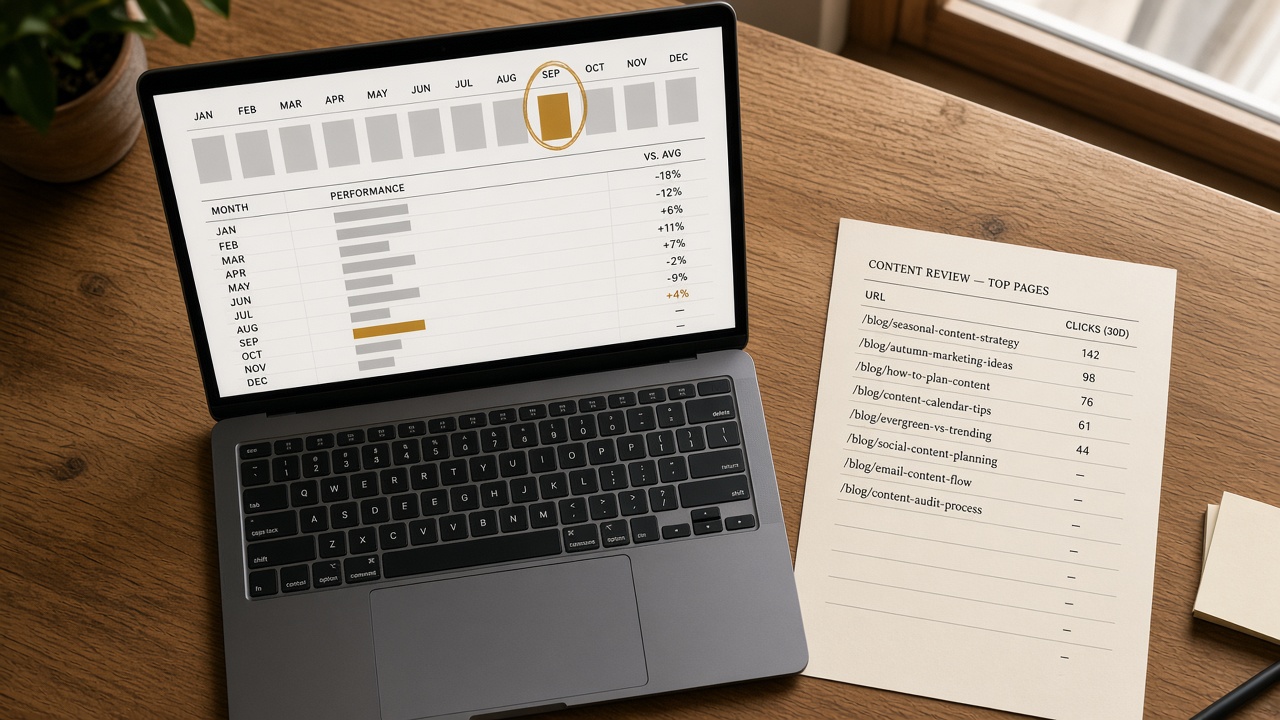
Find zombie pages in Google Search Console by exporting a full 12 months of page data and joining those URLs to the cluster map. The join keeps the screen inside the topic you meant to own; a quiet URL that is not on the map never enters this log.
A common technical cutoff is fewer than 10 total visits across 12 continuous months, and that line should move with the site's traffic volume. A stricter confirmed filter keeps only URLs with fewer than 10 sessions and zero organic impressions. Treat that screen as a candidate list, not an automatic prune.
Before you flag a row, compare the same months year over year. A holiday, launch, or annual spoke that went quiet this quarter may have compounded last year. Mark it seasonal rather than dead.
Candidate, not a prune — A 12-month Search Console export, joined to the cluster map and screened at a volume-adjusted visit cutoff plus zero impressions, is a candidate list—not a verdict that seasonal or utility URLs are dead.
Can a Page with No Traffic Still Be Worth Keeping?

Yes. A page with no traffic can still be worth keeping. An Ahrefs 2023 study of about 14 billion pages found that 96.55% received no Google traffic, so the Search Console cutoff only nominates a URL.
Keep a no-traffic URL when it still owns a unique intent, has backlinks, or does a job that is not ranking. Privacy, terms, disclaimers, login, and conversion pages stay even at zero clicks.
Google warns that removing a lot of older content mainly to look fresh will not help, so a prune is a quality decision, not a page-count cut. If intent is unclear, fail closed and hold the URL rather than scoring it as dead.
How Zombie URLs Dilute a Topic Cluster and AI Citations
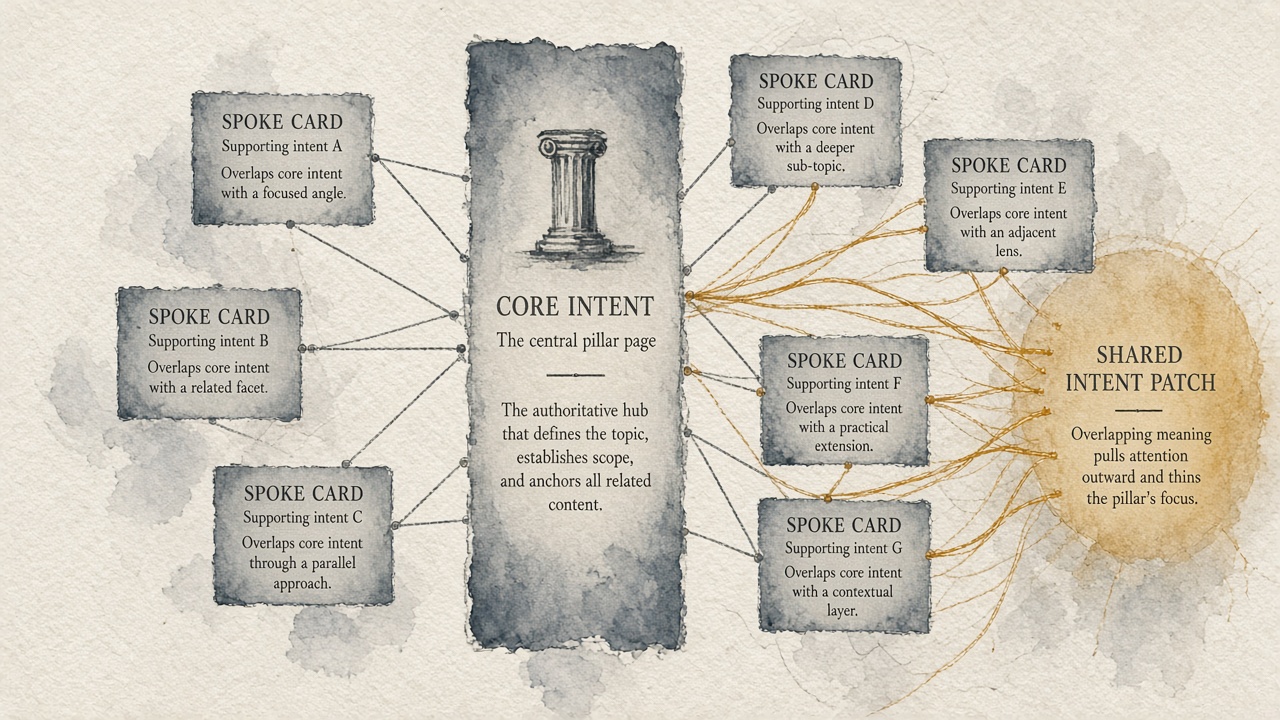
A URL you correctly held is not the problem. Dilution is split credit inside a mapped topic: near-duplicate spokes, tag archives, and parameterized URLs send mixed intent signals, so the pillar does not compound. That harm is topical, not a crawl-budget story.
When the helpful content system launched in August 2022, Google said removing unhelpful content could help the rankings of other content. That system became part of core ranking in March 2024, so unhelpful indexed URLs can weigh on pages you never edited. Google said the March 2024 spam and low-quality update was expected to cut low-quality, unoriginal content in results by 40%, and later reported a 45% reduction. Quality of the indexed set matters, not only the winner URL.
Thin or outdated cluster pages can also dilute generative-engine topical authority by sending conflicting signals to large language models. If you are still sizing the cluster, use the unique-intent spoke guide and the AI fan-out pillar map. This section explains the damage, not how many articles to publish.
Dilution — Zombie URLs split credit inside a mapped topic and can weigh on pages you never edited, including generative-engine topical authority when thin or outdated spokes send conflicting signals.
Does Crawl Budget Matter on a Small Automated Blog?

On a one-person autoblog, the main harm is topical dilution and a weaker sitewide quality signal, not classic crawl-budget exhaustion. Duffez treats crawl-budget damage from zombie pages as a real concern mainly once a site is large, on the order of 100,000 pages or more. Google's crawl-budget guide is aimed at sites with 1 million or more unique pages, 10,000-plus pages that change daily, or a large share of Discovered–currently not indexed URLs.
Duplicate or unimportant URLs Google still knows about do waste crawl time, and managing URL inventory is the factor publishers control most—so bloated tag and parameter URLs still matter. A 10x page-to-daily-crawl ratio is only a diagnostic of crawl inefficiency when inventory has exploded, not a reason for a small blog to panic-prune.
Small sites — On a small automated blog, zombie URLs hurt the cluster by splitting credit and weakening quality signals. Crawl-budget exhaustion is a large-site problem; inventory hygiene is the part you still control.
Cluster Dilution Log Fields and How Often to Audit
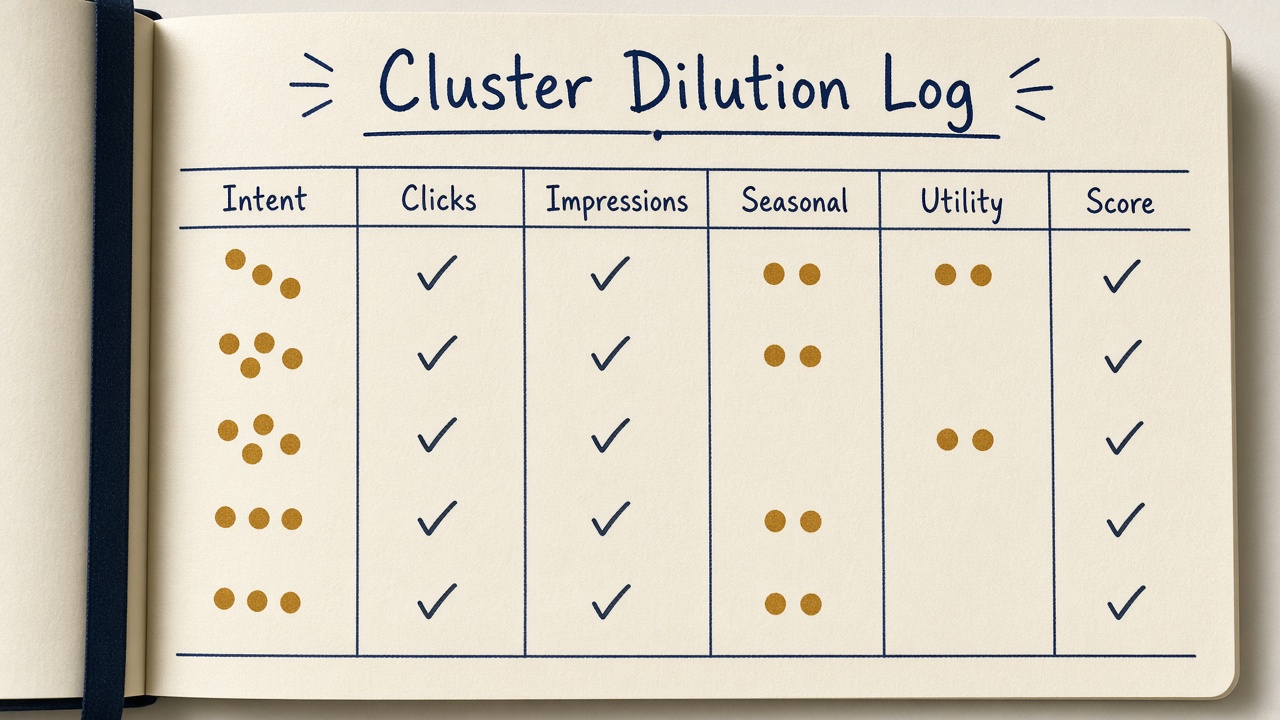
With crawl budget set aside for a small autoblog, the working record is a cluster dilution log, rebuilt quarterly rather than once a year. Each indexed URL already on the cluster map gets one row. That row is a score and a hold note, not an executed removal.
- URL, pillar or cluster, and a one-sentence intent
- 12-month clicks and 12-month impressions
- Index status, internal inlinks, and referring domains
- Last meaningful update, seasonal flag, utility flag, and near-duplicate-of
- Score, plus a hold note that explains the wait and does not carry out a noindex, 301, or 410
Score a URL as a zombie only when it is in the map, fails the 12-month compounding test, and is not seasonal, a utility page, linked equity worth keeping, or a unique intent. Quarterly is the right cadence because automated publishing recreates zombies through tag pages, near-duplicate spokes, and parameterized URLs between annual reviews. If two rows share an intent, stop and use the cannibalization check before any later redirect decision.
What Large Sites Saw After Pruning—and Why You Still Should Not Delete

The dilution log is still not an action list, even when large-site results make pruning look like the obvious next step. Those outcomes are context, not a quota, and they do not tell you to noindex, redirect, or delete a zombie cluster page from this scorecard.
CNET’s removal of thousands of obsolete pages was followed by a 29% organic-traffic increase in two months. Skroutz.gr removed 18 million obsolete URLs and later grew to 30 million monthly sessions—a scale no autoblog should copy. A Seer Interactive case cited an insurance client that pruned 14,000 low-value pages and saw organic traffic rise 23% year over year within six months, reversing a five-year decline.
Do not noindex, redirect, or delete from this scorecard. Those actions belong to a separate hold rule after unique intent, links, and utility checks. If a later hold permanently removes a URL, Google recommends a 404 or 410 and calls a 404 a strong signal not to crawl that URL again; blocked URLs can stay in the crawl queue longer. Spot and score here. Let the hold rule decide whether anything leaves the index.
Context, not a quota — Large-site traffic lifts after pruning are context, not a target. This scorecard never executes noindex, redirect, or delete.
Organic Traffic Lift After Pruning
Key Takeaways
Open a quarterly cluster dilution log for one mapped topic and hold every flagged URL until a separate rule says otherwise.
Frequently Asked Questions
You Might Also Like
- Strategy Content Pruning: When to Noindex, Redirect, or Delete Pages That Are Not Compounding
- Guides Noindex vs Delete vs Redirect: A Hold Rule for Pages With No Clicks
- Quality Content Cannibalization Audit: How to Merge, Redirect, or Hold Overlapping URLs
- Measurement When to Kill a Cluster That Is Not Compounding
- AEO Topic Cluster Strategy: How to Map Pillars That Compound Rankings