Noindex vs Delete vs Redirect: A Hold Rule for Pages With No Clicks

A URL with no clicks looks disposable. It usually is not. Ahrefs found that 96.55% of pages in its Content Explorer index get zero traffic from Google, across a sample of about 14 billion pages. That sample is biased toward the quality side of the web, and the traffic figures are estimates, so a zero is not proof the URL has no search job. It is only common enough that deleting on clicks alone would strip pages the business still needs. A pruning audit makes the same point from the pages that were kept. Of 386 URLs an auditor held, 213 also had zero clicks, including product pages, case studies, and the privacy policy. Clicks open the audit. They do not choose the action. Hold the URL until four gates are checked: whether anyone still needs it, whether anything links to it, whether a close replacement exists, and whether Google has had a fair window to crawl it. Fail those gates, then log one action. Noindex a live page users still need and search does not. Use a 301 or 308 only when a true replacement exists. Return a real 404 or 410 when nothing remains. Never point a dead URL at the homepage.
- Zero clicks is a lookup trigger, not a delete rule.
- Pages the business still needs stay live even when they earn no clicks.
- Noindex only a live user page with no search job, and do not block that URL in robots.txt.
- Redirect only to a close replacement; use 404 or 410 when there is no purpose, no links, and no replacement.
- Log one action per URL. A Search Console removal lasts about six months and is not a permanent fix.
Does Zero Clicks Mean You Should Delete the Page?

No. Zero clicks in Search Console are a lookup trigger, not a delete, noindex, or redirect trigger. The row opens a hold so you can check why the URL exists before you change its status. It does not close the page.
Those first two figures come from Ahrefs’ Content Explorer, a sample of about 14 billion pages. The sample is biased toward higher-quality sites, and the traffic figures are estimates, so zero estimated traffic is not proof a URL has no search job. Most pages in that sample earn nothing from Google. That is a description of the index Ahrefs measured, not a disposal rule.
A Search Engine Land prune makes the same point from the other direction. Of 600 crawled URLs, 198 earned 144 clicks — about 3.1% of the site’s clicks — and 140 of those 198 had never earned a click. Yet 213 of the 386 pages the auditor kept also had zero clicks, including product pages, case studies, and the privacy policy. A clicks-only cut would have thrown out pages the site still needed.
For an automated blog, that evidence is why the row is fail-closed. The Ahrefs index and the prune case both show zeros on pages that still have a job, so an empty click cell cannot emit a status code by itself.
Hold first — Zero clicks start a review. They do not choose noindex, a redirect, or a delete.
Is Noindex Better Than Deleting a Zero-Click Page?
Zero clicks do not make noindex the kinder version of a delete. Noindex is the right action only when the URL must stay a live 200 for people and has no search job. Delete only when there is no purpose, no links, and no close replacement.
Legal, login, and thank-you pages should be noindexed, not deleted, for as long as users still need them. Account pages and internal promo URLs belong in the same bucket: a visitor arrives from a known path, and a searcher does not need that URL in results. A practical pruning matrix reserves noindex for pages visitors still need but searchers do not — thank-you, account, and internal promo pages — and reserves delete for pages with no traffic, no links, no conversions, and no close replacement.
That is how needed pages were handled in the pruning case: they stayed live with noindex rather than being removed. Between July and October 2025 the newsletter archive then earned zero Google impressions while remaining reachable from email. The page had no search job left, and it still had a job for readers who already had the link.
Noindex is the wrong mercy for a page that still has a search job. An empty click report does not mean the query should be abandoned. That URL should be improved, differentiated, or permanently redirected to a true replacement — not hidden because the report looks empty.
Not a softer delete — Noindex keeps a live page people still use when search does not need it. Delete only when purpose, links, and a close replacement are all gone.
When to 301 Instead of Noindex — and Why a Homepage Redirect Fails
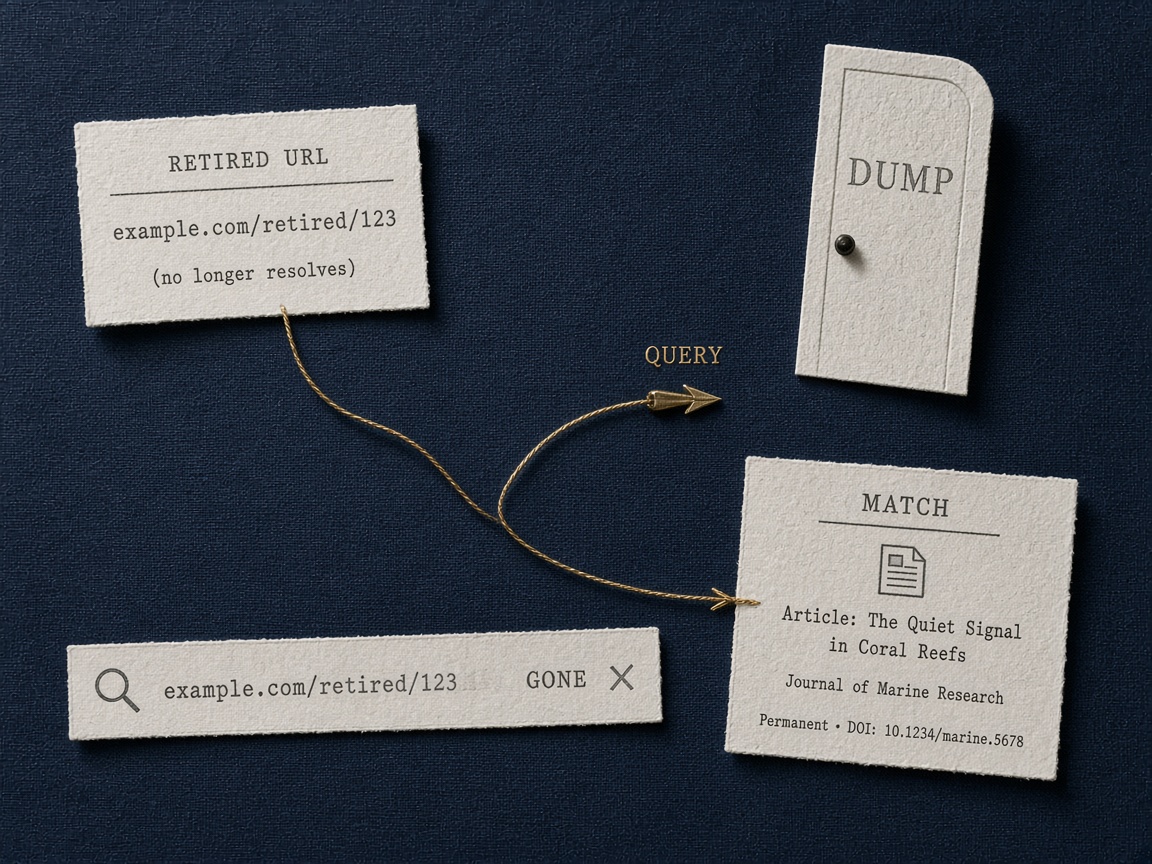
A 301 belongs on the hold card only when a close replacement already exists and can honestly inherit the query the old URL was meant to answer. If the page must stay reachable for people and has no search job, noindex it and leave it as a live 200. If neither is true, hold it or delete it — do not invent a redirect just to tidy the sitemap.
Permanent redirects are a strong signal, not a parking spot
Google treats a 301 or 308 as a strong signal that the redirect target should be processed, and it ignores content on the redirecting URL. A 302 or 307 is only a weak signal. A permanent redirect should become the URL shown in results, which is why Google recommends a permanent server-side redirect when the result URL must change. The target has to be able to carry that job.
Refuse a redirect to the homepage, or to a loose hub that does not answer the same query. Soft 404 pages keep getting crawled and waste crawl budget, and long redirect chains also hurt crawling. If you cannot name the query the target should rank for, the redirect does not belong on the card. A homepage dump is not a canonical.
Inherit or refuse — Use a 301 or 308 only when a close replacement can inherit the query. Noindex a live page people still need, and never park a dead URL on the homepage.
404 and 410 Come Last — Including Thin Autoblog Posts
Once you cannot name the query a replacement should inherit, the redirect is off the table. What is left is disposal, and for Google a 404 and a 410 are the same disposal. All 4xx codes except 429 are treated alike: crawlers tell the next system the content does not exist, indexed URLs that return those codes are removed over time, newly encountered 404s are not processed, and crawl frequency on those URLs gradually falls. A 410 is a clearer signal to other systems, not a faster way out of the index.
Thin autoblog posts should return 404 or 410 only when they have no user purpose, no links, and no close replacement. Noindex is the wrong call if the URL has no live job. A live 200 with noindex still has to be hosted and crawled; hiding it does not retire it.
Weak numbers are not that failure by themselves. On one site, 161 templated AI-scaled posts earned 570,020 impressions and 521 clicks in 90 days, a 0.091% CTR, and 112 of 161 had zero clicks, against a 0.280% CTR for surviving hand-built content. That gap is a review queue, not an automatic delete. Delete only after purpose, links, a replacement, and the indexing window all fail.
Last step — 404 and 410 are the same Google disposal. Use them for a thin autoblog URL only after the hold checks fail — never as a shortcut for a low CTR.
How Long Noindex Takes — and Why robots.txt Blocks It
That indexing window is not a countdown. There is no fixed timer for how long noindex takes to drop a page from Google. Once Google crawls a noindex meta tag or an X-Robots-Tag header, it drops the URL from Search results, but a low-priority URL can take months to be recrawled after the tag is added. And no: do not noindex a page and also block it in robots.txt. If crawlers cannot fetch the page, they never see the tag, and the URL can still appear from links.
Those exclusions exist only because crawlers could read the tag. Keep the URL crawlable until it leaves the index. Tighten access later only if users no longer need the page.
Crawl first — Noindex has no fixed timer. Google drops the URL only after it fetches the tag, which can take months on a low-priority page, and a robots.txt block stops that fetch so the URL can still appear from links.
Does Removals Permanently Delete a URL — and Can Noindex Keep AI Citations?
Keeping the URL crawlable is what makes noindex real, and the next two shortcuts do not replace it. No: a Search Console Removals request hides a URL for about six months; it does not delete it. Permanent blocking still means removing or updating the content, password-protecting the page, or serving a noindex tag Google can crawl. And no: noindex is not a way to keep AI citations while hiding a weak URL. There is no separate index for AI features, so noindex removes the page from Google's AI answers as well as from blue links.
Use Removals only as an emergency hide. Do not log it as disposal, and do not stack it on a URL you still need crawled so Google can see the noindex. When the six months end, an unread tag leaves the same hole as a robots.txt block: the URL can still surface from links.
If the page must stay citable, it must stay indexable. A URL you still want cited cannot be logged as noindex.
No side door — Removals hide a URL for about six months; noindex drops it from blue links and AI answers together. Stay indexable if the page still needs to be cited.
What to Check Before Pruning a Page With Backlinks but No Clicks
A crawlable noindex is what actually takes a URL out of results. Backlinks do not override that, and they do not license a delete either. Before you prune a zero-click page that other sites still point at, check whether those links still describe this URL, whether a close replacement can inherit them, and whether the page still has a user job. If the links still fit and nothing can inherit them, hold the URL and improve it. If a true match exists, use a permanent redirect so the replacement can take the query. Links plus no clicks is a hold or a true-match 301, not an automatic 404.
How to update internal links after a delete or redirect
After a delete or redirect, update internal links to the surviving URL or remove them in the same deploy. Do not leave template links pointing at a 404, and do not point them at the homepage as a shortcut.
Google drops a page entirely from Search results once it crawls a noindex meta tag or X-Robots-Tag, regardless of whether other sites link to it. That drop still waits on the crawl. External links do not move the URL out faster, and they are not a reason to hide a page that still answers a query.
Then recheck autoblog templates, related-post modules, and sitemaps so the stack stops emitting the retired URL. A logged 404 or redirect is undone the moment the next build republishes the address.
Hold the kill — Backlinks freeze a zero-click kill until the links are rehomed or the page is kept; change internal links, templates, and sitemaps in the same deploy.
Does Pruning Zero-Click Pages Improve Crawl Budget on a Small Site?
Crawl budget is a weak reason to prune zero-click pages, including on a small site, and it is a poor reason to kill a URL that still has a job. An empty click report is not evidence that a sweep will free meaningful crawl.
Google's crawl guidance is narrower than that impulse. A 404 is a strong signal not to crawl a known URL again, while robots.txt-blocked URLs stay in the crawl queue much longer and are recrawled once the block is removed. That argues for a real 404 on a true dead URL, not a sitewide pass over every page with no clicks.
An early organic lift is not clean proof either. In the pruning case, paid search sessions fell from 11,863 to 182 in the same window, and total search sessions dropped 27%. Log the disposal because the hold card failed — no purpose, no links, no close replacement, and the indexing window checked — not for an imagined crawl or traffic payoff.
Hold first — Crawl budget is a weak reason for a zero-click sweep; dispose of a URL only after purpose, links, a replacement, and the indexing window all fail.
What Belongs on a Hold-or-Kill Card
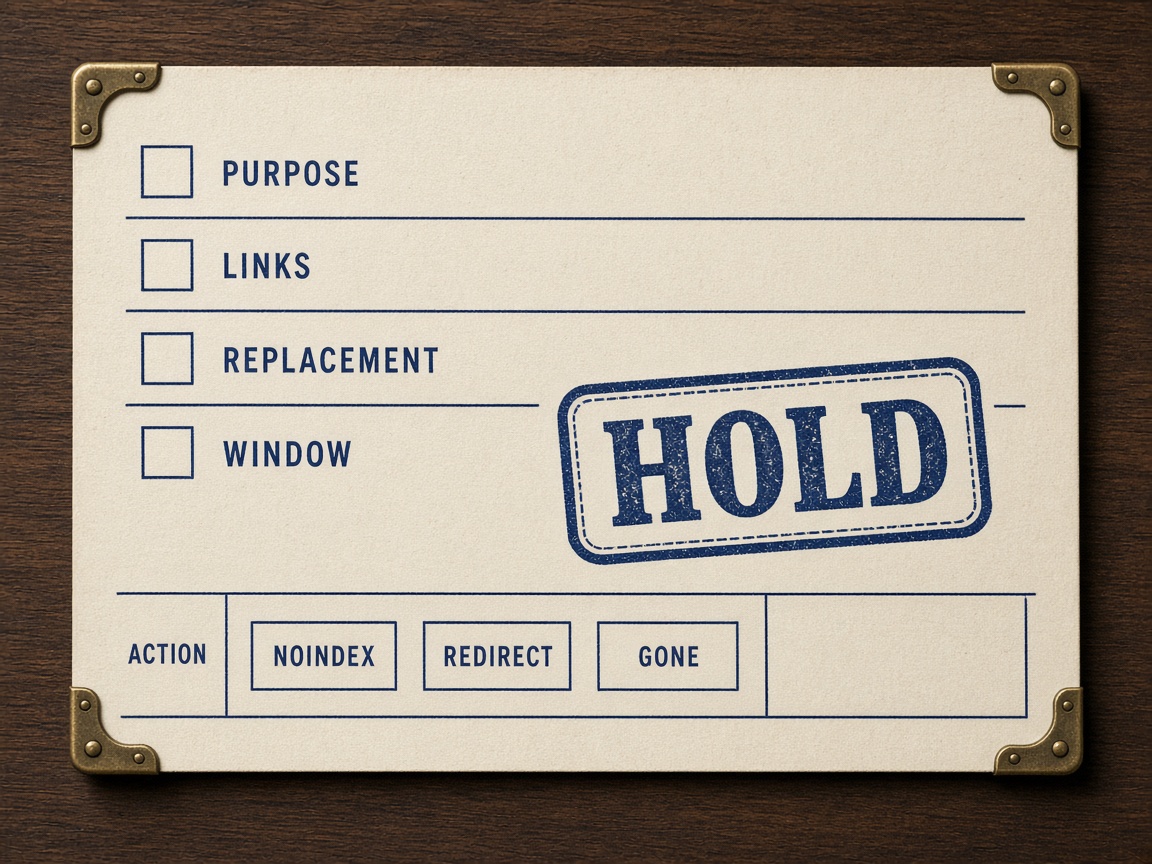
Logging a failed hold is not a free-text note. For an automated publisher, the hold-or-kill card is one row: URL, template, age against the indexing window, clicks, impressions, user purpose or an explicit none, a backlink note and whether a replacement can inherit those links, a close-replacement URL or an explicit none, one action, internal-link status, date, and owner. The default action is hold. A decay audit may open the card. It may not close it.
The same row must refuse a homepage redirect, a loose-hub redirect, noindex paired with a robots.txt block, Search Console Removals treated as a permanent delete, and noindex used to stay eligible for AI citations. One row, one action, one log line. Only this rule closes the card.
Close rule — Zero clicks open the card. Purpose, links, a named replacement, and the indexing window decide the single logged action: hold, noindex, a permanent redirect, or a real 404 or 410.
Key Takeaways
Open a hold-or-kill card for every zero-click URL, then log one action — noindex, a true-match 301 or 308, or a real 404 or 410 — only after purpose, links, replacement, and the indexing window are checked.
Frequently Asked Questions
You Might Also Like
- Measurement Impressions Without Clicks: A Hold-or-Rewrite Rule for Existing Pages
- Quality Content Cannibalization Audit: How to Merge, Redirect, or Hold Overlapping URLs
- Strategy Merge, Redirect, or Canonical: A Decision Rule for Overlapping SEO URLs
- Publishing When Autoblogging Creates Cannibalization: A Hold Rule Before the Next Brief
- Measurement When to Kill a Cluster That Is Not Compounding