Content Cannibalization Audit: How to Merge, Redirect, or Hold Overlapping URLs
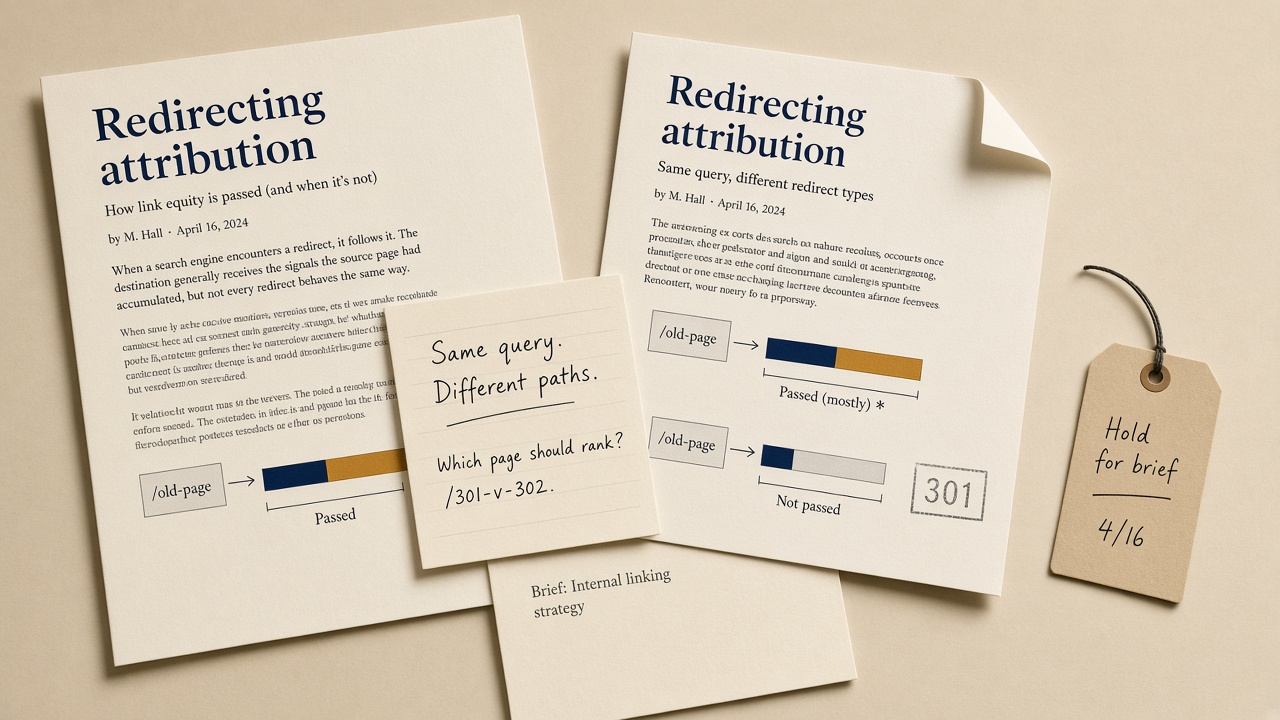
Two of your URLs showing up for the same query is not, by itself, content cannibalization. In September 2025, Google’s John Mueller said three different pages in one search result is not a problem merely because there is more than one, and pages are not duplicates just because they share a results page. Search Console only records pages that were actually shown, so a keyword overlap report is a lead, not a verdict.
The useful test is narrower. Ahrefs defines bad cannibalization as ranking swaps between pages, or simultaneous rankings for pages similar enough to consolidate — not every multi-URL keyword. A hand review of 80 multi-ranking keywords found only one that needed action, out of about 9,700 cases where a site ranked with more than one page. On smartsites.com, about 10% of queries showed two or more URLs and those queries carried 39% of impressions, but after filters for a real impression split, non-brand queries, and neither URL in the top 3, only about 0.3% remained. Median search volume for multi-ranking keywords was nearly the same as for single rankings (50 vs. 40), so volume does not mark the problem either.
This audit is fail-closed. Same intent plus a material split is the only merge: fold unique material into the stronger URL, 301 or 308 the rest, and stop briefing that intent. Different intents stay separate. Near-duplicate variants that must remain accessible get a canonical, not a fake consolidation. If nothing genuinely replaces a retired URL, hold it with a 404 or 410 instead of pointing it at the nearest category.
- Multiple URLs on one query are not cannibalization; Google has said shared results do not make pages duplicates.
- Act only when intent is the same and the ranking split is material — most overlap fails that test.
- Merge into one owner URL, then permanently redirect the losers and update internal links and the sitemap.
- Keep both pages when intents differ; use rel=canonical only for variants that must stay live.
- Do not 301 a dead URL to an irrelevant category, and do not publish a new brief that matches an existing owner.
What Content Cannibalization Is, and How It Differs from Keyword Overlap
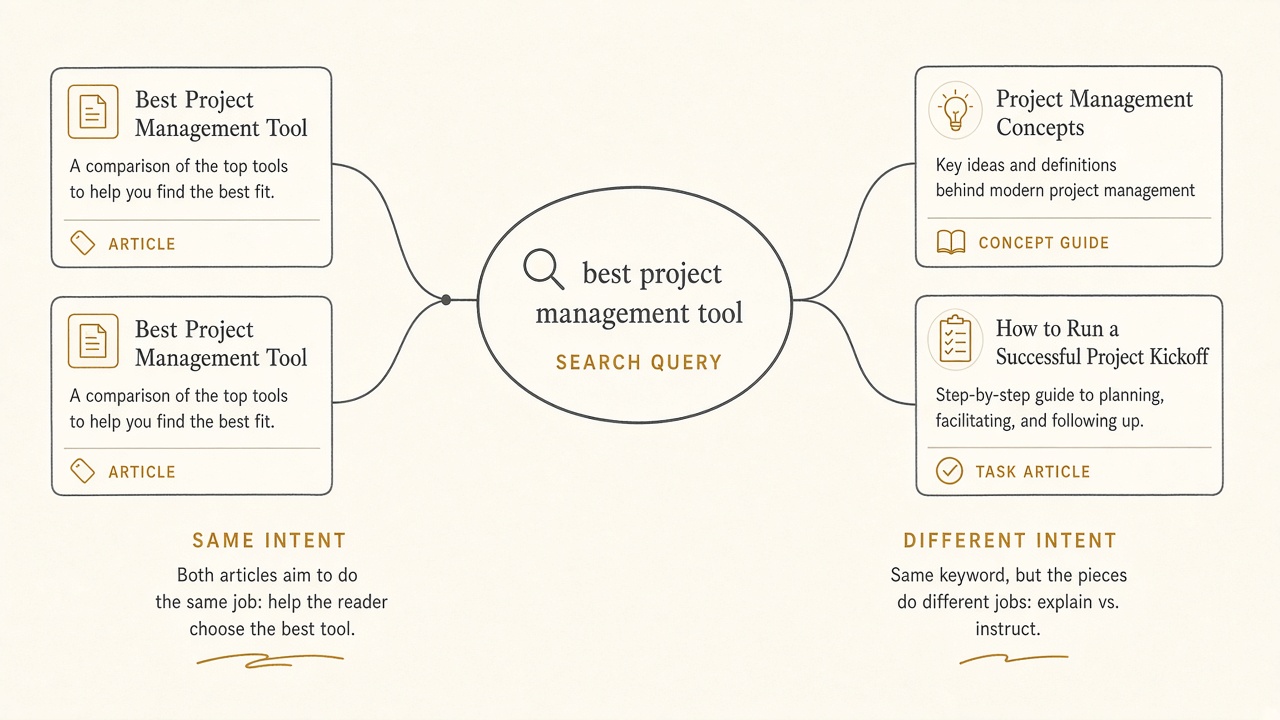
Content cannibalization is two or more of your URLs competing to own the same reader intent. Keyword cannibalization is the narrower symptom of that fight: those URLs showing up for the same query. Sharing a keyword is not the diagnosis, and the two names are not the same problem.
What makes the overlap bad is a ranking swap between similar pages, or simultaneous rankings for pages similar enough to consolidate — the definition Ahrefs uses for harmful cannibalization. Multiple rankings that serve different intents are diversification. They should not be merged just because they share a query.
Keyword overlap is also not duplicate content. Pages are not duplicates merely because they appear together in one result, and three of your pages in a single result is not a problem just because there is more than one. Google's John Mueller made that point in September 2025: co-appearance is not, by itself, evidence that the pages are copies.
Duplicate or near-duplicate primary content is a canonicalization issue. Same-intent articles that are written differently can still cannibalize. The audit asks whether one page can satisfy the job, not whether the HTML matches.
Log one owner URL per meaningful intent, not one URL per keyword. A shared head term with different jobs — a concept guide versus a support task — is a cluster, not a collision. Compete only when a single URL could do the work; otherwise the right move is to keep both and make the jobs obvious.
Does Google Penalize Cannibalization or Duplicate Content?

No. That one-owner-URL rule is about control, not punishment. Ordinary duplicate content is not a penalty, and a shared result is not a manual-action risk. When Google finds pages with the same or very similar primary content, it groups them, picks the version it thinks is best, crawls the others less often, and consolidates signals such as links onto that URL.
The cost is loss of control. The page you wanted to rank may not be the one shown, and a weaker URL can collect the impressions. You can state a preference with a canonical tag or a redirect, but Google may choose a different canonical than you do.
Search Console only lists pages that were actually shown, so theoretical overlap in a keyword tool is not cannibalization. John Mueller’s useful instruction is to reduce unnecessary duplication and spend the energy on one strong page — not to treat every shared term as a collision. Pages are not duplicates merely because they appear together.
Treat the overlap as a control problem. Before you rewrite, redirect, or brief anything new on that intent, confirm in URL Inspection which URL Google is indexing as canonical.
Not a penalty — Duplicate overlap does not trigger a penalty. It can hand impressions and link signals to a URL you did not choose, so verify the canonical before you merge, redirect, or publish again.
How to Find Cannibalizing Pages in Google Search Console Without a Paid Tool
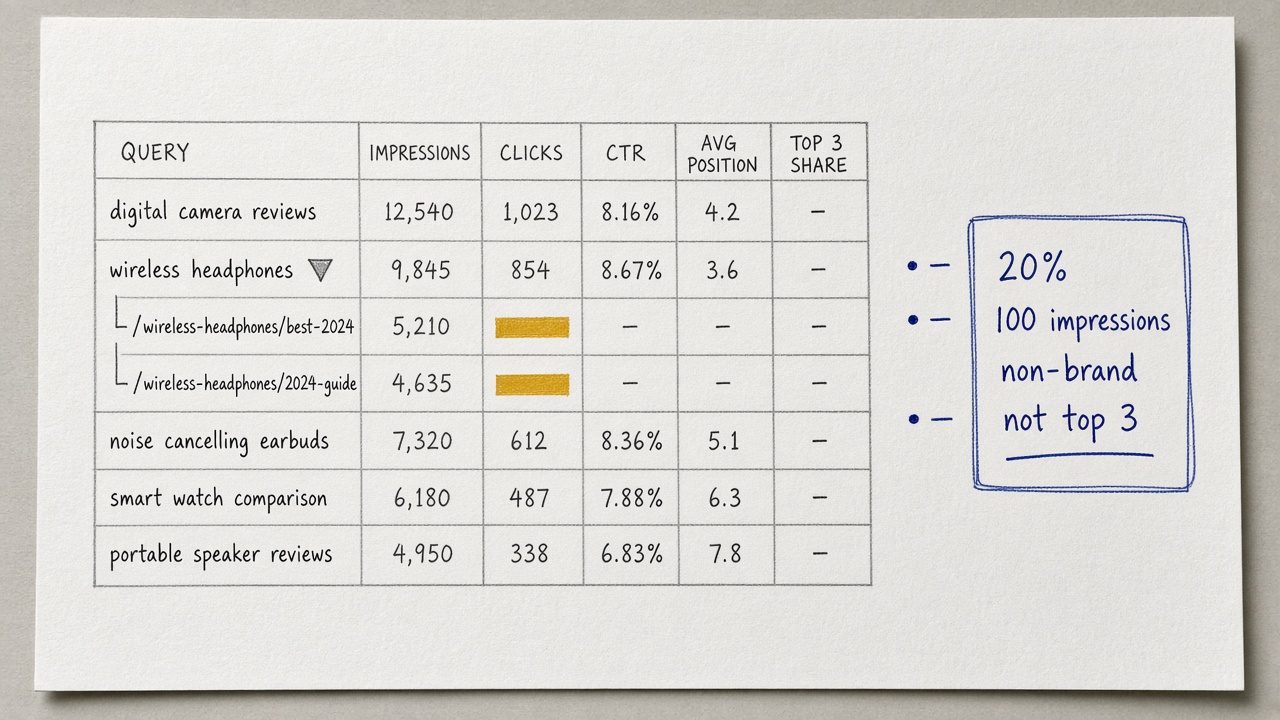
URL Inspection tells you which URL Google chose. It does not tell you whether two of your pages are splitting the same query. The unpaid audit is the Performance report: open it, set a recent window such as 28 days, export Queries and Pages, and keep only queries where two or more of your URLs received impressions. That export is the whole unpaid audit.
Most of what you export is noise. On one site over 28 days, about 10% of queries — 4,613 of roughly 44,200 — showed two or more URLs, and those queries carried 39% of impressions. That share looks like a crisis until you keep only a material split.
Keep a query only if the second URL has at least 20% of the top URL's impressions, the query has at least 100 impressions, it is non-brand, and neither URL is already in the top 3. On that site, 131 queries survived — about 0.3% of the queries they appeared for. That filtered set is the work list, not the raw export. A separate hand review of 80 multi-ranking keywords, drawn from about 9,700 cases of a site ranking with more than one page, found only one that needed action. Median search volume for multi-ranking keywords was nearly the same as for single rankings (50 versus 40), so volume alone does not mark a problem. Do not sort the export by search volume and start merging.
A swap is the same query changing its top URL across two comparable date ranges, or the two URLs trading clicks while combined position stays flat. Compare the pages filter for that exact query over the prior period. A stable second URL with a different job is not a swap.
Work list — Search Console overlap is a candidate file. Act only after the material-split filter, and call it a swap only when the top URL changes or the two pages trade clicks with position flat.
Raw Overlap vs Action Needed
When Two URLs Ranking for the Same Query Are Actually Fine
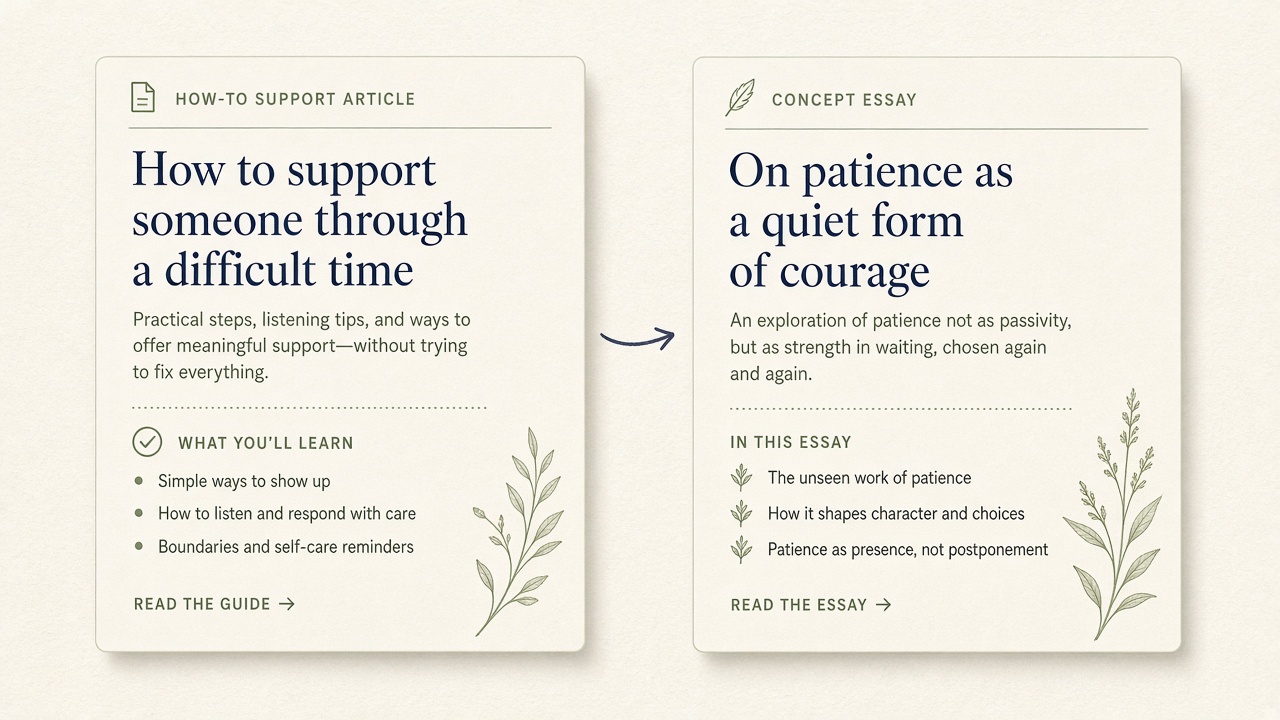
A second URL on the same query is fine when the jobs are different. A concept guide and a tool, or a support article that walks someone through a task and a blog post that explains the idea, can share a head term without colliding. Sharing the query is the observation; intent is the diagnosis. If each page answers a question the other does not, keep both and differentiate titles, H1s, and internal anchors so the cluster reads as two owners, not two drafts of one page.
Give each intent one owner
Assign ownership the way a support-versus-blog rule does. The support URL owns the task; the blog owns the concept. Link them both ways so a reader can move from explanation to action and back, but do not let both claim the same query in the title. Anchors should name the job they point to — “how the feature works” versus “complete this step” — rather than repeating the head term on every link. On the cluster map, note which intent each URL owns, then hold both. A third URL that would sit between them has no job left; refuse that brief instead of publishing into the gap.
Cannibalization is not the same as content decay
Cannibalization is a split across URLs. Content decay is one URL that already owns the query losing clicks or position on its own. Do not merge a decaying owner with a sibling just because a second page also appears, and do not rewrite a ranking page if that second URL is the thing stealing the click. Run the decay checklist on the single owner first: whether the query mix has shifted, whether the snippet still matches what people click, and whether the drop tracks seasonality. Only if a second same-intent URL is materially splitting impressions does this audit take over from the decay audit. A stable companion with a different job is a cluster, not a collision.
Hold the split — Keep both URLs when intents differ, name one owner per job, and treat a lone ranking page that is slipping as decay — not as a reason to merge.
Should You Merge, 301, Canonicalize, Noindex, or Keep Both?

Once you know whether the two URLs share a job, the fix is one of five actions, not a default merge. Merge when one destination can satisfy the intent. Keep both when the jobs differ. Canonicalize only when near-duplicates must stay accessible. Noindex only a page that must exist for users but should not compete. Use a 301 or 308 only when you are deprecating a real duplicate onto a real replacement — not onto the nearest category. If nothing genuinely replaces a retired URL, a 404 or 410 is cleaner than a hopeful redirect.
The rule under all five is one unambiguous owner per meaningful intent, not one URL per keyword. If a single page can carry the query’s job, fold the unique material into the stronger URL, point the rest there with a permanent redirect, update internal links, and drop the redirected URLs from the sitemap. If the second URL answers a different job, leave it live; consolidation would retire a page that was never competing.
How Google weighs the signals
Google ranks these hints by strength. A redirect is a strong signal that the target should become canonical, and rel=canonical is a strong signal too. Sitemap inclusion is only a weak hint. The methods stack when they agree, and they fight when they do not. Never list one URL in the sitemap and name a different URL in rel=canonical.
A canonical tag is the wrong shortcut when two articles do the same job. If two pages are too similar, merging or redirecting is the better fix, and a canonical fits only when overlap is minimal and both URLs still have a purpose — a print view, a parameter URL, or another variant that must stay reachable. Do not noindex a URL you are also redirecting, and do not canonical Article A to Article B while both remain in the sitemap as indexable owners. Conflicting signals make Google pick for you.
Write the decision on a one-line log: query, intent, owner URL, action, and date. That log is what the next brief has to clear before another URL is published on the same intent.
One owner — Merge or permanently redirect when one page can satisfy the intent; keep both when the jobs differ; canonicalize or noindex only for variants that must stay reachable — and make every signal agree.
Which URL Should Survive When Both Have Traffic or Links?
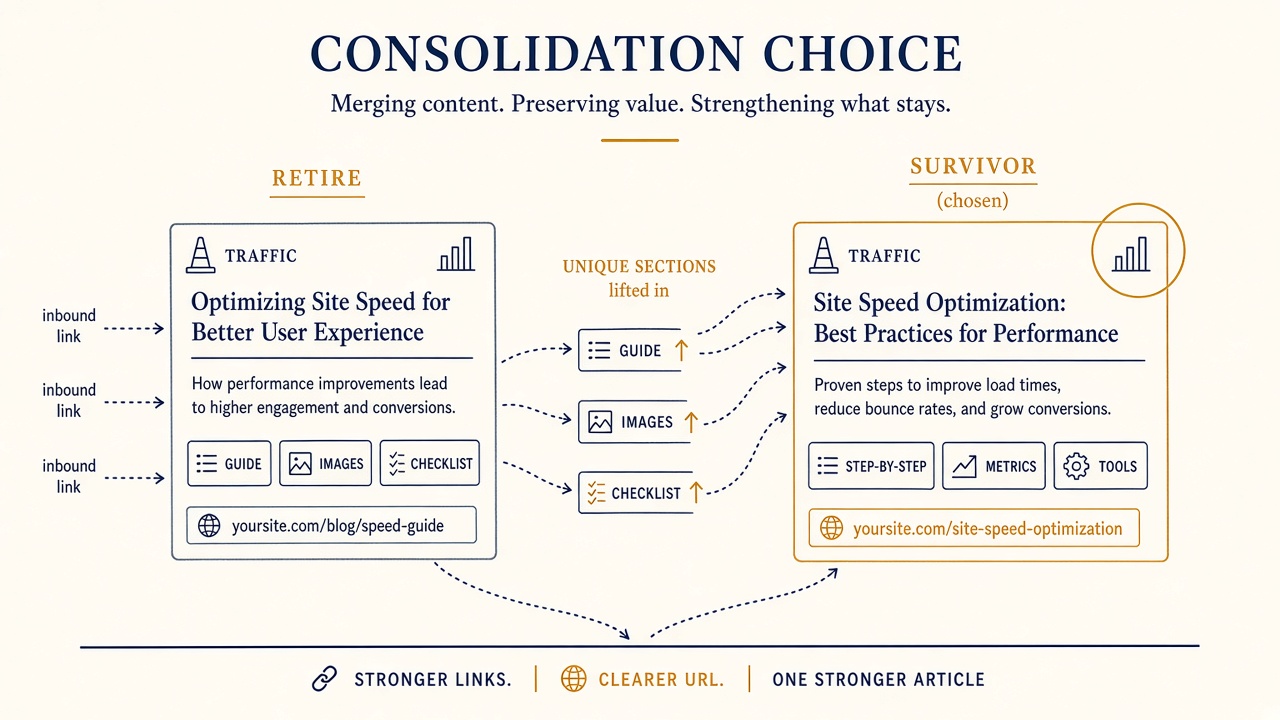
Once a merge is the right call, keep the URL that can fully satisfy the intent and already combines the clearer query match, the stronger links, and the cleaner path. Do not automatically keep the page with last month’s clicks if the other URL is the one people link to and the one that matches the query.
Fold the loser’s unique examples, steps, and answers into that survivor before you redirect. Same-intent pages are unlikely to rank for lots of different long-tail variations, so consolidating usually gains more than it loses once backlinks and internal links stop being split.
A permanent 301 or 308 is a strong signal that the target should be canonical. Googlebot follows it, and the indexing pipeline uses it that way. Temporary 302, 303, and 307 redirects do not make the target canonical. Do not promise a one-to-one transfer of every link. What you can count on is consolidation: ranking signals group onto the URL Google treats as canonical. Point the redirect at the final survivor, not at a hop in between.
After a real consolidation, the survivor can outrank the pair. Competing case-study posts folded into a pillar reached the top 10 almost immediately and stayed in the top 3 most of the time. Two broken-link guides merged onto one existing URL earned more estimated organic traffic than both pages combined had before.
Survivor rule — Keep the URL that can own the intent — clearer match, stronger links, cleaner path — fold the unique material in, then 301 or 308 straight to that survivor.
What to Do with Internal Links and the Sitemap After a Redirect — and How Long to Wait
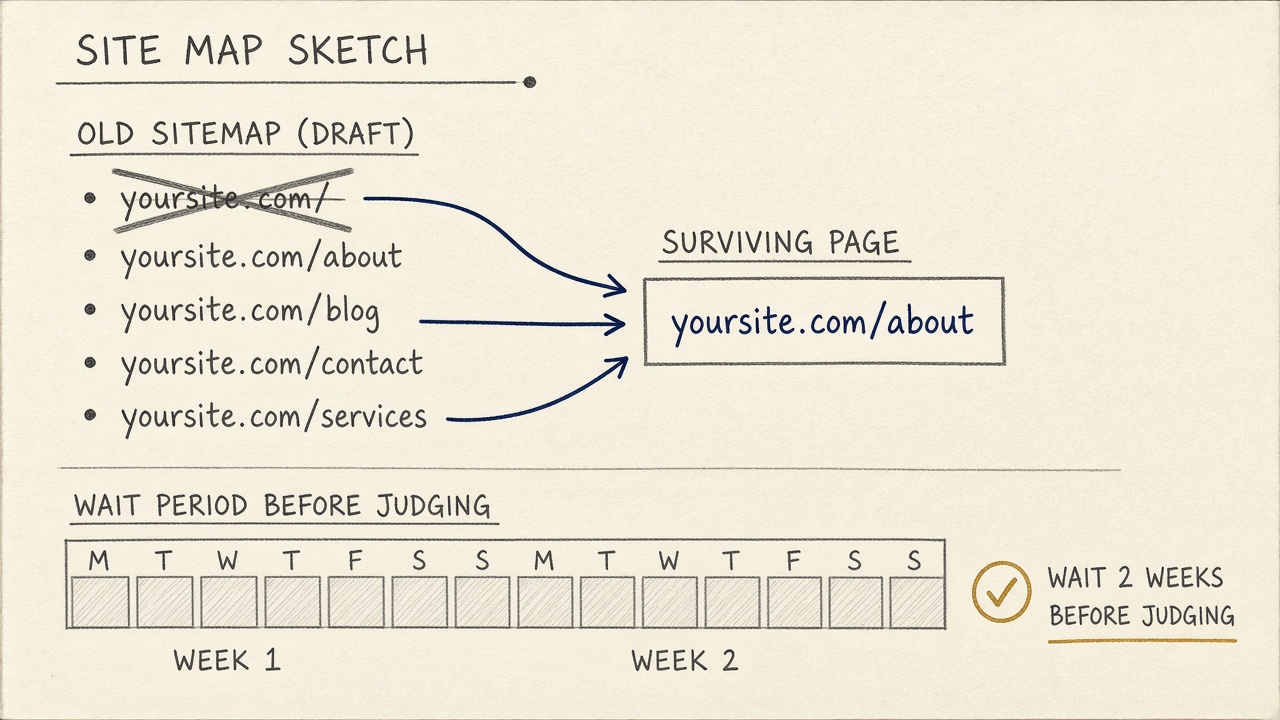
Pointing the permanent redirect at the final survivor is only half the deprecation. Update every internal link to that URL — pillar-to-spoke links, related-post modules, and navigation. A redirect that still has dozens of internal links pointing at the old URL wastes crawl and keeps the retired page in the graph you control.
Remove the redirected URL from the XML sitemap in the same change. Google says to use permanent redirects only when deprecating a duplicate page, and not to declare conflicting canonicals, such as one URL in the sitemap and a different URL in rel=canonical. Sitemap inclusion is a weak signal; leaving the old URL listed while the redirect names another page is that conflict. Use a permanent redirect only because you are retiring the page.
Send the redirect straight to the final URL. Google can follow chains of up to 10 hops, but the recommendation is to redirect to the destination directly — ideally no more than 3 hops, and fewer than 5. Do not chain the old post to a hub and then to the survivor.
URL Inspection is the gate, not a ranking chart from the first few days. On the old URL and the survivor, confirm the canonical you declared, the one Google selected, and that the retired URL is not still the page being shown. Only then is a fresh 28-day window comparable to the one you audited before the merge.
Wait, then verify — Internal links and the sitemap should name the survivor, the redirect should be one hop, and a consolidation is not judged until URL Inspection agrees and a fresh 28-day window can be set against the one before the merge.
How to Stop the Queue from Briefing an Intent You Already Own
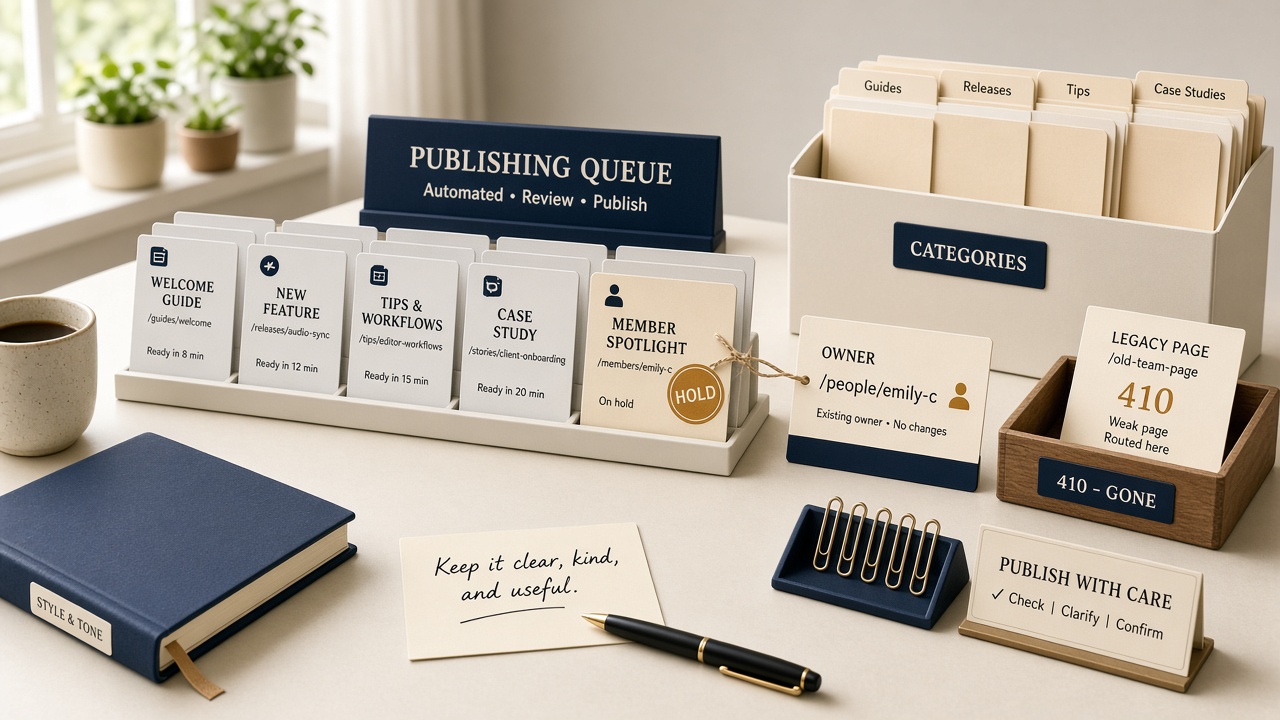
Once URL Inspection confirms the survivor, the audit is still open if the publishing queue can brief the same job again. The pre-publish gate is refresh-or-refuse. If a live page already matches the intent, refresh and expand that URL. Publish a new URL only when the intent is different. If several weak same-intent pages are still live, consolidate them first and redirect or noindex the rest — do not add another.
Match the incoming brief against the owner log and the cluster map, not against a keyword string. Sharing a head term is not a new job. A new angle on an owned query is a section for the owner, not a new slug. If a cluster is not compounding, stop briefing it rather than spawning a near-duplicate spoke that will split the same intent again.
Should a weak page redirect to a category if nothing replaces it?
No. A weak page with no genuine replacement should return 404 or 410. Do not 301 or 308 it to the nearest category, tag, or homepage. Permanent redirects are for a real replacement that satisfies the same intent. An irrelevant target wastes the signal and frustrates the click: if no suitable replacement exists, a clean 404 or 410 is better than forcing users and crawlers onto an irrelevant category page.
Hold the refused brief in the queue with the owner URL named in the rejection note. The next automated run should see that hold and skip the intent, refreshing the named URL only when the brief adds something that page can own. That hold is the difference between this audit and a one-time cleanup.
Hold rule — Refresh the owner or refuse the brief. A retired page with no real replacement gets a 404 or 410, never a permanent redirect to the nearest category.
Key Takeaways
Run the Search Console filter on your last 28 days, log each material same-intent owner, and refuse the next brief that would split that job again.
Frequently Asked Questions
You Might Also Like
- Measurement How to Export Search Console Queries Into a Brief Queue
- Measurement Search Console for Content Ops: Queries That Should Become Briefs
- Measurement Content Decay Audit: A Monthly Checklist Before Rankings Slip
- Measurement How to Prioritize a Content Decay Audit When You Publish Weekly
- Governance Content Approval Workflow: Hold, Edit, or Publish in One Pass