
What Is Autoblogging? The Fail-Closed System Lean Teams Can Scale
Most teams meet autoblogging as a promise: feed it keywords, an RSS stream, or a topic list, and posts appear on a schedule. That description is incomplete. Automatic creation is only the middle of the job. The system that holds up is a contract from research to publish: a chosen input, a page written for one reader intent, a person who can refuse it, and a place in the site where that page does not duplicate another URL. Google’s spam rules do not ban automation, generative tools, or a mix of human and machine work. They ban scaled content abuse: many pages made mainly to manipulate rankings rather than help users, no matter whether automation, human effort, or a mix produced them. Using generative tools to ship many pages without added value is one named example. The failure is unoriginal, low-value publishing, not the presence of an AI draft. Treat the rest of this guide as that contract. A plugin, an AI article writer, and a programmatic template are different jobs. Lean teams can automate research, briefs, drafts, formatting, and scheduling. They still need a human to own the query, check claims, and keep the publish gate closed until the page is worth indexing.
- Autoblogging is a pipeline—inputs, draft, review, publish—not a set-and-forget content spinner.
- Google’s scaled-content rule is method-neutral: volume without user value is the problem, whether humans, automation, or both produced the pages.
- An AI writer drafts; autoblogging scales editorial articles; programmatic SEO fills templates from data. Most teams need a hybrid, not one slogan.
- Automate production steps, and keep human decision rights on intent, claims, the publish gate, and pruning.
- A long generic post can still be thin. One URL should own each intent, and new posts should earn a place in the existing site before they go live.
Autoblogging Is a Pipeline, Not a Plugin
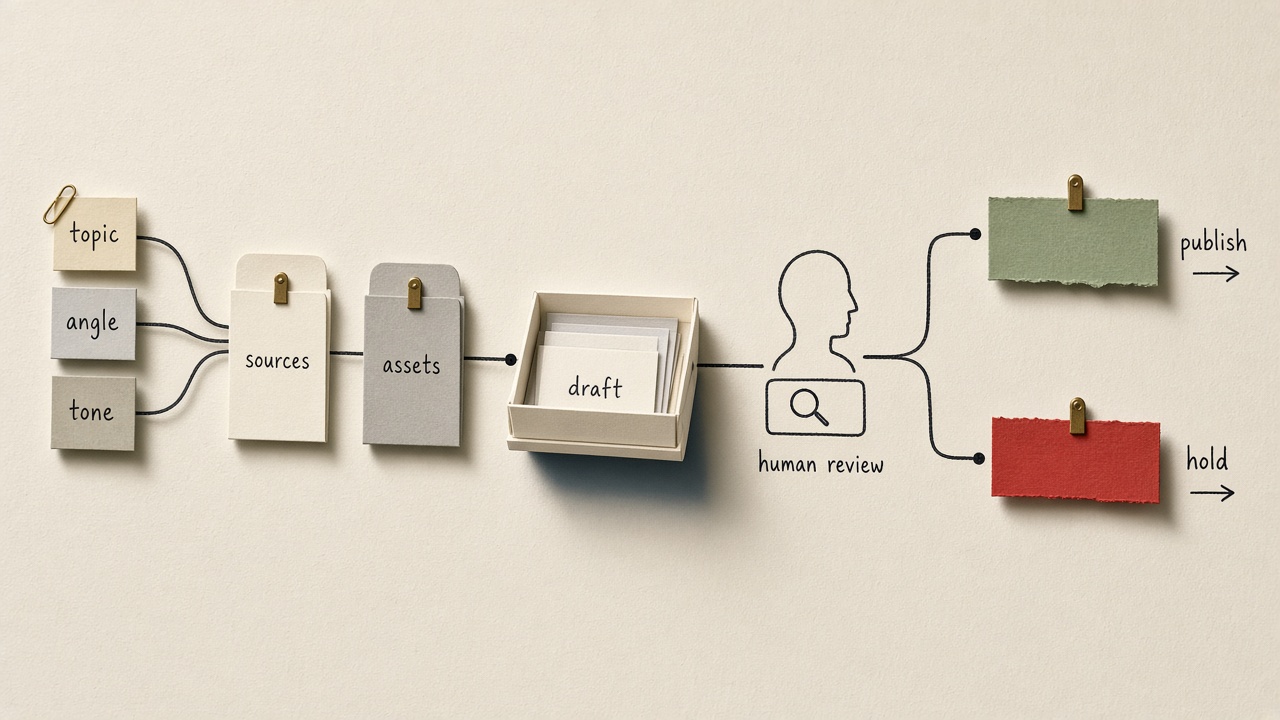
The useful definition is operational, not a product name. Autoblogging automatically creates posts from chosen inputs—RSS feeds, AI topic generation, keyword lists, or structured sources—then publishes them or parks them in a queue. The plugin, script, or assistant that moves the draft is interchangeable. What has to stay fixed is the order: selected inputs, a draft, a human gate, then one URL per intent.
An unattended spinner reverses that order. It generates pages mainly to chase rankings and ships them because a schedule said so. Fail-closed means the opposite. If the claim check fails, the intent check fails, or the value check fails, the URL does not ship. Automation can gather inputs, format a draft, and suggest a publish time. It cannot own the decision to publish.
Briefs, workflow maps, and quality checklists are the material that gate already uses. They are inputs, not a second article inside this one. A brief tells the draft which query it owns. A workflow names who reviews claims. A checklist stops a page that adds nothing distinct. Point the pipeline at those controls, then let the gate decide whether this URL is allowed to exist.
Fail closed — Autoblogging scales only when chosen inputs become a draft a human can refuse—on claims, intent, or value—before any URL is published.
Three Production Jobs Hiding Inside One Slogan
A pipeline only stays fail-closed if the team knows which machine is running. Most lean teams do not. They buy “autoblogging” and expect one motion to draft a flagship article, turn a keyword list into a blog, and stamp out product or location pages. Those are three production jobs. Collapsing them into a slogan is how overlapping URLs get generated before anyone has decided they should exist.
What each job actually produces
- An AI article writer drafts one page from a brief. It does not decide that the URL should ship, and it does not scale a calendar by itself.
- Autoblogging scales editorial articles from chosen keywords and briefs: inputs in, a draft, a human gate, then publish or queue.
- Programmatic SEO assembles many pages from templates and structured data. It can ship thousands of pages quickly when the fields are real and the intent is distinct.
Pace is the giveaway that these are not the same job. A well-run AI content operation might produce 50 to 100 high-quality articles a month — slower than a template engine, and better suited to informational depth. Strong teams use both. They do not treat a templated landing page and a researched article as interchangeable drafts of the same post.
An operator comparison is a caution, not a winner’s board. It reported 4,200 monthly organic clicks from 87 semi-automated blog posts versus 11,800 from 312 programmatic landing pages at six months, with more cannibalization on the programmatic set. The larger click total came with a much larger page count and more pages fighting each other. Depth per URL and coverage from data fail in different ways. Neither result licenses hands-off publishing of the other job’s pages.
A hybrid is the sensible default only after each URL type has an owner, a template or a brief, and a reason to exist. Editorial posts come from briefs and claim checks. Templated pages come from fields you can defend.
Keep the jobs apart — A writer drafts one page, autoblogging scales reviewed editorial articles, and programmatic SEO fills templates from data. Use more than one only after every URL type has an owner and a reason to ship.
Programmatic vs Blogs (Blogs = 100)
The Spam Line Is Purpose, Not Who Wrote the Page
Once each URL type has an owner, the next question is whether that URL should ship at all. Google’s test does not ask which plugin, model, or writer produced the draft. Scaled content abuse is generating many pages for the primary purpose of manipulating search rankings rather than helping users. The harm it names is unoriginal, low-value content, no matter how those pages were created.
The March 2024 spam-policy update makes the method irrelevant: Google can act whether the pages come from automation, human effort, or some combination of both. Helpful-content guidance says the same thing in operator language. If automation, including AI generation, is used mainly to manipulate rankings, that is a spam-policy violation. Current generative-AI guidance narrows the point further: using those tools to generate many pages without adding value for users may itself violate the scaled content abuse policy. Appropriate automation is allowed. Publishing without a distinct intent, added value, or a review gate is the failure.
Two failure modes Google already names
- Generative AI, or similar tools, used to mass-produce pages that do not add anything a reader needed.
- Scraped feeds, search results, or other existing content turned into a large set of pages that mostly restate what was already published.
Those examples mark the line. They are not a map for getting around it. An unattended feed-to-post loop and a human writing the same empty pages at volume land in the same policy bucket.
Presence of AI is not the penalty. An Ahrefs study of 600,000 pages, as reported by EdgeBlog, found that 86.5% of top-ranking pages contain some AI-generated content, and that the share of AI text showed essentially no correlation with rank position. Treating “we used a model” as either the risk or the shield measures the wrong thing. The fail-closed check is still whether the page has a job a reader would notice, a claim worth standing behind, and a reason not to refresh an existing URL instead of minting another one.
The line — Many pages made mainly to manipulate rankings violate spam policy whether a model, a person, or both produced them. AI text is common on ranking pages; missing user value is what the policy actually names.
Cheap Drafts Pay Only After the Human Gate
Once a draft costs only a few dollars, review starts to look like optional overhead. That is where the pipeline breaks. A cheap article is not the same thing as a page that should ship.
One vendor cost model puts full AI autoblogging at $3.30 to $6.63 per article for 1,500–2,000-word posts, against a hybrid editor workflow in the low tens of dollars. The same model prices mid-tier freelance production at $200 to $500 per article on a 30-article month. The spread is real. It is not a case for hands-off publishing.
Those unit costs only make sense next to outcomes. An operator test of three autoblogging tools over 90 days found that AI drafts plus human editing produced about three times the organic traffic of fully automated posts after six months. The savings case is the edited path. A draft that fails a claim, intent, or value check should never get a URL.
Decision rights stay with people
Automate the labor that does not choose whether a page exists: research, first drafts, formatting, link suggestions, and scheduling. Keep humans on the calls that decide if a URL should exist at all.
- Intent ownership: one query gets one page, decided before a draft is generated.
- Claim checks: unsourced or overstated lines go back, not live.
- The publish gate: fail closed when the page adds nothing a reader would miss.
- Pruning: consolidate or remove URLs that never earn a job.
Treat the editor pass as that gate, not a courtesy rewrite after the post is already live. Freelance rates still fit flagship work. They do not excuse skipping review on the automated set, because unedited volume is the expensive mistake once you count traffic that never arrives.
Gate first — A few dollars per draft is a bargain only when people still own intent, claims, publish, and pruning—edited drafts drew about three times the organic traffic of fully automated posts.
Cost per Article: AI vs Freelance
Name the Owner URL Before You Generate

The publish gate only holds if the hard choice happens before a draft exists. Intent is not a label you paste on after the page looks finished. It is the rule that decides whether generation is allowed at all.
Require one owner URL per intent before anyone—or anything—writes. Map the query to the address that already answers it. If the new keyword is the same job in different wording, refresh that page: revise the brief, add the missing example, tighten the answer. Overlapping demand should not spawn a rival. A second URL splits links, impressions, and authority you meant to accumulate on one address, and you will eventually have to merge it anyway.
Cluster first, then draft
A cluster makes the owner rule concrete. The pillar owns the broad intent. Related articles own narrower jobs the pillar should not try to swallow. Before publish, each new post ships with internal links into that pillar and into the related articles that share the cluster—not as a cleanup task after the URL is already live and unlinked.
Length does not rescue a page that never earned its URL. A 2,000-word article can still be thin if it repeats obvious points, lacks examples, or fails to answer the user’s real question. Restating what already ranks, only in more words, is not added value. If the draft echoes the search results and misses the query the reader actually brought, it fails the same test a short stub would fail—and it should not ship.
After publish, pruning stays inside the pipeline. Watch whether the URL earns impressions, clicks, or a distinct job no other page owns. Pages that never do should be consolidated into the owner URL or removed. Leaving them up “just in case” is how a cluster turns into a set of rivals competing for the same intent.
Before the draft — Name one owner URL per intent before generation, refresh overlaps instead of spawning rivals, link into the pillar and related articles before publish, and consolidate or remove pages that never earn impressions, clicks, or a distinct job.
Volume Still Needs an Answer Worth Citing
Naming the owner URL only settles which page is allowed to compete. It does not make that page worth quoting. Answer engines assemble a short reply from several sources, and a near-duplicate that restates the same results has nothing new to hand them.
Surfer’s study of 405,576 AI Overviews found answers average 157 words, cite about five sources, and that 52% of the sources they mention also rank in the top 10. Ranking in that set is useful, not sufficient: nearly half the citations already sit outside it. An Ahrefs comparison reported by AEO Rankings found only 37.9% of AI Overview citations still came from top-10 pages in March 2026, down from 76.1% in July 2025. The top-10 share of citations has fallen, so a page can be the source an answer engine lifts even when it is not the page that currently ranks highest.
What the gate should be able to extract
Each scaled post has to carry a sourced, extractable answer a reader or an answer engine would miss—not keyword coverage alone. That answer is a specific finding, a worked example, or a decision rule tied to a named source, written so it can be lifted without the surrounding filler. If the draft only rearranges what the current results already say, it has nothing distinct for an answer engine to lift.
Citation readiness is an input to the publish gate, beside intent ownership and claim checks. It is not a reason to generate more near-duplicate URLs in the hope that volume will be sampled. When a query already has an owner page, refresh that page with the citable answer and link it from the pillar before anything new ships. Briefs, automation workflows, quality guardrails, internal linking, and the line between an AI generator and autoblogging all feed that gate. They do not replace it. A fail-closed pipeline scales only the pages that still have an answer worth citing.
Cite or don't ship — A scaled post earns its URL only when it holds a sourced answer a reader or answer engine would miss. Citation readiness closes the publish gate; it does not justify more near-duplicates.
Top-10 Share of AI Overview Citations
Key Takeaways
Name the owner URL, the human gate, and the reason each page exists before you generate the next draft.
Frequently Asked Questions
You Might Also Like
- Automation Fail-Closed SEO Briefs: The Publish Gate Autoblogging Needs
- Automation Automated Blog Posts: Quality Guardrails That Prevent Thin Content
- Automation SEO Content Brief: How to Brief Writers (and AI) So Pages Rank
- Automation AI Content Generator vs Autoblogging System: Which Scales?
- Automation Content Automation: What to Automate in Your Publishing Stack