
Fail-Closed SEO Briefs: The Publish Gate Autoblogging Needs
Autoblogging is research-to-publish automation for SEO articles, not a firehose of unedited drafts. The useful version clusters keywords, locks a brief, and drafts against that brief. The version that gets sites demoted treats volume as the product. Spam policies target scaled content abuse—large numbers of pages made mainly to manipulate rankings—whether a person or a model wrote them. A durable system therefore splits the work: automate discovery and first drafts, then refuse to publish until originality, sources, and internal links clear a human gate. This article treats the SEO brief as that gate. Freeze the brief before drafting. Score the draft against it. If facts, citations, or links fail, the page does not ship. Success is indexed pages, rankings, and later citations—not posts published per day.
- Autoblogging is automated research-to-publish, not unedited AI volume.
- Scaled content abuse is about manipulative mass pages, not whether AI wrote them.
- Cluster and draft automatically; freeze the brief before anything is written.
- Publish fails closed until facts, citations, originality, and internal links pass review.
- Judge the system by indexed pages and rankings, not posts per day.
Three Stacks, One Word
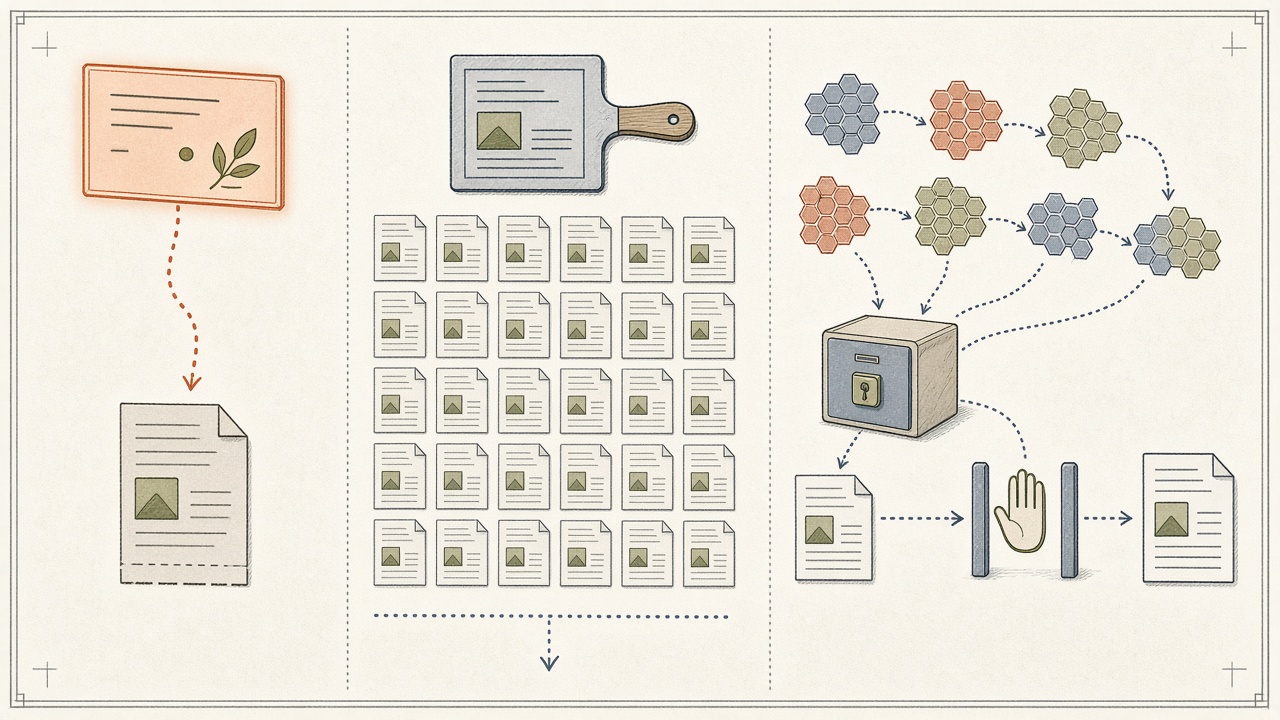
The word gets stretched over three machines that do not do the same job. Only one of them is autoblogging in any sense worth building.
A generator stops at a file
A one-off AI generator ends when the draft appears. There is no research lock, no quality check, and no internal-link job. The output is a file sitting outside the site, not a page that knows which cluster it belongs to or which neighboring URLs it should point to.
A template is not a brief
Programmatic SEO is the second stack. It fills one template across many URLs—locations, products, modifiers—so the page job is structural repetition, not a fresh argument. That can be legitimate when each URL answers a query the template was built for. It is not editorial autoblogging. Editorial work still needs a distinct brief per cluster: one intent, one angle, and a set of claims the draft is not allowed to wander from.
Calling all three AI content hides the break point. The pages that fail are the ones with no unique job on the site—nothing a neighboring URL does not already say, and no reason to exist except volume. The stack worth automating is narrower: clustering and drafting run without a person in every keystroke, a brief freezes, and publish stays closed until that page has a job the rest of the site does not already cover.
The break point — Autoblogging is the editorial stack, not a generator and not a template stamp. Automate clustering and drafting, freeze a distinct brief per cluster, and refuse any page that has no unique job on the site.
Scaled-Content Abuse Is a Pattern, Not a Model

Once those three stacks are separated, the policy question gets simpler. Search engines do not punish a site for using a model. They look at what the published set is doing: many URLs made mainly to manipulate rankings, with little distinct purpose, few real sources, and almost no reason for a reader to prefer one page over the next.
That is the line behind scaled-content abuse. It is a pattern of pages, not a label on the software that drafted them. A human writer can cross it by spinning the same thin article across many URLs. An AI blog writer can stay on the safe side of it if each cluster has its own job, its own evidence, and a page that would still be worth keeping if rankings never moved. The tool is incidental. The violation is mass publication without a distinct reader purpose.
What the policy names, and what it does not
Spam policy explains the boundary. It does not hand you a research-to-publish workflow. Knowing the line does not cluster keywords, freeze a brief, check citations, or decide whether two drafts are the same article in different clothes. Treating the policy as a checklist of phrases to avoid, or as a trick for slipping a firehose past review, misses the point. The missing piece is operator control.
- A model is not the violation. Publishing many URLs with no distinct purpose, sources, or reader value is.
- The same rule applies whether a person, a template, or an AI writer produced the pages.
- Policy states the line. It does not replace a frozen brief or a human gate before anything goes live.
The line — Scaled-content abuse is a pattern of mass pages made to manipulate rankings, with or without AI. The brief is the operator control that keeps each URL from joining that pattern—not a trick for getting past the rule.
The Frozen Brief Is a Permission Boundary
Policy can name scaled content abuse. It cannot tell a pipeline which page is allowed to exist. That decision has to be frozen before a writer or a model starts, as a brief that works like a permission boundary rather than a prompt you hope the draft will honor.
Freeze the job before the draft exists
Four fields have to be locked first. Intent is the reader job this URL exists to do. The cluster is the set of queries that share that job, so a synonym does not become a second page. The differentiation angle is what this page says that neighboring pages on the same site do not. Non-goals are the adjacent topics, claims, and formats this page will not cover, even if covering them would make the draft feel more complete.
Then mark which sentences cannot stand without a source, and which topics are out of scope. A gap the brief does not authorize is not an invitation. Neither executor gets to fill it with confident fiction, a plausible figure, or a citation that was never assigned. If the fact is not in the brief, the sentence is not written, or it waits until a human adds the source and freezes it.
Named judgment versus completed fields
The writer may make the calls the brief names: tone inside a stated range, which approved source supports which marked claim, how to phrase a point the brief already decided. The model may only complete fields that contract already settled—outline slots, headings, examples that stay inside the non-goals. It does not choose the angle, invent the cluster, or promote a draft past the gate.
That split is what makes later automation safe to run. Clustering and drafting can move quickly because the contract already settled what each field may contain, so speed never becomes permission to invent what was left blank.
Permission, not a prompt — A brief is useful only when it is frozen before drafting: intent, cluster, differentiation, and non-goals decide what may be written, sourced sentences and out-of-scope topics block invented facts, and the model may only fill fields that contract already settled.
Split the Jobs Before a Draft Exists
Once the brief is locked, the next decision is which jobs may run without a person in the loop. Autoblogging is useful only when that split is made before anyone drafts, not after a pile of pages is already sitting in the queue.
Keyword discovery, clustering, and draft assembly are the repeatable work. The same queries can be grouped, the same cluster can be matched to one frozen brief, and a draft can be assembled only into fields that brief already decided. That is content automation in the narrow sense: research-to-draft against a permission boundary, not a firehose of unedited posts.
What stays on the human side of the gate
Money-page claims, citations, originality, and the publish decision do not travel with the automation. A model can fill a sentence the brief already scoped. It cannot invent a source, invent an internal link, or decide that a page is distinct enough to go live. Those checks are the publish gate.
That last rule is what keeps scaled publishing from sliding into pages with no distinct purpose. A page that cannot show its source, its internal link, and its differentiation note has not earned a URL, no matter how clean the draft reads.
Fail closed — Automate discovery, clustering, and assembly; keep claims, citations, originality, and publish human. If a required source, internal link, or differentiation note is missing, the page stays unpublished.
Earn the Citation in the Brief, Not in the Tone
A missing source, internal link, or differentiation note already keeps the page from publishing. That same gap is what keeps it from being cited. Answer engines select a page with a direct answer, a clear entity, and facts a reader can attribute. They do not select a louder tone, and they do not treat confident wording as evidence.
Specify the answer block, not the voice
The brief should name the answer block: the question, the entity the page is about, and the sentence that answers it. It should also name the source list those sentences are allowed to use. It should not tell the draft to sound authoritative. An instruction to sound like an expert is an invitation to imitate certainty and invent proof the brief never locked.
The model may complete that block only with fields already decided and sources already listed. It may not upgrade a hedge into a finding, attach a study that was never named, or borrow authority from adjectives. A human still confirms that each sourced sentence matches a source on the list before the page can go live.
One gate for rankings and citations
The check does not split into a ranking list and a citation list. Both surfaces need the same three conditions: a unique angle the cluster does not already cover, named sources for every claim the brief marked as sourced, and no invented proof. If any of those is missing, the draft stays a draft. A surer tone does not complete a brief that was missing one of the three.
Same gate — Answer engines cite a direct answer, a clear entity, and attributable facts. The brief specifies the answer block and the source list; it never asks the draft to sound authoritative.
Score Indexed Pages, Not the Publish Firehose
Those same fail-closed conditions only matter if you score the system by what search and answer engines actually keep. Indexed pages, query rankings, and AI citations are the outcomes. Posts published per day is a throughput vanity metric that rewards the firehose the gate was built to stop.
What a healthy queue looks like
A quiet publish day is healthy when the gate blocked thin, unsourced, or undifferentiated drafts. The clustering and drafting jobs can still run; the human checks on facts, citations, originality, and internal links simply refused to unlock them. Volume that never clears those checks was never going to rank or get cited.
- Count pages that stay indexed and still match a distinct query job, not drafts that left the queue.
- Track rankings and AI citations against the answer block and source list the frozen brief named.
- Treat a blocked day as a working gate, not a broken pipeline.
When a cluster cannot support a differentiated brief—no unique angle, no sources worth naming, no internal-link job—retire it or merge it into a page that already has one. Forcing another URL recreates the pattern the rest of the system exists to prevent.
Score the gate — Score indexed pages, rankings, and citations. A quiet day that blocked thin drafts, and a cluster you retired instead of publishing, is the system working.
Key Takeaways
Freeze the next cluster brief before drafting, and keep publish closed until facts, citations, originality, and internal links have passed a human check.
Frequently Asked Questions
You Might Also Like
- Templates SEO Content Brief: How to Brief Writers (and AI) So Pages Rank
- Automation Automated Blog Posts: Quality Guardrails That Prevent Thin Content
- Workflows Content Automation Workflow: Research, Draft, QA, Publish
- Workflows SEO Workflow Process: A Repeatable Brief-to-Publish Checklist
- Automation Content Automation: What to Automate in Your Publishing Stack