Content Automation: What to Automate in Your Publishing Stack

Content automation is not a switch that writes your site for you. It is a stack of jobs—research, briefs, drafts, quality checks, and publishing—where some steps reward machines and others collapse without a person who understands the reader.
Teams chasing SEO automation, automated blog posts, or an AI content generator usually fail in the same place: they automate judgment instead of throughput. Autoblogging without gates produces thin pages, keyword stuffing, and duplicate clusters that search engines and users both ignore.
This article maps a practical content automation workflow: what to hand to software, where human gates belong, and how to keep every published piece useful whenever someone finds it—not just the week it went live.
- Automate research collection, outline scaffolding, QA checklists, and CMS publishing—not the decision of what is worth saying.
- Human gates belong on search intent, factual accuracy, brand voice, and uniqueness versus existing pages.
- SEO automation that skips originality and usefulness scales thin content, not rankings.
- A durable workflow treats AI as a draft and ops tool, with editorial ownership of claims and structure.
- Evergreen value comes from jobs that stay correct over time, not from volume of posts.
Map the Research-to-Publish Pipeline Before You Automate
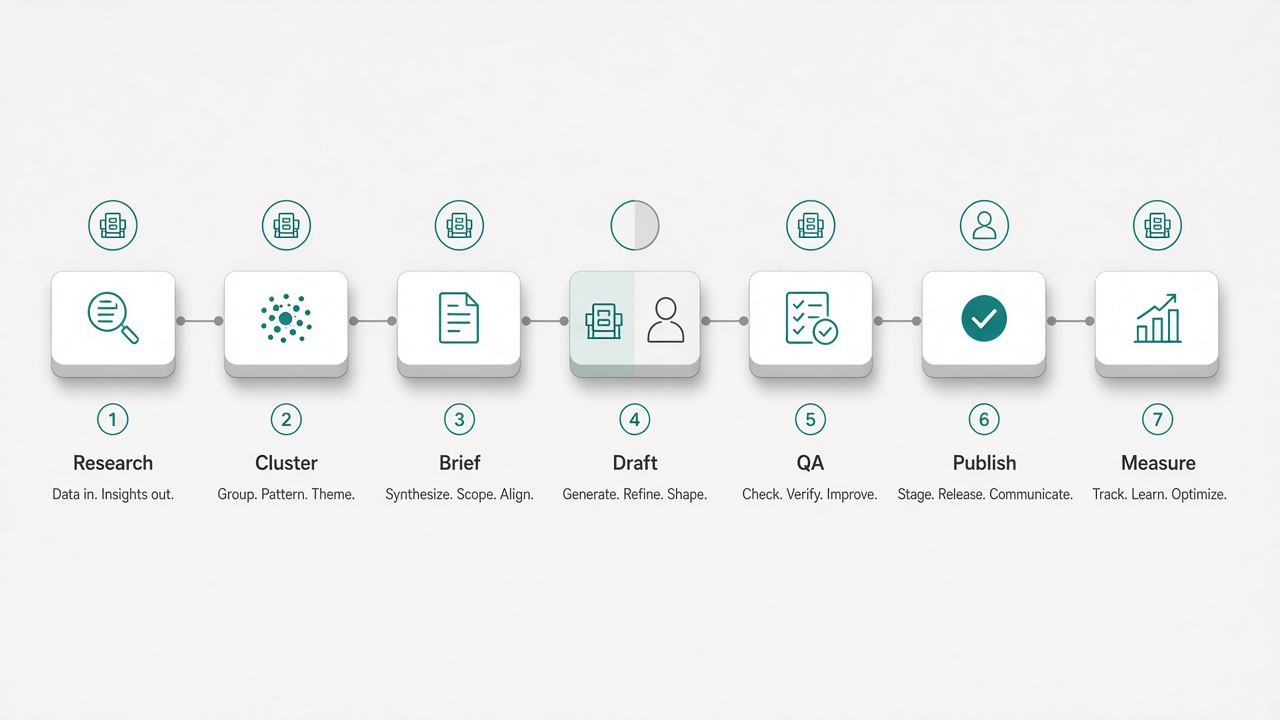
Once you treat publishing as a chain of jobs rather than a single “write the post” moment, it becomes obvious which pieces can run on rails and which still need a person. Name the path as discrete stages—discover, cluster, brief, draft, QA, publish, then measure—so operators can see the handoffs they already walk by hand.
If you still need a plain definition of content automation, use an existing explainer and come back. This section stays on the split between automatable work and human work. SEO automation—rank tracking, crawl diffs, internal-link suggestions—sits inside the same stack. It is a subset, not the whole thing.
The jobs you already do by hand
Most teams repeat the same sequence whether they notice it or not. Naming each task makes it possible to decide what to script, what to check, and what to keep in a human’s hands.
- Keyword intake and opportunity triage
- SERP capture and competitor pattern notes
- Outline and brief assembly
- First draft generation or assembly
- Fact check and originality pass
- Internal links, CMS fields, screenshots, and alt text
- Scheduling, publishing, and performance review
Those jobs are not equal. Before you wire anything, score each one on three traits so the rest of the stack shares a vocabulary: how often it happens (volume), how expensive a mistake is (error cost), and how easily you can undo it (reversibility). High-volume, low-cost, reversible work is where automation belongs. Intent, accuracy, and originality stay with people because thin or duplicate content is hard to reverse once it ranks.
The scored inventory is the input for everything that follows: wire the high-volume, reversible jobs first and leave high-error-cost calls as named gates rather than hoping a generator will catch them.
Shared map — Treat the stack as named jobs scored by volume, error cost, and reversibility. Automate the repeatable, reversible ops; keep people on intent, accuracy, and originality.
Start with research, clustering, and briefs
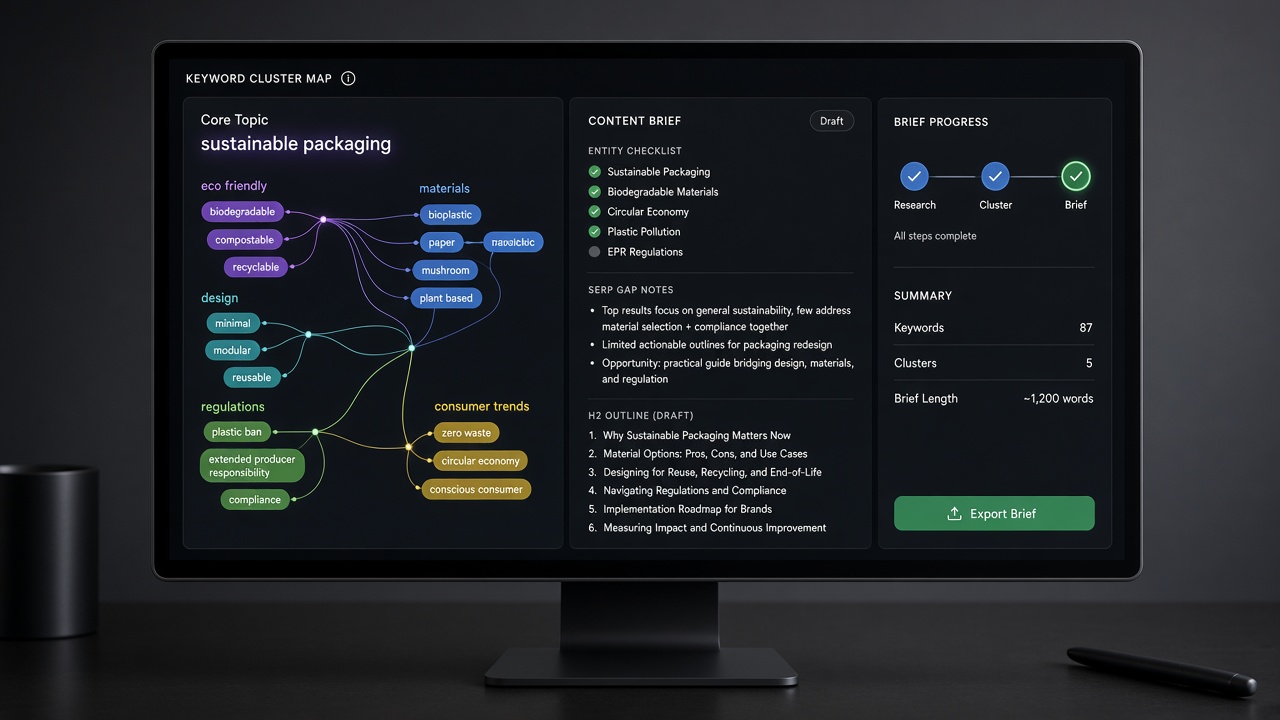
Once the pipeline is mapped, the first jobs worth wiring up are the ones that sit before a single sentence is drafted. Research, clustering, and briefing are repetitive, structured, and cheap to reverse: a wrong cluster can be renamed or merged; a thin brief can be rewritten. That is a better place to start than auto-publishing pages you later have to unpublish.
Treat SERP work as capture, not strategy. Snapshot the current results for the target query, pull competitor headings, collect People Also Ask questions, and group related queries into clusters with a consistent similarity rule. Those outputs are tables and outlines you can store, version, and re-run when rankings shift. What you do not automate is the last mile: final cluster names, which queries belong together, and cannibalization calls. A short human pass decides whether two pages would fight for the same intent and which URL, if any, already owns the keyword.
What a generated brief should contain
Research only scales when it becomes a brief the rest of the stack can consume. Automate the fill-in of fields that are already in the SERP and your own site graph: the target query, a working label for search intent, must-cover entities, a heading outline, internal-link candidates, and the questions the page must actually answer. That packet is what briefing means here—not a motivational paragraph, but a checklist the draft and QA stages can be scored against.
Auto-accept structure. Do not auto-accept positioning. An AI-generated brief is a map of what already ranks and what your CMS already links; it is not a decision about angle, original proof, or which URL deserves the keyword. If you treat the brief as strategy, you will scale into duplicate URLs: more briefs in the queue only help if each one maps to a real gap. Scale content marketing by filling missing intents, not by reprinting the same cluster under a new slug.
Keep humans on the three calls that still fail silently when they are skipped: intent (what the searcher is trying to do), accuracy of the entity list against what you can actually support, and originality of the promised angle. With those locked, the next stage—drafting, linking, and publishing ops—has something worth automating against.
Research first — Automate SERP capture, clustering, and brief fields first; keep humans on cluster naming, cannibalization, positioning, and which URL deserves the keyword so the queue grows into gaps, not duplicates.
Draft, link, and publish only after the brief is approved
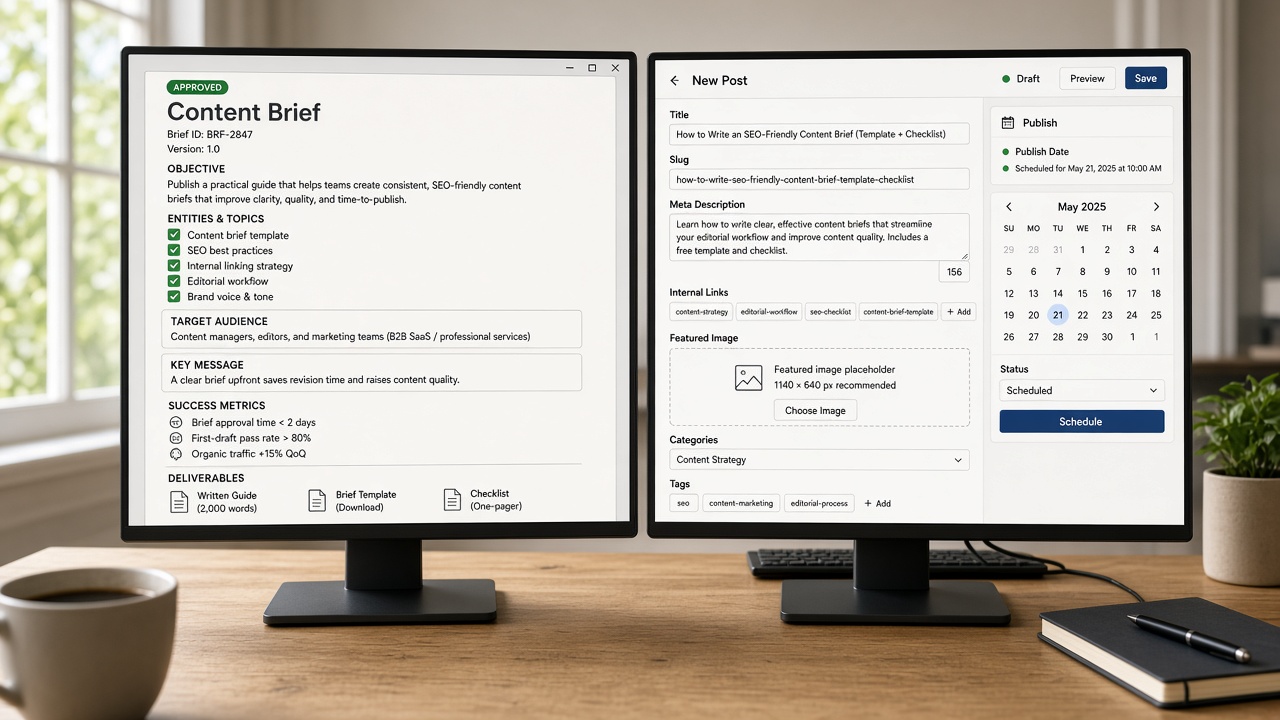
Once that brief is signed off, drafting is the next job in the stack—not the first. First-draft generation should only run on an approved brief: query, intent, entities, outline, and allowed internal links already decided. Starting from a blank prompt or a scraped competitor page skips the gates that keep scale from turning into thin or duplicate pages. The model’s job is to fill the brief, not to invent the assignment.
Treat the draft as downstream of research. If the brief is wrong, every paragraph that follows is expensive to unwind. If the brief is right, you can safely automate the mechanical on-page layer that does not require original judgment.
What belongs in the mechanical layer
- Title and meta variants generated from the brief’s primary query and intent label, not from free-form keyword stuffing.
- Slug, H2 skeleton taken from the approved outline, and schema fields that map to entities already listed in the brief.
- Alt-text drafts for screenshots and product shots, written as descriptions rather than keyword dumps.
- Internal-link insertion only from an allowlisted URL graph so the system cannot invent new paths or cannibalize a money page.
Publishing ops are the same class of work: high volume, low error cost if you can reverse a status, and no claim of originality. Automate CMS draft creation, status changes, scheduled go-live, a screenshot of the live URL, and a ping back to the tracker so the pipeline knows the URL exists. WordPress auto-bloggers are one CMS pattern for that publish job—not a research strategy. Operators who live in that stack should use a dedicated WordPress auto-blogger guide; this section is about which jobs belong in any stack.
Gated publishing is not unattended autoblogging
Automated SEO article publishing means the research-to-publish chain is gated: no draft without a brief, no go-live without QA. Unattended autoblogging scrapes or spins without those gates. If you are choosing between a prompt-to-draft writer and an end-to-end system, compare AI blog writers versus autoblogging elsewhere; here the distinction is the gates, not the CMS. A scheduled publish job is still gated publishing; a scrape-to-live job is not.
Gate first — Run first drafts, on-page mechanics, and CMS ops only after an approved brief; never start the workflow at the generator, and never confuse gated publishing with unattended autoblogging.
Keep humans on uniqueness, claims, and money-page judgment

Once the publish job is in the CMS, the temptation is to let every URL ride the same conveyor. That is where gated stacks and unattended autoblogging part ways. Machines already own research, briefs, mechanical on-page fields, and scheduling. What they must not own unsupervised is anything that, if wrong, is hard to reverse or quietly damages trust.
Uniqueness stays with a person
Original examples, proprietary data, screenshots from your own product, and a point of view the SERP does not already repeat are not filler. They are the difference between a page that could have been generated for anyone and a page that only you could have published. Automate the skeleton; keep the distinctive evidence and the stance in human hands so scale does not flatten into duplicate-looking copy.
Claims need a defender
Numbers, legal-, medical-, or financial-adjacent statements, competitor comparisons, and anything you would have to stand behind if challenged belong in review, not in an unattended generator. If you cannot name the source you would defend, the claim does not ship. That is accuracy as a job, not as a prompt instruction.
Money pages are high error-cost URLs
Pricing, category, and conversion URLs are where a wrong angle or a thin draft costs ranking and trust at once. Intent, positioning, and commercial promise stay human. Treat those URLs as gated even when supporting articles move faster.
On one side: a calendar of unreviewed AI drafts landing on every URL. On the other: machines handle research, briefs, QA checks, and publishing ops, while people only touch uniqueness, claims, and commercial pages. The second model still scales; it just refuses to treat every URL as equally cheap to reverse.
Human gate — Automate the repeatable path from research through publish ops; keep uniqueness, defendable claims, and money-page judgment with humans so scale never becomes thin or duplicate content.
Fail-closed QA so automated posts never ship thin or duplicate
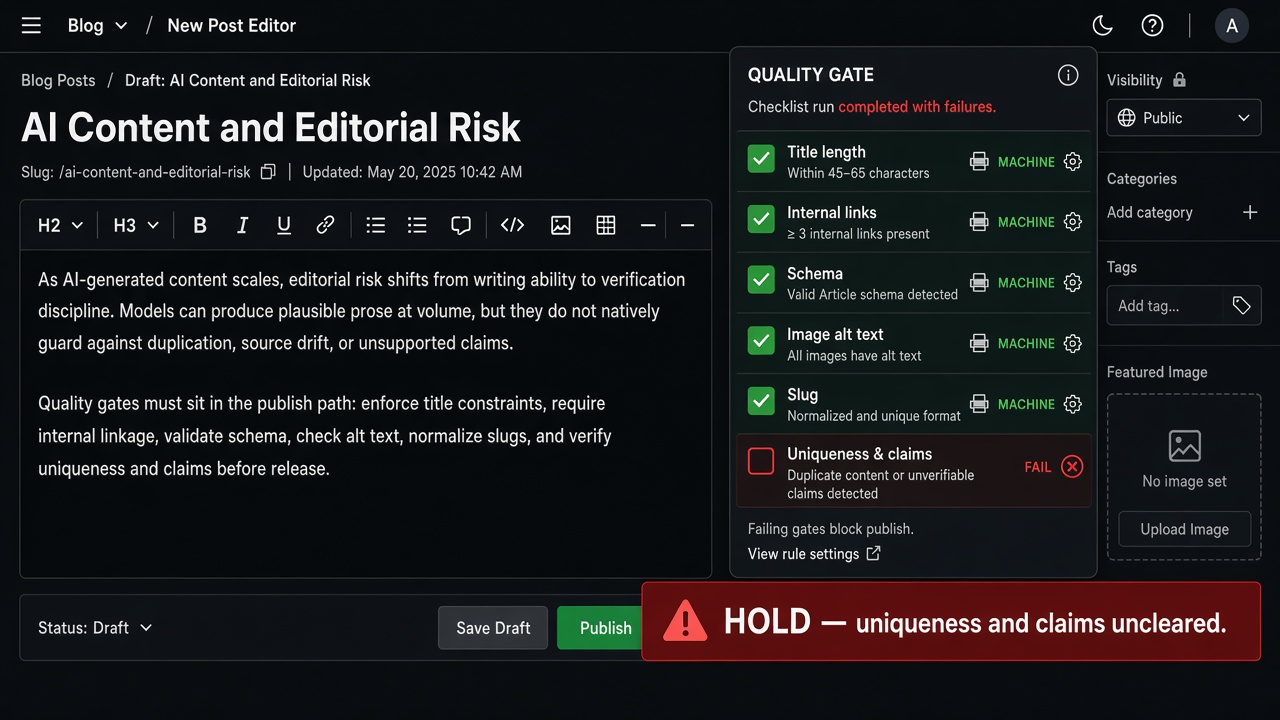
Once uniqueness, claims, and money-page judgment sit with people, the next job in the stack is to make quality a stage—not a hope. In a content automation workflow the loop is research → brief → draft → QA → publish. QA is the gate between an approved outline and anything the CMS can schedule. If a check fails, the article stays in draft. It never auto-publishes.
What you can safely automate in QA
These checks are repetitive, cheap to reverse, and easy to score against inventory and the brief. They belong in the machine layer so humans are not hunting missing tags by hand.
- Duplicate title or slug detection against the live site and the queue.
- Keyword cannibalization flags versus the live inventory and assigned cluster URLs.
- Missing H1 or meta, and thin word count relative to the approved brief.
- Broken or non-allowlisted internal links.
- Banned-phrase lists and “same outline as the top competitor” similarity flags.
What machines should not own
A pass on those checks is not a green light to publish. People still answer whether we would put our name on the piece, whether factual claims survive a spot-check, whether the offer and pricing language match the product, and whether the page adds anything the SERP already lacks. That last question is how you keep scale from becoming duplicate or interchangeable copy.
Operators also need a kill switch, not just a queue. If the model drifts, output suddenly goes thin, or a cluster starts overlapping money terms, pause generation and publishing for that cluster until a human reassigns intent and URLs. Fail closed: a tripped guardrail means draft status, never a live URL.
Fail closed — Automate inventory and brief-based checks; keep “would we ship this” human; if any guardrail trips, stay in draft and never auto-publish.
What to automate next: a scoring rule and a six-step rollout
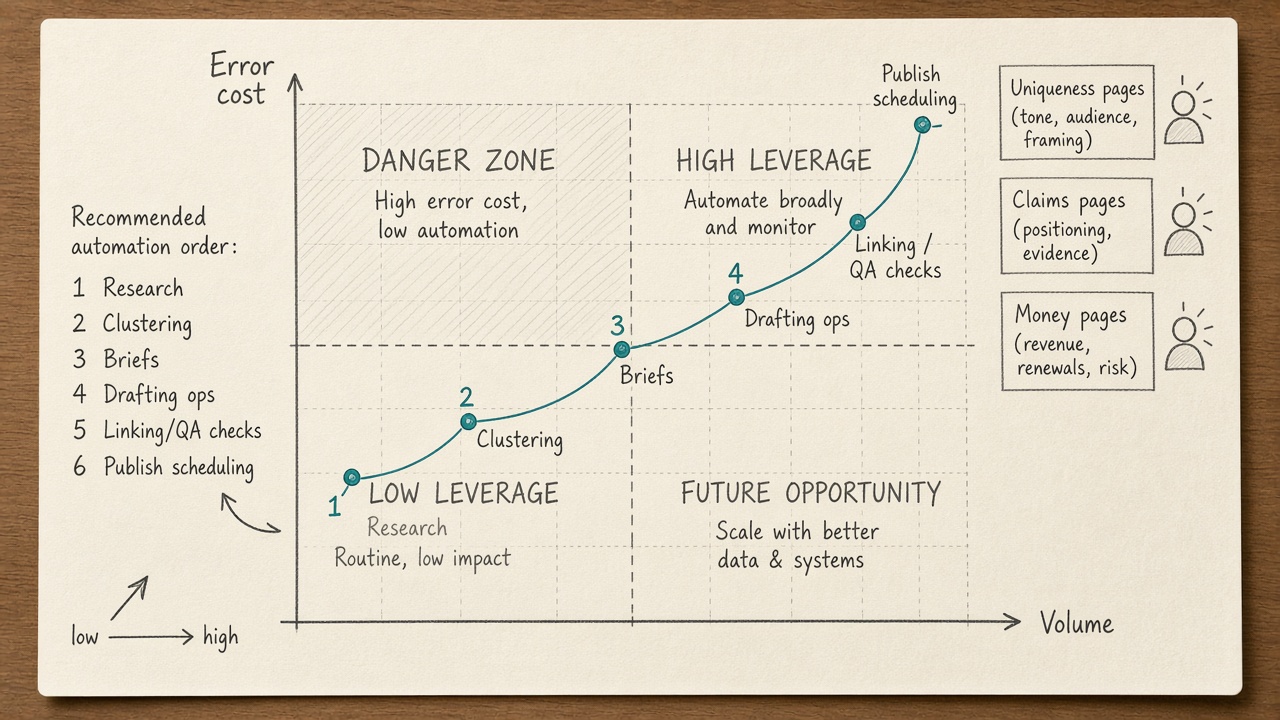
Once those guardrails sit in front of publish, the remaining question is not whether to automate more of the stack, but which job goes next. Score every candidate the same way: high volume, low error cost, and easy to reverse first; low volume, high stakes, and hard to undo last. Research snapshots and clustering win that ranking. Uniqueness, claims you would defend, and money-page judgment never do.
Use that score as a rollout, not a wishlist. Automate research and clustering, then briefs, then CMS fields, metadata, and allowlisted internal links. Only after a brief is approved do you gate first-draft generation. Machine QA comes next so thin or duplicate drafts never ship. Scheduled publish is last. Humans stay in the loop on originality, factual claims, and conversion URLs at every step.
That sequence is the decision layer for the whole pipeline. For tool-by-job SEO picks, use a dedicated SEO automation workflows guide. For a broader marketing operating system, use a content marketing automation playbook. Those resources pick tools; they do not change the order you just scored.
Leave with a this-month cut: SERP and cluster capture, brief auto-fill, and CMS metadata plus allowlisted internal-link insertion. Hold cluster naming and URL assignment, uniqueness and claims review, and money-page judgment in the editorial loop until those ops jobs are stable.
The rule — Automate high-volume, reversible jobs in order—research, briefs, CMS, gated drafts, QA, then schedule—and never take humans off uniqueness, claims, or money pages.
Key Takeaways
Map your research-to-publish jobs this week and automate SERP capture, brief auto-fill, and CMS metadata while you keep cluster naming, claims, and money pages human.
Frequently Asked Questions
You Might Also Like
- Automation SEO Automation: Tools, Workflows, and What to Automate First
- Automation How to Automate Keyword Research for Content Briefs
- Comparisons AI Article Writer: When to Use One vs a Full Publishing System
- Strategy How to Scale Content Marketing Without Diluting Quality
- Automation Content Marketing Automation: A Practical Playbook