
SEO Content Brief: How to Brief Writers (and AI) So Pages Rank
Autoblogging is not a button that turns a keyword into a ranked post. It is a publishing system: keyword selection, briefs, drafting, quality checks, and a decision to publish have to be designed together, whether a person or an AI article writer does the draft.
Google does not ban AI content. It does treat scaled pages made mainly to manipulate rankings as spam, no matter who produced them. Pages that last are the ones with a clear search intent, original information the reader cannot get from the rest of the results, and a person who can stop a weak page before it ships.
That is what a real SEO content brief is for. It is not a handoff checklist. It is the gate that automation must pass: no brief, no sources, no quality pass, no publish. The rest of this piece shows how to build that system so content scaling stays useful instead of becoming a thin-content mill.
- Autoblogging is a full publishing system, not a one-click AI blog writer.
- Google allows AI-assisted pages but treats scaled ranking manipulation as spam.
- Surviving pages need clear intent, original information gain, and a human review before publish.
- Automation should handle clustering, briefs, internal-link suggestions, and formatting; people should own claims, sources, and the publish decision.
- A fail-closed rule — no brief, no sources, no QA, no publish — is what separates scaling from thin content.
Autoblogging Is a Publishing System, Not a Writer
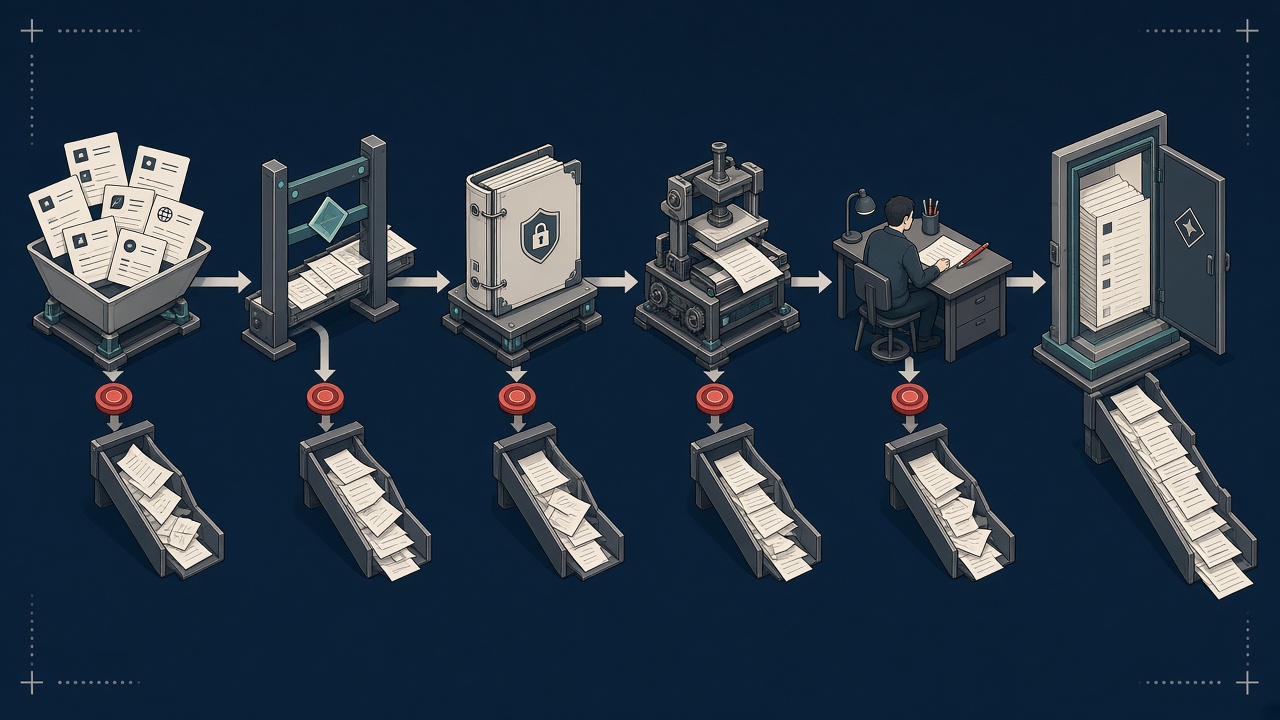
That only works if autoblogging is a connected publishing system, not a writer you hand a topic to. Keyword selection, the brief, the draft, QA, and the index decision have to be designed as one chain. Each station has a job, and each one can halt the next. Bolt them on after a draft already exists and you no longer have a system—you have a pile of pages waiting for someone to notice what went wrong.
An AI blog writer, or any automated blog post tool, is one station on that line. It is the right place for repeatable work: turning a finished brief into structured copy, applying formatting, and proposing internal links. It is not the system. It does not choose the query, read search intent, vouch for sources, or decide that a URL should be indexed. Content automation and programmatic SEO fail in the same place when generation is allowed to run before those decisions are locked.
The brief is the contract research must satisfy before any model is allowed to draft. It states the intent, the questions the page has to answer, the sources claims may rest on, and the original information the page has to add. If that contract is unmet, drafting does not start. A prompt library cannot do this job. A library stores instructions; an operating system can stop a page. No brief, no approved sources, no QA pass, no human publish decision—no index. That gate is what separates content scaling from a mill that ships whatever the model returns.
System, not writer — Autoblogging ranks when selection, the brief, drafting, QA, and the index decision are one fail-closed chain—and the model is only allowed to draft after the brief is already satisfied.
Scaled Content Abuse Is a Production Failure, Not an AI Ban
Knowing the brief is the contract is not enough if the system cannot name the failure it is supposed to stop. That failure is not that a model wrote the draft. Google does not ban generative AI content. It treats mass-produced pages made mainly to manipulate rankings as spam, and it does not care whether a person or a model produced them.
The March 2024 scaled-content policy is best read as a production rule, not a writing rule. Volume without a reason to publish is the failure mode. A page that exists because a keyword list was long, a template was cheap, or a queue needed filling is the page that rule is aimed at. A page that exists because the query has a clear intent, and the site can add something a reader could not already get from what ranks, is a different production decision—even when automation helped draft it.
Official guidance explains that risk. It does not hand operators a research method, a brief, a QA pass, or a publish workflow. It will not tell you which claims need a source, when two queries should be one page, or who is allowed to send a URL live. Those gaps are not a loophole. They are the work.
This article’s job is that missing operating layer, not another restatement of the policy. Autoblogging stays on the safe side of scaled content abuse only when selection, briefing, drafting, and review are one system, and when missing intent, missing sources, or a missing human publish decision stops the page. The policy says what must not go live. The brief and the gates decide whether anything can.
Five Fail-Closed Gates Before a Page Can Go Live
Naming scaled-content abuse as spam does not, by itself, stop a queue from shipping pages. The operating layer is fail-closed: the safe state is unpublished. If cluster fit, sources, a locked brief, a QA pass, or an index decision is missing, the page does not go live. A blank field is not a soft warning. It is a closed gate, and drafting is not allowed to start early just because a model is ready.
Walk the stops in this order so indexing cannot happen by default either. Each one has to pass before the next job is even offered to the system.
Keep those last two distinctions sharp. A draft sitting in an AI article writer, a CMS draft folder, or an automation run is not a page the web is allowed to see. The URL is a separate permission. So is the index decision: a live URL that should not compete can stay noindexed until a human says otherwise. Automation may format, cluster, and suggest links. It does not get to treat “file created” as “page published.”
Overrides are allowed only as exceptions, never as a skipped checkbox. If someone publishes without cluster fit, sources, a locked brief, or a QA pass, the override has to be explicit, named to a person, and written to a log with the reason. An unchecked box, a default “publish all,” or a silent retry is not an override. It is the gate failing open—the failure mode that turns content scaling into a thin-content mill.
Fail closed — If cluster fit, sources, a locked brief, a QA pass, or an index decision is missing, the page stays unpublished. A draft in a tool is not permission for a URL, and any exception has to be named and logged.
Automate the Repeatable Work, Never the Publish Call

Those stops only hold if you also decide which jobs may run with no one in the loop. A fail-closed system is not a ban on automation. It is a split of labor: machines handle work that looks the same every time, and a person keeps the calls that change what a page is allowed to claim.
Clustering, brief skeletons, internal-link suggestions, and formatting belong to automation. Grouping candidate queries into a topic map, filling the empty fields of a brief from that map, proposing links from pages you already publish, and applying house formatting are pattern jobs. They get faster and more consistent when a system does them, and none of them decides whether a URL deserves to exist.
Claims, source selection, experience, and the publish decision stay with a person. A model can draft a sentence. It cannot decide that a source is trustworthy enough to cite, that the team actually has the experience the page implies, or that this URL should be indexed. Those are judgments. Handing them to SEO automation is how a publishing system becomes a content mill: volume keeps moving because nothing is allowed to say no.
The writer executes a locked brief
An AI article writer should receive a locked brief, not invent the assignment. By the time drafting starts, intent is named, allowable sources are listed, the original point the page must add is fixed, and the questions it must not wander into are already ruled out. The writer—human or model—executes that contract. Ask the model to pick the keyword, invent the angle, and declare the page ready, and you have skipped the gates and called it efficiency.
The same split governs automated blog posts and programmatic SEO. Templates can fill repeatable fields. They cannot be the reason a page ships. Automating judgment is the failure mode: content automation that chooses its own claims, sources, and index decision will scale thin pages faster than anyone can review them.
Information Gain Is the Only Reason a Page Ships
Locking the brief and keeping a person on the publish call only matters if that call has a real test. Information gain is the test. A page ships when it adds something the current results do not already say — a step, a constraint, a distinction, or a checkable claim the ranking pages leave out. If the draft only restates what already ranks, the fail-closed rule still applies: it does not go live, however clean the draft looks.
Search intent has to come before keyword coverage. Automated blog posts fail when the assignment is to hit a term list instead of to finish a specific job for the reader. A query that wants a process does not need a smoother rewrite of the same headings already on the results page. Coverage without a reason to exist is the same production failure as volume without a reason to publish — just written in a more confident voice.
What counts as gain
Gain has to be named in the brief before drafting starts, not hoped for after the model finishes. Practical gain is specific enough that a reviewer can point at it:
- A first-hand process: what you actually do, in what order, and where it breaks.
- Original examples tied to a real constraint, not a generic illustration that could sit on any competing page.
- Limits the current results never name — tools, budgets, edge cases, or conditions under which the advice fails.
- Sourced claims a competitor page lacks, so the new page is the one a reader can check.
Fluency, length, and keyword placement are not quality. A long, readable page that only rearranges what already ranks is still thin. The human publish decision is the moment someone can point at the gain and say it is new enough to index. If they cannot name it, the page stays unpublished.
Publish test — A page ships only when it adds something the current results do not already say. Smooth writing, extra length, and keyword coverage are not that something.
Programmatic SEO and Autoblogging Are Different Bets
Information gain is the same publish test for both production styles, but they are not the same machine. Programmatic SEO fills a real template with unique data: each URL exists because a record, place, comparison, or inventory row has attributes the page can actually show. Autoblogging produces articles. It starts from a topic or query and has to earn a page through research, a locked brief, and something current results do not already say.
Either approach can be legitimate. Either can be abuse. The split is not the tool and not the volume. It is whether that URL has a distinct reason to rank—unique data the template is built to display, or original information gain the article was briefed to add. A thousand near-duplicate location pages with swapped names fail the same way a thousand model-written explainers fail: pages shipped because a system could generate them, not because a searcher needed a new one.
Failed pages stay uncrawlable
A draft sitting in a tool is not a URL search engines should be invited to fetch. Anything that misses cluster fit, sources, the locked brief, QA, or the index decision stays in a held queue until those gates pass.
- Noindex every page that has not cleared the publish decision, so a live URL is not treated as an invitation to crawl.
- Keep failed and pending URLs out of the sitemap; inclusion is a release signal, not a default export from the CMS.
- Hold candidates in a queue that cannot publish itself. Overrides stay explicit, named, and logged.
The fastest way to break that control is to connect keyword research automation directly to publish. A keyword list is an input to selection and briefing, not a release trigger. Clustering can propose candidates and even draft a brief skeleton. It cannot decide that a page is distinct, sourced, or worth indexing. That call stays with a person, and it stays fail-closed—whether the bet is a data template or an article.
Different bets — Programmatic SEO and autoblogging stay legitimate only when each URL has its own reason to rank, and anything that fails the gates stays noindexed, out of the sitemap, and off the publish path.
A Weekly Cadence That Will Not Become a Mill
That separation only holds if the week has a shape. A small SEO or content team does not need a faster writer. It needs a rhythm that selects, briefs, drafts, reviews, and then releases only what already cleared every gate. Keyword research still stops at the held queue. Nothing in that queue becomes a URL just because the calendar turned.
Automation does not mean reviewing a sample and shipping the rest unseen. Scaled content abuse is what happens when volume skips the person who owns the publish call. If ten drafts look fluent and two were actually read, the other eight never earned a URL.
A rising reject rate is a capacity signal
When more pages fail cluster fit, sources, the brief, QA, or the index decision, the queue is moving faster than judgment. Slow intake. Do not hire another prompt, and do not loosen a gate so the draft count looks healthy. The pages that survive are the ones a person was willing to stand behind.
That is how content marketing scales without becoming a mill. Raise the pass rate: tighter selection, sharper briefs, fewer drafts that were never going to clear review. Autoblogging ranks when the week ends with fewer live URLs than drafts started, and every live URL had a reason to ship.
Pass rate — Scale by raising the share of pages that earn a human publish decision, not by increasing how many drafts an AI blog writer can produce.
Key Takeaways
Lock the brief and the publish decision before the next scaled page is allowed to exist.
Frequently Asked Questions
You Might Also Like
- Automation Fail-Closed SEO Briefs: The Publish Gate Autoblogging Needs
- Workflows Content Automation Workflow: Research, Draft, QA, Publish
- Workflows SEO Workflow Management: How to Run Content From Brief to Publish
- Workflows SEO Workflow Process: A Repeatable Brief-to-Publish Checklist
- Guides Free SEO Content Brief Generator: How to Brief Writers in Minutes