
SEO Workflow Process: A Repeatable Brief-to-Publish Checklist
Most SEO content operations do not fail because people lack talent. They fail because the path from brief to live URL lives in someone’s head: a Slack thread, a half-filled doc, a verbal “looks good.” When that person is out, the next writer, editor, or publisher guesses. Guessing is not a workflow.
A repeatable SEO workflow process is a sequence of gates. Each gate has a small set of artifacts you must produce, a test that says “this stage is done,” a person who is allowed to say so, and a rule for sending work backward without shame or mystery. That is how content ops, briefs, and any later automation stay honest: the machine can only run what humans already defined as done.
This article walks that path in order—why checklists collapse, the five packets that actually move, brief exit criteria, first-pass draft rules, QA and publish gates, then rework and ownership—so whoever runs the process next can follow the same map.
- Treat SEO production as gates with owners, not a linear to-do list in a spreadsheet.
- Require a handoff packet at every stage so the next person never reverse-engineers intent.
- Define exit criteria before work starts; “done” cannot be a vibe.
- Send incomplete work back on a named rework loop instead of patching it at publish.
- Automation only helps after the human process is explicit enough to survive turnover.
Why a Stage List Is Not a Repeatable SEO Workflow
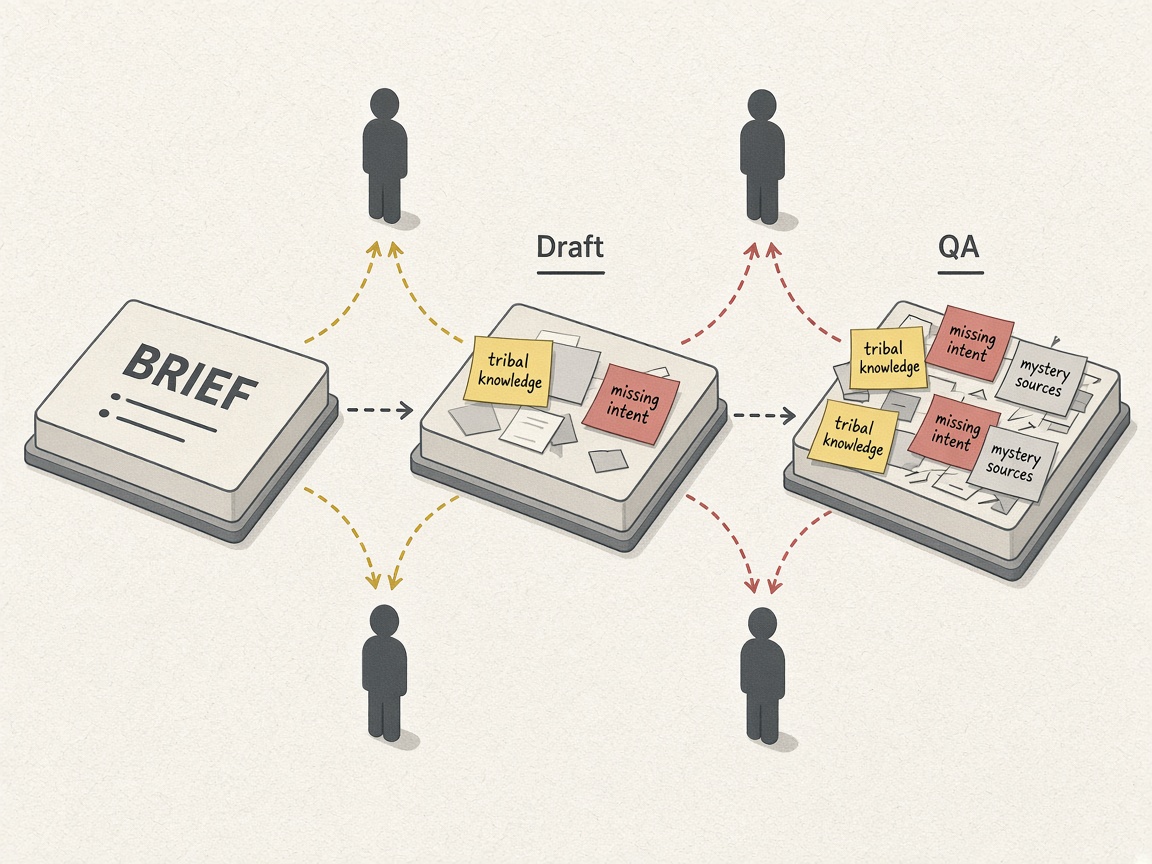
A brief-to-publish checklist looks complete on a slide: brief, draft, QA, publish. It still is not a process until someone can fail a stage with a documented reason and send the work back without restarting the pipeline. If every ticket always “passes,” you do not have quality gates. You have a sequence of labels. Scaling content then becomes a game of hope: more drafts, more variance, more silent rework that never shows up as a named loop.
Most of that variance is not “writers being inconsistent.” It comes from unlocked search intent, missing or uncited sources, SERP shifts nobody recorded, and delays that have no owner. When those inputs are optional, two people can follow the same stage names and still ship two different articles. The checklist did not fail because someone skipped a box. It failed because the box never defined what “done” or “return” actually means.
Personality is not process
If only one person can judge a “good brief,” the workflow is a personality, not an SEO workflow process. That person becomes the bottleneck, the unwritten standard, and the reason new editors cannot take a ticket cold. Repeatability means a stranger to the ticket can apply the same pass/fail tests and reach the same ship-or-return decision. Until those tests live on the ticket instead of in one editor’s taste, turnover will always reset quality to whoever happens to be in the room.
The test — A stage list scales only when any qualified stranger can fail a stage with a documented reason and return the work without restarting the pipeline.
Five Artifacts That Make an SEO Workflow Portable
Work that cannot be opened cold is not portable. Chat, memory, and “you know what I meant” force the next person to reconstruct the assignment. A portable process moves packets—one required output per stage that a stranger can judge against exit criteria and either accept or send back without reconstructing the job from Slack lore.
Five artifacts carry that load. Each is a file (or ticket attachment) with a named owner, a timestamp, and enough context that the next person does not have to interview the last. If any of them is missing, the pipeline is still personality-driven, even if the calendar looks orderly.
Handoffs fail when people pass status (“brief done”) instead of the packet. Status cannot be opened cold. A packet can. The rework loop then returns work to the stage that failed its exit test—brief, draft, or QA—without wiping the rest of the trail. That is the difference between a checklist and a process someone else can run next week.
Packet, not lore — Portability is five openable packets—SERP, locked brief, change log, QA decisions, publish receipt—not a sequence of statuses in chat.
The Brief Gate: Nothing Drafts Until the Packet Can Fail
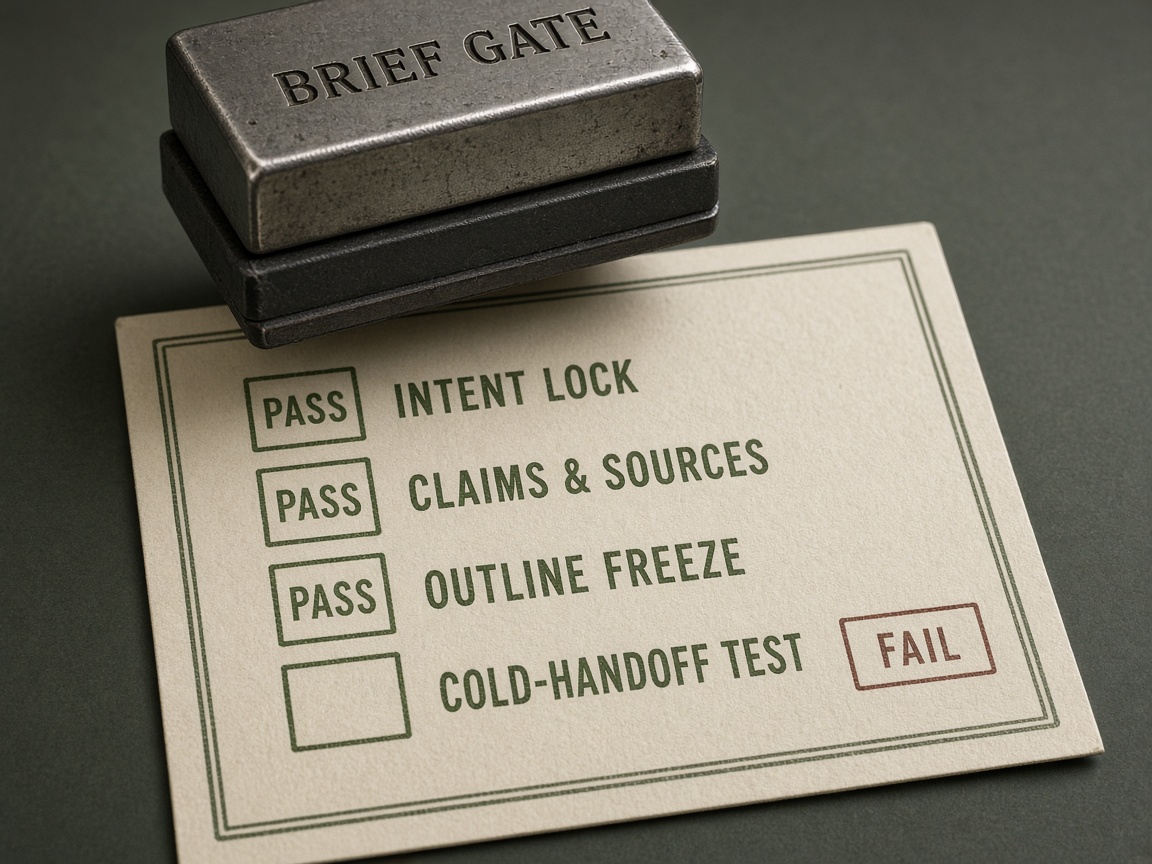
Those five artifacts only travel if the locked brief is actually locked. This stage is not a tutorial on how to generate a brief. It is the pass/fail test that sits in front of drafting: if the packet cannot be failed with a named reason, the writer is about to invent the page. The rework loop returns work here, not to a blank kickoff.
Fail the brief the moment search intent, page type, and primary query are still negotiable. “We’ll see once we start writing” is not an exit criterion; it is an unlocked SERP. A stranger applying the same test should be able to say whether this is a how-to, a comparison, a definition, or a commercial landing—and which query the title, H1, and first screen are obligated to satisfy. If two reasonable people could still argue the job of the page, the gate stays closed.
What must be frozen before anyone writes
Require a claims list with source homes. Every assertion the page will make needs a place it will live—primary research, a named internal doc, or an agreed public source—so the draft cannot smuggle in unsourced authority. Pair that with explicit out-of-scope topics. Out-of-scope is not a suggestion; it is the fence that keeps the piece from sprawling into a neighboring SERP and forcing a second ranking problem onto one URL.
Outline freeze means the H2s are the contract. New sections after this gate are a rework request, not a “quick add.” If a heading must change because intent shifted or a competitor cluster appeared, that is a documented return to the brief owner with a reason—not a silent expansion in the draft. The outline is the portable map; treating it as a sketch reintroduces personality into a stage that is supposed to be a test.
The handoff test is simple: a writer who did not attend the kickoff can produce the page from the packet alone. If they still need a Slack recap, a voice note, or the strategist’s memory, the brief failed. Scale at this gate is whether the packet, not the meeting, is what the writer executes.
Brief gate — Drafting starts only when intent, page type, query, claims-with-homes, out-of-scope, and H2s are frozen enough that a writer who missed kickoff can still pass or fail the brief from the packet.
The Draft Gate: Score the Brief Before You Touch the Prose
Once a brief has cleared its gate, the next owner is not “the writer in the abstract.” It is whoever must produce a first draft that can fail against that same packet. Drafting is not a creative free-for-all after a kickoff. It is the first test of whether the locked intent, claims, outline, and out-of-scope actually survived contact with a blank page. Score that test before you spend a minute on voice, rhythm, or comma placement. Line-edit quality is a later problem. A beautifully written page that answers the wrong job is still a failed stage.
The first-pass review is a structural match, not a style pass. Open the SERP packet and the locked brief side by side with the draft. You are asking whether the page still does the job the brief promised, not whether it already reads like a published article. If it cannot pass these checks, it returns to draft—or, if the brief itself is the cause, it returns to the brief gate. Either way, you do not restart the pipeline from keyword research.
Must-pass items before anyone polishes
- Title and H1 still encode the locked primary query and page type; they do not wander into a related but different job.
- Entities and comparison points called out in the SERP packet actually appear in the body, not as afterthoughts in a leftover FAQ.
- Every promised H2 from the frozen outline is present in order; a new section is rework, not a “nice add.”
- Internal-link targets named in the brief are placed with working anchors, not left as “TBD” comments.
Those four items are exit criteria. Fail any of them and the draft does not enter editorial polish. Send it back for missing intent or outline drift. Burning editor time on a page that fails the brief is how workflows look busy while they quietly restart. The rework packet is simple: which criterion failed, the sentence or heading that proves it, and whether the owner is the writer (execution) or the brief (unlocked or incomplete packet). A stranger should be able to apply the same pass/fail tests without sitting in the original kickoff.
First-pass yield is the share of drafts that clear this gate without a structural rewrite. Treat it as a diagnostic on briefs and handoffs, not as a scorecard for writers. If yield is consistently poor, the brief gate is leaking—unlocked intent, missing source homes, or H2s that were never a real contract. If yield is high and later QA still explodes, the problem sits downstream. Either way, the draft gate exists so the next owner receives a page that already answers the right job, with a change log of what moved and why.
Draft gate — Do not polish a draft that fails the locked brief. Return it with a named failure so the pipeline rewinds one stage instead of starting over.
QA-to-Publish: Blockers Versus Polish
Once the draft has passed the brief score, QA is the next named gate—not a second round of drafting. Treat it as a split: blockers that fail the page, and polish that never should. A blocker is anything that would make the URL wrong on purpose: factual inaccuracy, cannibalization of a live money page, missing primary intent, broken or dummy links, or a piece that still has no unique value after the SERP packet. Those fail the ticket and send it back one stage with a documented reason. Polish is tone, extra examples, optional modules, and “I would have said it differently.” Polish does not hold the URL hostage. It becomes a dated follow-up so taste never restarts the pipeline.
What actually fails QA
- Accuracy: claims that cannot be traced to the brief’s source homes.
- Cannibalization: the page would rank for the same primary query as an existing URL without a deliberate merge.
- Intent miss: the page type or job-to-be-done drifted from the locked brief.
- Broken links and empty unique value: the reader still has no reason to prefer this URL over the SERP packet.
That split is what keeps QA from becoming an endless taste committee. The owner of the gate applies the same pass/fail tests a stranger could apply. If the work fails a blocker, it returns with a packet—not a vibe. If it only needs polish, it ships, and the polish ticket is dated so the live page is not waiting on preference.
The final gate is not “we hit publish.” It is the publish receipt: live URL, canonical, title and meta as shipped, internal links actually live, and who is on the hook if the URL never indexes. Without that receipt, the workflow ends in a status update instead of an artifact. With it, rework after go-live has a place to land instead of a blank restart.
Ship on blockers — Blockers return the ticket; polish becomes a dated follow-up. Ship with a publish receipt so QA never turns into a taste committee.
Rework Loops, Kill Criteria, and Named Gate Owners
Once a ticket leaves QA with a publish receipt—or comes back with a blocker—the remaining risk is not missing a polish pass. It is looping forever, or waiting with no one accountable. Structural rework (intent, outline, claims, page type) should be capped at two returns to the same gate. A third return is a signal that the brief or the keyword choice is wrong, not that the draft still needs another writer. Send it back to the brief gate, recast the query, or kill the URL. Do not keep feeding a doomed page through the pipeline.
Kill or recast when the job has changed underneath the ticket. If searcher intent has shifted, the SERP now demands a different format, or the unique value promised in the brief cannot be sourced, stop drafting. Continuing only creates a URL that will fail QA again and pollute the cluster. The artifacts already tell you which of those three happened: the SERP packet no longer matches the locked brief, claims have no source homes, or unique value is still a slogan. That is a product decision, not a writing problem.
One owner and a clock at every gate
Every gate has a single named owner and a clock: brief lock, draft due, QA decision, publish receipt. Shared ownership is unowned wait time, and unowned wait time is what actually kills throughput. The owner is the person who can fail the packet, return it one stage, or stamp the exit test. They are not a committee. When the clock expires without a pass, fail, or kill, the delay is logged on that gate—not blamed on “the process.”
A new operator should be able to fail, return, or kill from the artifacts already on the ticket—without a Slack thread or a personality to interpret quality. Close this last loop by naming the owner, starting the clock, and treating a third structural return as recast-or-kill rather than another rewrite.
Portable close — Cap structural rework at two loops, kill doomed URLs when intent or SERP format has moved, and put one named owner plus a clock on every gate so a new operator can run the ticket from artifacts and exit tests alone.
Key Takeaways
Lock your next SEO ticket to named owners, a fail-able packet, and a two-loop rework cap so a new operator can run brief-to-publish from artifacts alone.
Frequently Asked Questions
You Might Also Like
- Workflows SEO Workflow Management: How to Run Content From Brief to Publish
- Workflows SEO Content Brief: How to Brief Writers (and AI) So Pages Rank
- Guides SEO Content Brief Template: The Complete Guide to Briefs That Rank
- Guides SEO Content Brief Examples for Product, Comparison, and How-To Pages
- Workflows Content Automation Workflow: Research, Draft, QA, Publish