SEO Workflow Management: How to Run Content From Brief to Publish
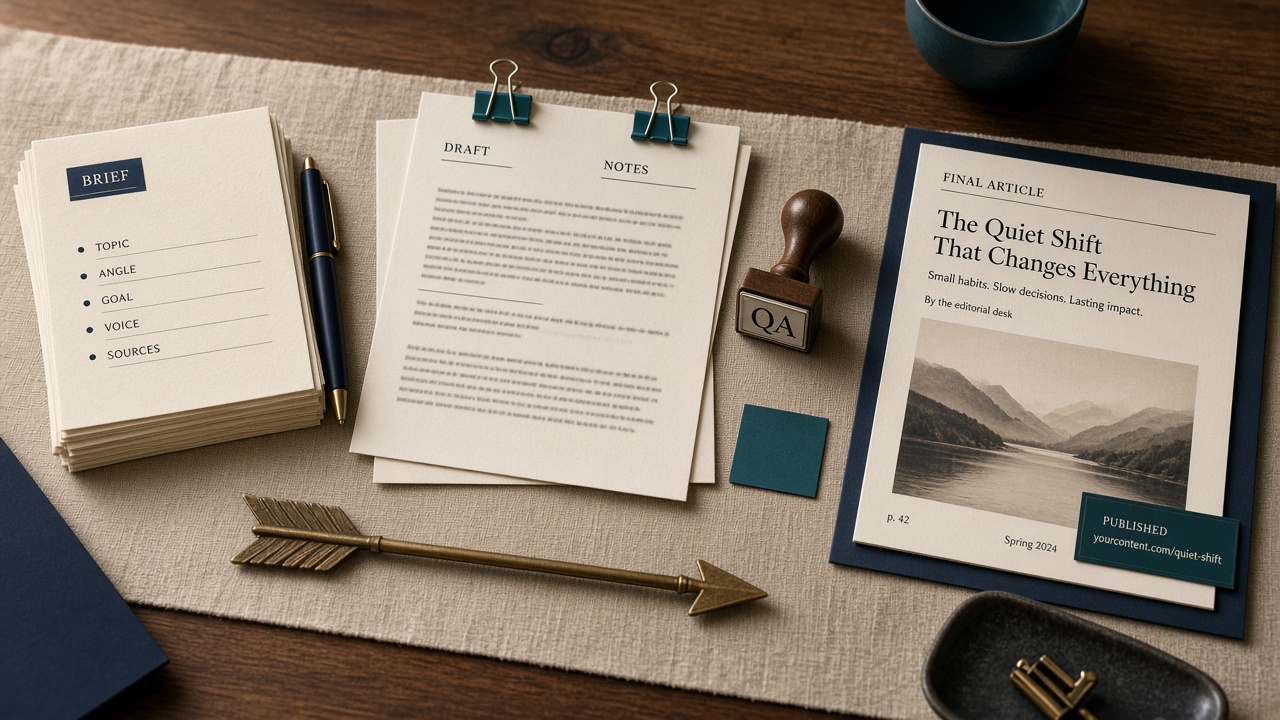
SEO content fails more often in the handoffs than in the writing. A strong keyword list still produces thin pages when the brief is vague, the draft never gets a second pair of eyes, or publish happens without a last check against search intent. SEO workflow management is the operating system that stops that leak: who does what, in what order, and what must be true before a piece can move forward.
This article treats the workflow as a lean-team process, not a bloated project plan. You will see how a content ops path from brief to draft to QA to publish keeps quality when volume goes up—whether you write by hand, use automation for drafts, or mix both. The goal is evergreen: stages you can reuse, owners you can name, and gates that stay useful whenever someone finds this page.
If you came here for an SEO workflow process, an SEO content brief, or how content automation fits without wrecking quality, start with the spine: one idea, one owner per stage, and no publish until the gates pass.
- A working SEO workflow is stages plus owners plus quality gates, not a longer document.
- The brief must lock search intent, evidence, and the single thesis before anyone drafts.
- QA is a gate, not a polite comment thread; thin or off-intent copy does not ship.
- Automation can speed drafts; it does not replace ownership or the publish checklist.
- Lean teams scale by repeating the same path, not by adding extra review layers.
What SEO workflow management is — and what it is not
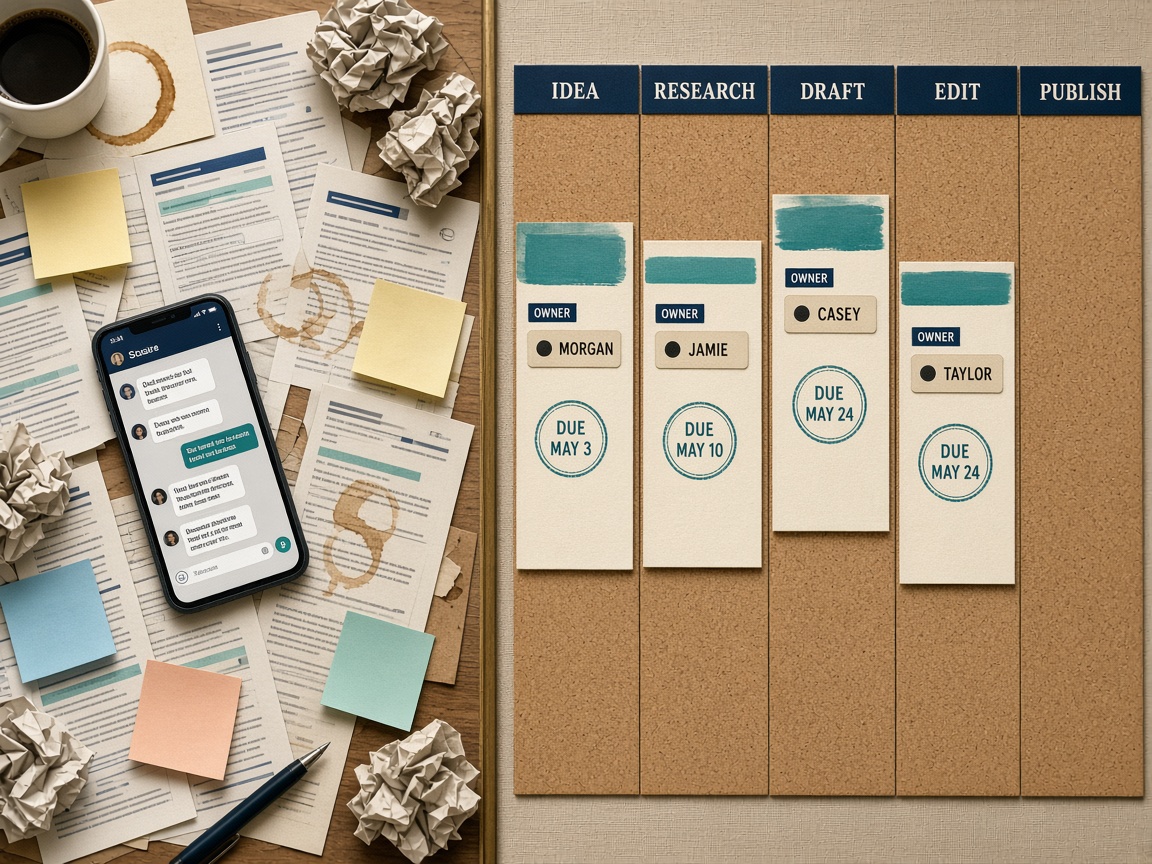
That distinction matters because “SEO workflow” is often used as a catch-all for keyword research, a CMS, or a stack of AI features. SEO workflow management is none of those. It is the set of rules that move a single piece of content through named stages without skipping intent, evidence, or editorial standards. Research still happens. Tools still publish. Assistants still draft. Management is the layer that decides when each of those jobs is allowed to start, who owns it, and what “done” means before the next person touches the asset.
An unmanaged pipeline looks familiar: status lives in chat threads, briefs are optional, and publish is whoever remembers. Work vanishes between people. The same URL gets rewritten twice. A piece ships without a primary intent because no one was accountable for checking it. A managed pipeline is the opposite. Every asset has a stage, a single owner, a due date, and exit criteria. If those four fields are missing, the work is not in the workflow yet — it is still a conversation.
This article stays in that territory: how to run the work from brief to publish. If you want job-by-job automation — generating outlines, clustering keywords, or pushing drafts into a CMS — that is a different layer. Point those questions at the site’s content automation and SEO automation pieces rather than stretching this one to cover both.
The three jobs of management
Whatever tools you use, management does three things and only three. Make work visible so anyone can see stage and blocker without asking. Assign a single accountable owner per stage so “we” never owns a gate. Require a pass/fail check before the next stage starts so intent, evidence, and editorial standards cannot be skipped under deadline pressure.
Lean teams feel the absence first. Fewer people means more context-switching: the same person briefs, drafts, and publishes, often in the same afternoon. Undocumented process then becomes the bottleneck, because memory is the only system of record. Naming stages, owners, and gates is how a small team stops paying that tax on every URL.
In short — SEO workflow management is not research, a CMS, or AI features — it is visible stages, one owner each, and a hard gate before the next stage starts.
The brief-to-publish sequence: stages, artifacts, and one owner each

What comes next is the pipeline itself: a short, named sequence you can copy without inventing a new process every time a URL is requested. Lean teams do not need a dozen departments. They need stages that produce a concrete artifact, a single owner for each stage, and an exit line so work cannot drift forward on vibes.
A default sequence looks like this: intake and priority, SEO content brief, draft, editorial and SEO QA, revisions, publish in the CMS, then post-publish checks. Optional work—design, legal, localization—sits beside that line as add-ons. It is not in the default path, so a two-person team does not overbuild a factory they cannot staff.
On a lean team the same person may own two adjacent stages, but never two owners for the same stage. Dual ownership is how briefs get “almost done” and drafts ship without a gate. The brief is the contract: QA and revisions do not invent a new topic; they ask whether the live piece still matches intent, keyword, outline, and sources of truth. That is the whole job of the document—a lock later stages inspect, not a prompt for generating more copy.
Copy this line — Copy a seven-stage line with one artifact, one owner, and one sentence of exit criteria each; treat the brief as the contract later stages inspect, and keep design, legal, and localization off the default path until you actually need them.
Quality gates that keep speed from producing thin pages
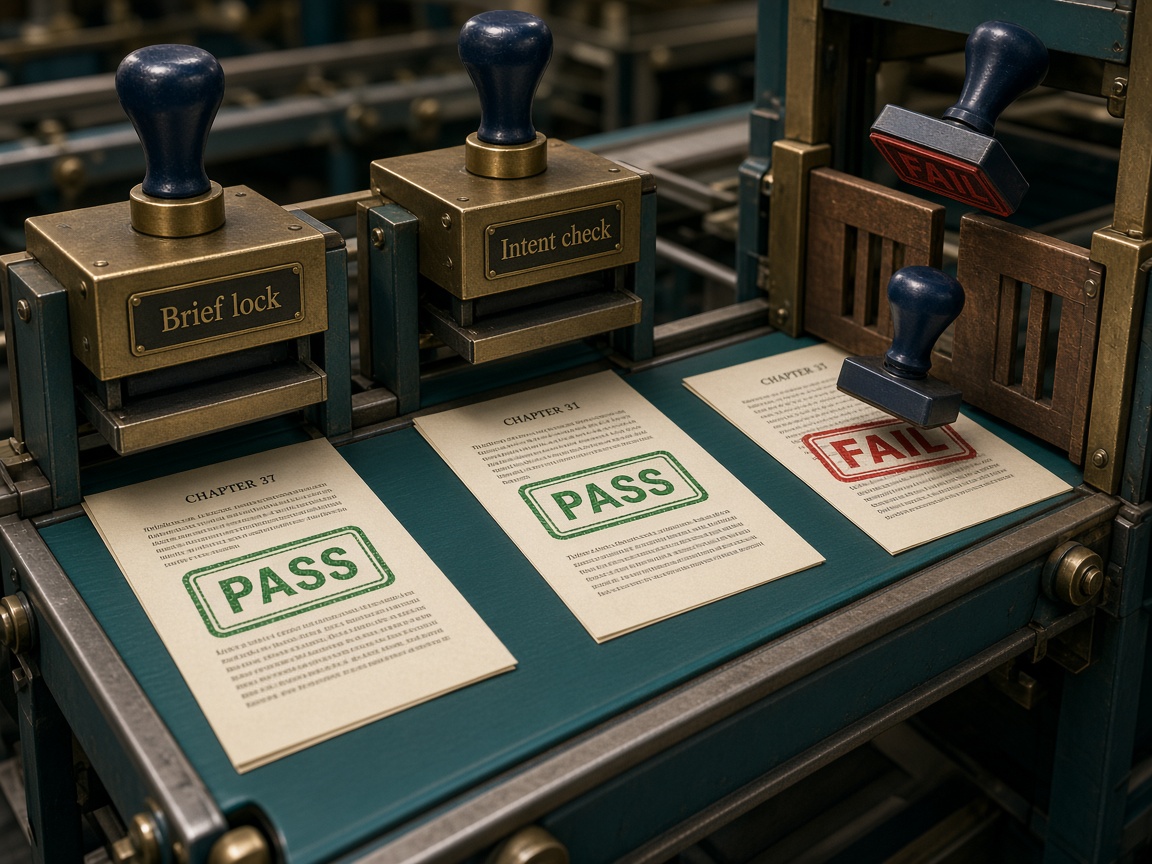
Those named stages only protect the reader if something hard sits between them. Workflow is the quality gate between faster production and pages that could have been written by anyone. Speed without a lock on intent, evidence, and uniqueness simply ships interchangeable copy. Each gate is fail-closed: if it does not pass, the piece goes back to the previous owner with a punch list, not a vague “needs work.”
Gate 1: the brief must lock before anyone drafts
No drafting until the brief is locked. That contract has to state search intent, who the page is for, a working outline, the internal links that belong on the page, and which claims need sources. Later stages inspect this artifact; they do not reopen strategy. If intent is still fuzzy, the owner of the brief owns the fix.
Gate 2: the draft has to beat what already ranks
The draft’s job is not to fill the outline. It has to answer the query more clearly than what already ranks—specific examples, an original structure, and no padded intros that stall the reader. If the piece restates SERP consensus in a new order, it fails this gate and returns to the drafter with the gaps named.
Gate 3: QA is a checklist, not a rewrite
Editorial and SEO QA is a pass/fail checklist: intent match, title and H1, on-page basics, links, facts, and voice. It is not a second brief and not a full rewrite. Failures go back as a punch list to the person who owns that defect. Humans stay on judgment gates—intent, uniqueness, accuracy—even when drafting or formatting is assisted. Automation can move files; it does not get to decide whether the page deserves to publish.
Fail closed — A stage is only a workflow if it can fail closed: lock the brief, require a better-than-SERP draft, run a checklist QA, and send defects back to a named owner.
Status, handoffs, and cadence for lean teams

Those gates only hold if everyone can see where a piece sits and what it needs next. After QA returns a punch list or a draft clears, the work still dies in chat unless status is explicit. Lean teams do not need a heavy PM stack; they need a short, shared vocabulary so a writer, editor, and publisher can glance at the board and know the truth.
Use one status set and nothing else: queued, in brief, in draft, in QA, blocked, scheduled, live. Pair blocked with a required reason field—waiting on SME, missing source, legal, CMS access—so “blocked” never means “we stopped looking.” Everything else (almost ready, in review 2) recreates the undocumented pipeline you already left behind.
Handoff packets, not pings
Every stage change carries a handoff packet: link to the artifact, what changed since the last owner, open questions, and the next owner’s ask. That packet is how the brief stays the contract. A Slack “draft’s up” is not a handoff; it dumps context onto the next person and invites them to re-litigate intent.
Set stage SLAs that match actual capacity—short enough that work does not stall, long enough that the owner can finish the artifact—and treat a miss as a process signal, not a performance review. Chronic brief delays usually mean intake is stuffing the queue; chronic QA delays usually mean drafts are arriving without the evidence the brief promised. The SLA exists to surface that, not to shame the owner.
Once a week, run a short standup on the board: what is shipping, what is blocked and why, and what should never have entered the pipeline. That last question is the WIP limit in practice. Finished pages beat a pile of half-drafts because unfinished work still occupies an owner, still burns context, and still never hits a quality gate. Keep the system in one place—board, brief template, QA checklist. Extra tools without a status model just recreate the chaos in more tabs.
Cadence — A lean SEO workflow is a single board with a tiny status set, a handoff packet at every move, SLAs as signals, and a hard WIP limit so finished pages outrun a pile of drafts.
Run one article end to end: a copy-paste SEO workflow checklist
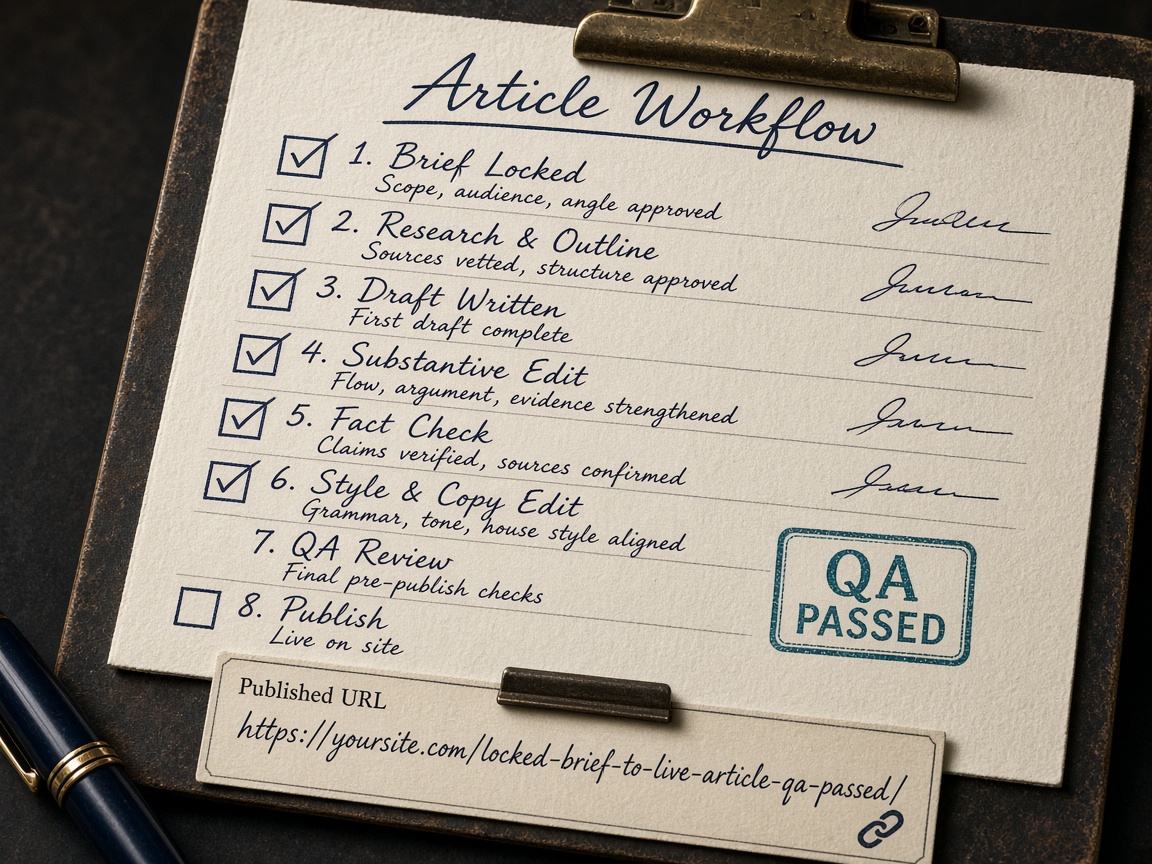
Once status, handoffs, and WIP limits are in place, the remaining job is mechanical: take a single URL through every named stage without improvising. Treat the list below as the runbook for one piece—not a tour of tools. Copy it onto the card and tick it in order. If a box is empty, the work is not ready to leave that owner.
Work the list in order on the card itself so nothing lives in memory or chat. Skip a line and you recreate the unmanaged pipeline—side-channel drafts, half-finished URLs, and pages that never quite match intent.
End-to-end rule — One article is done only when every box from priority through live URL is ticked by its named owner—gaps go backward, they never get papered over in the next stage.
Where SEO workflows break—and the repairs that stick
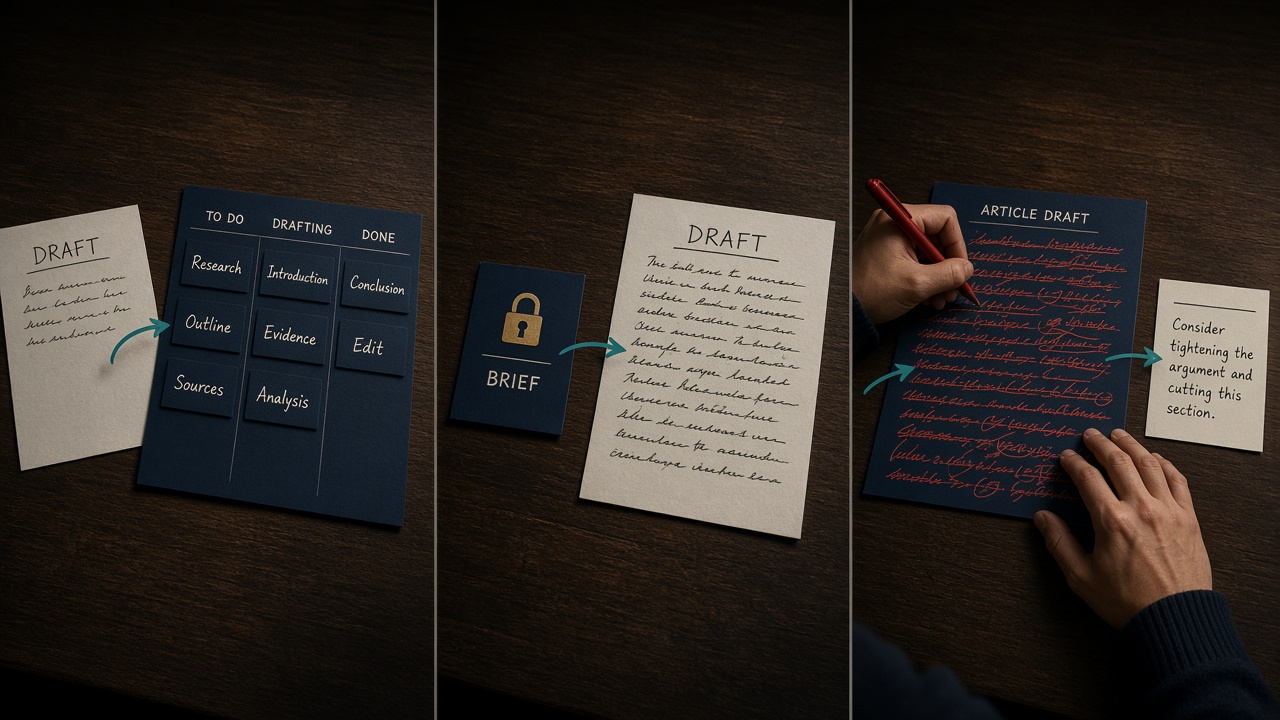
Even a clean brief-to-publish sequence fails in the same three places: work that never hits the board, briefs treated as optional color, and QA that quietly becomes a second author. Those breaks are not personality problems. They are missing rules.
Invisible work is the first leak. Side-channel drafts, “quick” updates, and hallway requests skip intake, so they skip owners, dates, and gates. Repair it with one hard rule: if it is not on the board, it is not in progress. Anything started off-board gets parked until it has a stage, an owner, and an exit criterion—or it does not exist.
Weak briefs fail next. When editors “fix it in edit,” writers learn the contract does not count. Send the draft back at the first quality gates instead of rewriting the angle in QA. If intent, audience, outline, or sourced claims were never locked, the previous owner still owns the work. That is how the brief stays the artifact later stages inspect, not a suggestion.
Rewrite-heavy QA is the third break. Split the punch list: must-fix is intent match, accuracy, headings, links, and on-page fields; voice polish is nice-to-have and never a ship blocker on its own. Fail-closed on the musts, pass the rest, and keep humans on uniqueness and truth rather than restyling every sentence.
Overload looks like a board full of almost-articles. Hold WIP limits and apply a kill-or-merge rule before overlapping topics eat a full cycle. Shipping complete URLs beats babysitting unfinished ones. When that operating system is stable—named stages, single owners, hard gates—automation can take repetitive steps. It should never replace the gates this workflow defined.
The repair — Board the work, enforce the brief at the first gates, split must-fix from voice, and cap WIP. Automation only after those rules hold.
Key Takeaways
Put one article on a board with named stages, owners, and gates this week, and ship it from brief to publish without skipping intent or editorial standards.
Frequently Asked Questions
You Might Also Like
- Workflows SEO Content Brief: How to Brief Writers (and AI) So Pages Rank
- Guides Free SEO Content Brief Generator: How to Brief Writers in Minutes
- Strategy How to Scale Content Marketing Without Diluting Quality
- Automation SEO Automation: Tools, Workflows, and What to Automate First
- Strategy Long-Tail Keyword Research: A Practical Workflow for Briefs