Free SEO Content Brief Generator: How to Brief Writers in Minutes
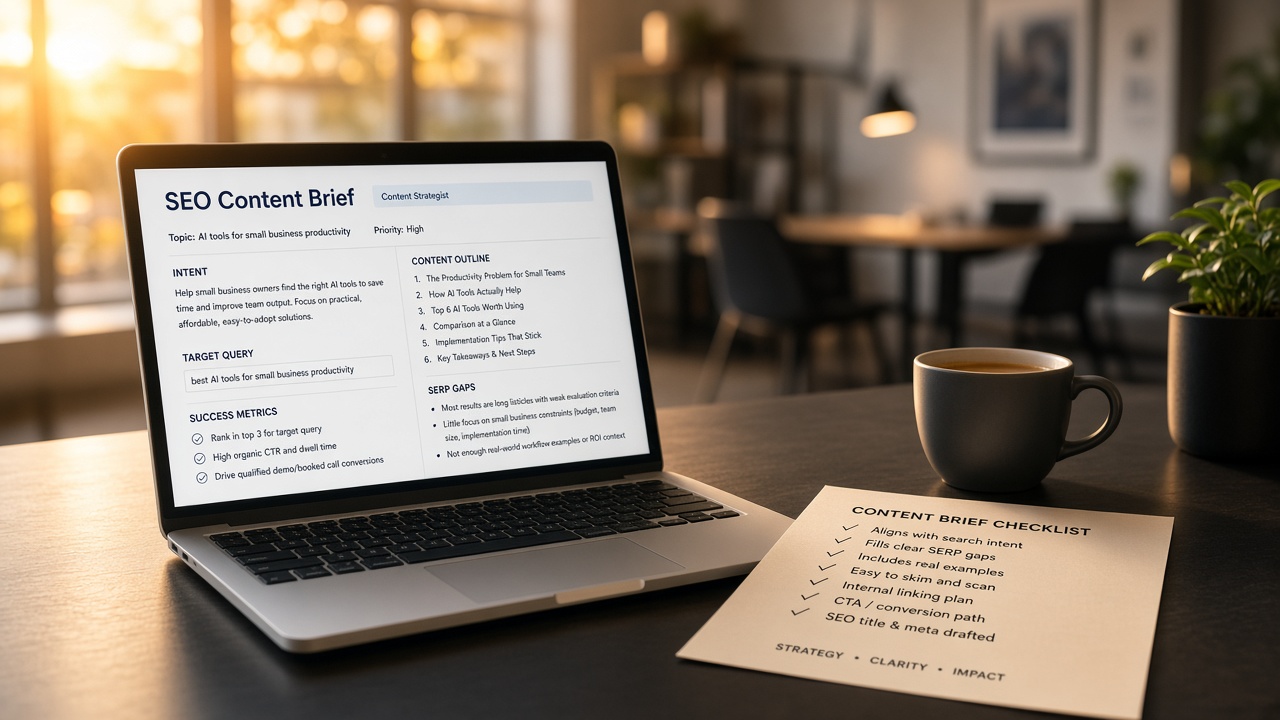
The draft is rarely what stalls a lean content team. The brief is. Most teams spend 30–60 minutes creating SEO content briefs manually, or they pay about $89/mo for tools like Surfer SEO for brief help—and a thin brief still sends writers and models into the wrong intent, a keyword dump, or a rewrite loop.
A free SEO content brief generator sits between a blank template and a full AI article writer. You give it a keyword (and usually a SERP snapshot plus brand rules); it returns a structured assignment—search intent, outline, competitor gaps, links, E-E-A-T notes, CTA, and the citation blocks answer engines need—not a finished page. Generators change; that job-to-be-done does not.
What follows is the playbook: the fields that make a brief rank-ready, a minutes-not-hours workflow, how free generators compare with paid suites, and the quality gate that keeps orphan docs from reaching a writer or an automated publishing stack.
- A free SEO content brief generator structures the assignment; it does not write the article.
- Manual briefs still take 30–60 minutes; a generator plus a short quality gate is the lean-team default.
- Rank-ready output needs intent, keywords, SERP gaps, outline, E-E-A-T, links, CTA, and AEO citation blocks.
- Outline-only and keyword-only briefs drive rewrites; brand rules and examples lift first-draft acceptance.
- Gate every brief before writer or AI handoff so automation ships pages, not orphan docs.
What an SEO Content Brief Generator Is—and What It Isn’t
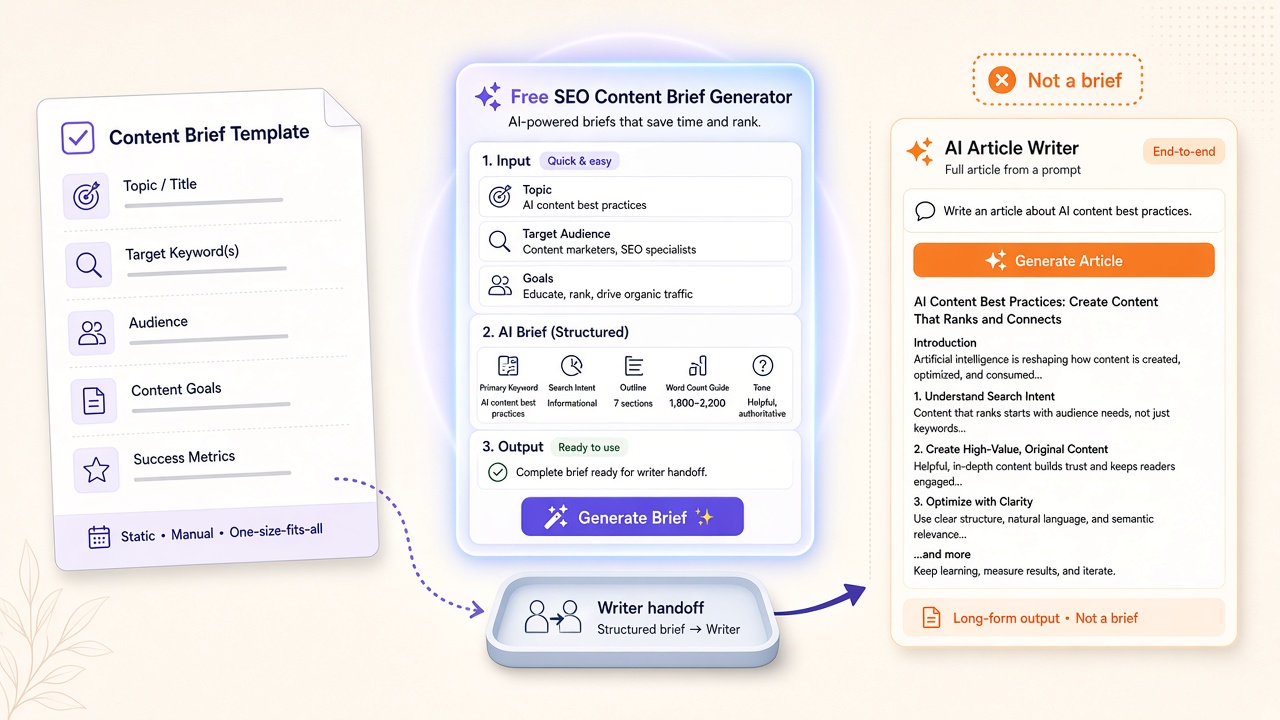
Treat the generator as a briefing engine, not a publishing engine. It turns a target keyword plus your brand rules into a structured brief—not a finished article. The operator job is a consistent, rank-ready handoff for freelancers or AI writers, so research-to-outline stays fast and human judgment stays on search intent and brand.
It is not a static SEO content brief template, which is a reusable shell you still fill by hand. It is not a full AI blog writer or autoblogging system, which is a draft producer. The generator sits between those two. For startups, agencies, and small teams, a free generator is the entry path: the same handoff quality without locking into a paid suite before the process is proven.
Semrush puts the case simply: briefs save time and money because they give writers a clear starting point, enable their best work, and minimize the need for lengthy revisions. Generate the brief first; only then should anyone draft.
Not a writer — A generator turns a keyword and brand rules into a structured brief. Templates are empty shells; autobloggers produce drafts. Keep human judgment on intent and brand, then hand off.
Why Weak Briefs Waste Time, Budget, and Rankings
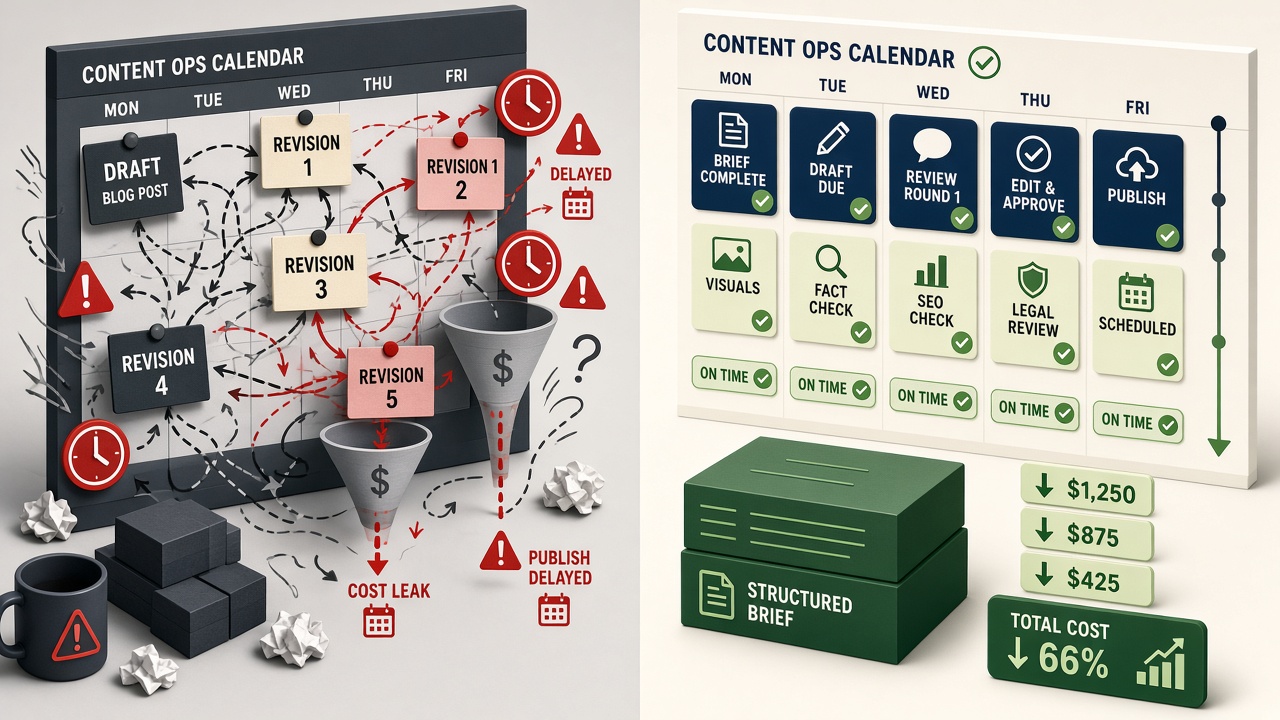
That distinction matters the moment you look at what a thin brief actually costs. A comprehensive brief can take 2–3 hours of research, competitor analysis, outline, and alignment—time lean teams rarely have on every URL.
Skip those fields and the waste shows up downstream. BetterBriefs estimates 33% of marketing spend is wasted on misdirected work from poor briefs: wrong intent, thin outlines, and no brand rules that send writers and models toward the wrong page. The ranking cost is just as real. A B2B SaaS agency case study reported Page 1 ranking rate rising from 18% to 47% after moving from ~50-word minimal briefs to comprehensive ~2,400-word briefs, with editor revision time falling from 3.5 hours to 1 hour per piece.
That is the commercial case for a free generator: compress research and structure without buying a full SEO suite on day one. AI-assisted briefs can drop to roughly 20–30 minutes—up to 80% time saved—so you can standardize the brief, quality-gate it, then scale writers or AI.
Standardize first — A weak brief is not a shortcut—it is misdirected work. Require a complete brief, quality-gate it, then scale writers or AI.
The Fields a Free Generator Must Fill Before Anyone Drafts
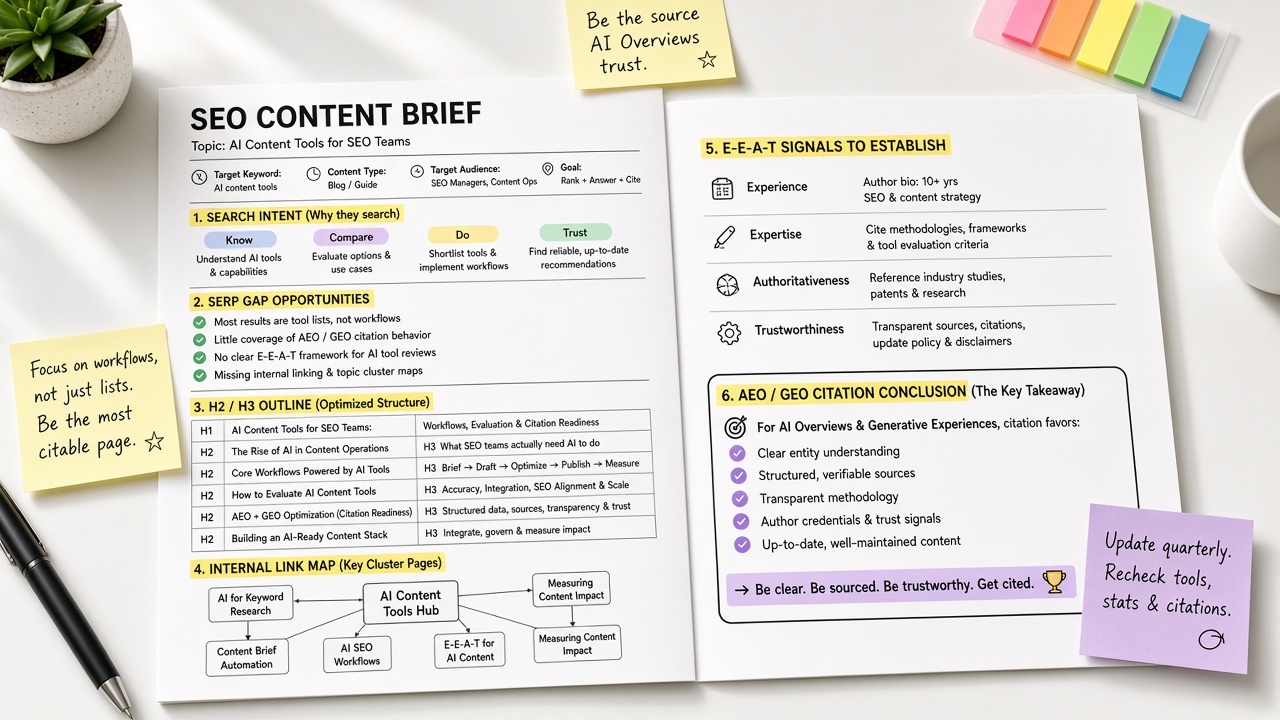
That compression only works if the file that comes out is a complete brief. A free generator that returns a title and a keyword list still leaves the writer reconstructing intent, outline, and proof—so the minutes you saved on research come back as revisions.
From eight non-negotiables to a thirteen-element brief
Eight elements are non-negotiable: search intent, primary and secondary keywords, word count, competitor gaps, E-E-A-T, heading structure, links, and audience and tone. A complete SEO content brief should include about thirteen core elements, each with a distinct job, running from the business goal through technical notes such as schema, meta, the CTA, and link targets. Map every generator run onto that set so the tool is never used as a keyword dump.
- Search intent, audience, and tone
- Primary and secondary keywords, plus a word-count target
- Competitor and SERP gaps, with a heading structure that closes them
- Internal and external links, E-E-A-T notes, CTA, meta, and technical notes
Dual SEO and GEO briefs also need AI-facing questions or prompts someone would put to an assistant, and a citable core conclusion—a tight answer block engines can quote. After the generator pass, deepen that structure with FlowCrews’ SEO content brief template. Use it as the quality gate, not a second guide, before anyone drafts.
Complete output — A free generator only briefs writers in minutes when it fills eight to thirteen SEO fields plus GEO citation blocks, then you quality-gate the brief against a template before anyone drafts.
From Keyword to Handoff in Minutes
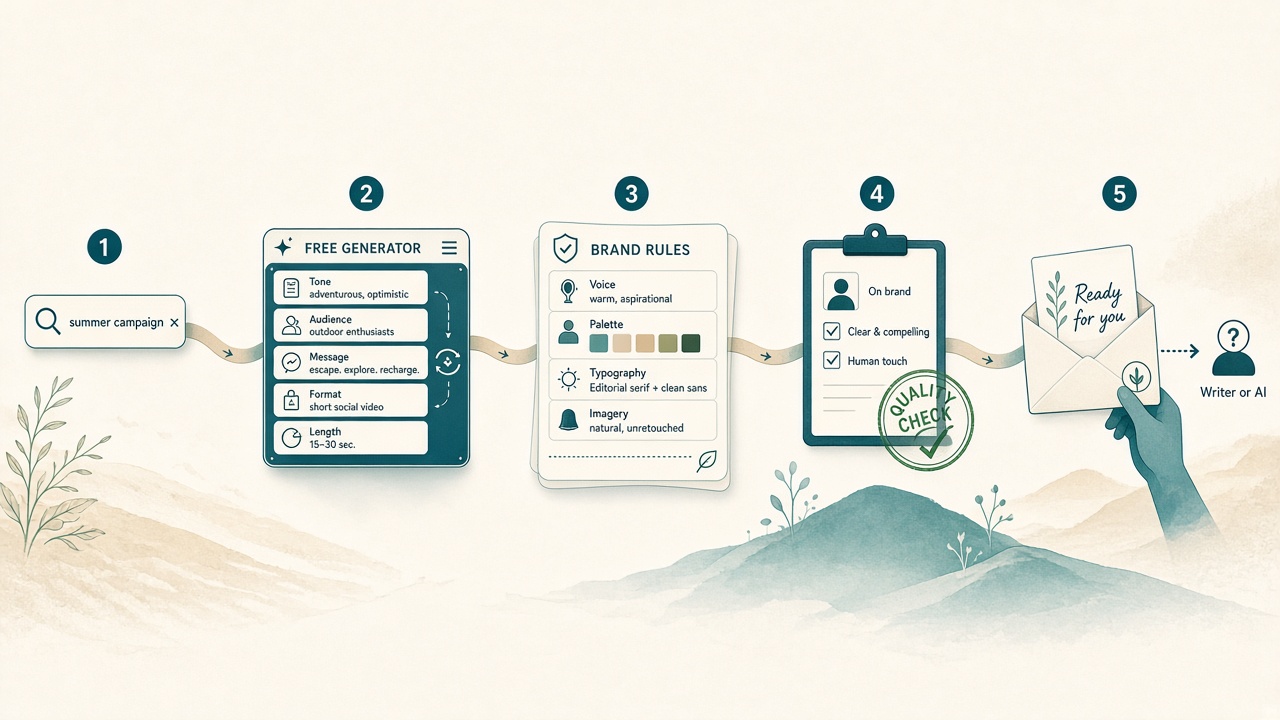
Treat that template as the last filter, not another research hour. Automation should swallow SERP research and outline; the strategist still owns intent, uniqueness, and internal-link mapping. Run the same sequence every time so a 12-article month does not turn into a week of briefing.
That split is how brief hours collapse without thin content. Teams that automate briefs report an 80 percent reduction in research time. A 12-article/month team can cut 24–48 manual brief hours down to about 3–4 hours.
Before anyone drafts, confirm this operator gate:
- SERP format match—guide, list, or comparison, not a mismatched dump
- Two to four internal links the writer must use
- A single CTA
- AEO citation block verified (citable core conclusion plus the AI questions)
- On-brand tone examples attached
Gate, then draft — Let the generator eat research and outline time; refuse the handoff until a human has locked intent, uniqueness, links, CTA, and the AEO block.
Free vs Paid Suites: Match the Job, Then Gate the Brief
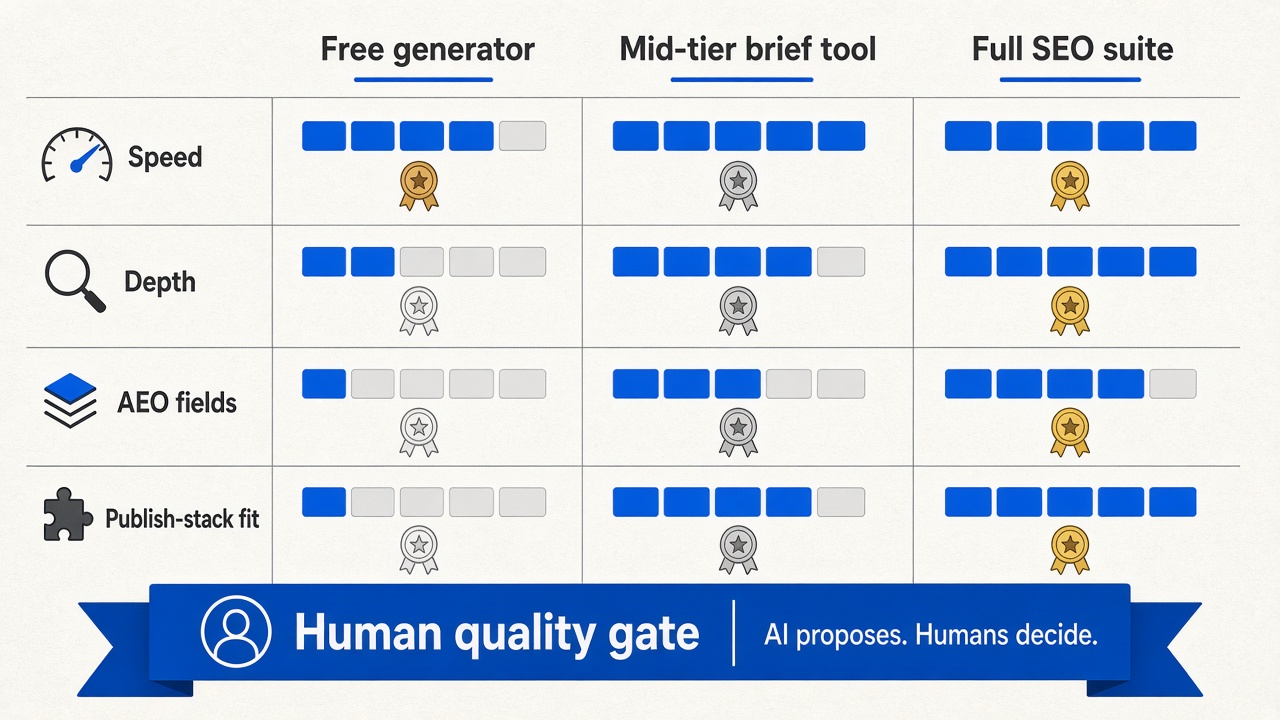
What remains is matching the tool to the job. Free generators and lightweight templates cover one-off briefs and lean teams locking a first standard; Semrush-class research, Surfer-class helpers, MarketMuse-class models, and plan-to-publish suites pay off for shared team standards or research-to-publish automation. PekkerAI pegs manual brief plus freelance writing for 12 articles at roughly $600–$2,400 a month, versus Surfer plus a writer at $89 plus $600 or more—so stay free-plus-checklist until volume justifies the helper.
Neither path works without a quality gate. Grigora’s 2026 survey of 218 content teams found keyword-only briefs at 11% first-draft acceptance and outline-only briefs at 24% with 3.4 revision rounds; full AI briefs with brand rules and examples hit 62%. One agency playbook saw acceptance rise from 42% to 78% and rounds fall from 2.3 to 0.8 after a structured system. Wrong intent, keyword dumps, outline-only shells, missing brand examples, and skipped SERP gaps or internal links still sink output—so gate every brief, human or rules-based, before anyone drafts, then feed it into automated SEO publishing as shippable content, not an orphan doc.
The rule — Match free generators to lean brief volume and paid suites to plan-to-publish workflows—but gate every brief before it reaches a writer or AI.
Key Takeaways
Paste your generator output into FlowCrews’ SEO content brief template, fill every SEO and AEO field, and only then hand the brief to a writer or your automated publishing stack.
Frequently Asked Questions
You Might Also Like
- Guides SEO Content Brief Template: The Complete Guide to Briefs That Rank
- Automation SEO Automation: Tools, Workflows, and What to Automate First
- Comparisons Best SEO Automation Tools in 2026 (Compared by Job-to-Be-Done)
- Strategy Keyword Clustering: How to Group Keywords into Rankable Topics
- Automation What Is Content Automation? A Plain-English Definition