
SEO Content Brief: How to Brief Writers (and AI) So Pages Rank
Programmatic SEO is one template merged with a structured dataset so each eligible row becomes its own URL. It is not a factory for automated blog posts. The page ranks only if the row answers a query the rest of the site does not already own.
Google defines scaled content abuse as many pages generated for the primary purpose of manipulating Search rankings and not helping users. That policy applies no matter whether content is produced through automation, human efforts, or some combination, and it also covers attempts to manipulate generative AI responses in Google Search. A prompt that says “make it unique” does not meet that bar.
The brief has to be a contract the writer or model can fail. It names the demand, the fields that are actually different, the exclusive page job, and the noindex rule for sparse rows. Everything that follows starts from that row, not from a generation prompt.
- Programmatic SEO is one template plus a structured dataset, not mass AI article generation.
- Google’s scaled content abuse policy covers humans, automation, and both, including attempts to game generative AI answers.
- Index only rows with real demand, unique fields, and a page job no other URL already owns.
- Vendor bars such as three data points, eight fields, or 50% different copy are operating rules, not Google thresholds.
- Noindex sparse variants, publish in small batches, and prune pages that stay unindexed or impressionless.
The Brief Is a Row Contract, Not a Writing Prompt
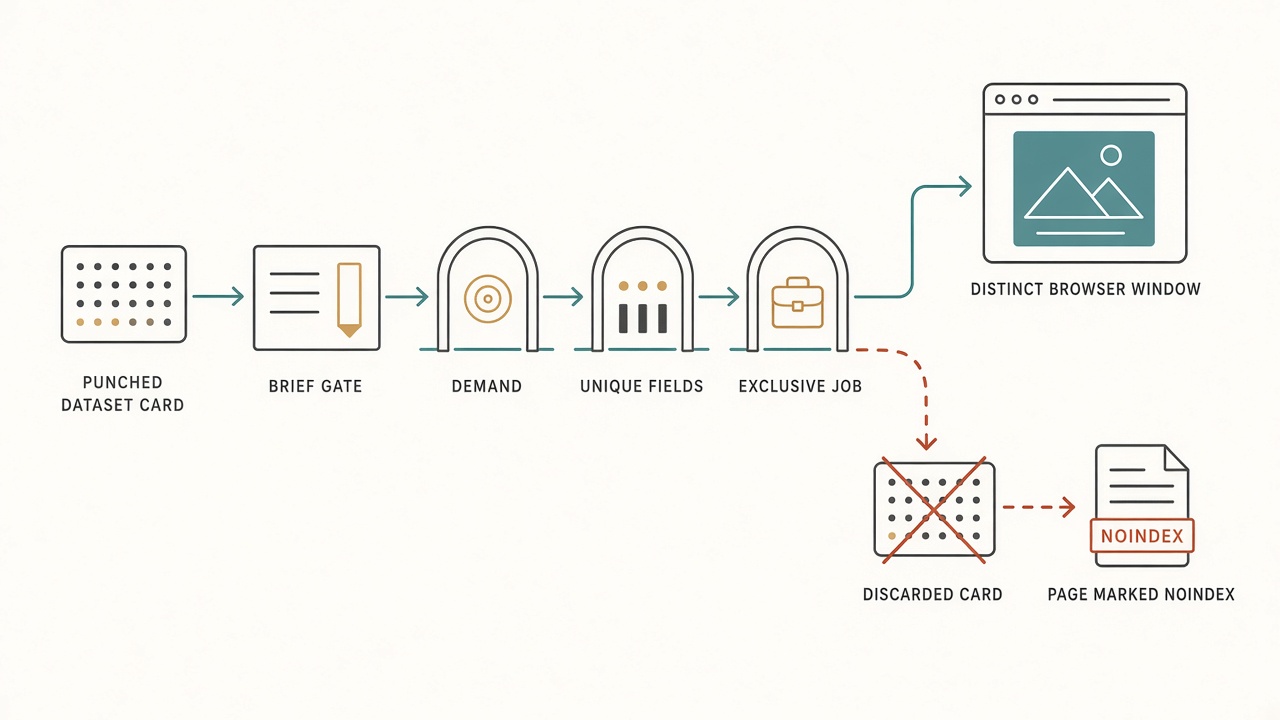
Once a site already knows how its programmatic pages should link, the brief's job is narrower than most writers expect. It is not a creative assignment and it is not a prompt to invent a page. It is a decision about whether one row in a dataset is allowed to become its own URL.
The publish step is a gate, not a writing pass. If the row cannot stand on its own, the stack should refuse the URL rather than force one into existence. A headline pattern shared across rows is not a reason to emit a page.
Eligibility is the only question the brief answers
May this row become a distinct URL, or must the system hold it back? A row clears that gate only when it has real demand, enough unique fields to answer something the rest of the site does not already answer, and a page job no other URL owns. Sparse rows, duplicates, and near-duplicates fail the contract. They do not get a softer brief.
Humans and AI accept the same contract. Tone, outline length, and prose style are secondary. Whoever writes the page is filling fields and explaining the row, not inventing a reason for the page to exist. If the row fails eligibility, cleaner sentences will not save it.
That is also the line between this system and autoblogging. The differentiator is proprietary or maintained data, not who typed the sentences. Generated prose on a thin row is still a thin page. Maintained data that no other URL on the site already covers is what makes the template worth publishing.
The contract starts after the site's existing programmatic internal-linking rules. Those rules already decide hubs, parents, and siblings. This brief does not restate them. It only decides which rows are allowed to enter that structure.
Eligibility first — A programmatic brief is a row-level contract: publish a distinct URL only when that row has real demand, unique maintained data, and a page job no other URL already owns.
Google’s Line Is Manipulation, Not a Vendor Formula
That row contract only holds if you keep Google’s rules and your own operating math in separate columns. Shipping a row that earned a URL is not the same thing as publishing many pages whose main job is to rank. Vendors often blur that difference by selling a uniqueness score as if it were policy.
Google defines scaled content abuse as cases where “many pages are generated for the primary purpose of manipulating Search rankings and not helping users.” The same spam policies also cover “attempting to manipulate generative AI responses in Google Search,” so the exposure is not limited to classic blue links. A page family built to steer an AI overview, rather than to answer the person who landed on that URL, sits on the wrong side of the line even if every row renders cleanly.
Who produced the page does not decide the case
Production method is not a defense. The policy applies “no matter whether content is produced through automation, human efforts, or some combination.” Danny Sullivan put the operational point more bluntly: Google doesn’t “really care how you’re doing this scaled content, whether it’s AI, automation, or human beings.” A human-edited template can fail the test. An automated row can pass it, if the page exists to help someone rather than to multiply rankings.
March 2024 quality work was the enforcement signal, not a template checklist. Google expected that work to reduce low-quality unoriginal content in results by 40 percent, then reported that searchers would see 45 percent less of it after rollout. That figure is a result-quality outcome. It is not a formula you can reverse-engineer into field counts, block counts, or a percent-different copy score.
Numeric uniqueness bars belong in the eligibility gates, and they should be labeled there as operator rules, never as Google thresholds. They are how you decide a row is worth a URL. Treating a vendor scorecard as policy is how teams either ship thin variants or suppress pages that actually answer a distinct query. The policy test is purpose at scale: many pages whose primary job is to manipulate rankings or generative answers fail it, whoever wrote them.
Policy vs. math — Google judges scaled content by whether many pages exist mainly to manipulate rankings or generative answers, not by who wrote them and not by any vendor uniqueness formula. Keep numeric gates as your own operating rules.
Doorway Risk Is a Different Failure Than a Thin Page
Policy already draws a line at pages made mainly to manipulate rankings. Doorway abuse is a separate failure, and it is not solved by adding words. It is the pattern of substantially similar pages that funnel people toward one destination instead of a clearly defined, browseable hierarchy. Google’s spam policies describe that pattern as pages closer to search results than a site a person can actually move through.
Length does not clear the pattern. A page can run long and still be a doorway if its siblings are interchangeable and exist to capture queries. Swap the city, the modifier, or a near-synonym, keep the same pitch and the same next step, and the family is a funnel with many entrances, not a catalog. Readers cannot browse a real difference because there is none.
Name the job before the row is written
The brief has to name the destination job of the template family so rows do not all collapse into one offer. That job is what this URL is for: a comparison only this attribute supports, a location with inventory the parent does not list, a decision the sibling pages do not make. If every row’s useful ending is the same form, the same product, or the same sales page, the template is doorway-shaped no matter how the intro is rewritten.
Quality-rater guidance is a different test, and it should stay labeled that way. Raters are told to rate main content that is copied, paraphrased, or AI-generated with little originality and added value as Lowest. That is an originality judgment. It does not decide whether siblings form a doorway. A unique paragraph on an otherwise identical funnel page does not fix the funnel, and a shorter page with an exclusive job is not automatically a doorway.
- City, modifier, or synonym swapped into the same pitch, with no change in offer or modules.
- Siblings that all resolve to one destination instead of a parent, hub, and distinct child jobs.
- Pages that read like a query list: interchangeable entries whose only purpose is to catch a variant.
Refuse those patterns in the brief, before generation. If the row cannot change the destination, the modules, or the decision the reader is making, it has not earned a URL.
Separate tests — Doorway risk is interchangeable siblings funneling to one destination, not a short word count. An originality rating of Lowest does not substitute for a named page job that keeps rows from collapsing into one offer.
Three Gates Before a Row Earns a URL
Clearing an originality check, or avoiding a doorway pattern, still does not entitle a row to a URL. A distinct URL is created only for a row that clears an eligibility contract. Everything else stays in the dataset.
The three gates
Ship a row only when all three gates pass. Fail any one and the template should refuse the URL rather than pad the page into existence.
- Real demand: the row maps to a query people already search, not a city, modifier, or synonym invented to multiply pages.
- Enough unique fields: the row carries data the template can render as a distinct answer, not a label swap over shared boilerplate.
- A page job no other URL owns: the row is not a second entrance to a destination, comparison, or listing the site already covers.
How many unique fields is “enough” is an operator decision, and published builds disagree. One case study found that pages with only one or two unique data points looked thin, while three or more changed indexing outcomes. Crawl depth in that build stayed within three clicks of the homepage. This template should inherit that depth from the site’s existing programmatic internal-linking rules, not invent a new link scheme at publish time.
Keep those stacks apart. A 2026 operator guide treats eight distinct dataset fields as the density bar for a comparison or listing page. The same guide claims that fixing density, links, and noindex together can lift indexation from 30–40% to 70–80%. Another guide’s own bar is that each page should differ by at least 50% from every other page in the set. Read that 50% figure as copy distance, not proof of unique data: two pages can clear it with rearranged sentences and still share no proprietary fields. Three data points, eight fields, and a 50% copy gap are practitioner thresholds you may adopt, tighten, or reject. None of them is a Google cutoff, and none of them replaces the three gates. A row that hits a density bar but has no demand, or that duplicates a page job another URL already owns, still does not ship.
Ship the row — A URL is earned only when real demand, enough unique fields, and an unowned page job all pass. Operator counts — three data points, eight fields, 50% copy distance — never substitute for that contract or for Google’s qualitative abuse test.
Show the Unique Answer First, and Noindex What Is Still Sparse

Clearing the three gates only earns a row the right to a URL. The template still has to spend that right on the fields that made the row eligible, not on shared copy that every sibling already carries.
Thin programmatic content is a missing unique value, not a short word count. As Digital Astronauts puts it, a long page can still be thin. Length does not rescue a city, modifier, or synonym swap whose only new tokens are the row label.
Lead with the row, not the boilerplate
Put the unique answer and the row's data above the fold so the page is useful before any shared intro, FAQ shell, or brand block. The first screen should answer the page job with the fields that passed the uniqueness gate: the comparison figures, the local inventory, the maintained dataset — whatever no other URL already owns. Boilerplate can follow. It should not be what a reader, or a quality check, meets first.
When a field is missing, vary or remove that module instead of filling the hole with repeated copy. An empty price, missing review set, or absent local fact is a signal to drop the block, swap in a shorter module, or hold the row. Padding the gap with the same paragraph the rest of the template family uses turns a sparse variant into a near-duplicate, which is how a family that started eligible drifts back toward thin or doorway patterns.
Noindex is a template rule, not a later cleanup
- Noindex sparse variants inside the template when required fields are absent or the page job collapses into a sibling.
- Do not publish those rows and hope a later cleanup saves the template family.
- Treat indexation as a consequence of the brief, not a Search Console chore added after a bulk push.
If the contract says a row needs those fields, the publish step should refuse or noindex anything that fails them. Shipping first and pruning later trains the template to emit URLs that were never eligible, and the family pays for that in crawl waste and in pages that look interchangeable. The brief decides what can be indexed. Search Console only reports whether that decision held.
Hold the gap — A sparse row does not get a padded URL and a promise to fix it later. Show the unique data first, drop modules the row cannot fill, and noindex the variant in the template so indexation follows the contract.
Ship Small Batches, Then Spend Where the Clicks Land
With sparse variants already noindexed inside the template, indexation is a publishing decision, not a cleanup job after a bulk push. Ship eligible rows in small batches and read the result before the next wave goes out. In an 18-month B2B case study, 512 programmatic pages grew from 240 to 11,840 monthly clicks, and 87 percent were indexed within 90 days, while publishing stayed capped at 30 pages a week. That cap is what made the outcome readable: a template can mint URLs faster than Search can show which families it will keep.
Plan for a power law, not an even lift across the set. In that study the top 10 percent of pages produced 42 percent of clicks, while the bottom 30 percent produced 5 percent. A minority of rows will carry the program. Treating every URL as equally worth a refresh spends the budget the winners have already earned.
Read the family, not the vanity URL
Watch indexation and impressions by template family, not by how a single URL looks in isolation. One quiet page is normal under a power law. A whole family that stays unindexed, or that indexes and never collects impressions, means the brief let through rows that still look interchangeable — or that never had demand worth a URL.
Re-check weak pages on a 60- to 90-day loop. A quality rulebook, used here as an operator standard rather than a Google threshold, also wants each URL to include at least three uniqueness blocks that are not shared verbatim. If those blocks are still missing after the loop, the page has failed the contract. Do not pad the module the earlier gates already told you to vary or drop.
- Prune or merge pages that stay unindexed or impressionless after the review window.
- Fold a failed variant into the sibling that already owns that page job, instead of keeping a near-duplicate live.
- Put the next data refresh and clearer unique answer on Search Console winners, not on rewriting the template.
The template already did its job when it refused ineligible rows and held sparse ones out of the index. Ongoing effort belongs where demand showed up. That is how a row-level contract survives launch: the dataset keeps earning URLs only where clicks prove the row was real, and the rest of the set is merged, noindexed, or left unpublished.
Follow the clicks — Small batches make a power law visible. Fund the pages Search Console already rewards, and prune or merge the ones that stay unindexed or impressionless.
Share of Clicks by Page Tier
Key Takeaways
Turn your next template into a row-level brief and publish only the rows that clear demand, unique data, and a page job no other URL already owns.
Frequently Asked Questions
You Might Also Like
- Automation How to Turn Keyword Clusters Into Briefs Automatically
- Guides SEO Content Brief Examples for Product, Comparison, and How-To Pages
- Workflows Content Automation Workflow: Research, Draft, QA, Publish
- Templates SEO Article Outline Template for AEO and Classic Rankings
- Guides Free SEO Content Brief Generator: How to Brief Writers in Minutes