SEO Article Outline Template for AEO and Classic Rankings
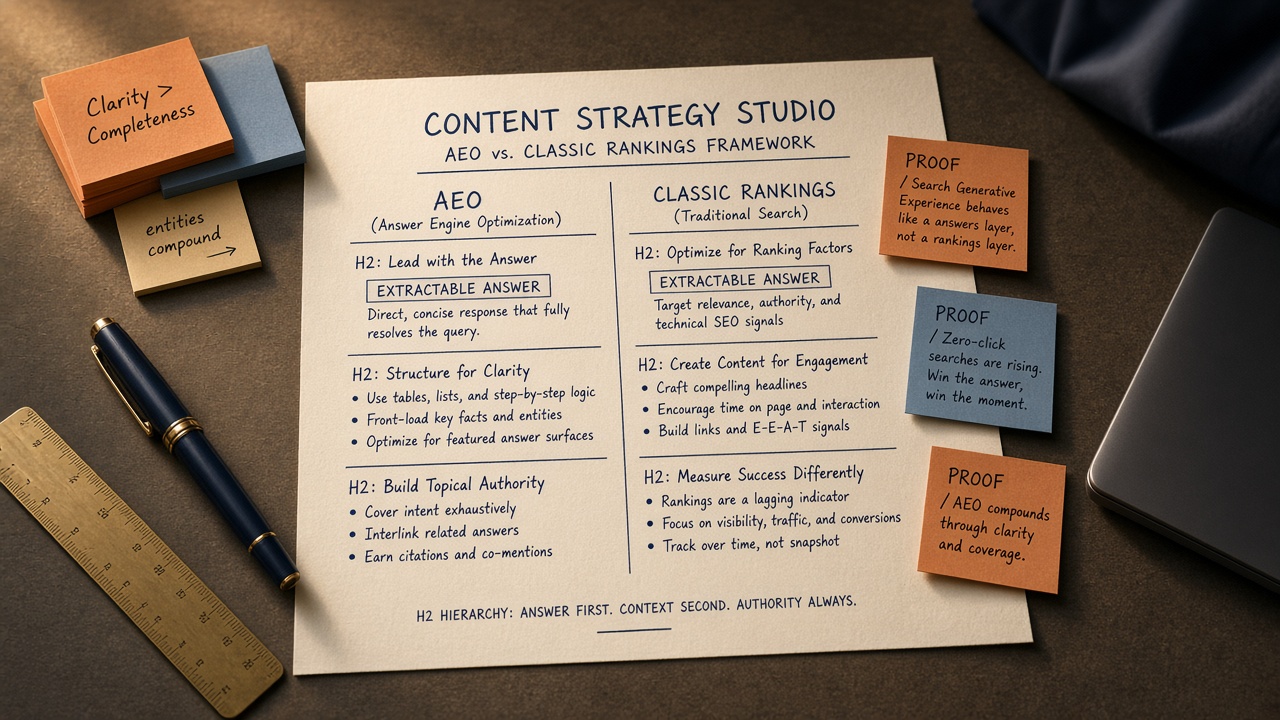
Most content briefs still treat an outline as a list of H2s and a target keyword. That is not enough when readers (and answer engines) want a clear, citable answer and search engines still reward depth, originality, and a page that deserves to rank. The job of an outline today is to be a contract: what must be extractable, what must be original, and in what order the argument unfolds.
This template is that contract. You use it to brief a human writer or an AI so the finished article can be quoted in snippets and answer engines without becoming thin, interchangeable copy. Every section that follows is built to serve one spine: extractable answers first, then proof that classic rankings still require.
If you came here for an SEO article outline template, treat what follows as a reusable briefing format—not a gimmick for one algorithm. The structure stays useful whether you are clustering keywords, writing the piece yourself, or handing it to a publishing stack.
- Brief the page as a dual-win outline: extractable AEO answers plus original proof for classic rankings.
- Lead with a one-sentence thesis so every section advances the same idea.
- Write short, self-contained answer blocks that engines can cite without losing your argument.
- Demand original examples, method, or evidence so the page is not interchangeable filler.
- Use the same outline to brief writers or AI without changing the ranking intent.
What the outline must lock in after the brief
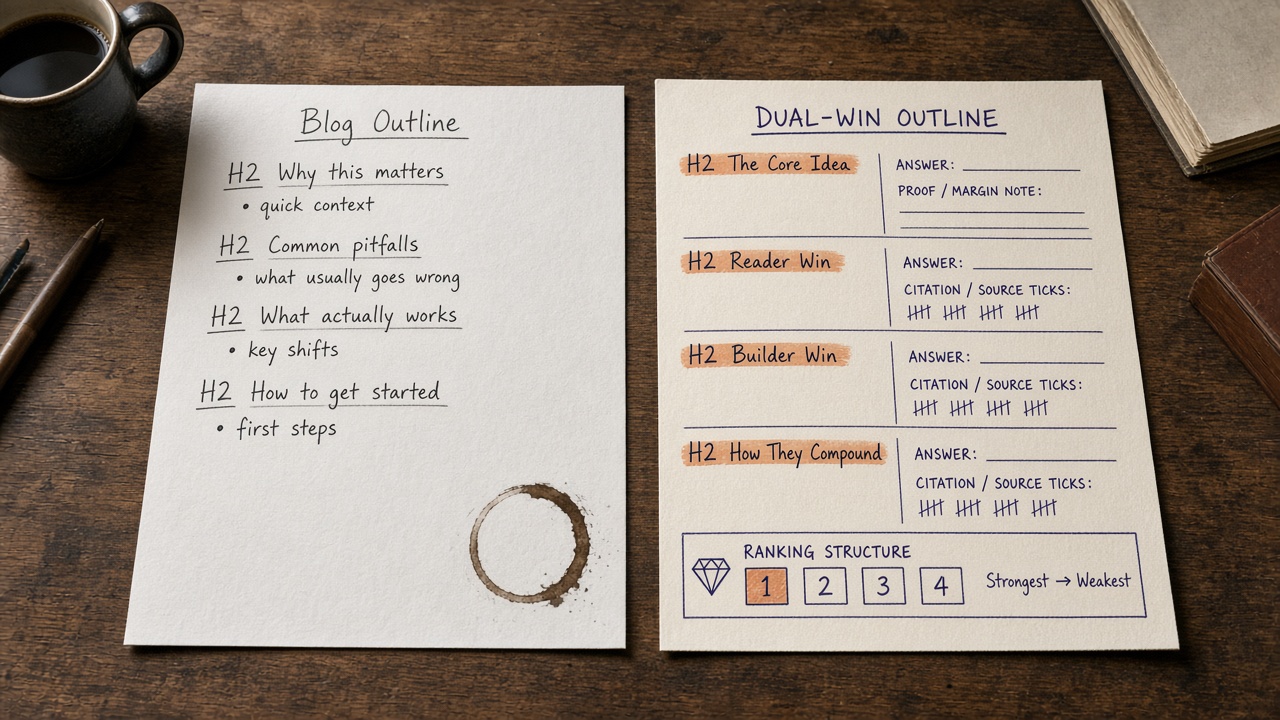
Sit this template after the content brief and before the draft. The brief already owns audience, primary query, and voice. The outline should not restate style rules or duplicate those fields. Its job is architecture: which claims get extracted, which headings earn a click, and which passages carry original proof so engines do not invent it for you.
Classic rankings still need a clear primary query, a scannable H2/H3 spine, internal links that deepen the cluster, and a reason to click through instead of bouncing on a snippet. Answer engines need something extra: extractable answer blocks, named entities, and section-level claims they can cite without filling gaps.
Give every H2 one job—answer, differentiate, or convert—never a filler heading. If you still need the conceptual split, read AEO versus SEO. If you need sentence-level rules for AI Overviews, use the writing guide. This outline only maps structure so those two systems can share one page.
Placement — Place the outline between brief and draft, then assign every H2 a single job so extractable answers and ranking architecture share one map.
The dual-win outline: every field the brief must fill
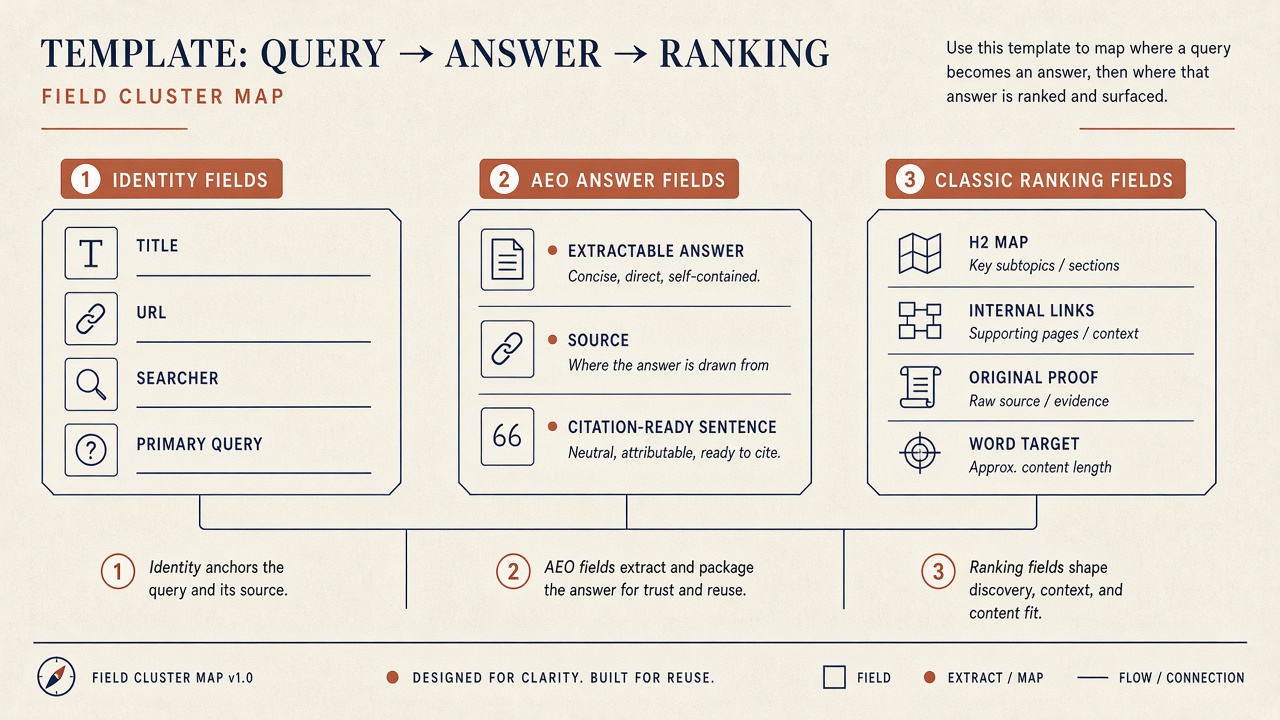
Once that setup is in place, the outline itself is a filled form—not a loose list of headings. Copy these fields into every brief so writers and models cannot skip the dual-win contract.
Page-level lock
Start with a working title, the primary keyword, search intent, the audience, and one sentence that states the page job. That sentence is the north star: if a section does not answer, differentiate, or convert against it, it does not belong. Add slug, meta angle, and a plain note of what unique evidence this URL owns so the page does not republish a sibling’s proof.
Cluster map and heading tree
Map the keyword cluster next: primary query, supporting queries the page should cover, and queries that are explicitly out of scope so this URL does not cannibalize siblings. Then require an H2/H3 tree. Each heading gets a one-line section purpose and a target word range—enough to force depth without inviting filler.
AEO fields and ranking fields, per section
- AEO: a direct-answer sentence, named entities to mention, and one citation-ready fact or definition—not a full draft.
- Ranking: original proof to include, internal links (brief, AEO hub, writing guide), FAQs the section should earn, and the closing CTA job for the page.
Fill those boxes before anyone writes prose. Extractable answers sit first; original proof is demanded in the same pass so the page can be cited and still rank.
Template first — A dual-win outline is a complete field list—page job, cluster map, heading purposes, AEO extractables, and ranking proof—filled before the draft, not after.
Lock query intent and clusters before you draft headings
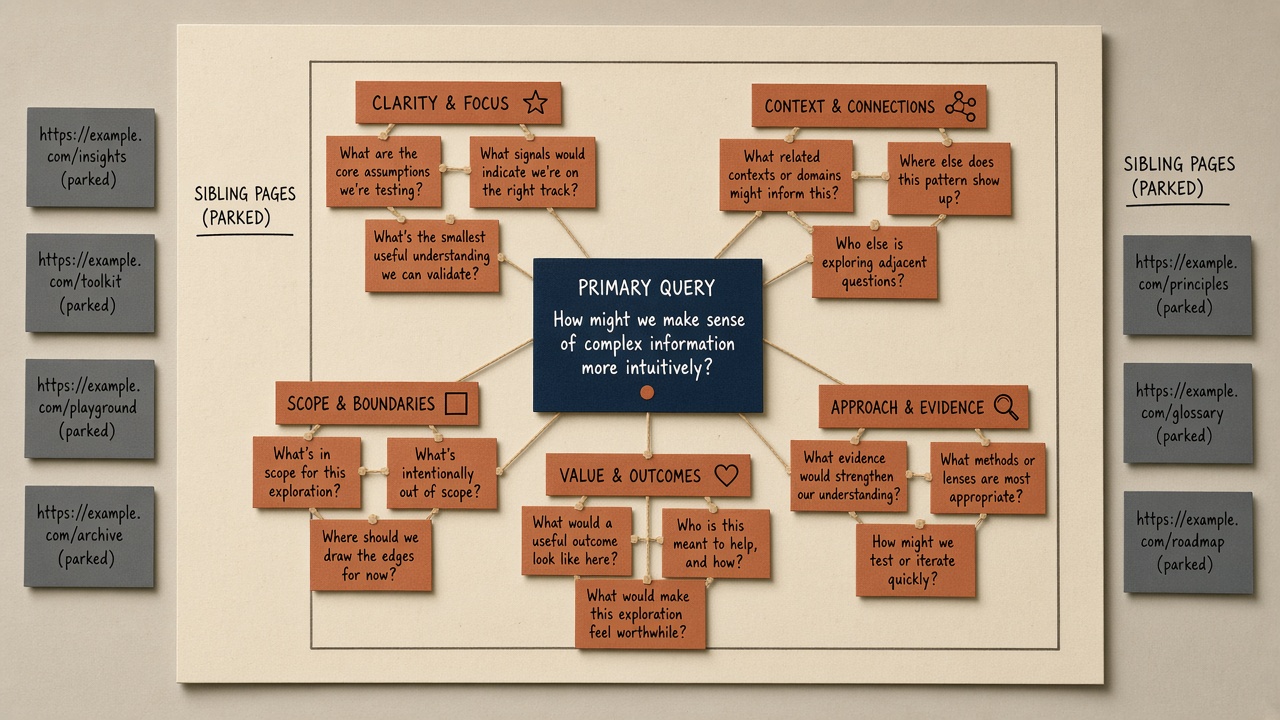
With those fields in place, the next lock is the job the URL is actually hired to do. Name it first: learn, compare, grab a template, or implement. Supporting questions stay on this page only when they serve that same job. Near-duplicates collapse into one cluster; adjacent jobs—brief versus outline versus writing—belong on URLs you already publish, not as extra H2s here.
If the brief itself is still missing, stop and complete the SEO content brief template first. The outline inherits intent, audience, and cluster map from that upstream step; filling headings without it is how pages sprawl.
Cluster first — Cluster by job, not by keyword similarity, then write a not-covering list so the outline cannot invent new URLs or H2s for work you already published.
Slot extractable answers and original proof under every H2
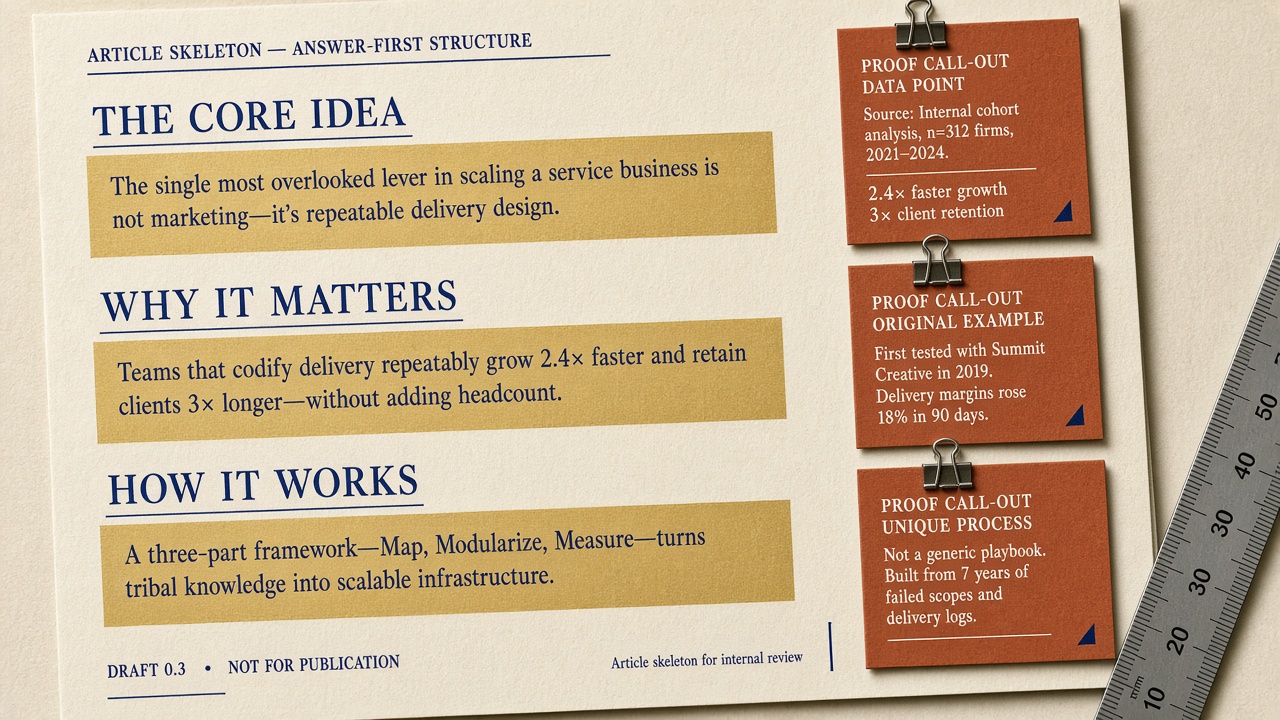
With intent and clusters locked, the outline’s next job is to pin what each heading must say before anyone writes a paragraph. Under every H2, require a short, self-contained answer-first line the writer cannot bury in preamble. That sentence is the extractable unit: it states the claim in searcher language, names the entities the answer depends on, and includes any number or caveat the block needs so a citation stays accurate. If the writer cannot produce that line from the outline alone, the heading is not ready.
Mark each section as definitional or experiential. Definitional blocks are the ones you want cited: terms, steps, constraints, and what the template includes. Experiential blocks explain why the click still happens—trade-offs, when the template fails, and how an operator actually uses it. Both can sit on the same page; only the definitional ones need a citation-ready fact in the outline.
Original proof is not a recycled SERP summary. Specify it in the outline as process, template logic, examples, or operator constraints unique to this URL. Note which entities, figures, and caveats the answer block must carry; leave full citation-tracking tactics to the AEO how-to-get-cited guide. The outline only locks the extractable sentence and the proof that keeps classic rankings from collapsing into generic copy.
Lock the block — Every H2 needs an unburied short answer plus named proof (process, template, example, or constraint)—definitional sections for citations, experiential ones for the click.
Hand the outline off as locked constraints, not inspiration
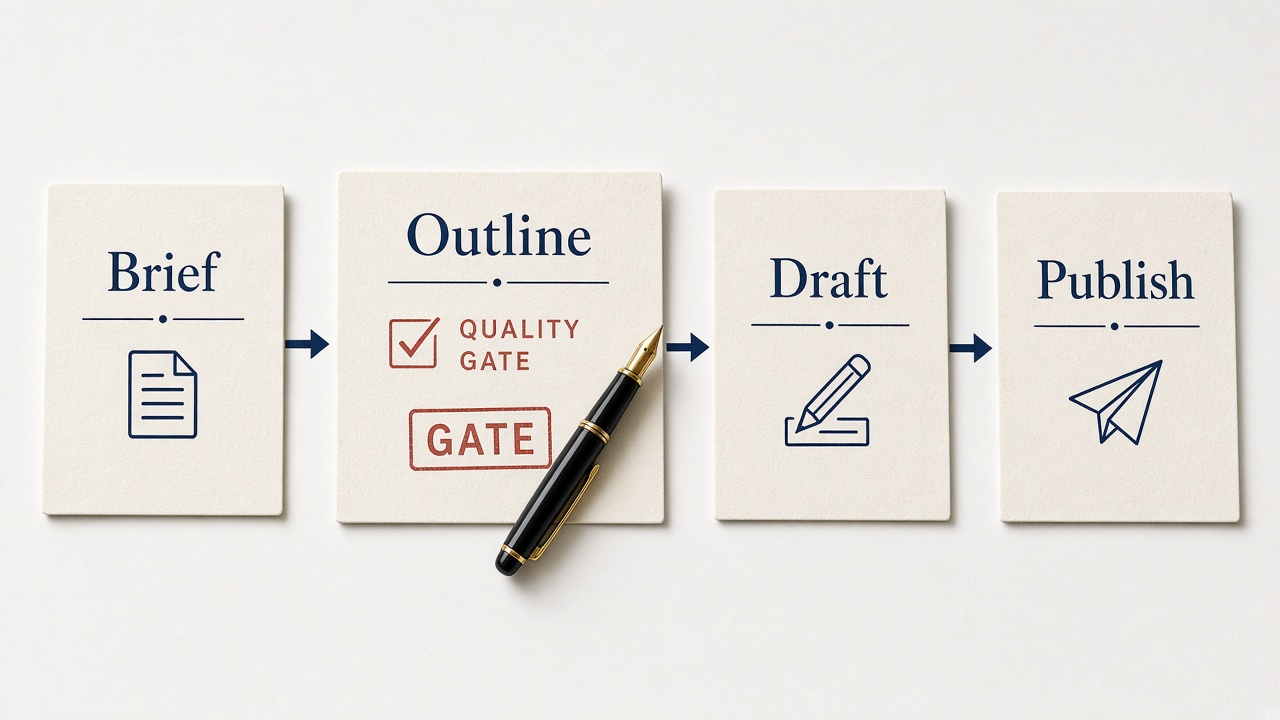
Once every heading has an extractable answer and a proof note, the outline is ready to leave the planner. Gate it first: each H2 still needs a job (answer, differentiate, or convert), an answer slot, a proof note, and no overlap with URLs you already publish. If any of those four is missing, send the brief back—do not open a draft.
Hand the filled template to a writer or a model as constraints, not optional inspiration. In automated publishing, treat the outline as the structure file: headings, word budgets, internal links, and the CTA job stay locked. Reject any draft that skips answer-first lines or invents proof the outline did not specify. A brief generator can fill upstream fields faster; it is not a substitute for this outline. That is how one brief earns both citations and classic rankings without the page drifting in production.
Lock the handoff — The dual-win outline only works if production treats it as a locked structure file—jobs, answer slots, proof, links, and CTA—rather than a mood board a writer or model can rewrite.
Key Takeaways
Use this dual-win outline on your next brief so the same page can earn citations and still rank in classic search.
Frequently Asked Questions
You Might Also Like
- Guides SEO Content Brief Template: The Complete Guide to Briefs That Rank
- Workflows SEO Content Brief: How to Brief Writers (and AI) So Pages Rank
- Strategy Keyword Clustering: How to Group Keywords into Rankable Topics
- AEO How to Write SEO Articles That Survive AI Overviews
- AEO Answer Engine Optimization (AEO): How to Get Cited by AI Search