How to Turn Keyword Clusters Into Briefs Automatically

A keyword cluster is a decision: one page, one primary query family, one job for the reader. A content brief is the contract that tells writers and models how to fulfill that job. Most teams still copy cluster rows into a sheet, rewrite intent in Slack, and hope the brief matches what ranking pages actually answer. That handoff is where scale dies and cannibalization starts.
This article treats the cluster as the source of truth. You define which cluster fields become which brief fields, you lock intent so it cannot drift after approval, and you fire a workflow the moment a cluster is marked ready. The output is a brief you can ship—outline, questions, entities, internal links, and success criteria—without rebuilding the argument for every URL.
If you came here to understand automated content briefs, the useful question is not which tool dumps keywords. It is how to make the mapping explicit so every generated brief stays faithful to the cluster you already approved.
- Treat the approved cluster as the source of truth; the brief is a mapped, triggered output, not a rewritten spreadsheet.
- Lock search intent and page type at cluster approval so briefs cannot drift after generation.
- Define a field-mapping contract: primary keyword, modifiers, questions, entities, and internal-link targets become named brief slots.
- Trigger generation from cluster status, not from a human copy-paste step.
- A rank-ready brief states the reader job, competing SERP patterns, and what “done” means for that URL.
Why a Keyword Cluster Is Not an SEO Content Brief

Calling a cluster a brief is how teams ship stuffed drafts with competing H2s and no clear job. Related queries that belong on one URL are a grouping decision. The execution contract is separate: it names the primary query, locks intent, sets the outline, and tells a writer or generator what the page must cover and what it must refuse.
Dumping every clustered term into a document does not produce a brief. It produces a synonym list. The page then tries to rank for informational how-tos and commercial comparisons at once, headings fight each other, and the draft reads like a keyword dump rather than an answer. Clustering methods live elsewhere; this piece starts after an approved cluster already exists.
The conversion rule is strict: one approved cluster equals one brief and one page. If two clusters overlap, merge them or issue a no-brief decision. Two articles for the same intent is how you compete with yourself. Rank-ready briefs start from that contract, not from a spreadsheet export of every related query.
One cluster, one page — One approved cluster becomes one brief and one URL. Overlaps get merged or skipped—never two competing pages.
Lock a Field Map Before You Generate Anything
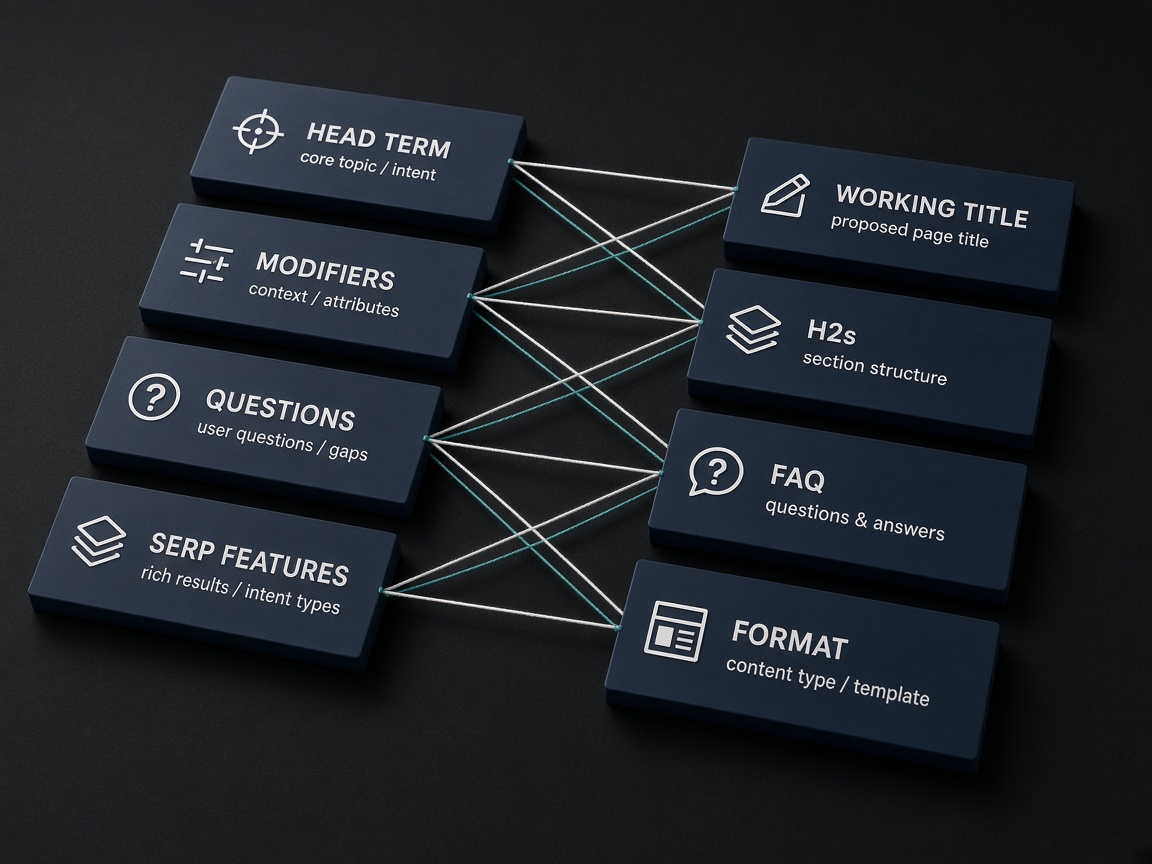
Once the cluster is approved, the next move is not a dump into a doc. It is a contract: every signal on the cluster record maps to a named field on the brief, and generation is allowed only after that map is frozen. Without it, a writer or model invents structure from a pile of terms and the page collapses back into competing intents.
Treat the mapping as fixed, not suggestive. The head term becomes the title and H1 target. Modifiers and subtopics become H2s, in the order the SERP already rewards. Question-shaped queries become FAQ items, not extra body headings. Named entities become a must-mention list. SERP features become format notes—list, table, or steps—so the outline matches what already ranks instead of a generic blog skeleton.
Freeze intent, then assign roles
Search intent is locked from the cluster’s dominant SERP pattern, not from the loudest keyword in the spreadsheet. If the pattern is informational, the brief cannot mix in a transactional outline, pricing blocks, or a hard CTA ladder. Mixing those shapes is how one URL tries to rank for two jobs and ranks for neither.
Cap supporting keywords by role rather than by volume of variants. Primary sits on the title, H1, and opening. Secondary terms attach to specific H2s. Question terms stay in FAQ. Instructing a writer to use every clustered variant is stuffing by another name; assigning roles is how the cluster actually gets executed.
Keep only fields a person or model can act on: angle, outline, questions to answer, links in and out, and what not to cover—especially sibling cluster URLs that already own overlapping queries. Everything else is noise. With that contract in place, generation can fire from the cluster record itself.
The contract — A brief is executable only when cluster signals map to fixed fields, intent is frozen from the SERP, and keywords have roles instead of a variant quota.
Trigger Briefs From Approved Cluster Records, Not Spreadsheet Dumps
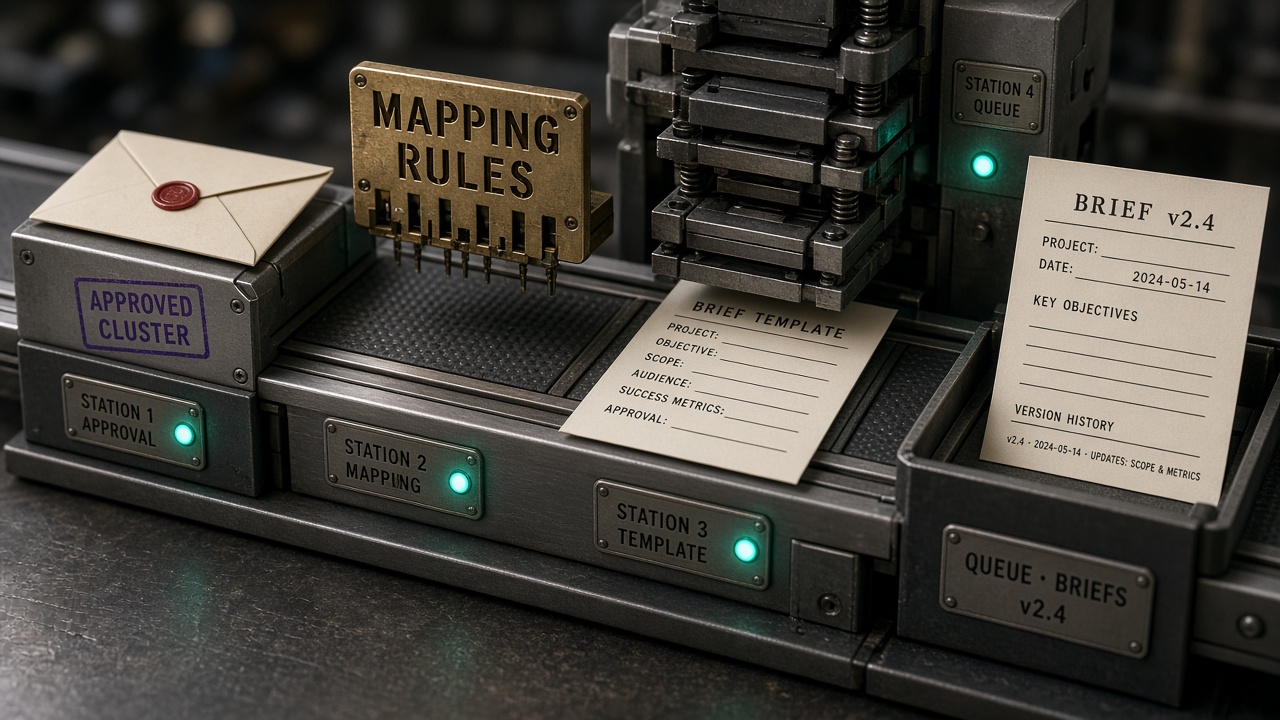
With that mapping locked, generation should never start from a research export. Auto-briefing every group in a dump is how junk clusters become drafts. The job fires only when the cluster record is marked approved (or an equivalent gate). Unapproved, overlapping, or incomplete groups stay out of the queue so they never become pages.
Treat the cluster record as the source of truth. A one-off script against a spreadsheet will not rerun cleanly when modifiers, questions, or the target URL change. A workflow or publishing automation can: same job, same IDs, updated fields, no second brief.
Idempotency is the contract that keeps automation from competing with itself. One cluster ID, one URL target, one living brief. When the cluster changes, the workflow updates that brief rather than minting a duplicate outline for writers to fight over.
Trigger, don’t dump — Generate only from an approved cluster record, map into one template, and update by cluster ID so the same URL never gets two briefs.
Quality-Gate Briefs Before They Ship

Once a brief is written from an approved cluster record, it still should not reach a writer until it passes a hard quality gate. Generation is not publication. The job either produces a complete, internally consistent contract or it fails closed—no half-filled outline in the queue, no “we’ll fix it in the doc.”
Block handoff if required fields are empty: primary keyword, locked intent, an outline with at least a few H2s drawn from the mapped modifiers, and a target URL or slug. Without those, the brief is not executable. Fail the job when the intent stored on the brief disagrees with the live SERP pattern attached at generation time, or when two briefs share the same primary keyword or a near-duplicate slug. Those collisions are cannibalization waiting to happen; they belong in the error log, not in editorial.
The same gate should read sibling cluster records and require the brief to list pages not to cover. That exclusion list is how automation stops topic overlap at brief time instead of after two articles rank for the same queries. Spot-check a sample of auto-generated briefs for mapping drift and SERP freshness. Do not re-edit every field by hand—if you do, the pipeline is not automatic, and you have rebuilt the spreadsheet dump under a nicer name.
Fail closed — A brief ships only when required fields are complete, intent matches the SERP snapshot, slugs and primaries are unique, and sibling exclusions are filled—then sample, don’t rewrite.
Batch, Trace, and Hand Off Without Breaking the Contract

Once a brief clears the gate, do not drip it out as a lone assignment. Generate in pillar or calendar batches so the supporting pages, internal links, and sibling exclusions land together. A cluster that ships as an orphan page will fight its own neighbors; a batch that ships as a set already knows which URL owns the head term and which ones only support it.
Every output keeps both the cluster ID and the brief ID. That pairing is how you re-brief when rankings or SERPs shift without losing the original grouping. You update the same record, not a new dump, so history, exclusions, and intent stay attached to the URL they were written for.
Handoff is a routing choice, not a rewrite. The same field-mapping contract goes to a writer queue, an AI draft job, or a CMS. Do not rebuild the brief per channel—the executor changes; the angle, outline, questions, links, and exclusions do not. What belongs in a rank-ready brief, and how you brief a human versus a model, lives in the site’s brief-quality and generator pieces. This pipeline stops at a locked, batch-ready contract that any of those paths can consume.
Scale the handoff — Scale the handoff, not the brief: batch by pillar, keep cluster and brief IDs on every file, and send one contract to whatever writes the page.
Key Takeaways
Lock your field map and generate the next briefs from approved cluster records, not from a spreadsheet dump.
Frequently Asked Questions
You Might Also Like
- Workflows SEO Content Brief: How to Brief Writers (and AI) So Pages Rank
- Guides SEO Content Brief Template: The Complete Guide to Briefs That Rank
- Strategy Keyword Clustering: How to Group Keywords into Rankable Topics
- Guides SEO Content Brief Examples for Product, Comparison, and How-To Pages
- Automation How to Automate Keyword Research for Content Briefs