SEO Content Brief Examples for Product, Comparison, and How-To Pages
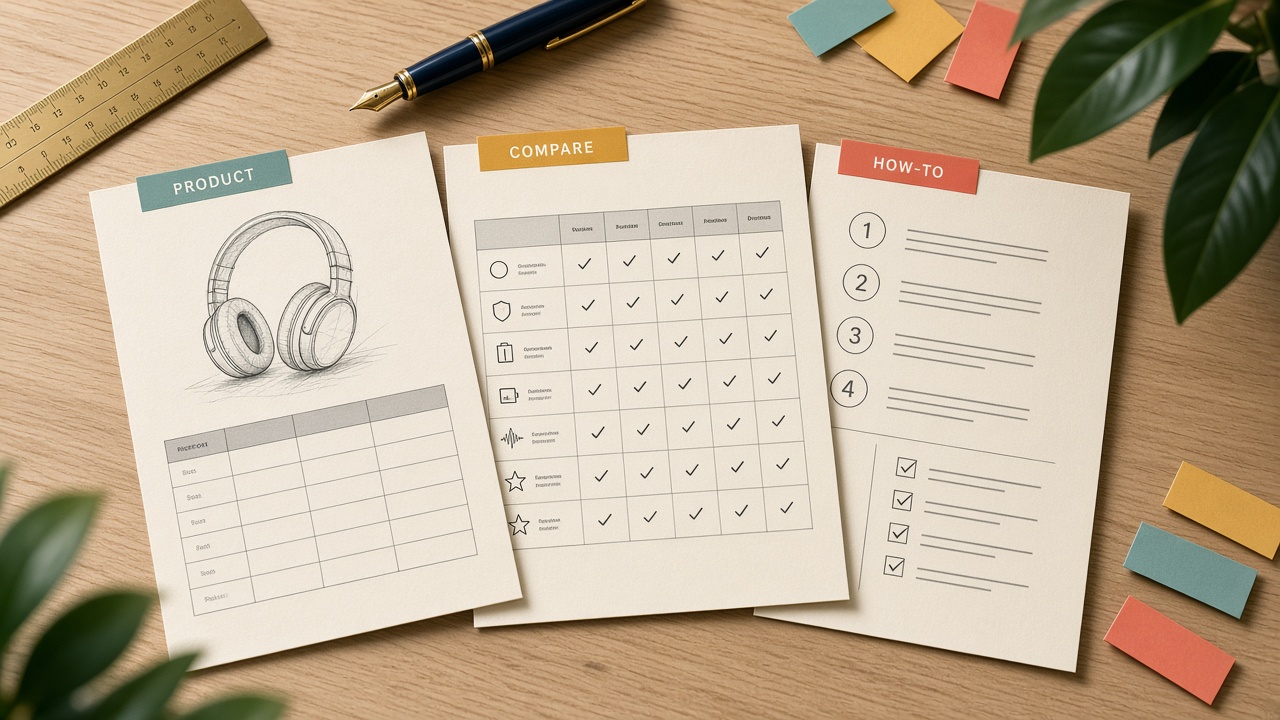
A generic content brief fails the moment you switch from a product page to a comparison or a how-to. Search intent, evidence, and the job the page must do all change—so the fields that matter change too. Readers who look up SEO content brief examples usually need filled samples they can copy, not a blank template and a pep talk.
This article treats the brief as the single source of truth between research, clustering, and the writer. You will see how product, comparison, and how-to briefs differ in target query, SERP features, outline, proof, and calls to action—so you can brief without cloning one all-purpose doc.
Use the samples as a starting structure: lock intent first, then entities and objections, then the conversion path. That order keeps evergreen pages accurate whenever someone finds them, and it scales when you automate publishing without letting briefs go vague.
- Match the brief to the page type: product, comparison, and how-to each need different fields and proof.
- Lock search intent and SERP job before you write the outline or assign a writer.
- Cluster related queries into one brief so the page covers a topic, not a single keyword.
- Spell out entities, objections, and the conversion action so ranking copy still converts.
- Reuse filled examples as a contract; do not clone a generic one-size brief.
Why product, comparison, and how-to briefs cannot share one outline
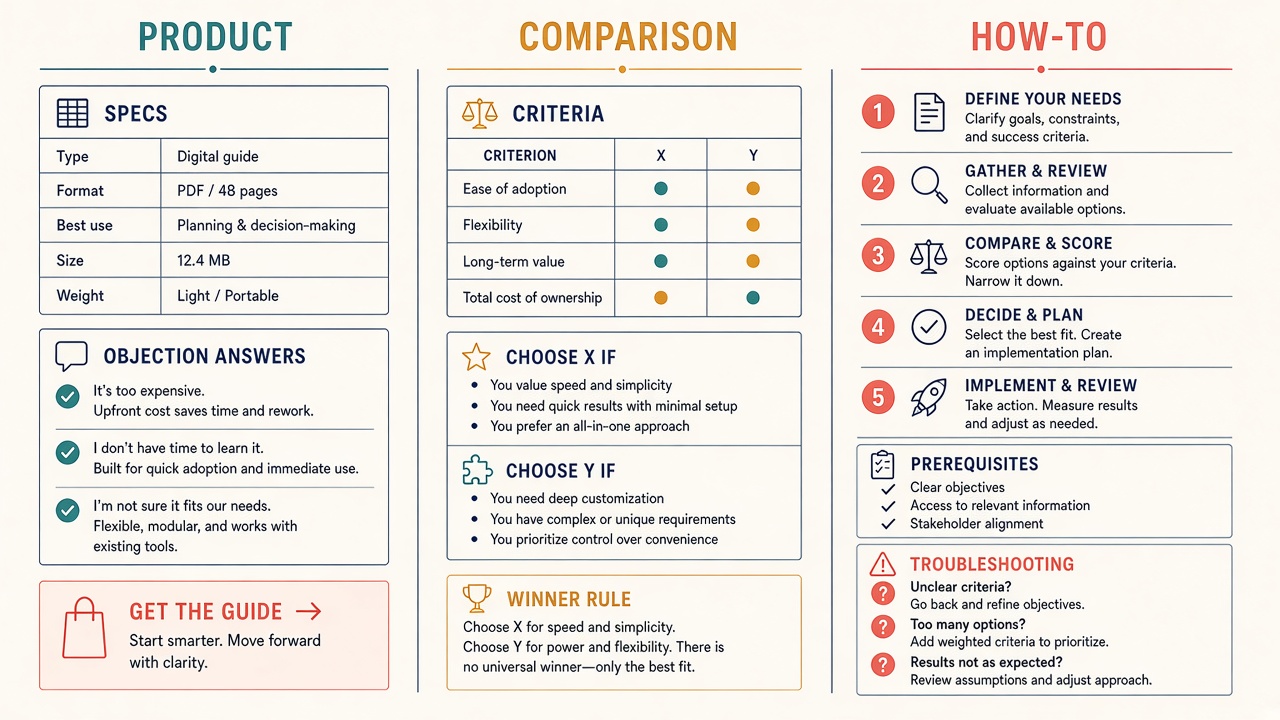
A brief still has to lock the same rank contract on every page: primary keyword, search intent, audience, SERP notes, must-cover entities, internal links, and a clear definition of done. What cannot be shared is the outline that delivers that contract. Paste the same H2 list onto a product page, a comparison, and a how-to, and the draft will miss featured snippets, comparison tables, or product modules because each SERP rewards a different job.
Product briefs optimize for transactional or commercial investigation. They force specs, proof, objections, and a conversion path so the writer can move a buyer from “is this right?” to “add to cart” without inventing the pitch. Comparison briefs optimize for decision-making: criteria, fair trade-offs, a recommended pick with explicit rules, and alternative paths for readers who do not match the winner. How-to briefs optimize for task completion: prerequisites, numbered steps, troubleshooting, and extractable answers search can lift.
Keep this article as worked examples. Use your site’s brief template for the blank fields; the three page types below show how those fields change when intent changes—not a reusable skeleton you can copy from one URL to the next.
Same contract, different job — The shared contract is keyword, intent, entities, and done criteria; the outline must still be page-type-specific so writers ship ranking copy without reinventing structure.
A filled product-page brief for a mid-market workflow tool
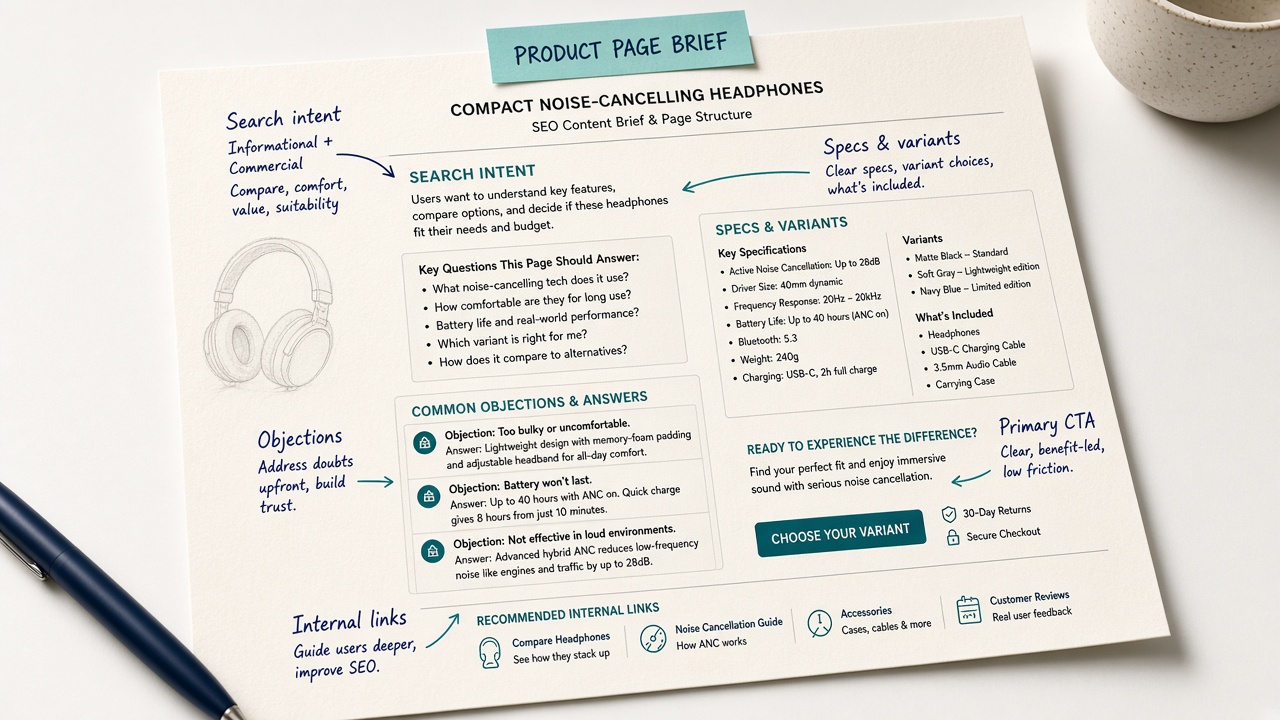
Treat the product brief as a conversion contract, not a feature dump. Use a concrete fictional SKU so writers never invent a vendor. Call it Northline Flow, a mid-market work-management platform for operations teams. Primary keyword: “work management software for operations teams.” Secondary terms sit around workflow automation, task routing, and ops dashboards. Intent is commercial investigation: the searcher is choosing a tool, not learning a concept. ICP: operations managers who outgrew spreadsheets and need audit trails without enterprise bloat. Unique value: configurable routing that maps to existing SOPs, not a blank canvas that forces a process redesign.
Must-include specs: role-based permissions, SLA timers, native Slack and email intake, CSV and API export, SSO, and a published uptime commitment. Social proof is only earned reviews and named case-study logos already on file—never invented testimonials. Objections to pre-answer: migration effort, whether it replaces the current ticketing stack, and what happens if the team is not technical. Primary CTA: start a trial; secondary: book a demo. Outline modules in this order: hero promise with the outcome in one line; who it is for and who it is not for; feature-to-outcome blocks (each feature tied to a job the buyer already does); plan notes without a full pricing table if SERP leaders keep price off-page; a short teaser that points to a comparison page; FAQ that matches People Also Ask phrasing.
On-page and AEO notes: Product schema plus FAQ schema; review markup only if ratings are real and current; a scannable spec list so extractors can lift facts without scraping prose. Internal links: one to the comparison page (same cluster) and one to a how-to setup guide. Writer constraints: no unverifiable performance claims, no stuffing secondary terms into headings, match the commercial language of ranking product pages. Definition of done: a buyer can choose trial, demo, or compare without leaving because a spec, plan note, or objection was missing.
Product brief — A product brief is done when every spec, objection, and next step lives on the page so the writer cannot invent proof and the buyer does not have to leave.
A filled comparison brief: two tools, one verdict, no feature dump
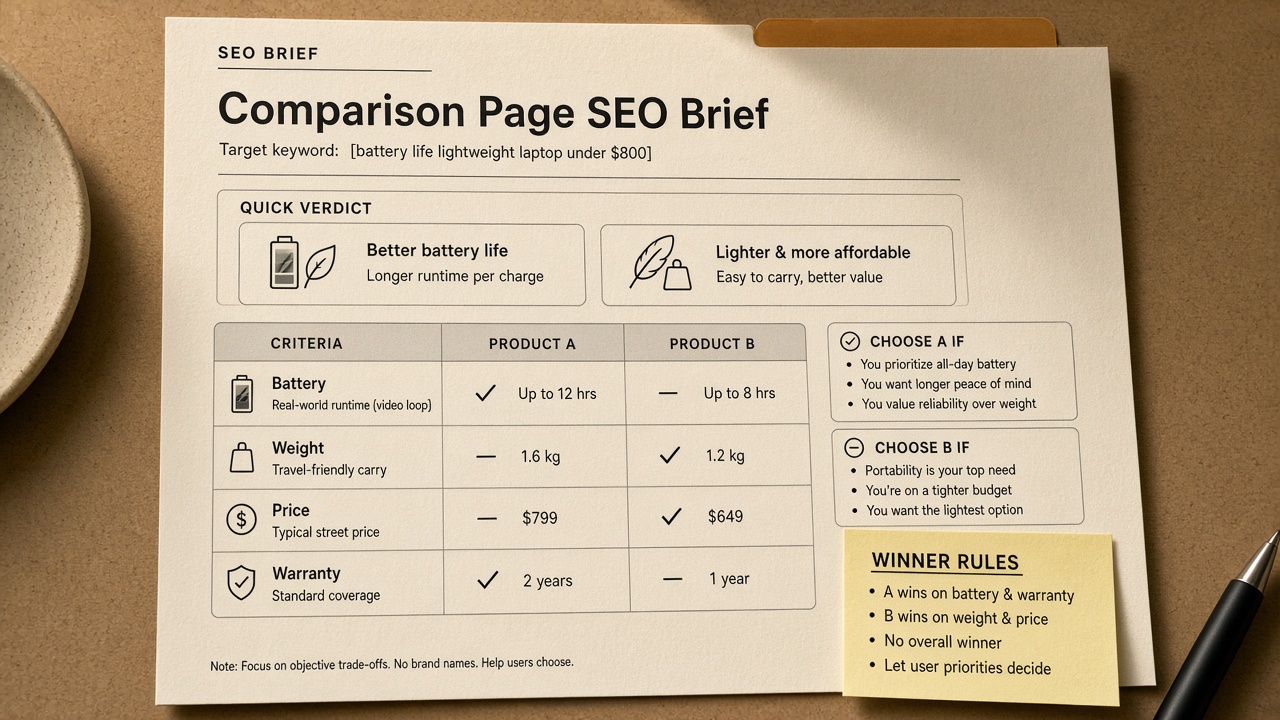
That product brief exists so a writer can sell one option without inventing proof. A comparison brief has a different job: it must help someone choose between two named products, not recap every feature twice. Pair a concrete versus (Northline Flow vs. HarborDesk, for example) with a “best for” frame so the page is a decision, not a dump.
Fill the rank contract with a comparison cluster (primary versus query plus “best for [role]” and “alternative to” variants), commercial-investigation intent, and two audience segments—ops leads who need governance versus teams who need speed. List must-compare criteria before anyone writes: price, setup time, integrations, usage limits, and support. Spell winner logic in the brief (“pick Northline if you need audit trails; pick HarborDesk if you need a same-day start”) and require a disclosure line if any affiliation exists.
What the outline must lock
Do not leave “it depends” as the close. Require a criteria table and a choose-X-if / choose-Y-if block. The H2 sequence should be: quick verdict, who each option fits, side-by-side table, a deep dive per criterion, honest alternatives, then FAQ aimed at switching objections (data export, overlapping seats, training cost). Internal links go to each product page, a how-to for migration or setup, and the cluster hub so the comparison is never an orphan.
Definition of done: a hurried reader can pick a path in the first screenful; a careful reader can verify trade-offs without feeling sold. That is the contract. The next page type—how-to—has to teach a sequence instead of a choice.
The contract — A comparison brief is a scored decision: named pairing, must-compare criteria, explicit winner logic, and links to both product pages plus a how-to—never a second feature list.
A filled how-to brief: cluster to publishable page
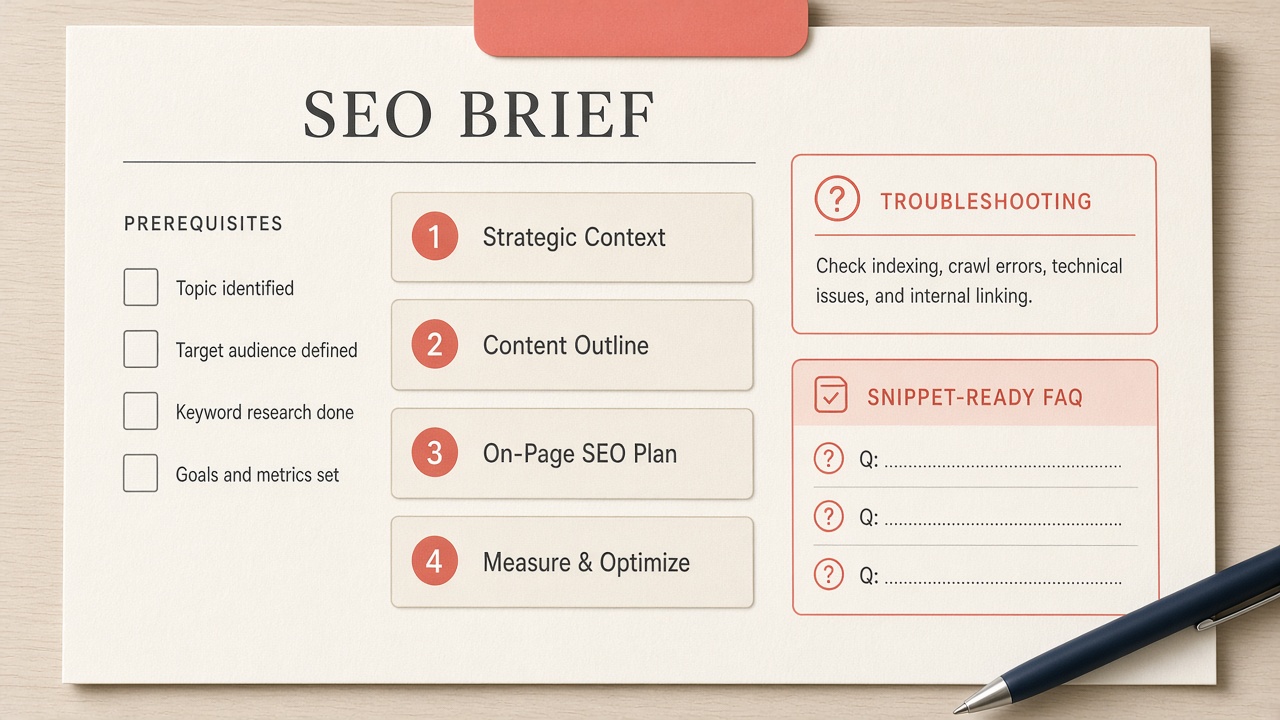
Comparison pages close a choice. How-to pages close a task. The brief below is for a companion article—how to turn a keyword cluster into a publishable SEO content brief—so it complements product and comparison copy instead of repeating template or automation explainers. Primary keyword: how to write an SEO content brief from a keyword cluster. Intent is informational/how-to. Searcher job-to-be-done: leave with one shippable brief, not a theory of clustering. Skill level: SEO generalist who already has a cluster export. Time estimate: one focused working session. Prerequisites: cluster spreadsheet, SERP notes, and access to the page-type template. Tools: spreadsheet, SERP window, brief doc. Success state: a writer can draft without inventing H2s or missing conversion jobs.
Keep the outline as numbered steps with one action each. Do not shuffle the sequence: SERPs reward prerequisites first, then the procedure, then failure modes. A short “why this order” line belongs in the brief so writers cannot bury setup in the intro.
AEO notes: write HowTo-style step clarity; add a definition box only if a term is required to complete the task. Schema should mirror the numbered steps, not a marketing outline. Definition of done: a first-time reader can finish from this page alone—no prerequisite hidden in the opening paragraph. That is the same rank contract as the other briefs, applied to a task instead of a purchase.
Ship the task — A how-to brief is finished when the reader can complete the job in order, recover from mistakes, and only then follow a link to choose a product—without reconstructing the outline themselves.
Key Takeaways
Open the on-site brief template and fill the next product, comparison, or how-to page against the matching example above.
Frequently Asked Questions
You Might Also Like
- Guides SEO Content Brief Template: The Complete Guide to Briefs That Rank
- Workflows SEO Content Brief: How to Brief Writers (and AI) So Pages Rank
- Guides Free SEO Content Brief Generator: How to Brief Writers in Minutes
- Strategy Long-Tail Keyword Research: A Practical Workflow for Briefs
- Workflows SEO Workflow Management: How to Run Content From Brief to Publish