Keyword Cannibalization vs Duplicate Content: Which Problem the Brief Should Name

The next brief should not inherit a diagnosis just because two URLs show up for one query. Duplicate content and keyword cannibalization send the work in opposite directions, and naming the wrong one queues the wrong page.
Name duplicate content only when the same or near-identical primary text exists at more than one URL. That is a canonicalization problem, not a topic problem: Google clusters those pages, picks a preferred URL, and crawls the duplicates less often. Name keyword cannibalization only when different pages serve the same intent and actually split the query. Different prose does not clear that label.
John Mueller has said three pages in one result are not a problem merely because there is more than one, and pages are not duplicates just because they share a results page. Ahrefs hand-reviewed 80 multi-ranking keywords and found only one that needed action. The brief's job is to name same text, same intent, or neither—before content automation scales the wrong fix.
- Duplicate content is the same or near-identical primary text at more than one URL, and it is a canonicalization problem.
- Keyword cannibalization is different pages serving the same intent and splitting the query; different wording does not clear the label.
- Two or more of your URLs in one result are not, by themselves, either problem.
- Ordinary on-site duplicates are not a Google spam-policy violation; Google clusters them and crawls duplicates less often.
- Leave both labels blank unless same text or a real intent split is present.
Keyword Cannibalization vs Duplicate Content: Same Text or Same Intent?

The difference is a split in what is actually repeated. Duplicate content is identical or near-identical primary text at more than one URL. Keyword cannibalization is different pages on the same site competing for the same keyword and the same intent — the split Search Engine Land draws between copied text and an unintended fight for one query.
Same text is what a reader could swap between URLs without losing the answer. Same intent is the query job — the question the searcher needed answered — regardless of wording, title, or keyword variant. A shared topic, a shared results page, or a shared cluster is not either label. Grouping those searches onto one owner URL is a clustering decision, not a reason to name either problem here.
The split — Name duplicate content only for the same primary text at more than one URL, and keyword cannibalization only when different pages split the same intent.
Can Two Articles with Different Wording Still Cannibalize Each Other?
Yes. A rewrite does not clear keyword cannibalization. Two articles can use completely different wording and still collide if both answer the same query. Different prose competing for one job is the cannibalization label, not a passed duplicate check.
Overlap still counts when the keywords differ, if both pages would satisfy the same searcher. Different keywords with different jobs are a cluster, not a collision.
The adjacent test is the owner URL. A support article and a blog post should not both own one query job. Do not brief a second URL just because the keyword string changed.
Same job — Different wording does not clear cannibalization. If both pages would satisfy the same searcher, keep one owner URL and do not brief a second page because the keyword changed.
Is Keyword Cannibalization a Google Penalty?

No. When two of your pages split the same query job, that is self-competition, not a spam-policy penalty, so the brief should never write “penalty.”
Ordinary duplicate content on your own site is not a spam violation either. Google says some duplicate content on a site is normal and is not a violation of its spam policies, and it has long said there is no duplicate-content penalty in the way most people mean it, unless the duplication is deceptive. Martin Splitt has also said duplicate content does not change how Google perceives site quality.
The ranking effect is consolidation. Google clusters the same or very similar primary content, picks a canonical, and crawls the copies less often. The separate quality risk is unoriginal cloned text, which Google’s March 2024 quality systems targeted — later reported as 45 percent less low-quality, unoriginal content in results — not two pages that merely share a topic.
Does Google Combine Similar Pages It Never Calls Duplicates?
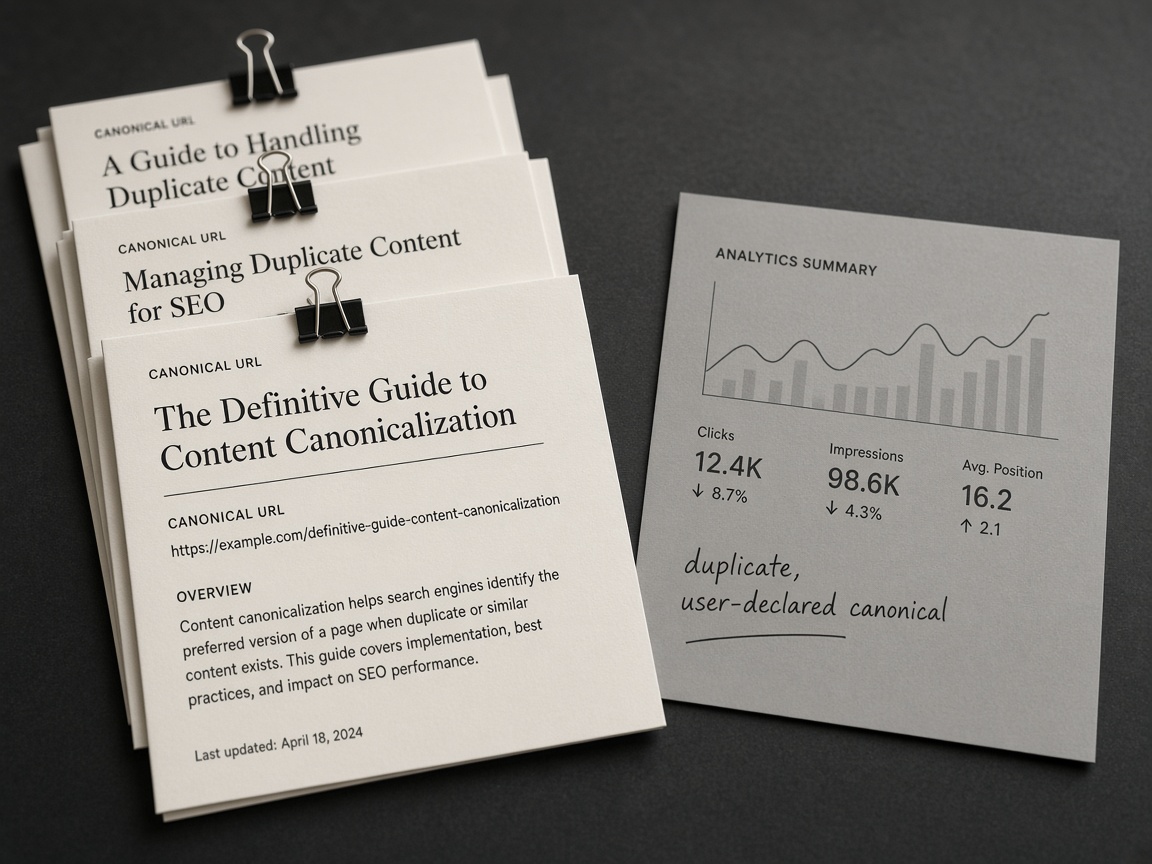
That clustering is not limited to pages Google is willing to call duplicates. Similar pages can still compete with each other, and at a larger scale they can take longer to get crawled, though Martin Splitt said that is not something to lose sleep over. Pages that cover the same job should be combined anyway, even if Google never treats them as duplicates.
A duplicate reason in Search Console means that grouping already happened and a canonical was chosen. It is not a cannibalization verdict and not a penalty notice. Console only reports pages that were actually shown. A keyword overlap that never appeared is theoretical, so it is not evidence for either label.
Same job, one page — Combine pages that cover the same job even when Google never calls them duplicates. A Search Console duplicate reason only means a canonical was chosen — not cannibalization, and not a penalty.
Is It a Problem If Two of My Pages Show for the Same Query?
No. Pages that actually show still are not a verdict. John Mueller has said three different pages from one site in the same result are not a problem merely because there is more than one, and that pages are not duplicates just because they share a results page. Shops, recipes, and tools for one topic can legitimately sit together.
Google has said users usually will not see more than two listings from the same site in the top results, with an exception when more are especially relevant. Extra overlapping URLs rarely buy more space on the page. Two URLs are a prompt to test whether each page does a different job, not a reason to name either problem.
Test the job — Two of your pages in one result are a reason to test intent, not a reason to write duplicate content or keyword cannibalization on the brief.
When ranking with more than one page is a good thing
That second listing is usually diversification, not a failure the brief has to name. A hand review of 80 keywords already ranking with more than one page found only one case that needed action. On one site, more than 9,700 keywords ranked with more than one page — a volume that would be absurd if every extra URL were a defect.
Keep the extra URL when the pages answer different jobs and the query is not materially split. Name a problem only when the same intent plus a real split is present. If the only evidence is another URL, refuse both duplicate content and keyword cannibalization. That hold is the brief’s correct outcome.
Diversification — Multiple rankings are a good thing unless the same intent is actually split; an extra URL alone is not a problem to name.
Which Label Belongs in the Brief's Problem Field?
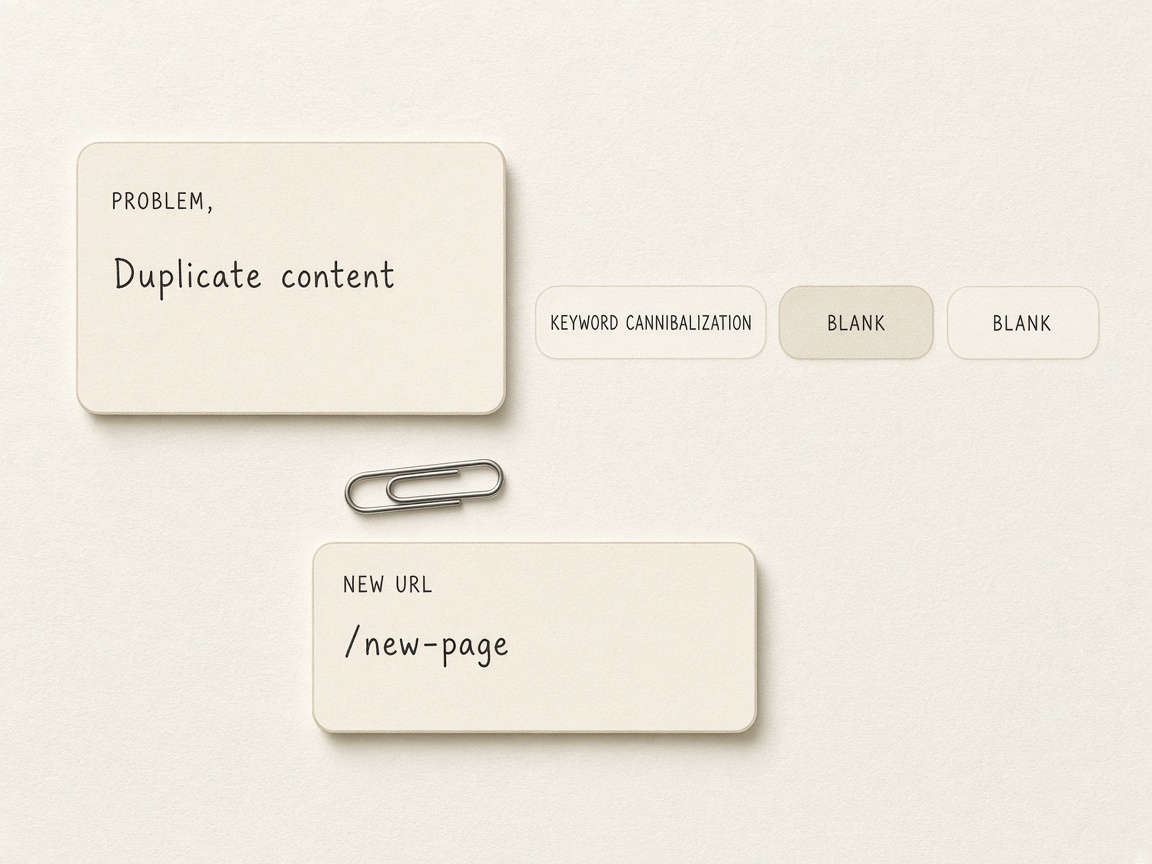
The problem field takes exactly one of three outcomes: duplicate content, keyword cannibalization, or blank. Never both, and never a vague third label such as overlap. Fill the card in that order before you queue anything.
A brief that clones the same primary text is a duplicate-content case. A brief that retargets an intent the site already owns is a cannibalization case. An extra ranking URL with a different job is neither, so the field stays empty.
One label — Name cannibalization only for different pages that share an intent and split the query, name duplicate content only for repeated primary text, and leave the field blank when the extra URL is not a real split.
Should an Automated Brief Refuse a Repeated Intent?

Yes. Once the owned URL already answers the intent, the automated brief refuses the new page. A rewrite of the same job is another cannibalizing URL, not a fix.
The label only chooses the next document. Duplicate content points to consolidation, not a new topic: redirects and rel=canonical are strong signals, sitemap inclusion is weak, and a declared canonical is a hint Google may ignore — often because owners use it incorrectly. Do not spend crawl time, or a new brief, on duplicate versions of the same text.
Keyword cannibalization points to the content cannibalization audit for merge, redirect, or hold. Do not re-decide that fix in this brief. A blank field means queue nothing and do not open either fix.
Stop here — Refuse the page when the intent is already owned. The label routes the work; it never authorizes a second URL for the same job.
Key Takeaways
Before the next brief is queued, check primary text, query job, and a confirmed split, then name one problem or leave the field blank.
Frequently Asked Questions
You Might Also Like
- Quality Content Cannibalization Audit: How to Merge, Redirect, or Hold Overlapping URLs
- Governance Support Article vs Blog Post: Which URL Should Answer the Query
- Workflows Content Refresh Calendar: When to Update vs When to Brief a New Page
- Workflows How to Brief a Content Refresh for Writers and AI
- Measurement Traffic Drop vs Content Decay: What the Brief Should Capture