How to Brief a Content Refresh for Writers and AI
A content refresh brief is not a new-page SEO brief with the target phrase swapped in. It is a change contract for a URL that already has a job: what the live page says, what must stay, what must change, and what a writer or model must refuse. Once decline starts, organic content decays at an average rate of 1.21% per week, compounding to more than half of peak traffic over a year, according to ContentForce. Fractl found that a typical piece loses about 76% of its peak traffic after it peaks. Waiting for a vague annual cleanup is how that decay becomes the plan. The brief has to name the failure, not the mood. RefreshOS is blunt about the alternative: tell a writer to "improve the article" and you get grammatical edits and nothing else. Search Results makes the same point from the automation side — without a clear brief, refresh work often becomes cosmetic. The assignment should already say whether this is a surgical update or a rewrite. Do not reopen that call inside the draft. AI makes a weak brief more expensive, not less. Search Roost's rule is the one that belongs on the first page of the handoff: do not let AI invent updated numbers or claims. The contract that follows is how you keep the original URL, attach only verified sources, and run the same fail-closed gates on a human draft and a model draft.
- A content refresh brief is a keep, change, and refuse contract for an existing URL, not a new-page brief with the keyword swapped.
- Name the current failure and the specific replacement; "improve the article" only produces cosmetic edits.
- Decide surgical update versus rewrite before drafting, and do not let the writer or model reopen that call.
- Attach a source pack and ban unsourced statistic swaps so an AI article writer cannot invent fresher numbers.
- Lock the canonical URL and score human and model drafts against the same publish gates.
What a Content Refresh Brief Is, and How It Differs From a New-Page SEO Brief
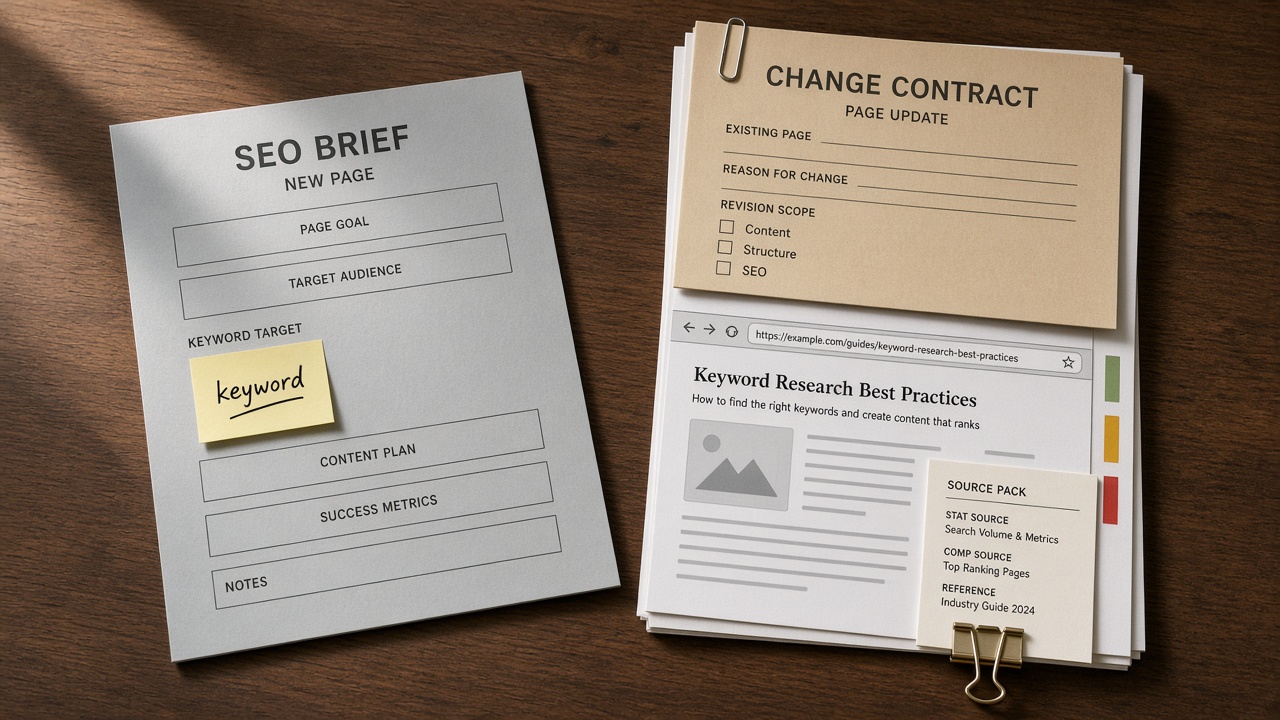
A content refresh brief is a change contract for one live URL: the current page, what must stay, what must change, and what the writer or model must refuse. It is not an SEO content brief for a new page with the keyword swapped. A new-page brief proposes an outline from a blank slate. A refresh brief constrains an edit against an asset that already ranks.
Link the new-page template. Do not paste it in.
Do not copy the new-page template into this packet. Link to it. This brief exists only because the URL already has a query, a canonical, and a commercial job. Those three facts are the baseline the edit has to respect. Dropping a keyword into a blank-slate outline throws that baseline away and invites a rewrite the ranking page never asked for.
The difference shows up in what “done” means. A new-page brief is finished when a draft exists. A refresh brief is finished when the named failure has been replaced and every unmarked block is still the live page. Without that boundary, there is no finish line, and the ranking asset gets rewritten by default.
Change contract — A content refresh brief locks one live URL: what stays, what changes, and what the writer or model must refuse. If it only says improve the article, it is not ready to hand off.
Which Pages Deserve a Refresh Brief First?
With the keep, change, and refuse contract defined, the next decision is which live URLs deserve that packet. Brief first the pages a bounded edit can still move: positions 4–20, where refresh work pays off fastest, and only where the query intent still matches the page’s job. Older posts that already carry the results belong in that same first pass. At HubSpot, 76% of monthly blog views and 92% of monthly blog leads come from old posts, which is why a maintenance brief beats another net-new assignment.
Trigger the queue from decay, not a yearly sweep
A vague annual cleanup waits too long. Most teams still wait until the content is obviously stale: only 50% of marketers update content when it becomes outdated, and 9% rarely update at all. Fire the brief on the decay signal, while a same-URL edit can still recover the page.
Do not spend those first briefs on topics the site has never covered. Only 5.7% of newly published pages rank in the top 10 within a year, so an already-ranking URL is the higher-leverage job. Leave consolidate-or-ignore calls to the refresh-strategy decision. This queue is only for URLs that will receive a same-URL change contract, not a merge, a retirement, or a fresh slug.
First in line — Brief first the URLs a bounded, same-URL edit can still move — positions 4–20, intent that still matches, and older pages already producing views and leads — and trigger that queue from decay, not a yearly sweep.
Why Refresh Briefs Come First
What Fields and Baseline a Content Refresh Brief Needs
Once a URL clears the queue, the packet is not a prompt to improve the article. Before anyone edits, a content refresh brief has to hold a performance baseline and a bound set of fields, so a writer or a model cannot invent fresher facts or open a new slug.
The baseline that belongs in the brief is a pre-refresh window for that live URL: impressions, clicks, average position, and the queries it already earns. Those are the only figures a later read may compare. Without them, a lift is just a new date stamp.
The fields the packet must already hold
Leave one of these out and the draft starts deciding things the brief was supposed to settle.
- Live URL, locked as the canonical
- Query and the intent that URL already serves
- Named failure, plus the specific replacement
- Preserve list, change list, and refuse list
- Source pack the writer or model may cite
- Assigned internal links and metadata locks
- Extractable answer and a review-date rule that must match the updated facts
- Acceptance criteria for the same window and the same queries
The failure is written in plain language: a buried answer, a dead statistic, a missing section. The change list names the replacement — the paragraph that moves up, the sourced figure that replaces the dead one, the section written from the source pack. “Make it better” is not a field, and neither is a request to find fresher numbers. If a claim needs a figure, the source pack already holds it.
Acceptance criteria belong in the packet now, not after publish. They say which headings, sources, preserve rules, and metadata locks must pass, and they lock the comparison to that same window and those same queries. The brief also inherits the update-versus-rewrite call already made: surgical when most of the page is still sound, a fuller rewrite only when the foundation does not hold. That call is not reopened inside the draft.
Before the edit — A refresh brief is ready only when the pre-refresh window, the named failure and its replacement, and the acceptance criteria are already in the packet — not when someone has been told to make the article better.
What Writers and AI Must Keep, Change, and Refuse
The brief tells both the writer and the model the same thing: keep every block that still satisfies intent and still earns the query, change only the diagnosed failure, and refuse anything that is not on the change list. Those three lists are the contract. If either executor gets a looser version, the handoff is incomplete.
The preserve list is as binding as the outline. A section that is not marked for change stays, including examples, internal links, and claims that are still sourced. The surgical-versus-rewrite call already lives in the packet; the draft does not reopen it by polishing paragraphs that still hold.
A prompt that only says refresh this is not this brief. Humans and models receive the same three lists, or the work is not briefed.
What both executors must refuse
- No new slug, and no second URL that dilutes the one that already ranks.
- No unsourced number swap, even when a fresher-sounding figure would read better.
- No scope creep into a different article, query, or commercial job.
- No cosmetic rewrite of sections that still satisfy intent and still earn the query.
The refuse list is shared, not a style note for one side. Change is limited to the failure the brief already named and the replacement it already specified. Everything else stays, so freshness is an edit to the live page rather than a new draft wearing the old topic.
Same lists — Writers and models keep what still earns the query, change only the named failure, and refuse everything else — including a new slug, an unsourced stat, and a cosmetic pass.
How to Stop Invented Statistics and Brief the Extractable Answer
You stop a writer or model from inventing updated statistics by attaching a sourced replacement pack and banning every figure that is not in it. The extractable answer is then briefed as an edit on the page that already ranks: a direct answer near the top of the page, a source on each claim, and a review note that appears only after those facts have actually been replaced.
A line that only says “update the numbers” is how invented freshness gets in. Dead statistic links are a brief input, not a prompt to hunt for a fresher percentage. In one audit, 28.6% of embedded statistic URLs were already dead. If the pack supplies a sourced replacement, that figure is the only swap allowed. If the URL is dead and no replacement is supplied, delete or flag the claim. Do not let the model manufacture a number that sounds more current.
AI-assisted refreshes start from verified sources. The operating rule is not to let AI invent updated numbers or claims. A visible review date is allowed only after the facts it claims to update have been replaced. Recency is rewarded when it is real: 76.4% of pages cited by ChatGPT were recently updated, and AI search platforms prefer to cite content that is 25.7% fresher than what ranks in classic organic results. A rewritten introduction stuffed with unsourced statistics is not that freshness. It is a new set of claims on an old URL, which the refuse list exists to block.
What the extractable answer on this URL must include
- A direct answer in the first 100–150 words, written for the query this URL already earns.
- Claim-level sources drawn only from the replacement pack, not from the model’s memory.
- A visible review note that matches the facts that changed, never a date stamp on an unchanged page.
That answer block is an edit to this URL, not a new article. It does not earn a new slug, a new canonical, or a this-year version of the same piece. Freshness for answer engines is the sourced replacement sitting where the old claim was, not a cleaner opening paragraph.
No invented freshness — A sourced replacement pack is the only legal number set. Dead stats without a replacement are deleted or flagged, and a review date appears only after the facts it advertises have actually changed.
Freshness Gaps in Source Briefs
Should the URL, Canonical, and Title Stay the Same?
Yes. During a refresh the URL, canonical, and title stay the same unless a separate, already-decided exception is written into the brief. Do not publish a new updated slug. The extractable answer belongs on the page that already ranks, so the address does not move when the facts do.
Keeping the original URL is the point of the brief. Updates that hold that URL improve rankings on average 83% faster than publishing a new URL on the same topic, and strategically updated posts have a 27% higher conversion rate than new content created on that topic. A second URL dilutes the asset that already does the commercial job.
The packet then assigns three link jobs so equity and context cannot leak onto a sibling page.
Metadata updates travel with the same canonical. A corrected description and a review note that matches the replaced facts publish against this URL. The title stays unless a separate exception is already in the brief. Freshness is a change to this address, not a new one.
URL lock — A refresh brief freezes the live URL, canonical, and title, and assigns inbound, on-page, and outbound link jobs so freshness stays on the page that already ranks and converts.
When to Brief an Update Instead of a Rewrite — and How Long Each Takes
Keeping the same URL does not decide how much of the page you may touch. That call is already made, and the brief only inherits it. Specify an update when most of the page is still accurate: if more than 60% of the post is still accurate and well written, a surgical update is the efficient choice. Specify a rewrite only when little of it is worth keeping — the case where about 40% or less still holds, so preserving the old draft would cost more than replacing it. Do not reopen that split inside the draft.
A surgical refresh is the short job: a few hours of focused work on a page whose foundation already holds. Many so-called content-gap audits are really refresh queues — 40 existing pages that could move into the top five with two hours of work each, not a blank-page rebuild. A rewrite takes longer to produce. It is the faster path only when keeping the old draft is the more expensive mistake.
Even a rewrite brief stays on the same URL. The time box changes; the canonical lock does not. Put the chosen path and the hour budget in the packet so a model cannot quietly expand a two-hour update into a full rewrite.
Time box — Inherit the update-or-rewrite call, lock the hours to the path, and never let a longer rewrite brief invent a new URL.
What a Refresh Draft Must Pass, and How You Know the Brief Worked
A locked path and hour budget only count if the draft is scored before it goes live. Publish only when preserve rules still hold, every changed statistic comes from the source pack, required headings are present, the canonical is unchanged, the extractable answer is in place, and the review note matches the new facts.
- Preserve blocks that still satisfy intent were left alone.
- Every changed statistic is in the source pack; nothing was invented to sound fresher.
- Required headings are present, and the canonical is the same URL.
- The extractable answer is on the page, and the review note matches the facts that were actually replaced.
Score a human draft and a model draft on that same gate. The checklist does not loosen because a model wrote the first pass. If a required heading, a source, or a refuse rule fails, hold publish and send the draft back to the packet instead of patching it in the CMS.
Then measure the brief, not the timestamp. Compare the pre-refresh baseline with a post-reindex window on the queries, position, and clicks the packet named. A new review date is not evidence the contract worked.
A surgical brief worked when position and clicks move in the range the acceptance criteria named: a successful surgical update typically moves a post 3 to 8 positions higher and lifts clicks 15% to 40%. Quarterly maintenance beats a once-a-year stamp — teams on a quarterly cycle see 42% better results than teams that refresh only once a year — but only if the keep, change, and refuse contract was actually executed.
Fail closed — Hold publish until preserve rules, sources, headings, canonical, answer, and review note pass the same gate for a person or a model; then judge the brief by the named queries, position, and clicks after reindex, not by the date on the page.
Key Takeaways
Open the next decaying URL that still matches intent and write its refresh packet before anyone—or any model—touches the draft.
Frequently Asked Questions
You Might Also Like
- Guides Update vs Rewrite: A Decision Rule for SEO Articles
- Measurement Content Decay Signals: What to Check Before You Rewrite a Ranking Page
- Workflows Content Refresh Strategy: How to Update Pages So Rankings Do Not Decay
- Workflows Content Refresh Calendar: When to Update vs When to Brief a New Page
- Automation Fail-Closed SEO Briefs: The Publish Gate Autoblogging Needs