Support Article vs Blog Post: Which URL Should Answer the Query
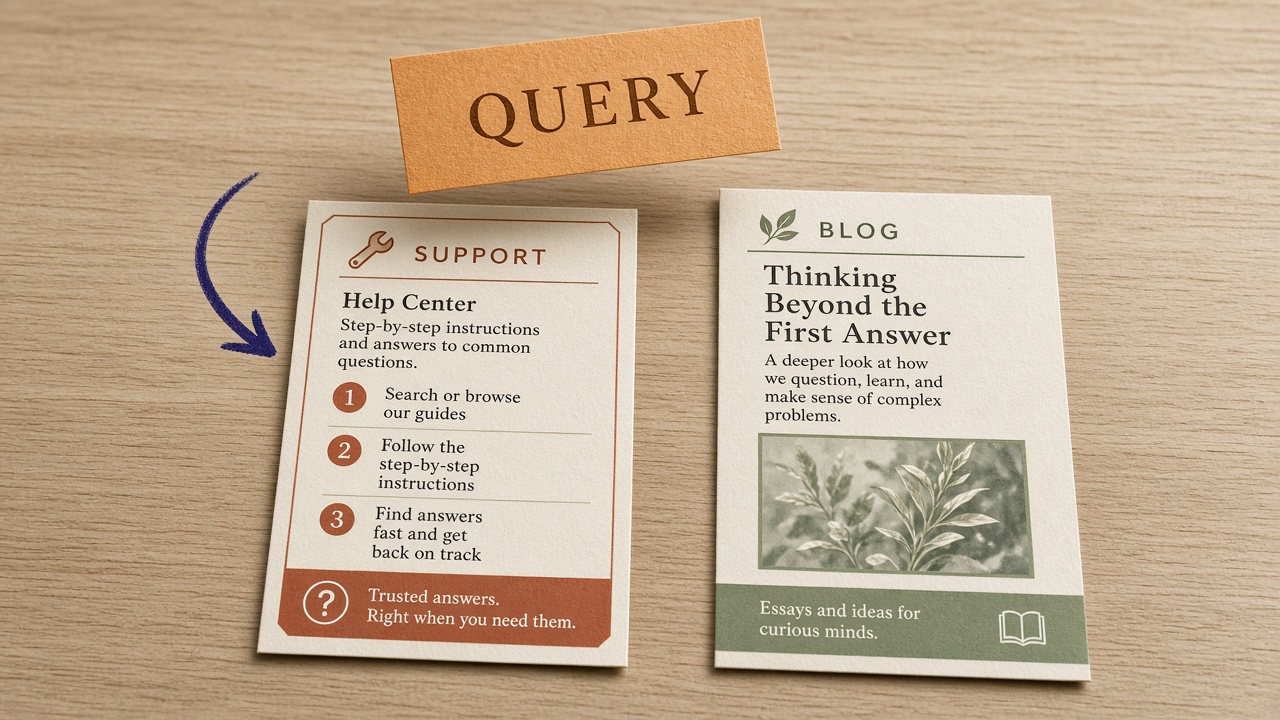
A support article and a blog post can both look like the right answer to the same search. They are not the same job. A blog attracts and educates a broad audience; a knowledge base helps someone already using the product solve a specific problem. When two pages target the same query without a clear intent split, indexed help content can cannibalize blog rankings, and search may keep the page it judges more useful even if you preferred the other one.
The assignment rule is one intent, one owner URL. In-product how-tos and error fixes belong on a public support article, which is a solution page, not a blog post. What-is, why-it-matters, comparison, and opinion queries belong on the blog. Someone searching how to fix a broken redirect after a domain change is closer to a decision than someone searching what a redirect is, so the fix query belongs on a help URL—not on whichever team published first.
That owner is also the page an answer engine and an on-site concierge should cite. Fan-out often pulls the page that answers a narrower sub-question, not the page that ranks for the head term. In Ahrefs’ March 2026 analysis of 863,000 keywords, only 38% of AI Overview citations also ranked in the top 10. The rest of this article is how to choose, publish, and measure that owner so the right URL keeps the query.
- Assign the URL by query job: product tasks and error fixes on a public support article, concepts and comparisons on the blog.
- One intent, one owner URL. A second page on the same job splits signals, and a canonical hint is a preference, not a command.
- Keep both only when a reader can name the difference—concept versus account-specific steps—and cross-link instead of canonicalizing across intents.
- If both pages already answer the same task, name the support URL as owner and merge, redirect, or rewrite the blog. Do not publish a third URL.
- Measure the assignment in Search Console: URL swaps and split impressions mean the wrong page is answering.
When Should a Support Article Answer the Query Instead of a Blog Post?
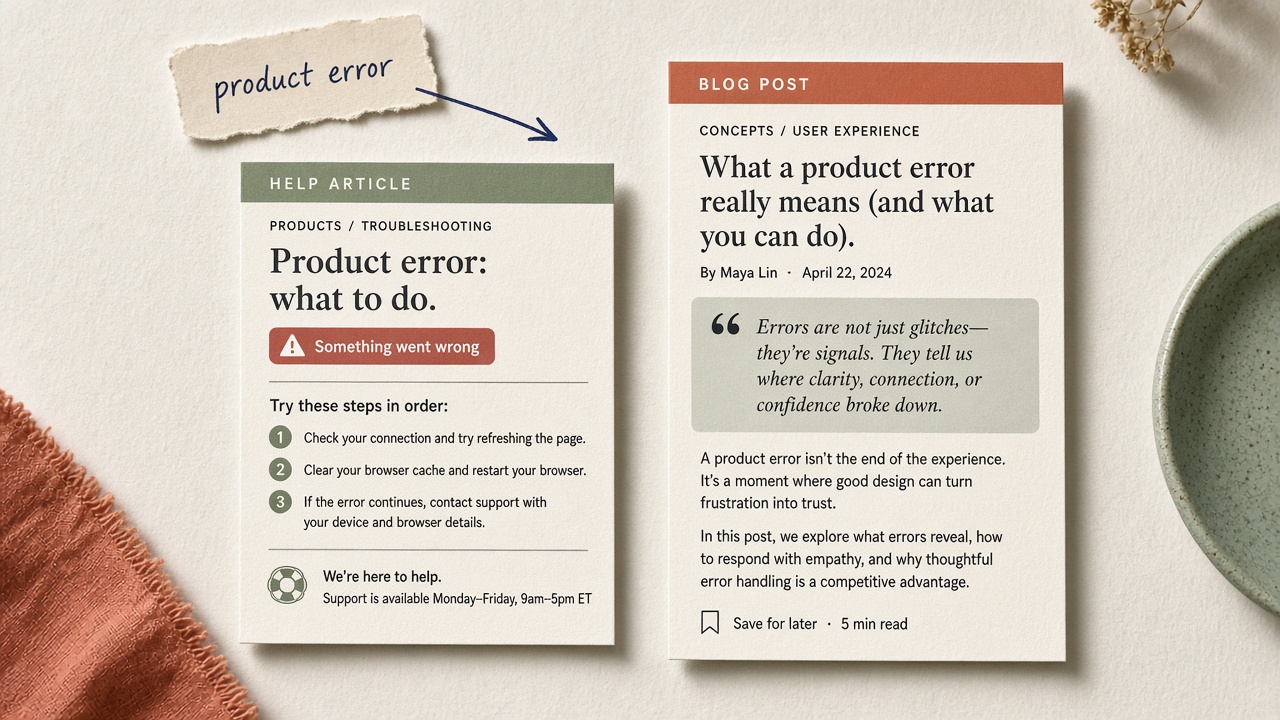
Question type assigns the URL. Acquisition and thought leadership go to the blog; support and self-service go to the knowledge base.
The knowledge base sits between broad blog content and in-product help, so a specific fix belongs on a help URL rather than a concept post. Both URLs may exist only when a reader can name the different angle. How a chosen support URL becomes rankable is help-center SEO, not a second lesson in article format.
Product How-To Queries Belong in the Help Center, Not the Blog
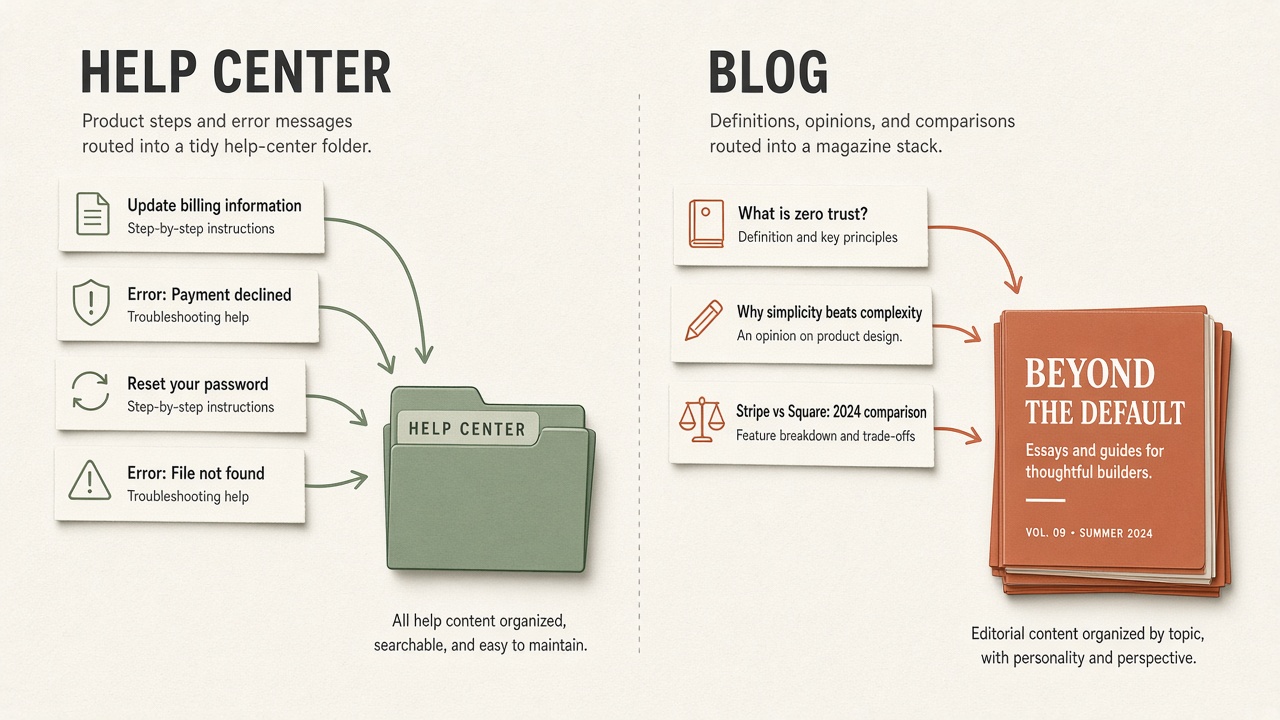
Title the help article as the question users search, because how-to queries dominate support SEO.
Awareness, thought leadership, comparisons, and why-it-matters stay on the blog even if a support writer could sketch an answer. Customer-experience tasks belong in the help system; awareness belongs in the marketing system on the company domain. Put the rankable task URL there too. Help content hosted off-domain does not pass search credit to the company domain.
If support could answer a concept query, still refuse that URL. Giving the blog’s job to help creates a second owner, not better coverage.
One job, one system — How-to and error fixes own a public help article on the company domain; concepts, comparisons, and awareness stay on the blog even when support could answer them.
How to Stop a Blog Post and a Help Article Ranking for the Same Query
That second owner is how a blog post and a help article start ranking for the same query. Stop the collision before you publish: assign keyword ownership and a URL architecture so each query has one home. Do not leave the help center unindexed just because overlap is possible.
For AI publishing, that collision is an intent clash, not a duplicate-content penalty. The rule is one intent, one owner URL—not one page per keyword. A second page on the same job splits the signals search and your concierge should send to a single answer.
Keep both only when the jobs differ in a way a reader can name: the blog explains the concept, the support article gives the steps. Cross-link those pages. Do not canonicalize across different intents.
One owner — Assign the query to one URL by intent before you publish; keep both pages only when the jobs differ, and cross-link rather than canonicalize.
How to Assign Keyword Ownership Before You Publish
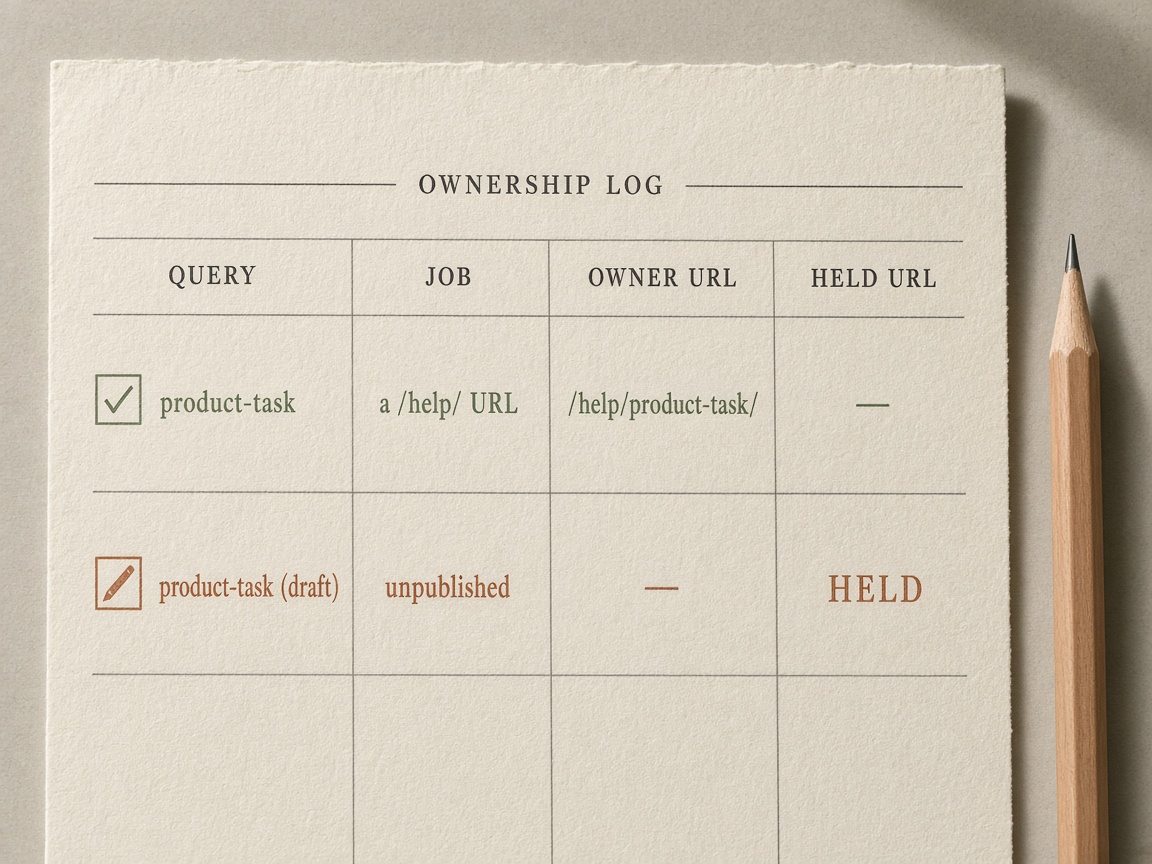
That one-intent rule only holds if you assign ownership before anyone publishes. Log the query, the job—task or concept—the owner URL, and the URL that is held. Ship a new URL only when the intent differs from every logged owner.
Third-party keyword tools often miss support-style queries. Niche, highly specific queries are notoriously under-tracked, so Search Console and ticket themes—not volume estimates—should decide which support URL owns the term.
Each help article should own one long-tail product question. One article a week can add 52 ranking pages a year, but only if each page has a distinct intent. AI and autoblogging do not create cannibalization by themselves; they publish faster than ownership rules. If both pages could answer, fail closed and do not ship the second URL.
Fail closed — Log query, job, owner URL, and held URL before publish, and refuse a second URL unless the intent is already different from every owner in that log.
When a Blog Post Already Outranks the Support Article
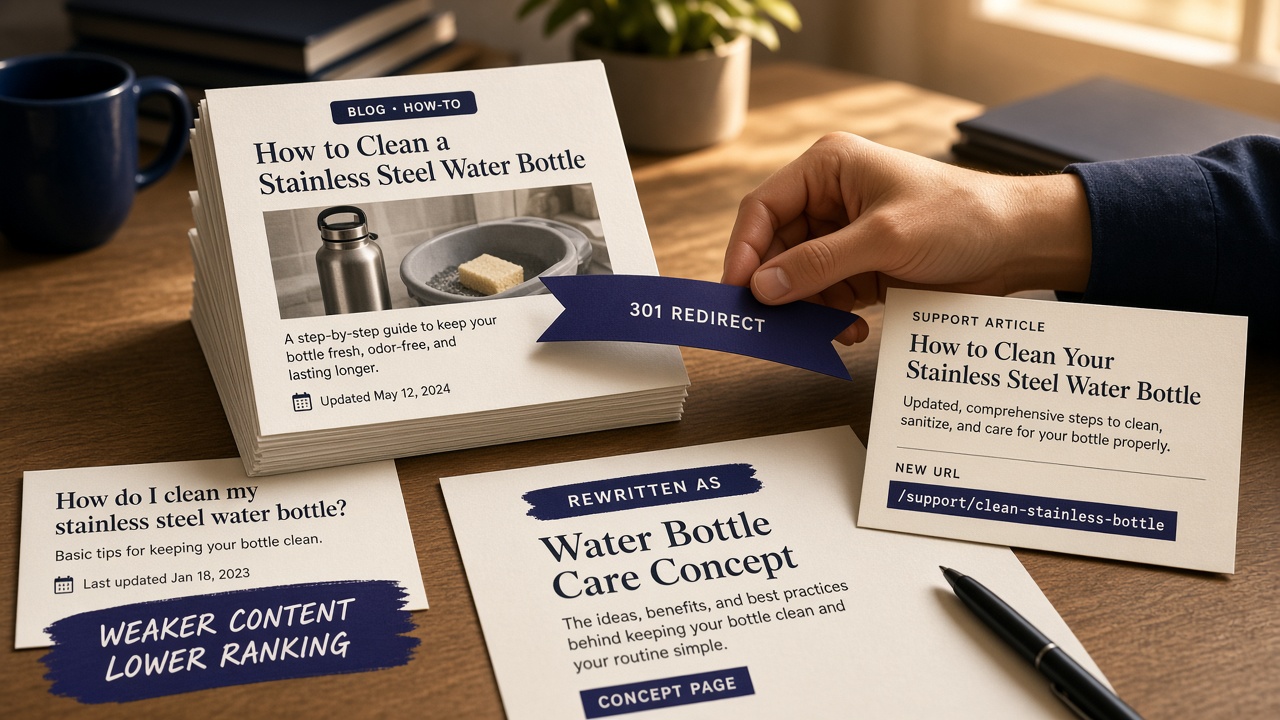
When a blog post already outranks the support article on a task query, the blog is still not the owner. Name the support URL, then merge or 301 the blog version, or rewrite the blog to an intent that does not overlap. Do not publish a third URL.
Publish a new URL only when the intent is different. When you are truly retiring a duplicate, a redirect is Google's strongest consolidation signal, a rel=canonical annotation is next, and sitemap inclusion is weak. Stack those methods for a retired duplicate, not across different intents.
Owner first — Outranking does not transfer ownership. Same task means the support URL; a named concept means a rewritten blog; no new job means one page.
Does a Canonical Tag Force Google to Rank the Help Article?
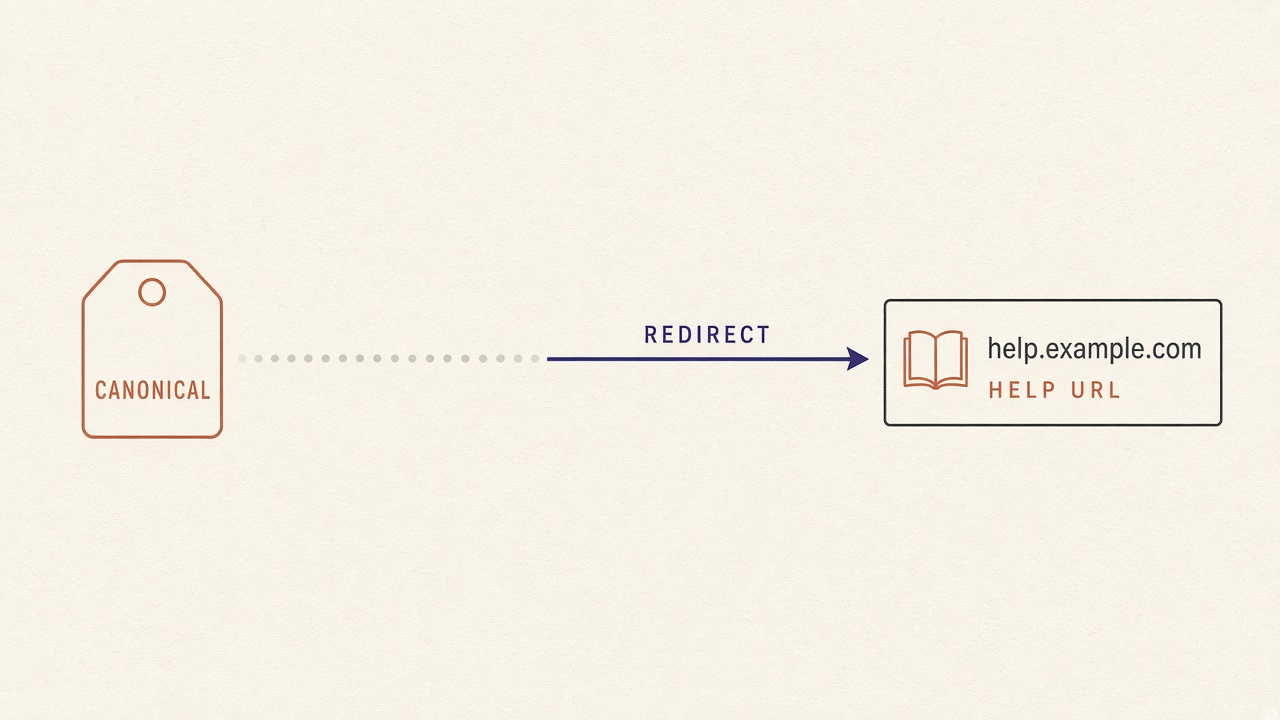
No. The strength order ends with a hint, not a switch: a rel=canonical annotation is a preference, not a command. Google clusters pages with the same or very similar primary content and may select a different canonical than the one you specify.
Do not canonical a concept blog post to a help article, or the reverse, to force a winner. Canonicals are for the same answer existing twice, pointed at the primary version. After clustered pages are differentiated, Google may still hold them in a duplicate cluster for up to two weeks. They split out faster when the content difference is clear and significant.
If the help URL must be the only answer, redirect the loser. A canonical hint alone will not override the page Google judges more useful.
Subfolder or Subdomain, and When to Noindex a Support Article

If the help center needs to rank, keep it in a subfolder such as /help/ or /knowledge-base/ when the platform allows it. Subdirectories tend to rank faster because they inherit domain authority more directly; subdomains are treated more like separate sites, and the same articles should not live on both.
That path lets Search Console filter by path and signals a topical group. Leave on-page ranking to the help-center SEO guide. Index public product articles; noindex internal-only pages, thin stubs under 50 words, and auto-generated tag or search-result pages, and point a canonical at the primary version when the same answer exists twice. A library of 50 or more distinct substantive articles favors indexing; fewer than 20 short or overlapping ones favors keeping the library closed until the inventory is differentiated.
Place and index — Put a ranking help center in a subfolder, index public substantive articles, and noindex thin, internal, or auto-generated pages.
Which URL Should an AI Concierge Cite for a How-To Question?
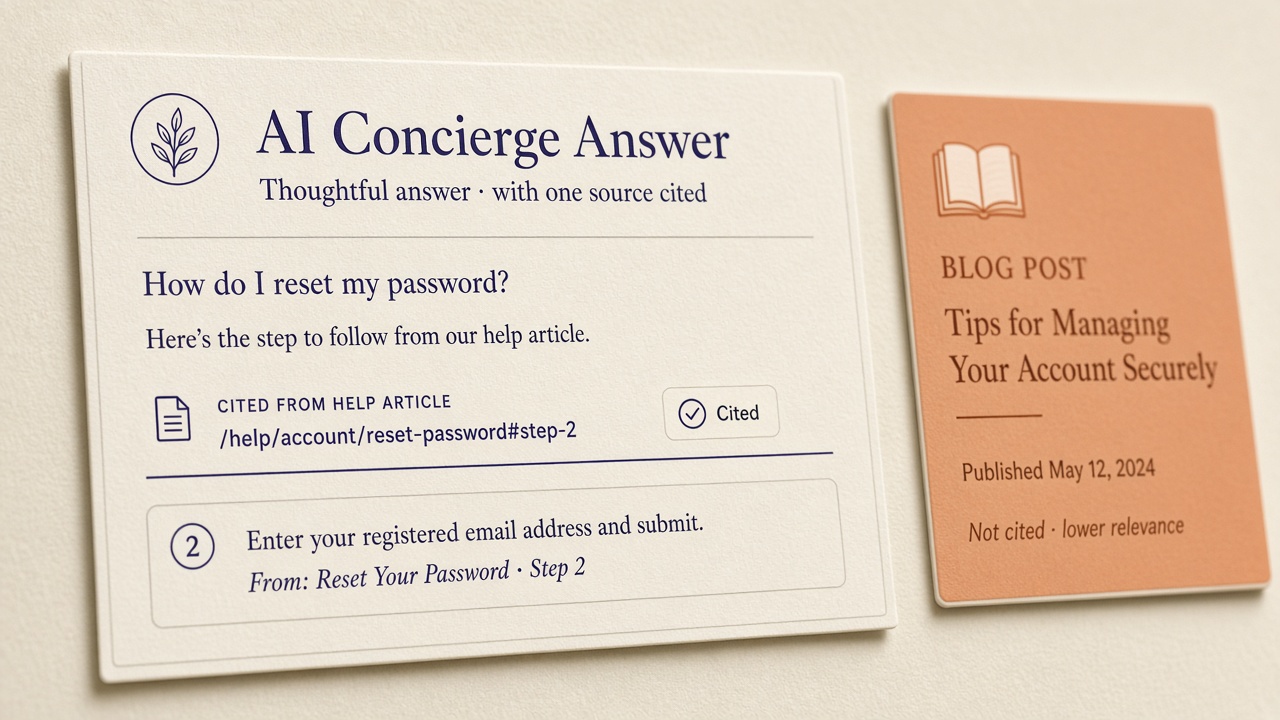
With public product articles indexed on a /help/ subfolder, the concierge still has one job: cite the logged owner URL for that how-to sub-question, not whichever blog ranks highest for the head query. If no owner is logged, it holds and does not guess. Operators follow the concierge cite-or-log allow-list rather than inventing the rule in the reply.
Nothing here shows help-center articles are cited more often than blog posts as a format. Citation follows the page that answers the narrower sub-question. The knowledge-base structure guide covers the HTML pattern; the AEO comparison covers ranking versus citation.
Ahrefs’ March 2026 analysis of 863,000 keywords found only 38% of AI Overview cited pages also ranked in the top 10, down from 76% in July 2025.
After Gemini 3 became the default AI Overviews model on January 27, 2026, query fan-out can cite a page for a sub-question even when it does not rank for the head query. Keep a complete answer in the first 40 to 60 words under the title. Sources and statistics lifted generative visibility by up to 40 percent in the Princeton GEO study—put that proof on the owner URL, not a second draft.
Cite the owner — The concierge cites the logged owner URL for the how-to sub-question and holds if none is logged. Rank position does not decide the citation.
Where AI Overview Citations Rank
How Do You Measure Whether the Right URL Is Answering the Query?
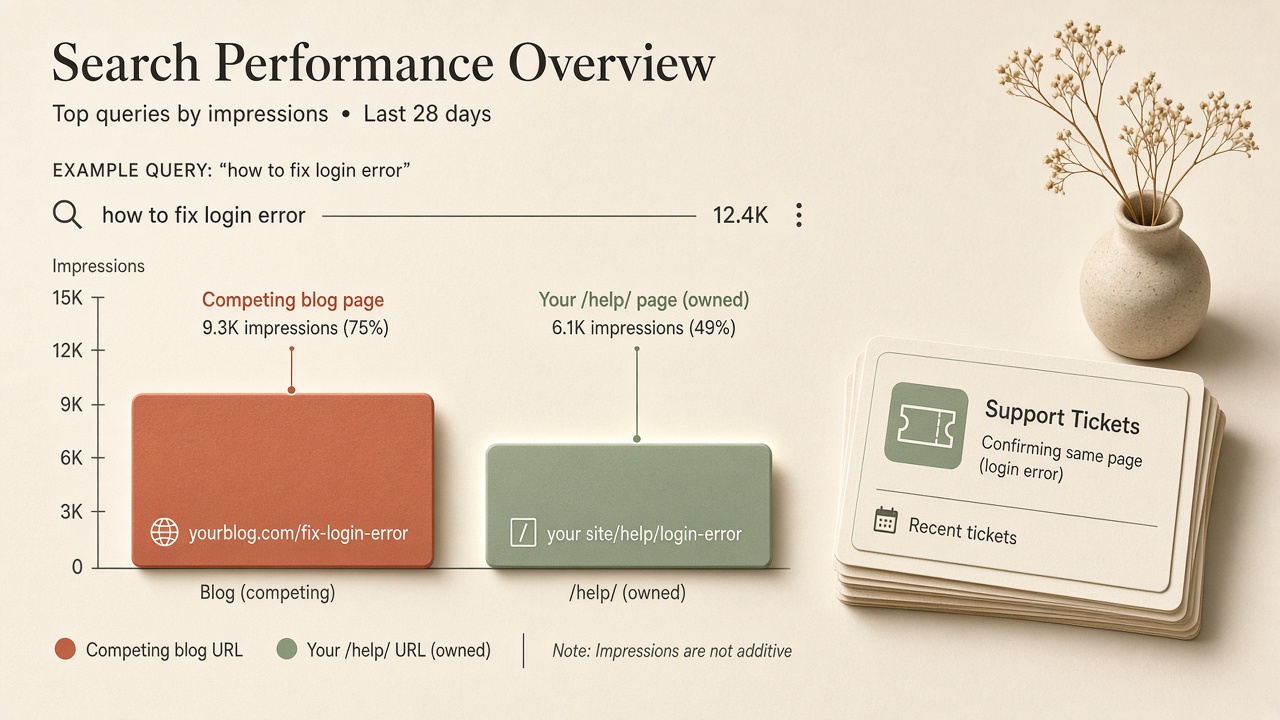
Once the concierge is pointed at the owner URL, check whether that page is the one actually answering. Measure the assignment in Search Console, not by which page you prefer. URL swaps and split impressions on the same query mean the wrong page is answering.
If Google cites a different URL on your domain than the page ranking in the top 10, that is a content-structure problem. Fix the narrower page that answers the sub-question; do not pile more authority onto the broad page. Filter Search Console by the /help/ path so blog traffic does not hide the support URL, and read ticket themes beside that path. When the cited URL and the owner disagree, recheck the ownership log. Do not add a third page to chase the citation.
Measure the owner — Search Console shows whether the logged owner is answering: swaps and split impressions mean it is not. Repair the narrower page, and never publish a third URL to chase a citation.
Key Takeaways
Before the next page ships, log the query, the job, and the single owner URL—and hold the draft if that intent already has an owner.
Frequently Asked Questions
You Might Also Like
- Guides Help Center SEO: How to Turn Support Articles Into Rankable Answers
- Concierge Flows Concierge: Questions It Should Answer From Your Articles
- Automation How to Automate Keyword Research for Content Briefs
- Concierge What Questions Should an AI Concierge Answer vs Escalate?
- Measurement How to Prioritize a Content Decay Audit When You Publish Weekly