Content Refresh Calendar: When to Update vs When to Brief a New Page

A content refresh schedule is useful only if it decides what kind of work belongs on a date, not how many URLs a team promised to touch. Traffic does not decay on a publishing quota. Across 719 editorial pieces, Fractl found the typical page reached peak traffic a median of four months after publishing, then lost about 76% of that peak within three months. A calendar that ignores that curve fills slots with new briefs while pages that already rank quietly lose the visits the library was built to keep.
The gate is simple and strict. Update the existing URL when search intent, page purpose, and core topic are still the same. Brief a new page only when the query is a different decision, audience, or cluster and no current URL already answers it. A date change without a substance change is not a refresh, and a new slug on a page that should have stayed put throws away the links and crawl history the calendar is supposed to protect.
What follows is that decision, repeated: diagnose decay and intent, choose update, rewrite-on-URL, consolidate, leave, or new brief, and lock a date only after the choice passes. Lean teams use it to spend hours on pages that already have equity—especially those sitting just off the first page—instead of treating every traffic dip as a reason to publish again.
- Schedule from decay and intent, not from a fixed publish quota.
- Default to the existing URL when intent, purpose, and topic still match.
- Brief a new page only for a different decision, audience, or cluster with no current match.
- Change the visible date only when the substance changed, and keep the slug unless you are consolidating.
- Lock the calendar date only after the update-or-new gate passes.
How Fast Does Blog Traffic Decay, and How Often Should You Refresh?
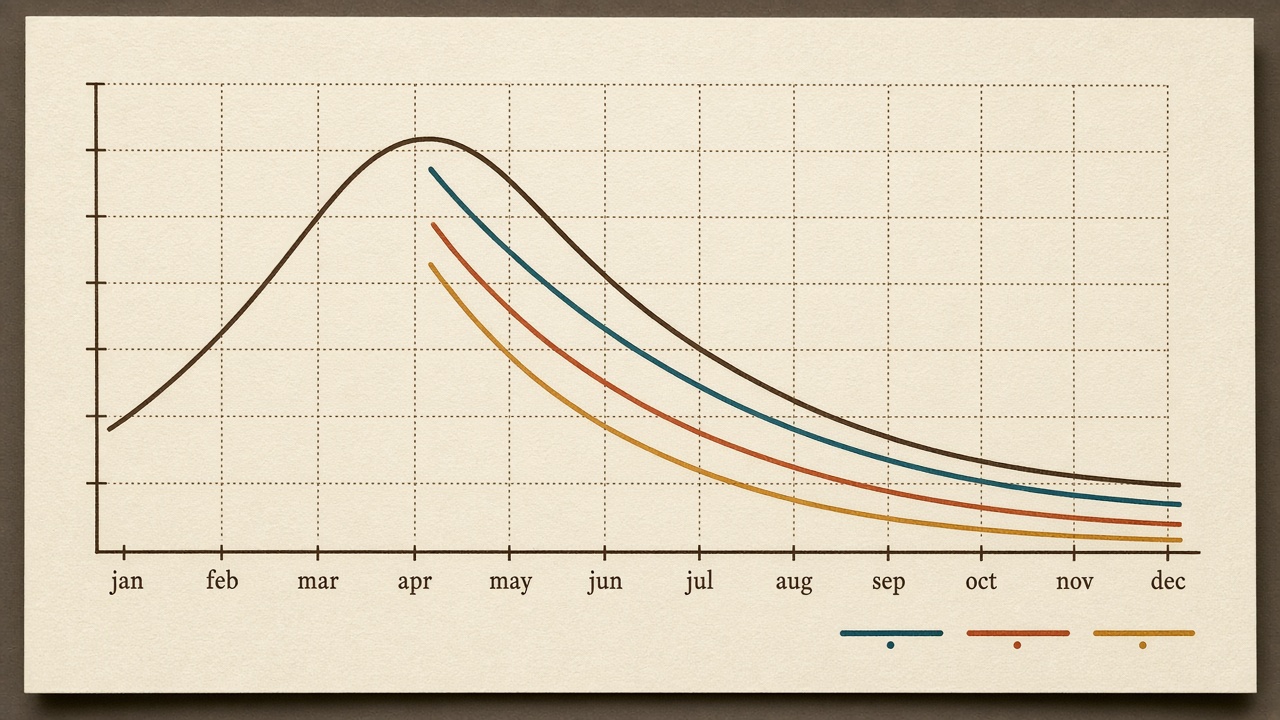
That post-peak drop is not one speed for every page, so schedule from the decay you can already see, not from a quota that treats every URL as equally stale.
Decay speed splits by format. Research and data peaked in a median of one month and lost 89% of peak traffic within three months. How-tos peaked in five months and lost 61%. Listicles peaked in five months and lost 82%. Research and data belong on the short review cycle; how-tos can wait until the steps, the facts, or the traffic slip.
A lean team does not need a vanity monthly edit. Review high-value pages at least twice a year, and check research or data pieces within a month or two of publishing because they die fastest.
Use SERP norms as a ceiling check, not a copy target. Ranking pages averaged a last-update of 730 days, about two years, while best-software queries averaged an update every 143 days. Match the surface, then stop.
Schedule from the drop — Refresh when peak traffic has already faded and the format is decaying, not because a calendar month turned over.
Traffic lost within 3 months of peak
When to Update a Page Instead of Briefing a New One

Once the diagnosis is in, the calendar choice is narrow. Update the existing URL when search intent, page purpose, and core topic still match. Cape Wired’s rule is the same: update when those three still hold, and create a new page only when the topic is a genuinely different intent or decision journey — and no current URL already owns it.
A new URL earns a brief only when the query is a different job to be done, a different buyer stage, or a cluster with no home. The same question with stale facts, examples, or screenshots is a refresh, not a launch.
Keep the slug. A refresh that changes the URL throws away the equity the calendar is protecting. Use a 301 only when consolidation is the decision — two URLs competing for the same intent. Prune when the page has no demand, no links worth keeping, and no cluster role. Leave it alone when the diagnosis is not decay.
Run that diagnose step in the existing refresh-strategy guide; do not reopen the gate here. This slot only records the choice already made.
Same URL — Same intent stays on the same URL. A new brief is only for a different decision with no current owner, and competing URLs get consolidated. Prune a page with no demand, no links worth keeping, and no cluster role; leave it alone when the diagnosis is not decay.
Which pages should go on the content refresh calendar first?

Once the gate says same-URL update or a genuinely new brief, fill the first slots with pages already in positions 4–20. Those near-miss URLs can reach the first page within weeks; net-new pages on the same topic usually take months.
Audits that expected content gaps often found about 40 existing pages that could move into the top five with roughly two hours each. Schedule that debt before gap-filling briefs.
Size the split to the library. Under about 30 pages, about 70% new and 30% updates still makes sense: a small site still needs missing cluster homes, and refreshing a thin library into a closed loop leaves those homes unbuilt. Past about 100 pages, flip toward a 60/40 or 50/50 update bias. Refreshed pages in one cited ecommerce set delivered 268% organic click growth versus 22% from new pages, and only about 1.7% of newly published pages reach the top 10 within a year. A large library should not keep briefing topics it already ranks for.
First slots — Put positions 4–20 and the two-hour near-misses on the calendar first, then size new versus update to library depth so small sites still open cluster homes and large ones stop re-briefing pages they already own.
Share of effort that should be updates
How AI Citation Windows Tighten the Refresh Schedule Versus Google
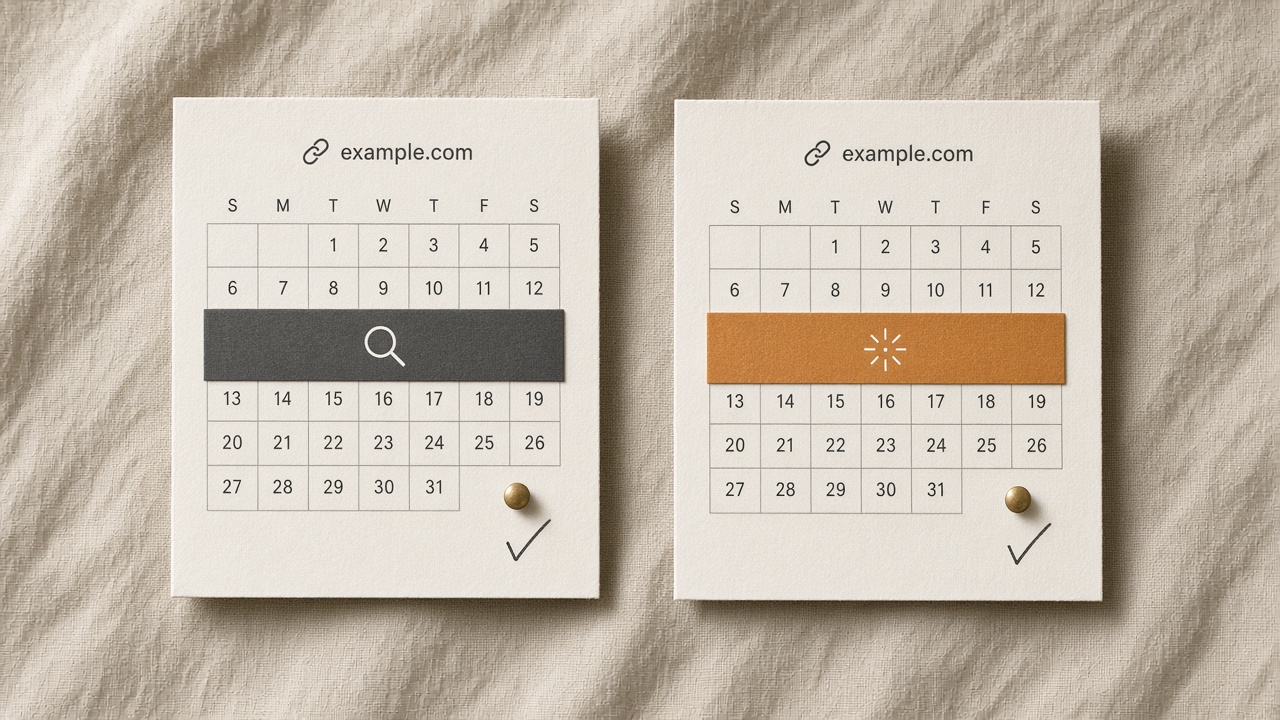
Those near-miss URLs stay one page. AI visibility is a tighter clock on that URL, not a second publishing quota.
An AirOps 2025 study found 95% of pages cited by generative systems had been updated within 10 months, and a visible last-updated timestamp earned 1.8 times more citations. Pages untouched for more than a year were more than twice as likely to be left out of AI citations, and unrefreshed pages see about 3x more citation loss than pages on an active cadence. About 50% of cited pages change every month, and nearly 6 in 10 appear once and do not return.
Split that same URL by surface. High-value landing pages stay on a 3–6 month SEO cycle and about every 30 days for AI visibility. Evergreen guides stay annual for organic search and move to every 6 months for citations. Automation may flag a stale statistic or a missed window. It may not lock the date or ship the rewrite. The same intent gate still has to pass.
Tighter clock — AI citation windows compress the cadence on the same URL; they do not add a second publish quota or bypass the intent gate.
Refresh interval: SEO vs AI (days)
What Should a Quarterly Content Refresh Calendar Actually Contain?
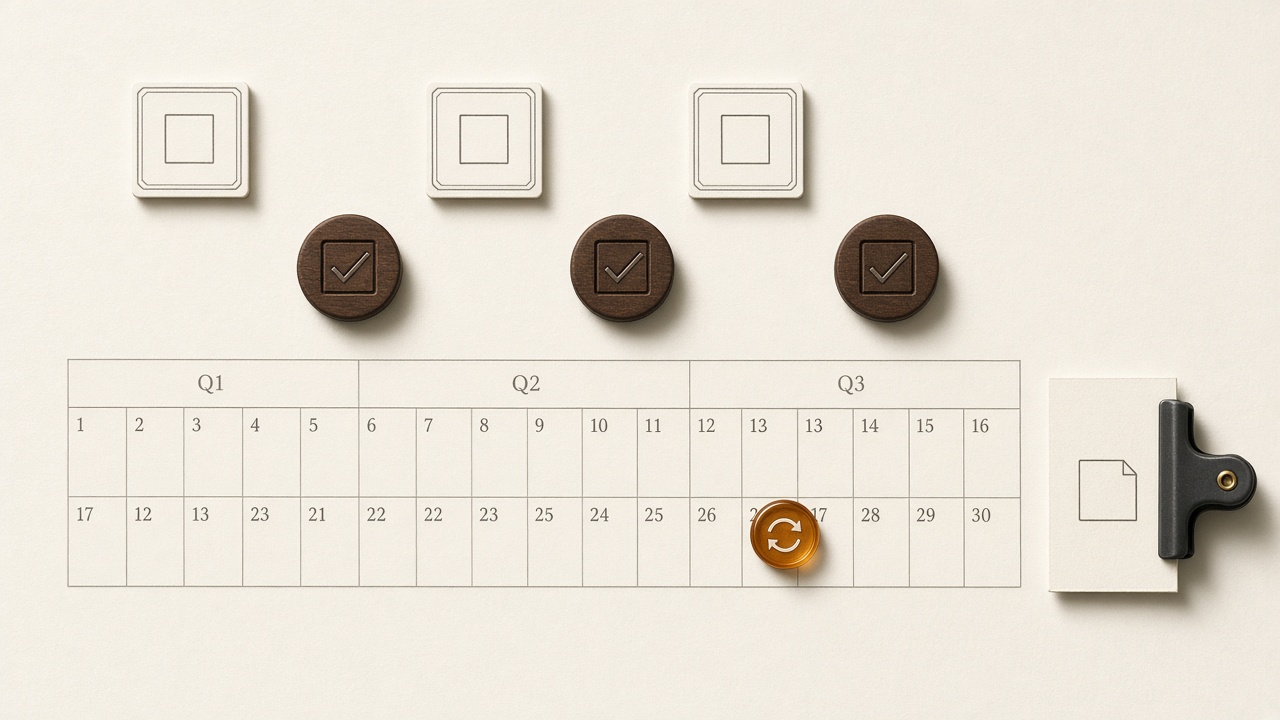
A quarterly content refresh calendar is a queue of open rows, not a post count. Keep the date empty until the diagnosis is already on the row, so the quarter cannot fill with briefs that skipped the gate.
The row also names owner, reviewer, lock date, and baseline. A refresh brief covers what changed, what must stay, sources to replace, internal links, the same slug, and that baseline. A net-new brief covers unique intent, why no existing URL matches, the cluster home, and a reviewer. If either packet is incomplete, the row stays open. An empty date is the control, not a failure.
Empty on purpose — A date is earned only after the intent gate passes and both the row and the brief packet are complete.
How Do You Know a Refresh Beat Leaving the Page Alone?
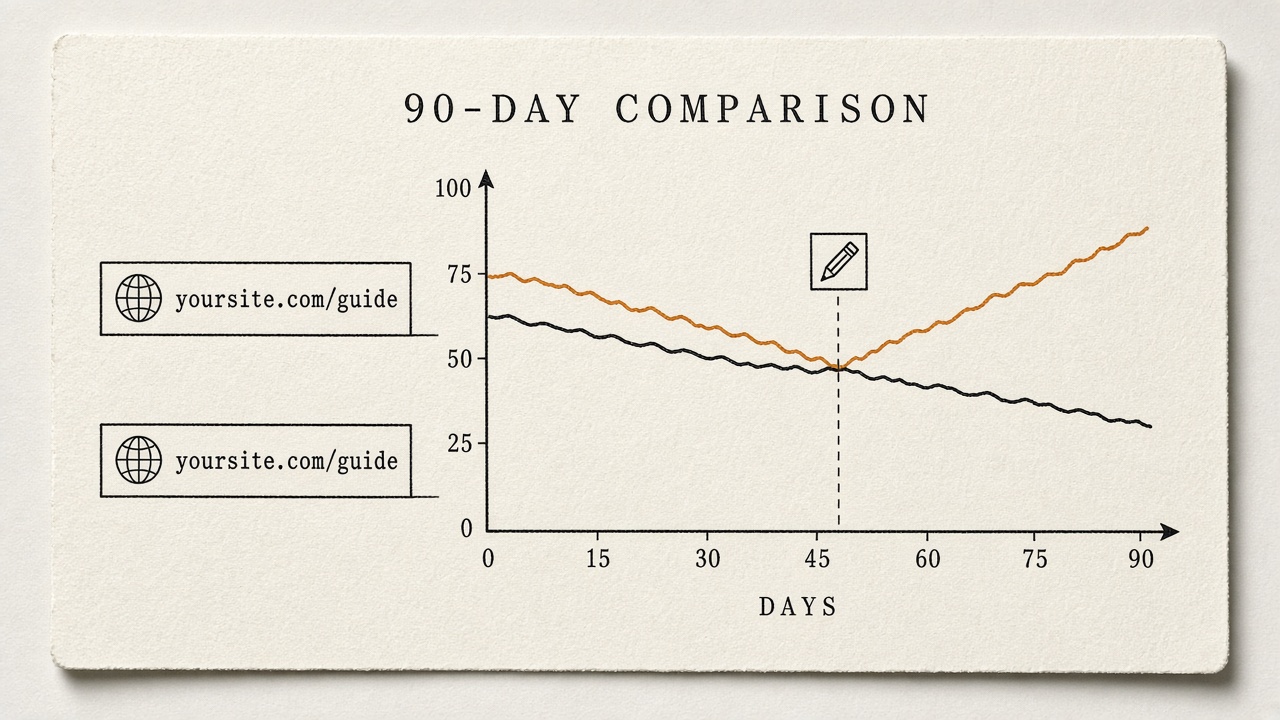
Once the gate locks a date, the only honest test is whether the edit beat leaving the page alone. A moved timestamp is not that test.
On established pages, meaningful ranking movement often shows within two to four weeks. Hold the read against the pre-update baseline for several more weeks after that, so a short spike is not treated as a durable gain.
Substance is what separates a refresh from neglect. Across 95 refreshed pages, Workshop Digital saw organic sessions rise from 610 to 3,341 in 90 days, a 447.7% lift, while a comparable untouched cohort fell 20.2%. Related lifts, not a promise for every URL: HubSpot’s historical optimization program grew monthly organic search views on updated posts by 106% on average, and Siege Media’s quarterly model reported 70% more organic traffic, 35% more LLM visibility, and 99% more LLM traffic.
The edit has to be real. Pages that added 31–100% more content gained 5.45 positions on average, while non-updated pages lost 2.51, a gap of about eight positions. Compare the URL to its baseline or a held-out similar page. If it did not beat leaving it alone, do not repeat that edit pattern — and do not refill the calendar with the same empty date change.
Measure the slot — A refresh earns its slot only when real substance moves rankings or traffic past the pre-update baseline. A date change alone never does.
Key Takeaways
Open next quarter’s calendar with the date column blank, and lock a slot only after the fail-closed gate chooses a same-URL update, a consolidation, a leave, or a genuinely new brief.
Frequently Asked Questions
You Might Also Like
- Workflows Content Refresh Strategy: How to Update Pages So Rankings Do Not Decay
- Guides SEO Content Brief Template: The Complete Guide to Briefs That Rank
- Workflows SEO Content Calendar: How Lean Teams Schedule Briefs Without a Bottleneck
- Workflows Programmatic SEO or Autoblogging? Route the Cluster Before You Brief
- Guides How Often Should You Publish SEO Articles? A Cadence That Holds Quality