Internal Linking Tool Gates: Detect, Insert, or Hold for Review
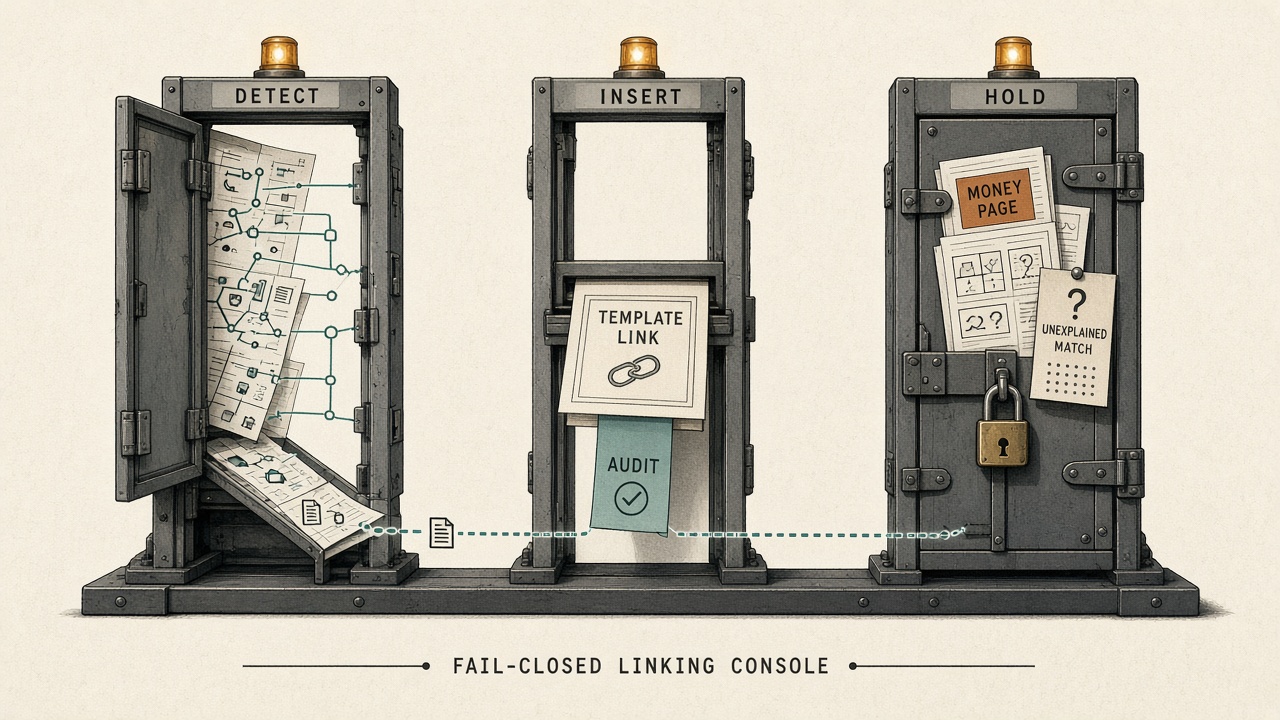
You already own the internal linking tool. The decision left is which writes it may commit. Google uses links as a relevancy signal and to find new pages to crawl, and it generally follows a link only when that link is an HTML anchor with an href. Detection comes first: orphans, broken targets, and links a crawler cannot use. Inserting more anchors is a narrower, later job.
Pair counts outrun a person long before judgment does. A blog of 50 posts already has 2,450 possible pairs; at 200 posts that is 39,800. Once the archive crosses about 50 posts, or publishing hits eight or more posts a month, discovery and backward-link queues have to be automated. Judgment does not. Internal linking is one of the biggest ways to show Google which pages you think matter, so money pages, pillars, and programmatic templates stay in review. The tool may suggest those targets. It should not invent them.
The gates below sort every suggestion into detect, insert, or hold. Auto-insert is limited to parent, hub, and breadcrumb links already encoded in the template. Contextual body links, dominant exact-match anchors, and any semantic match you cannot explain wait for a person. A tool scored on links inserted will pad the graph. Orphan rate, click depth of priority URLs, anchor diversity, and in-content versus template links are the measures that keep it honest.
- Fail closed: detect crawl and orphan problems, insert only auditable template links, and hold the rest.
- Google needs crawlable anchor links and at least one internal link to every page you care about.
- Automate discovery past about 50 posts or at eight-plus posts a month; keep unexplained and money-page links human.
- Do not turn correlation studies into a hard inlink cap or a reason to add sitewide nav on every new URL.
- Score orphan rate, depth, and anchor diversity—not how many links the tool inserted.
Three Write States, Not an On/Off Switch
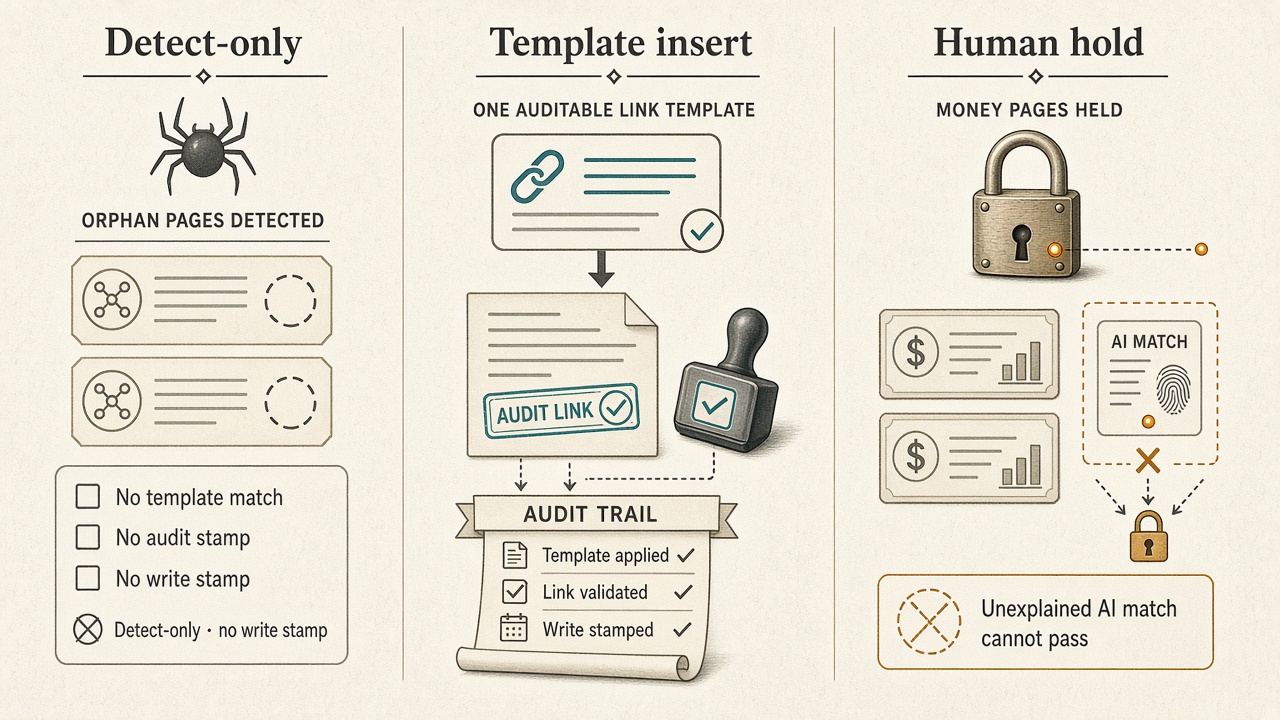
Once the linking tool is in the CMS, the decision is not whether automation is switched on. It is which write state each job is allowed to occupy. Publish rights are a privilege, and a fail-closed install starts without them.
What each state may write
- Detect-only reports orphans, broken hrefs, and links that cannot be crawled. It never publishes.
- Encoded insert may add only parent, hub, or breadcrumb links a person already approved in the template. The rule is auditable before any URL exists.
- Hold keeps contextual suggestions, money-page targets, and unexplained matches in a queue. The tool has no publish right there.
That split matches how automation actually performs. It wins decisively on scale, consistency, and orphan prevention, and loses on context and judgment. The loss is tolerable only when a person still approves the suggestion, or the rule is capped so tightly the tool cannot choose a new target on its own.
Refuse a single automate switch. The same tool that should detect a broken href must not invent a money-page target to replace it. Finding missing links can run unattended. Deciding which page deserves the link cannot.
Software choice belongs in the existing tool comparison. Template patterns belong with the programmatic linking rules. Broader workflow decisions belong in the automation playbook. This article only decides write permission.
Fail closed — Default to detect-only, allow encoded insert only for approved template rules, and hold everything that still needs a human judgment.
Enforce the Crawl Contract, Leave Importance to Editors
Those write states only hold if the tool respects what a crawler can actually follow. Google uses links both as a relevancy signal and to find new pages to crawl, and it generally crawls a link only when that link is an HTML anchor with an href attribute. A scripted click, a styled span, or an href that 404s does not meet that bar. Broken and non-crawlable links are a detect-and-fix job: report them, restore a real anchor, and do not treat the repair as a new publishing opportunity.
Coverage is the other half of the contract. Every page you care about should have a link from at least one other page on the site. The tool may list orphans—URLs with no inbound internal link, or only links a crawler will never see. A person still decides which of those pages deserve a link, and from where. Drafts, faceted URLs, and thin templates can look orphaned and still be pages you do not want in the graph.
Importance is a suggestion, not a target
John Mueller has called internal linking super critical for SEO and one of the biggest things you can do on a website. That weight is exactly why money pages, pillars, and programmatic templates stay suggested, never auto-targeted. The tool can propose a parent, a hub, or a body mention. It should not invent the destination and publish it. Choosing which pages matter is the judgment the hold queue exists to protect.
Orphan cleanup is the easiest place to cheat that rule. The fastest way to give every URL “at least one link” is a footer, a mega-menu, or a related-posts block dumped into global chrome. That zeros a report and hides the editorial graph. Detect the orphan. Hold the contextual fix. Do not spray sitewide navigation just to clear the queue.
Crawl vs. importance — Auto-detect broken, non-crawlable, and orphan links, then stop. A human still chooses which orphans deserve a link, and money pages never get auto-targeted through sitewide chrome.
Automate Discovery Once Pair Review Breaks
Once every page you care about has a crawlable path, the constraint is no longer Google's bar. It is how many candidate pairs a person can still look at before the archive outruns the review.
A blog with 50 posts already has 2,450 possible link pairs. At 200 posts that set is 39,800. Manual linking can still hold under about 50 posts. Past that threshold, or once publishing hits 8 or more posts a month, walking every plausible pair stops being an editorial practice and becomes a backlog nobody finishes.
That is the moment to automate discovery, not importance. The tool should scan the archive, surface orphans and weak parents, and keep a backward-link queue so every new URL gets a queued, explainable parent or hub suggestion inside the publish gate. The suggestion has to name the rule that produced it—a known parent, hub, or breadcrumb pattern—not an AI pick of a money page. Which target matters stays with the editor.
Treat that queue as fail-closed. An unpublished suggestion is the tool doing its job. A silent insert, especially into a priority URL, is the failure mode: the pair was never reviewed, and the write already happened.
Fail closed — Once the archive passes about 50 posts or velocity hits 8 or more a month, automate the pair scan and the backward-link queue. Leave importance, and any money-page target, unpublished until a human accepts an explainable suggestion.
Growth From 50 to 200 Posts
Freeze Auto-Inserts When Extra Inlinks Stop Tracking Clicks
Automating discovery does not mean every suggested link should publish. A backward-link queue can still flood a URL if each match is scored as an improvement. The saturation gate is the point where the tool stops treating “one more inlink” as progress.
Zyppy’s correlation study covered 23 million internal links across about 1,800 websites and roughly 520,000 URLs, matched to Search Console clicks. URLs with 0–4 internal links averaged 2 clicks from Google Search. URLs with 40–44 internal links received about four times that many. That mid-range association is useful as a warning, not as a quota to hit on every page.
After about 45–50 internal links, the relationship reversed. The author ties that turn largely to sitewide navigation: the same href lands in global nav or the footer on every template, so the count rises without a new editorial reason for Google—or a reader—to treat the page as more important. Use the reversal as a freeze. Do not auto-add global navigation or footer links to every new URL, and do not let the insert path treat an extra inlink as an automatic win.
What the freeze actually blocks
- Sitewide chrome written at publish time just to raise the inlink count.
- Template inserts whose only justification is that the URL sits below the study’s peak band.
- Any unexplained addition that would publish without a human deciding the page deserves the link.
Say the limit plainly: this is correlation in one large dataset, not a Google cap to hard-code as “never exceed 50.” A priority URL can still deserve carefully placed, crawlable links; a thin URL can already have too many because the footer repeats it. The tool’s job is to refuse automatic global inserts and hold unexplained additions. Editors still decide importance. The count is a warning light, not a ranking formula.
Freeze, don’t maximize — Past roughly 45–50 inlinks, Zyppy’s data stopped associating more links with more clicks, largely because of sitewide navigation. Block auto-added global nav and footer links, and do not hard-code that reversal as a Google limit.
Inlink Levels at the Click Plateau
Hold Any Anchor the Model Cannot Explain
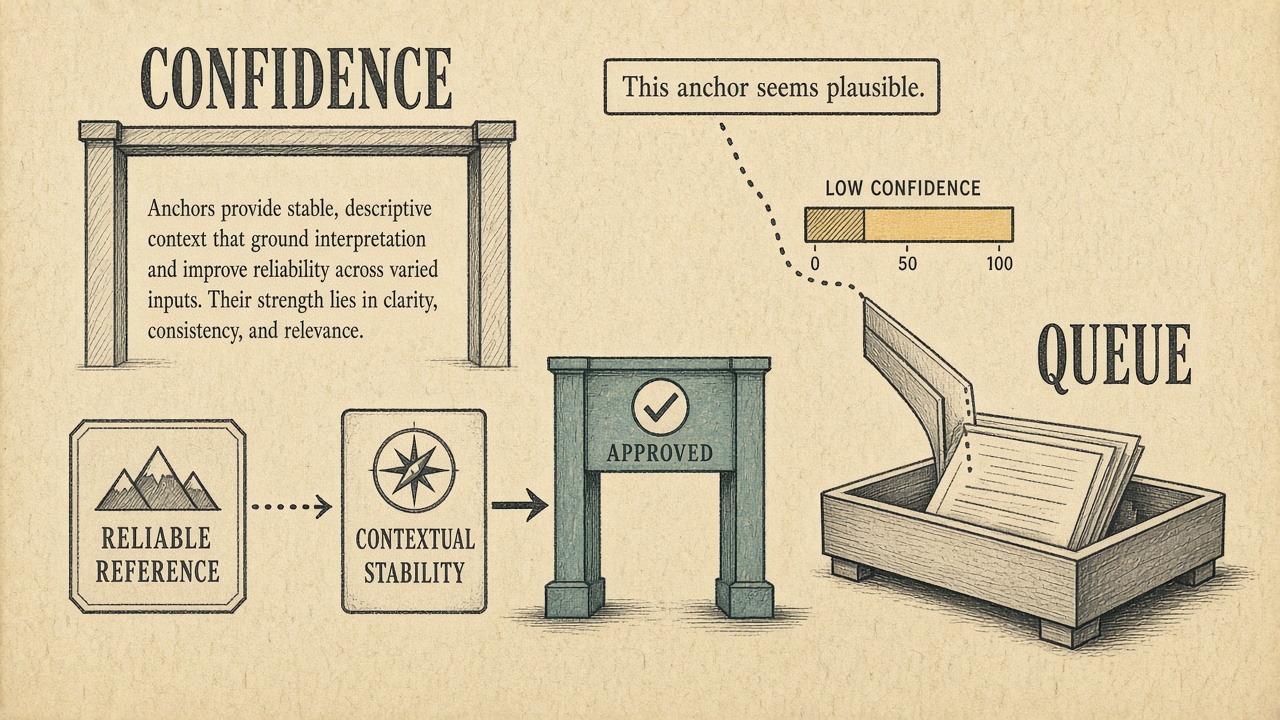
Once extra inlinks stop tracking clicks, the next place a tool overreaches is the words on the link. In the same Zyppy set, pages with at least one exact-match internal anchor had at least five times more traffic than pages without one. Zyppy treats that gap as correlation, not proof that exact match should be stamped everywhere. The automation failure is the identical phrase repeated from every new URL, not the existence of one clear anchor.
Google’s bar is the opposite of a keyword stamp. Site owners are told to write as naturally as possible and to resist cramming every related keyword onto the page; keyword stuffing is a spam-policy violation. Good anchor text is descriptive, reasonably concise, and relevant both to the page it sits on and to the page it points at. A tool that cannot say why this phrase belongs on this source, and why it names this destination, has not met that bar.
A confidence floor, not a blind insert
LinkStorm’s review of 2.5 million contextual internal links shows how weak most live anchors already are. Only 8% were strongly similar to the target title, 28% had no similarity to that title, and about 61% contained just one to three meaningful words. Semantic matching that copies that pattern at publish speed multiplies noise. Suggestions need a confidence floor: below it, the match goes to a reject queue instead of the page.
Ahrefs’ practical start of three to five contextual body links is an industry heuristic, not a Google number. Use it as a cap on what the tool may auto-insert, not as a quota to fill. Vary anchors by rule so one exact phrase cannot dominate a target, and hold that target for review the moment a single wording starts to. Template parent, hub, and breadcrumb links can still publish when the rule is auditable. Contextual body copy, money-page anchors, and any embedding match you cannot explain stay in the queue.
Explain or hold — Exact-match traffic in the Zyppy set is a correlation, not a license to repeat one phrase. If the model cannot explain the anchor against both pages, hold it.
Hold Deep Links and Matches You Cannot Explain
The same gate that keeps an unexplained anchor out of the publish path also has to ask where the link would sit. A match can be crawlable and still be the wrong kind of write.
In the LinkStorm set, 71% of contextual links sat within the first two hierarchy levels, and under 6% reached depth 4 or deeper. A tool that only links shallow hubs will look productive while deep URLs stay starved. Click depth of priority pages is a human check: the inserter must not treat a nearby hub as coverage for a page several levels down.
Explainable rules may insert; black boxes hold
Rule-based parent, hub, and breadcrumb matches are auditable. If those patterns are already encoded, the tool can name the rule that fired and insert. Embedding or NLP matches the operator cannot explain stay in the hold queue, even when a similarity score looks confident. This gate does not re-specify how parent, sibling, or contextual templates should be written—that encoding lives in the programmatic linking rules. Here the only question is whether the match is explainable.
Money pages and pillars may appear as suggestions. The tool must not invent those targets or publish their anchors unreviewed. Importance is still an editorial decision, not a side effect of a model that found a nearby phrase.
Fail closed — Shallow auto-links and unexplained semantic matches are not coverage. Encoded template rules may insert; deep URLs, black-box matches, and money-page anchors wait for a person.
Score the Graph, Not the Insert Count
Once unexplained matches stay queued and only encoded parent, hub, and breadcrumb rules may publish, the scorecard has to match that discipline. Judge the tool on orphan rate among pages you still care about, click depth of priority URLs, anchor diversity on those targets, and the split between in-content links and template links. A falling orphan rate with shallower priority pages and a wider mix of descriptive anchors means the graph is actually being built. A rising insert count does not.
Keep sitewide chrome out of that editorial graph. Navigation and footer links can satisfy a crawl, but they are not proof the tool is connecting related pages. Counting them as wins is how a vendor looks productive while every new URL inherits the same global links and priority pages stay buried.
What the weekly hold queue is for
Never KPI the tool, or the vendor behind it, on links inserted. That metric pays for the failure modes the gates exist to stop: silent body inserts, repeated exact phrases, and invented money-page or pillar targets. The weekly review should be a short hold queue, not a volume report. Work unexplained matches, exact-phrase concentration on any target, deep priority URLs that still lack a deliberate inlink, and every suggested money or pillar destination. If that queue stays short and those four scores move the right way, the tool is doing its job by refusing to publish what it cannot defend.
Measure refusal — Score orphan rate, priority click depth, anchor diversity, and in-content versus template links—and never links inserted. Sitewide nav is not an editorial graph, and the weekly job is a short hold queue, not a higher insert total.
Key Takeaways
Review your linking tool’s write permissions against these gates, then use the tool comparison, programmatic linking rules, and automation playbook to set detect, insert, and hold before the next publish.
Frequently Asked Questions
You Might Also Like
- Automation Internal Linking Tool: What to Automate vs What to Review
- Automation Internal Linking Automation: How to Scale Links Without Manual Work
- Templates Internal Linking Rules for Programmatic SEO Pages
- Automation Fail-Closed SEO Briefs: The Publish Gate Autoblogging Needs
- Automation Best Internal Linking Tools for Content Sites (Compared)