Internal Linking Automation: How to Scale Links Without Manual Work

Internal links still do some of the most reliable work in SEO: they help crawlers discover pages, move equity toward the URLs that should rank, and make topical relationships obvious. The catch is volume. Once publishing moves into autoblogging, programmatic SEO, or high-output AI workflows, picking anchors by hand in a CMS becomes the bottleneck that never clears.
Internal linking automation is not a plugin that sprays exact-match phrases through the archive. It is a productized step in the research-to-publish stack. Relevance signals decide what should connect, authority and priority rules decide where equity should flow, and quality gates stop thin, repetitive, or doorway-like patterns before they ship.
This playbook is for operators who already generate content faster than they can interlink it. The rest of the article walks through how to combine cluster maps, suggestion engines, and insertion rules so lean teams keep crawl paths healthy without turning linking into a second full-time job.
- Manual internal linking breaks as soon as content volume outruns editorial capacity.
- Useful automation mixes semantic relevance, authority rules, and quality gates rather than bulk keyword matching.
- New pages and orphans should get first claim on contextual links to pillars, clusters, and commercial URLs.
- Poor automation creates over-optimized anchors and diluted equity, so uniqueness and relevance checks are non-negotiable.
- Judge the system by crawl coverage, cluster rankings, engagement, and hours no longer spent in spreadsheets.
Why Internal Linking Becomes the Bottleneck at Scale

High-output publishing turns internal linking into an operations problem, not a theory problem. It is usually the first process to snap when volume rises. At a handful of posts a week, a spreadsheet and a CMS editor can still keep pages connected.
Autoblogging, programmatic SEO, and high-output AI publishing do not wait for that workflow. New URLs appear faster than anyone can map them to pillars and related pieces, so the linking layer falls behind the content layer. That lag is not cosmetic. It shows up as a few predictable failure modes.
- Orphan pages that never receive an inbound link from the rest of the site
- Thin cluster connectivity, where related articles barely point at each other
- Delayed links on new posts, so fresh URLs go live isolated until a cleanup pass
This piece stays on the linking layer, not another general tour of SEO automation. Semantic relevance, authority rules, and quality gates belong inside the research-to-publish loop so every new article ships with contextual links instead of joining a spreadsheet backlog.
The real bottleneck — Manual linking cannot keep pace with high-output publishing; without relevance, rules, and gates in the publish loop, scale produces orphans and thin clusters instead of topical authority.
What Internal Linking Automation Really Means
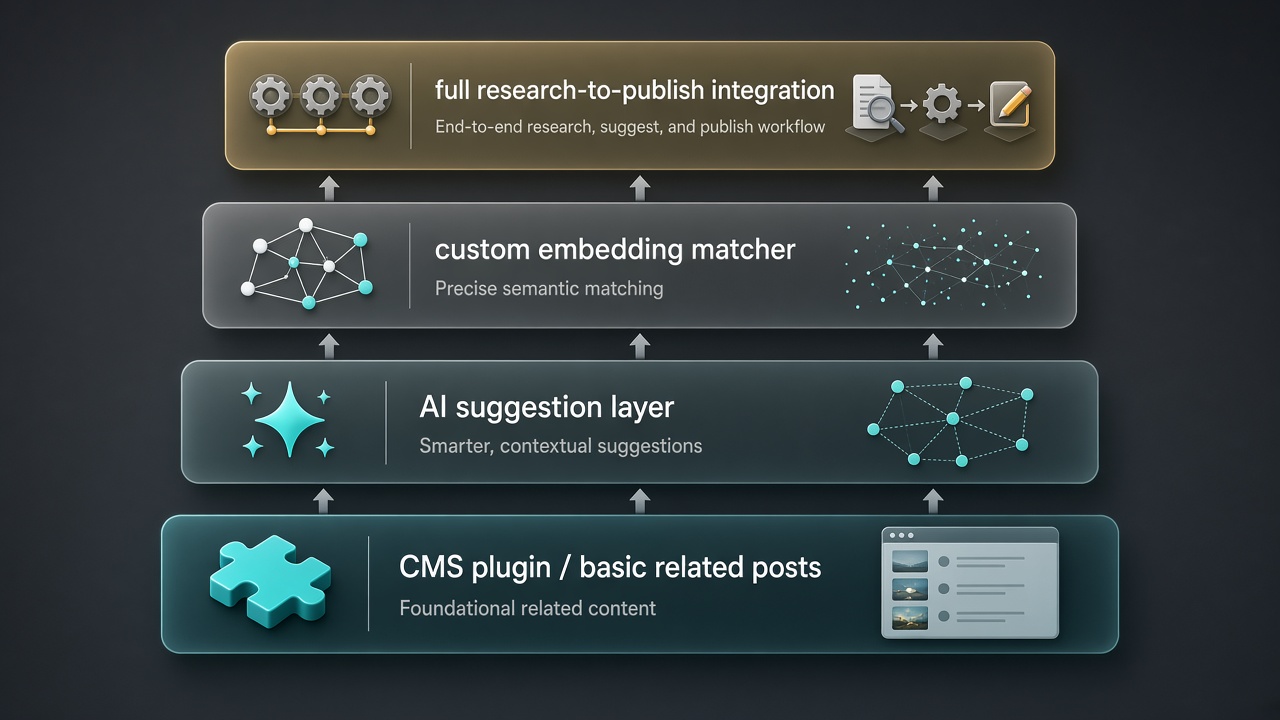
That is the point at which teams reach for automation—and where the word starts to mean too many different things. Internal linking automation is a spectrum of ways to replace the spreadsheet, not a single switch you flip in a CMS.
At the light end are CMS auto-linkers: they match a phrase, wrap it in an anchor, and fire wherever that phrase appears. Suggestion tools scan the library and queue candidates for an editor to accept or reject. Heavier setups use custom scripts against sitemaps, or embeddings that score semantic similarity instead of exact-match keywords. The same work also lives inside SEO automation and autoblogging platforms, as a step that runs when a draft is generated rather than as a cleanup pass weeks later.
None of that is set-and-forget. A linker with no relevance scoring and no quality gates is just spam at volume: irrelevant anchors, thin doorway-like patterns, and equity leaking onto the wrong URLs. Whether the gate is a human review or an automated threshold, something still has to reject weak matches before they publish.
Four jobs every setup has to finish
- Discover candidate targets from the current piece—cluster siblings, pillars, and related URLs—not a dump of every matching keyword.
- Score those candidates for topical and semantic relevance so the strongest matches rise first.
- Insert contextual anchors in the body copy, with limits on how many links a page may carry.
- Protect commercial and money pages from noisy, cannibalizing, or over-optimized links.
A light plugin can suffice when output is modest and someone still checks inserts. At programmatic volume, linking has to sit inside the research-to-publish loop as a pipeline step so every new article ships already wired into the cluster—otherwise the backlog simply returns.
The real definition — Automation that scales is discovery, relevance scoring, contextual insertion, and protection rules running in the publish path—not keyword matching with no gates.
Relevance Signals, Priority Rules, and Quality Gates
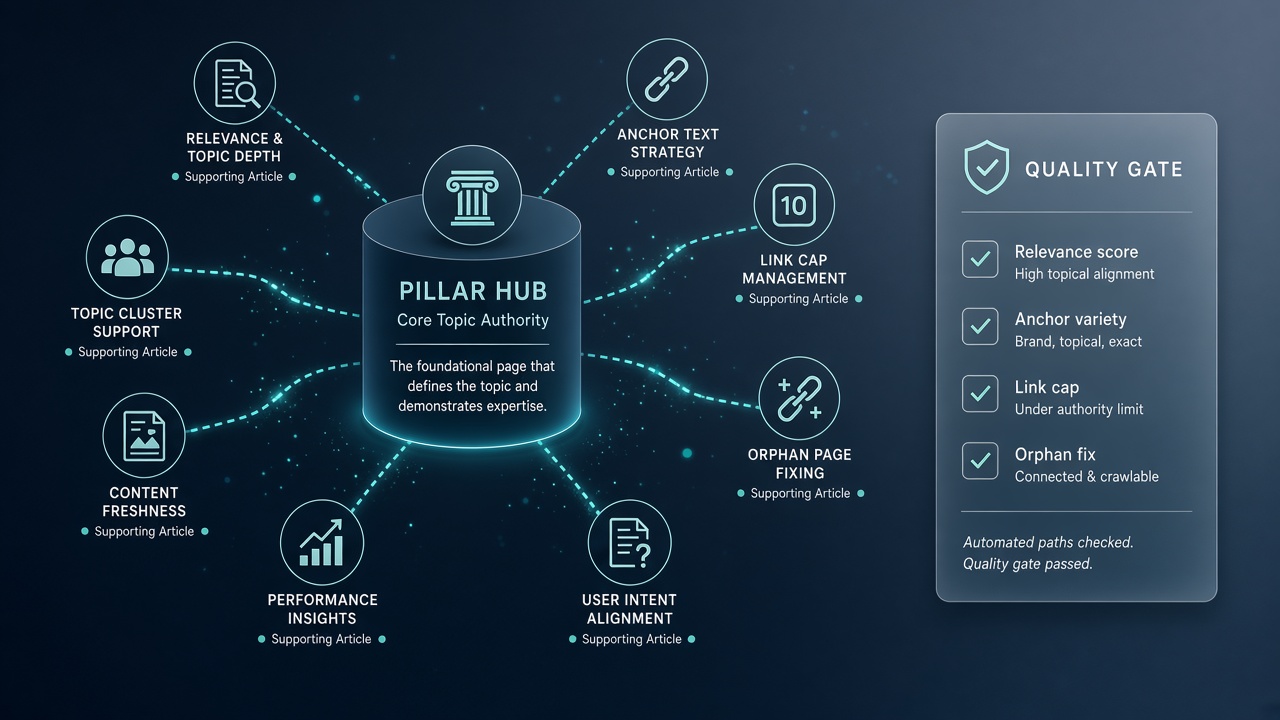
Those four jobs only hold if relatedness is more than a shared keyword. Semantic similarity, topic-cluster maps, and entity matches decide which URLs actually belong together. Phrase stuffing yields repetitive anchors and thin, doorway-like patterns; meaning-level matches yield contextual links that help crawlers and readers move through a topic.
Priority then decides who gets the click. Surface pillars, commercial pages, and orphans first, cap outbound links per page, and prefer natural in-sentence anchors. The sequence below is how those rules become something a publisher can actually run.
Keep a living cluster map so those signals stay aligned as the site grows. When membership updates with every publish, the next article already knows its pillars, siblings, and commercial targets instead of waiting on a backlog.
The principle — Automation only scales crawlability and topical authority when relevance scores, priority rules, and quality gates live with the article—so links ship in context, not as a later cleanup job.
Where Linking Belongs in the Research-to-Publish Loop
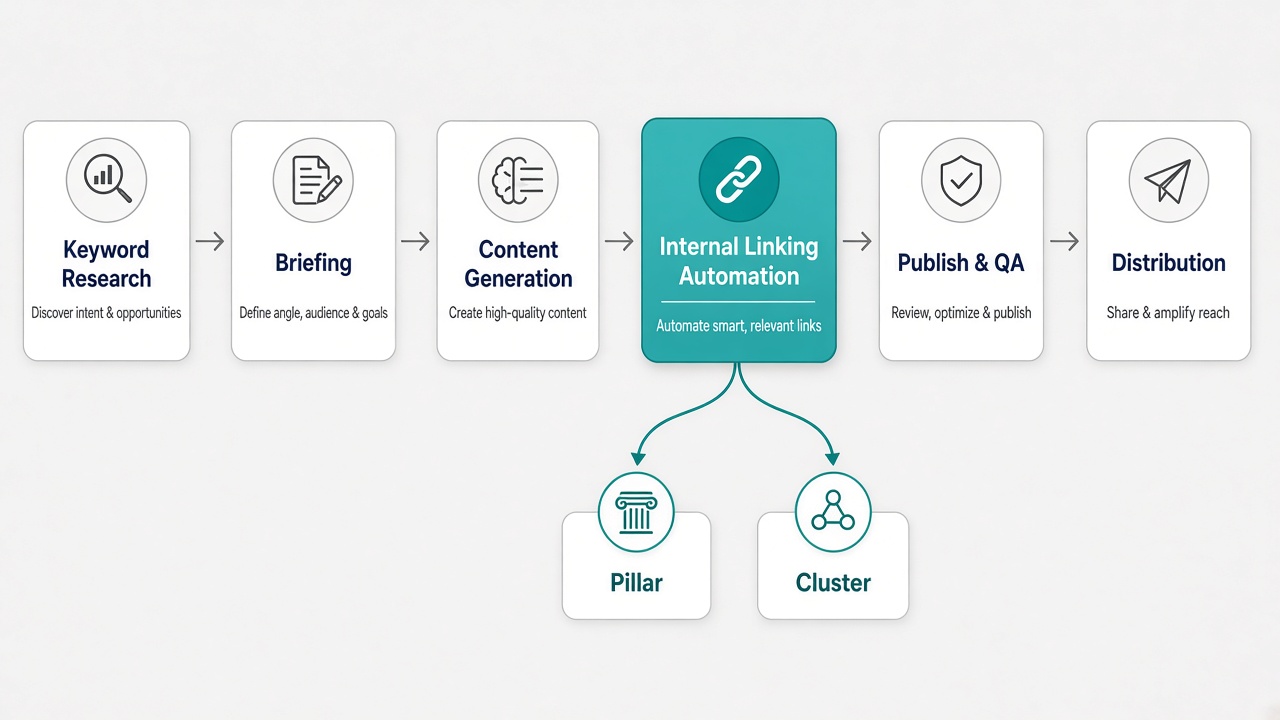
Those quality gates still need a home. Linking belongs after the draft has structure—headings, entities, and a cluster assignment—and before or at publish, so every article leaves with contextual links to its pillar, sibling cluster pages, and the commercial URLs that should receive equity. A spreadsheet of links to add later is how orphans and thin clusters form.
Publish-day linking is necessary but not enough. As the library grows, scheduled re-link and orphan sweeps should walk the living cluster map, find pages that never received inbound context, and insert a few high-relevance links without a rewrite. Those jobs sit beside existing SEO and content automation—the same publish hook, sitemap, and embeddings—without becoming a vendor catalog. Plugin, suggestion-engine, and autoblogging depth belongs in adjacent articles; here the requirement is a pipeline step, not a stack roundup.
Keep editors in the loop on high-stakes money pages and sensitive templates, where a bad anchor is expensive. Automate the long tail—supporting articles, FAQs, programmatic variants—so scored, gated links ship with the piece instead of waiting in a backlog.
In the loop — Run linking after structure and at or before publish, then sweep orphans on a schedule; editors stay on high-stakes pages while the long tail ships with contextual links already in place.
The Operator Checklist: Practices, Risks, and Metrics
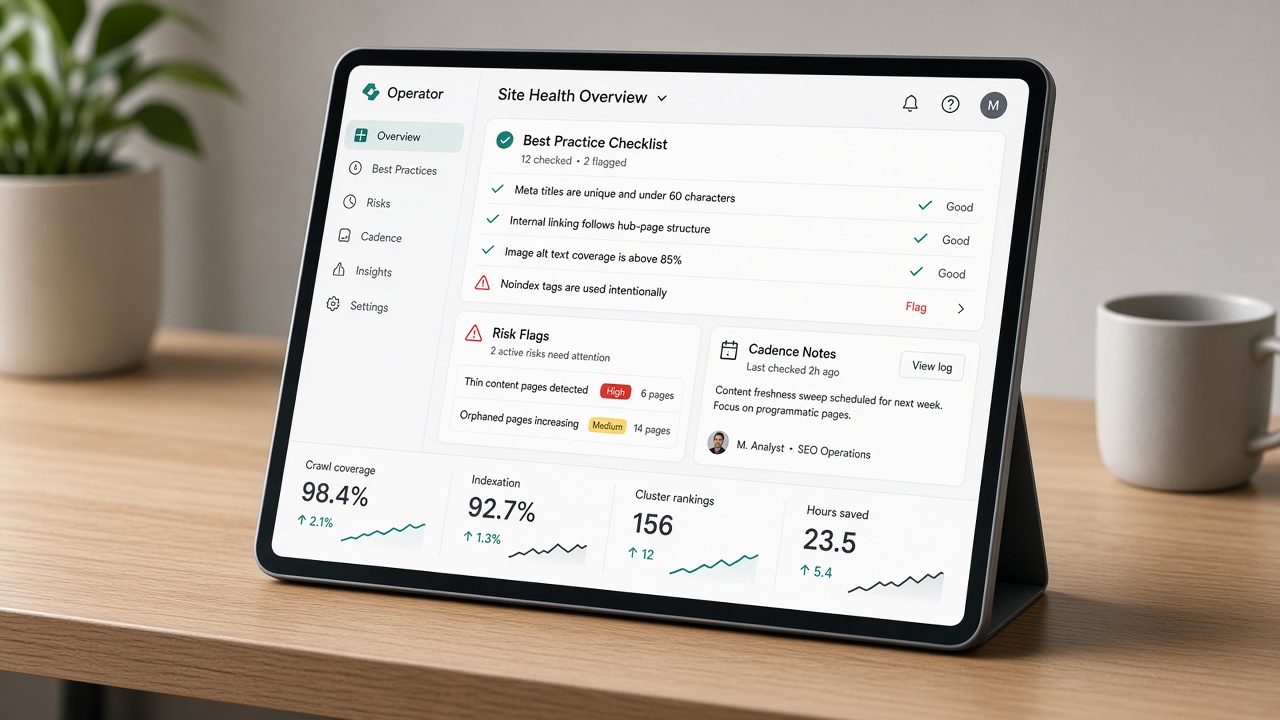
With that loop in place, the remaining work is operational. Prioritize new content and remaining orphans first, enforce contextual anchors, limit link density, and audit broken or low-value links before they accumulate.
Skip those gates and automation over-optimizes the same commercial URLs, drops irrelevant anchors, and can form doorway-like patterns that dilute equity. Pair every insert with relevance and uniqueness checks so volume never outruns meaning.
Judge the system on crawl coverage, indexed pages, rankings for cluster terms, pages per session, and hours saved on manual linking—not on how many URLs a script touched.
A checklist you can run every month
- Re-scan new URLs and orphans, then close gaps before the next publishing wave.
- Sample anchors for context and uniqueness; strip duplicates and stuffed phrases.
- Cap links per page and keep thin or sensitive URLs off the receiving list.
- Sweep broken, redirected, and low-value links and prune them.
- Confirm the cluster map still matches live pillars, supporting pieces, and commercial pages.
That monthly pass is what keeps publish-time linking from sliding back into a spreadsheet backlog.
Ship, then steward — Keep automation durable by recency-biasing new pages and orphans, gating anchors and density, and judging crawl coverage, cluster performance, and engagement—not raw link count.
Key Takeaways
Put semantic scoring, authority rules, and quality gates in your publish pipeline so the next article ships with contextual internal links instead of joining a spreadsheet backlog.
Frequently Asked Questions
You Might Also Like
- Automation SEO Automation: Tools, Workflows, and What to Automate First
- Automation Programmatic SEO: How to Scale Pages Without Thin Content
- Automation What Is Autoblogging? How Automated SEO Publishing Actually Works
- Strategy Keyword Clustering: How to Group Keywords into Rankable Topics
- Comparisons Best SEO Automation Tools in 2026 (Compared by Job-to-Be-Done)