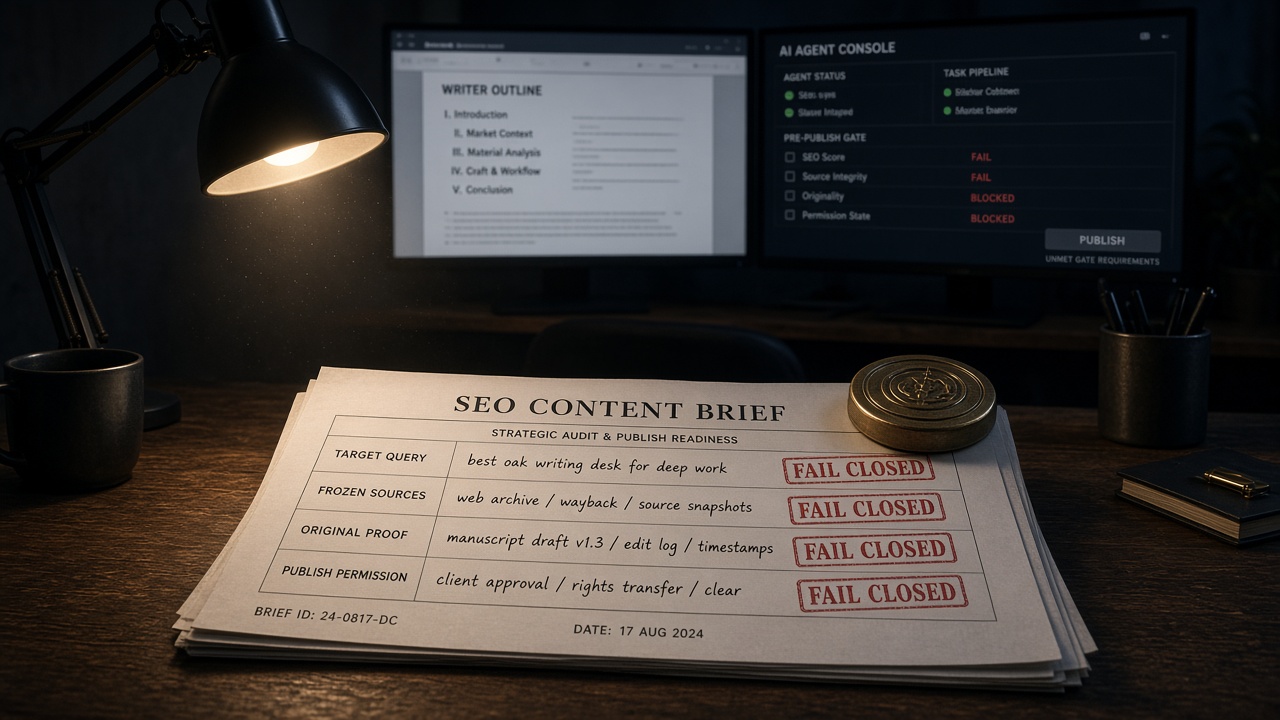
SEO Content Brief: How to Brief Writers (and AI) So Pages Rank
If you brief writers—or AI agents—the way most teams still do, you get a prompt dump, a pile of similar pages, and a publish button that never asks whether the draft added anything a user could not already scrape. Autoblogging is not a synonym for an AI writer or an RSS scraper. It is a pipeline: source, generate, QA, CMS. The original scrape-and-republish meaning still exists and search engines still discourage it. Google’s scaled content abuse policy is method-neutral. Generating many pages primarily to manipulate rankings or generative AI answers—not to help users—violates it whether automation, humans, or a mix produced the pages. Cadence still tempts operators, and chatbot substitution is putting traditional search volume under pressure, so briefs have to produce extractable, citable answers, not only blue-link SEO. The rest of this article turns that split into a brief you can hand to a writer or an agent and still refuse to publish if the contract fails.
- Treat the SEO brief as a fail-closed publish contract, not a prompt dump for writers or AI.
- Autoblogging is a source → generate → QA → CMS pipeline; scrape-and-spin is the old, discouraged form.
- Google’s scaled content abuse rule is method-neutral and covers unoriginal mass pages aimed at rankings or AI answers.
- Automate clustering, briefs, and scheduling; keep evidence freeze, original proof, and money-page review human.
- Pages also need citable answers as traditional search volume declines—not just more posts for blue links.
A writer brief is instructions; an agent brief is authorization
That distinction matters the moment the same file can be handed to a person or to a model that already talks to the CMS. A human writer treats a brief as instructions: read this, research that, stop at draft. An AI agent can treat the identical document as authorization to create, edit, and ship. If the brief never says what is forbidden, the agent will fill the gap with whatever its tools allow.
WordPress-class agent tooling already works that way. WordPress.com expanded MCP so agents such as Claude and ChatGPT can draft posts, build pages, and manage site content. That expansion includes 19 tools, with drafts created by default and activity logged. Draft-as-default is a safety rail, not a ranking contract. The brief still has to name what the agent is not allowed to publish, who must approve, and which claims are frozen before anything leaves staging.
Topic, keyword, and tone fields are enough for a freelancer who cannot hit Publish. They are not enough when the consumer can call the CMS. Add audience, non-goals, required original evidence, and a named human approver. The quality bar has to survive both consumers: if a writer on Monday and an agent on Tuesday cannot execute the same brief without lowering that bar, you wrote a prompt, not a ranking publish contract.
Fail-closed — Treat the brief as fail-closed authorization: freeze evidence, name a human approver, and list what the agent must not publish—otherwise CMS-connected tools will treat missing rules as permission.
Autoblogging Is a Pipeline—Only Research-to-Publish Honors a Ranking Brief

That authorization only works if you name the pipeline it governs. Autoblogging is not a synonym for an AI writer, a template farm, or an RSS plugin. It is a source → generate → QA → CMS path that automatically generates and publishes blog content using AI writing tools, APIs, RSS feeds or scripts with little to no manual input. The brief either freezes what may enter that path or it is just a prompt with a publish button.
The word itself is older than the models. The term initially meant copying and republishing content from other sites. That scrape-and-republish form is still common, and it cannot satisfy a ranking contract that demands unique evidence. Search engines still discourage it because the page adds no original proof—only velocity.
A 2026 research-to-publish system can honor the brief because the contract sits in front of generation: sources are chosen, claims are locked, originality is tested, then the agent may draft. “Little manual input” is legitimate only after those steps are already in the brief—not because the plugin skipped them. Autoblogging is cadence on individual URLs; the ranking brief still has to fail closed before any of those URLs hit the CMS.
Pipeline, not plugin — Only a research-to-publish autoblog—facts frozen, original proof attached, publish gated—can honor a ranking brief. Scrape-and-spin and skip-the-research generators cannot.
Empty brief fields are how scaled content abuse gets published
Once that pipeline is in motion, empty brief fields are not a style problem—they are how Google’s scaled content abuse policy gets triggered. Google defines the violation as generating many pages primarily to manipulate search rankings rather than help users, regardless of how the pages were created. The March 2024 expansion made that rule method-neutral: it applies whether automation, humans, or a mix produced the pages. “A writer touched it” is not a defense.
Google’s own examples map almost one-to-one onto default autoblogging setups: using generative AI to generate many pages without adding user value, and scraping or transforming feeds—including synonymizing or translating. Using automation or AI primarily to manipulate rankings is a spam-policy violation. The brief fails when it specifies volume and keywords but not user value. Spam policy now also covers attempts to manipulate generative AI responses in Search, not only classic blue-link rankings; a May 15, 2026 documentation update made explicit that existing spam policies, including scaled content abuse, apply to generative AI responses in Google Search.
Each example is a missing contract field
Map the examples to what the ranking brief never froze. Mass AI pages without added value mean no unique evidence and no reason this URL should exist. Feed scrape, synonymize, or translate means no primary source lock and no “do not scrape or rewrite this feed” rule. Search-engine-first volume without a people-first job for the page is the same gap: the Who/How/Why test still applies to automated drafts. Generative AI is allowed for research and structure; the risk is mass pages with no added value, not the model that drafted them.
A fail-closed brief therefore treats those fields as publish blockers. If original evidence, a named primary source, a non-scrape instruction, and a one-sentence reason the URL exists are blank, the agent is not authorized to ship—human or otherwise. That is how research-to-publish stays distinct from 2010s scrape-and-spin, and how the contract blocks thin autoblogged pages before they ever hit the CMS.
The contract — Scaled content abuse is method-neutral. Empty evidence, source, non-scrape, and URL-purpose fields turn a volume brief into spam—whether AI, a writer, or a feed produced the page.
Brief for extractable answers, not posting cadence alone
That gap is why operators still chase volume. HubSpot’s customer-base research is the incentive that keeps autoblogging pipelines funded: companies publishing 16+ posts a month saw about 4.5X more leads and almost 3.5X more traffic than those publishing 0–4. The cadence is real. The failure mode is the same one scaled-content policy already names—pages that exist to hit a calendar, not to add unique value.
Cadence still matters, but the surface the page has to win is no longer only the blue link. Gartner predicted that by 2026 traditional search engine volume would drop 25% as AI chatbots and virtual agents substitute for queries, and said search algorithms would further value content quality to offset the sheer amount of AI-generated content. A later study of more than one million high-volume keywords found 29% of that volume in measurable decline—four points above that 25% forecast. Ranking contracts that only lock a keyword and a publish date are already writing for a shrinking slice of demand.
So the brief has to freeze three things before anyone drafts: the extractable answer a model or snippet can lift without distortion, the citation-worthy proof that answer rests on, and the question this URL is supposed to win in AI surfaces. Posting frequency is an operations field. Extractability is the ranking field. If the contract only says “ship sixteen times,” the pipeline will fill the CMS with thin pages that look busy in analytics and look empty to both Google and agents.
Cadence vs. citation — A ranking brief specifies the extractable answer, the proof, and the AI-surface question—not a posting quota that invites scaled, unoriginal pages.
Traffic and leads vs posting cadence
Freeze original evidence before anyone—or any model—drafts
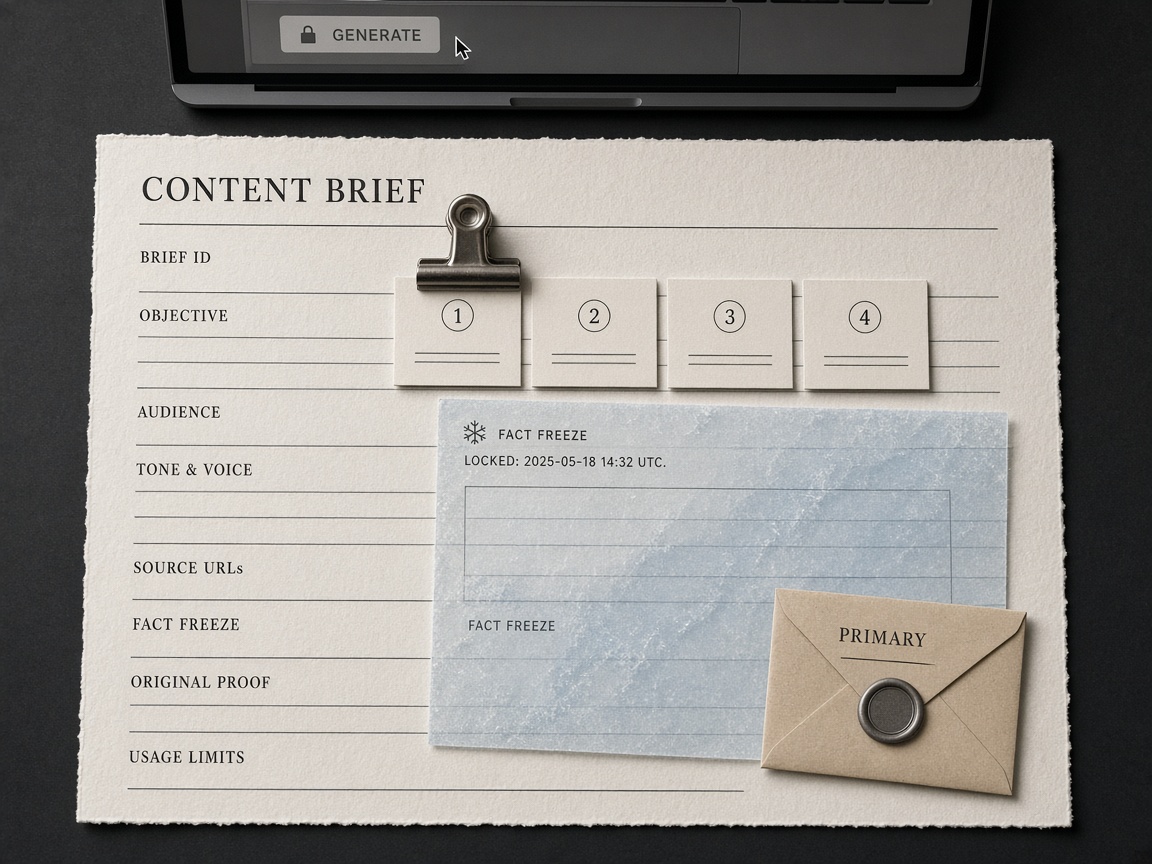
Once the brief names the extractable answer, the next failure is letting the writer or the agent “research” it from the same ten URLs everyone else already ranked. Cadence and AI surfaces only work if the page ships with proof the SERP does not already contain. That freeze happens before a single sentence is generated.
Using generative AI to generate many pages without adding value for users may violate scaled content abuse. The ranking contract therefore locks URLs, datasets, quotes, and first-party proof in the brief so neither a human on Monday nor an agent on Tuesday can clone the current top ten and call it research.
Require at least one asset the results page does not already show: a dataset you collected, a screenshot of the product in use, a method you actually ran, a customer artifact, or an operator teardown. If that asset cannot be named, the URL is not ready to generate—human or machine. Empty “sources TBD” is how thin autoblogged pages reach the CMS.
What AI may do after the freeze—and what it may not
After evidence is frozen, split jobs explicitly. Allowed work is outline, comparison tables from named figures, and internal-link suggestions against your own inventory. Forbidden work is invented citations, unsourced statistics, and feed rewrites. The agent is authorized to assemble from the locked pack, not to go hunting for substitutes. That is the difference between a research-to-publish pipeline and scaled content with a nicer interface.
No freeze, no draft — If the brief cannot name original URLs, data, quotes, and at least one SERP-unique asset, do not generate the page.
Put Who, How, Why, and AI Disclosure in the Brief—Not the Footer
Once original evidence is frozen, the brief still has to pass a people-first test before anyone—or any model—is allowed to draft. Name who the page is for, how it will be produced, and why this site is the publisher that should ship it. Those three answers belong in the contract, not in a CMS bio or a post-publish note. Automated drafts are not exempt: if the pipeline cannot state audience, method, and site-fit in writing, it is not ready to generate.
Google’s people-first checklist treats extensive automation to produce content on many topics as a search-engine-first warning sign. Cluster scope and topical authority therefore sit in the brief, not in a bulk queue. A research-to-publish system can still automate outlines, tables, and scheduling; it cannot treat “every keyword in the crawl” as a reason to exist. If the URL is outside the cluster you actually own, the non-goal is to skip it—not to fill a calendar.
When automation substantially generates the page, Google asks publishers to make AI use self-evident and to explain how and why it was used. That explanation is a brief field: what the model was authorized to do, what remained human (source selection, fact freeze, money-page review), and why the mix serves the reader. A disclosure bolted on as a footer after the CMS already received the draft is too late—the contract already failed closed.
A brief that only lists keywords and word count is already search-engine-first, whether a person or a model fills the draft. Volume without who, how, why, and a named disclosure is the same failure mode as empty evidence fields: the pipeline will ship thin pages because nothing in the authorization blocked them.
People-first in the contract — Who, how, why, cluster scope, and AI disclosure are publish-blocking brief fields—not afterthoughts—because extensive automation across many topics is the people-first warning Google already named.
Give Every Brief Field a Human Owner or a Machine Owner
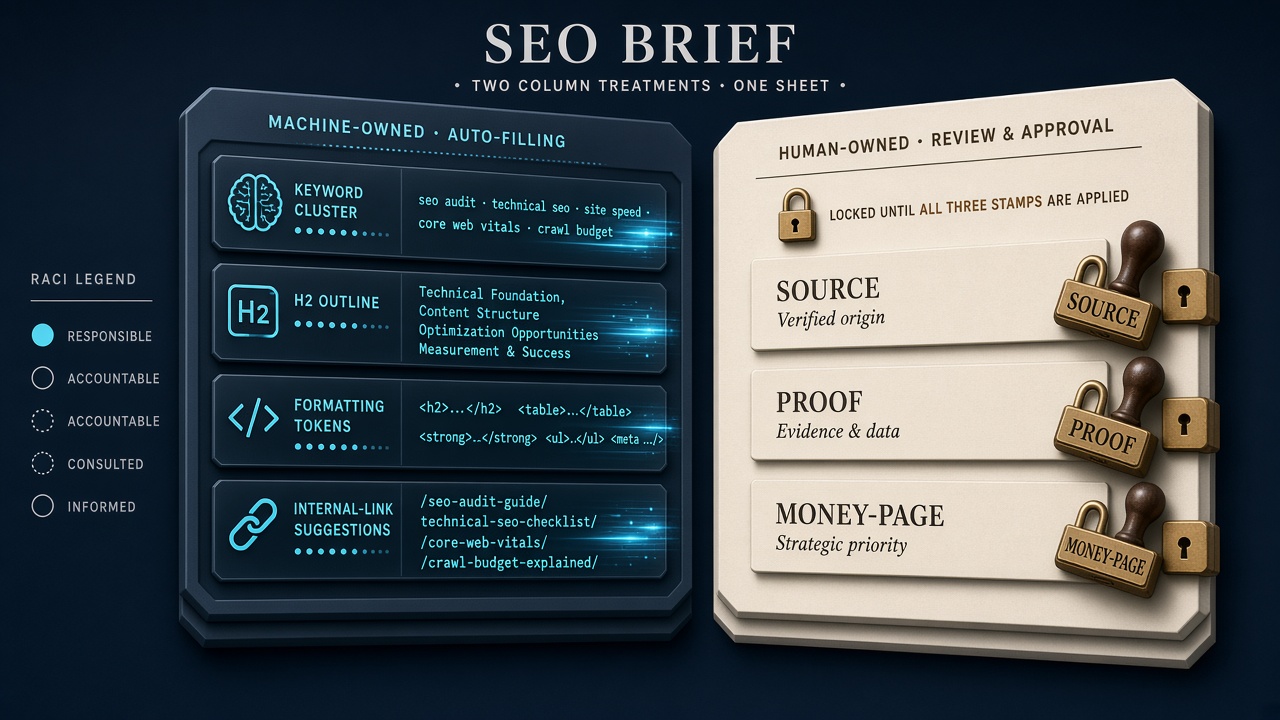
Once Who, How, Why, and disclosure live in the brief, the next job is ownership. A ranking contract does not treat every field as “someone’s problem.” It labels each cell as human-owned or machine-owned so an agent can move fast where speed is safe—and must halt where guessing would invent proof.
Automate the fields that raise velocity without creating facts: clustering, outline scaffolding, formatting, internal-link suggestions, and scheduling. Those jobs compress research-to-publish time. They do not decide what is true, which primary source is allowed, or whether this URL deserves to exist. Keep source selection, fact freeze, original evidence, and money-page review on a named human. That split is the ranking line. If a model fills a human-owned cell, the page is no longer fail-closed—it is a prompt with a CMS login.
Do not brief a programmatic SEO template as if it were a blog post. Programmatic SEO is page architecture plus structured data at template scale. Autoblogging is post-level velocity through a source → generate → QA → CMS pipeline. Each needs different frozen fields. A pSEO brief locks entity lists, schema, and URL patterns. An autoblogging brief locks unique evidence, do-not-scrape rules, and a human approver for that URL. Mixing them produces thin pages that look “scaled” because the contract never said which system was running.
Write the RACI so empty human cells stop the agent
Encode ownership as RACI, not as a Slack habit. Responsible and Accountable sit on the human for source selection, fact freeze, original proof, and money-page review. Consulted and Informed can be agents for clustering, outlines, formatting, links, and schedule. An agent may fill only machine-owned cells. On an empty human-owned cell it must halt—no invented citation, no inferred “why this URL,” no silent publish. That is how the same brief holds quality for a writer on Monday and an agent on Tuesday without collapsing into autoblogged filler.
Ownership — Machine-owned cells may be filled automatically; empty human-owned cells must stop the pipeline. That RACI is what turns a brief into a fail-closed publish contract instead of an AI writer with permission to guess.
Fail closed: the publish criteria a rank-ready brief must enforce
That halt is the point. Publish is not a calendar slot or a CMS click. It is a yes-or-no against the brief: unique evidence attached, Who/How/Why complete, no feed-rewrite source, human sign-off on money pages, and AI disclosure filled when generation was substantial. If any required cell is empty, the default is draft—not schedule—whether the next step is a writer, a WordPress agent, or an API. Fail closed means the page never reaches the live URL until those cells are filled. Fail open is how thin autoblogged pages slip into the index.
This is not a research-to-publish runbook and not a vendor scorecard. It is the quality contract those systems are missing. The brief does not care who drafted the sentences. It cares whether the page can be rejected.
A rank-ready autoblog is one whose briefs can say no. Tools that optimize for volume without that contract are how scaled content gets shipped: many pages, no unique evidence, no reason this URL exists. Cadence without a freeze is just a faster way to publish the same empty fields. Keep the pipeline—source, generate, QA, CMS—but treat QA as a gate, not a polish pass. When the contract is fail-closed, agents and writers share the same authorization: ship only what the brief already proved. Everything else stays a draft.
Fail closed — A ranking brief is the publish contract: empty required cells mean draft, not go-live—so the pipeline can reject pages before they ever hit the CMS.
Key Takeaways
Turn your next content request into a ranking contract: freeze evidence, assign every field a human or machine owner, and refuse to publish until the brief can reject a thin page.
Frequently Asked Questions
You Might Also Like
- Guides SEO Content Brief Template: The Complete Guide to Briefs That Rank
- Guides SEO Content Brief Examples for Product, Comparison, and How-To Pages
- Workflows Content Automation Workflow: Research, Draft, QA, Publish
- Workflows SEO Workflow Management: How to Run Content From Brief to Publish
- Comparisons AI Blog Writer vs Autoblogging: Which Model Scales Content?