Content Pruning Checklist for a Weekly Autoblog

A weekly autoblog does not need another planning template. It needs a disposal card that runs after the decay audit, because the risk is not a stale archive—it is a growing pile of thin URLs shipped to rank. Google lists extensive automation that produces content on many topics as a warning sign of search-engine-first content, and its scaled content abuse policy covers producing pages at scale to boost rankings whether automation, humans, or both are involved.
Pruning is a quality action, not a freshness trick. Google has said that removing unhelpful content could help the rankings of other content on the same site, because a sitewide signal can hold down pages that were never themselves unhelpful—and that signal can stay applied for months until unhelpful content has not returned. The same guidance is blunt about the wrong motive: removing a lot of older content mainly to make a site seem fresh will not help rankings.
This checklist is fail-closed. Inventory the newest and weakest URLs, join a long Search Console window with backlinks, conversions, and indexing status, then assign one verdict. Deletion is the last box on the card. A URL with backlinks, a real purpose, or a close replacement does not get a kill until a human signs off.
- Run a disposal checklist after the decay audit, not another content plan.
- Assign one verdict per URL: hold, refresh, merge-and-301, noindex, or 404/410.
- Prune unhelpful pages for quality; do not delete older content just to look fresh.
- Do not remove a URL with backlinks or a genuinely relevant replacement.
- Require a human sign-off before any kill, and judge the prune over months, not a fortnight.
What a content pruning checklist is, and how it differs from a decay audit
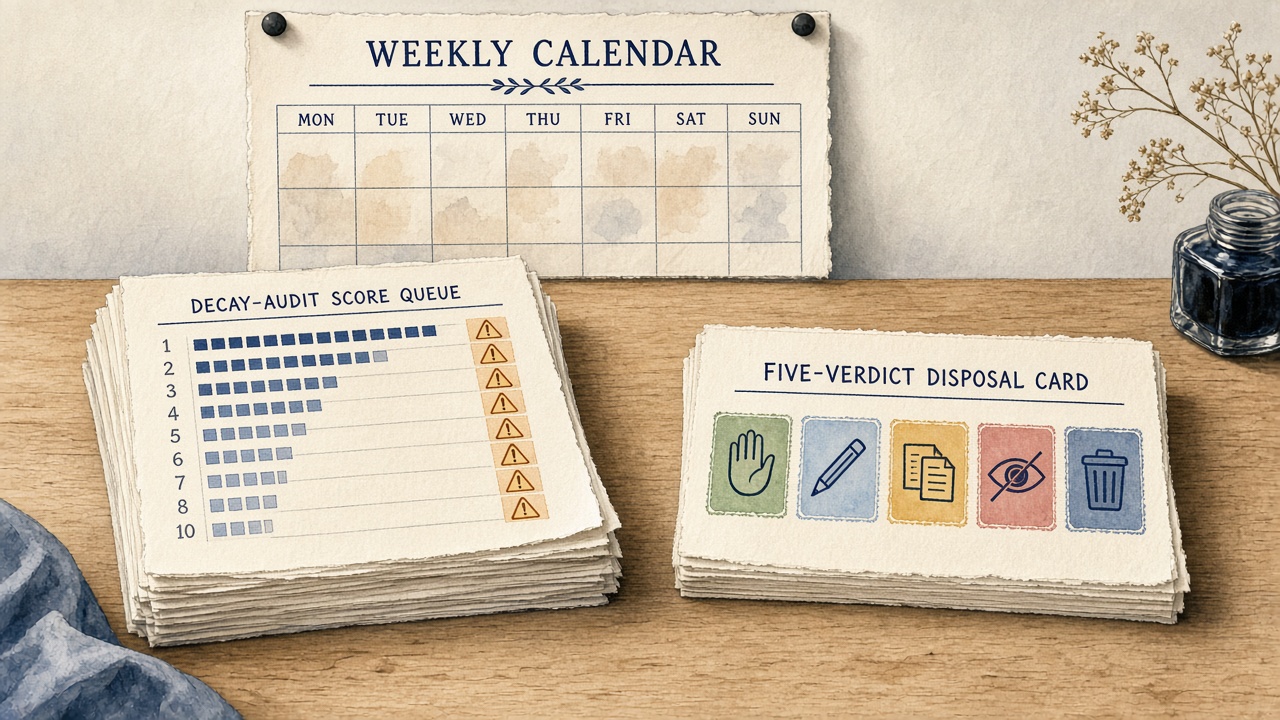
The checklist that follows is a disposal card, not another planning template: inventory the newest and weakest URLs, then assign one verdict — hold, refresh, merge-and-301, noindex, or 404/410.
It is not the decay audit. That audit scores what is slipping and freezes the next post when the queue is full; this card runs only after that score and still refuses a kill until purpose, links, and a close replacement are checked. Leave those mechanics to the decay-audit guide and the noindex/redirect/delete pillar.
A weekly autoblog prunes on a shortlist review, not a standing delete day. Smaller sites are commonly advised to review every 6 to 12 months, filtering for under 10 clicks in 12 months and no update in over a year, rather than wiping every low-click URL. Run the card on URLs just shipped plus the shortlist that failed the decay score — not on publish day, and not as an annual backlog purge.
Disposal, not planning — A pruning checklist assigns one verdict after the decay score and refuses a kill until purpose, links, and a close replacement are checked.
What Search Console data you need before a delete or redirect
Before you delete or redirect, do not act on clicks alone. Pull 12 to 16 months of Search Console clicks and impressions, then join that window with backlinks, conversions or other purpose signals, and indexing status, and assign one verdict. A URL is a prune candidate only if it fails every commonly cited floor: under 50 organic sessions, under 50 impressions, under 5 referring domains, and under 14 ranking keywords. Missing one floor is noise, not a kill.
Zero traffic is ordinary, not a disposal list. Those Ahrefs figures are estimates from about 14 billion Content Explorer pages, and the sample leans toward higher-quality pages. One operator put 201 legacy URLs through the card and deleted five—about 2.5%—because deletion should be the rarest of five outcomes. A weekly batch is only the shortlist that fails every gate.
Shortlist only — Join a year-plus of Search Console data with links, purpose, and index status, and prune only URLs that fail every floor—deletion stays the rarest verdict.
Pages by estimated Google traffic
When to update a page instead of pruning it
Failing the traffic floors does not mean delete. Update a page instead of pruning it when the URL still has a real job: a query people still search, impressions or links, or a purpose the weekly line can actually improve. Stale or thin is a refresh, not a removal, if that intent is still yours to own.
Do not refresh a page whose query is dead, whose draft was search-engine-first, or that duplicates a stronger URL. Point those to merge or removal instead of polishing them.
Merge when two posts chase the same intent. Keep the URL with the better links, impressions, and fit, fold in anything unique from the weaker post, then 301 only to that close replacement. A 301 is not a merge by itself. If you cannot name the surviving page and what it now covers, hold both URLs, and tighten the automated-post quality guardrails so the next brief does not recreate the duplicate.
When noindex beats a delete — and when to send 404 or 410

Once refresh is off the table, noindex is better than deleting only when readers still need the page and search should not rank it. It is not a soft delete. Thin autoblog URLs nobody should find should come down, not stay in the index as a quieter version of the same page.
For a page that is permanently gone, Google recommends a 404 or 410. A 404 is a strong signal not to crawl that URL again; blocked URLs stay in the crawl queue longer. All 4xx codes except 429 are treated the same: the URL is not indexed, previously indexed URLs are removed, and crawl frequency decreases. Prefer 410 when the CMS can send it, but do not claim Google processes 410s faster than 404s.
Card order — Purpose, links, then a named replacement. Refresh or merge if intent is still live. Noindex only if users still need the page and search should not rank it. Otherwise 404 or 410.
Is it safe to redirect old posts to the homepage?

No. A homepage is not a replacement for a retired post, so do not point old URLs there to clear the queue. Redirect only where a genuinely relevant page already exists. ALT Agency returned 404s for most removed posts and redirected only to a real replacement, warning that mass redirects to the homepage can act as soft 404s. When the page is gone and nothing close replaces it, send a real 404 or 410 — the statuses Google recommends for a permanent removal.
A page with no clicks but backlinks is not a delete. Zero clicks plus links fails the fail-every-gate rule, so hold the URL, or 301 only to a close topical page that can honestly inherit those links. If no replacement exists, keep it. Do not 404 a linked URL to tidy the blog, and do not noindex it just to hide a link asset you still want discovered.
Can pruning help other pages rank, or is that a myth?

Judge that question on the URLs you keep, not on whether the archive looks newer. The useful record is concentration: how much of the site's clicks sat on the pages marked for removal, and what happened to the rest after they were gone.
Case studies show concentration can lift what you keep, with messy attribution. A Search Engine Land study marked 198 of 600 URLs for removal; those 198 had 144 clicks, about 3.1% of site clicks. Seer reported a recovery after pruning about 14,000 lower-value and duplicate pages. ALT Agency cut nearly 400 posts to about 25 and saw impressions rise from 55,300 to 164,000, with average position moving from 55.3 to 38.3, while warning that other updates landed in the same window.
Treat those lifts as a quality action, not proof that deletion refreshed the site. Report the prune that way, then wait months before you call it.
Quality, not freshness — Removing unhelpful pages can help the rest of the site, but only as a lasting quality cut — not as a trick to look new.
Reported lifts after pruning
How content pruning relates to scaled content abuse

Concentration only helps if the next posts do not rebuild the unhelpful pile. The pruning card exists to stop the pattern scaled content abuse targets — and yes, check AI citations before you remove a low-click page.
After the March 2024 core update and related spam work, Google reported 45% less low-quality, unoriginal content in search results, versus the 40% it had expected. A weekly line that keeps shipping thin URLs is publishing into that cleanup, not around it.
A weekly autoblog that ships thin URLs is the pile this checklist is meant to stop. Pruning does not launder that pattern if the next publish still fails the quality gate; the automation guardrails and the cluster-kill rule still apply.
A low-click URL can still be the page you want a reader or an assistant to land on. If you still want that page found, hold it or refresh it — do not use noindex as a way to keep it quietly in place. If the page is unhelpful filler, that supports removal, not a softer status.
Fail closed — Pruning does not excuse a weekly line that still publishes thin pages, and a citation you want is a reason to hold the URL, not to noindex it.
What to update in the sitemap and internal links after a prune

Once those verdicts are live, the sitemap and the internal links have to match the card. Drop removed URLs from the XML sitemap, keep only URLs that should stay indexed — including genuine 301 targets — and resubmit once the status codes are actually serving.
Sweep links that still point at deleted or redirected posts. A nav item, related-post module, or cluster hub aimed at a 410 recreates the dead end you just cleared; point those links at the surviving page, or remove them. Do not tidy by blocking removed URLs in robots.txt or sending them all to the homepage. Let the 404 or 410 stay crawlable, and leave linked URLs you chose to hold in both the sitemap and the internal graph.
Log the batch: URL, verdict, replacement, date, and who signed off. Next week's card starts from that log, not from a fresh export of every zero-click page.
Key Takeaways
Run this week's shortlist through the fail-closed card before the next autoblog post ships, and refuse any delete until purpose, inbound links, and a genuinely close replacement have all been checked.
Frequently Asked Questions
You Might Also Like
- Measurement Content Decay Audit: A Monthly Checklist Before Rankings Slip
- Measurement How to Prioritize a Content Decay Audit When You Publish Weekly
- Guides Noindex vs Delete vs Redirect: A Hold Rule for Pages With No Clicks
- Quality Zombie Pages: How to Spot URLs That Dilute a Topic Cluster
- Measurement When to Kill a Cluster That Is Not Compounding