How to Prioritize a Content Decay Audit When You Publish Weekly
Publishing every week does not keep the library healthy. The typical editorial page reaches peak traffic a median of four months after it goes live, then loses about 76% of that peak within three months, according to Fractl’s tracking of hundreds of pieces in GA4. A new brief on a related query does not restore the URL that already earned the clicks, the links, and the leads.
For a one-person stack, the constraint is hours, not ideas. A mid-size library can surface dozens of declining URLs while a team can only ship 10 to 20 refreshes a quarter, Nico Digital notes, and the highest-leverage decision is which of those pages get the hours. Percentage drops on pages that never earned traffic are a distraction. Absolute clicks lost, early decay that is still reversible, and the time a refresh will actually take are the score.
This is a content performance review built for weekly publishing, not a standing invitation to rewrite the archive. Monthly detection on priority URLs, a quarterly classification pass, and one outcome per URL — refresh, monitor, consolidate, or refuse — keep the queue honest. When that queue is full, the next weekly post waits.
- Do not audit the whole library every week; detect decay monthly and classify quarterly.
- Score pages by absolute clicks and revenue at stake, plus hours a refresh will take, not by the largest percentage drop.
- Confirm a URL across two reviews before it enters the queue: clicks, impressions, or position moving the wrong way on a matching query set.
- Classify first, then route only the scored URL into an existing refresh brief.
- When the decay queue is full, freeze the next weekly post instead of adding another new URL.
How Often to Run a Content Performance Review If You Publish Every Week
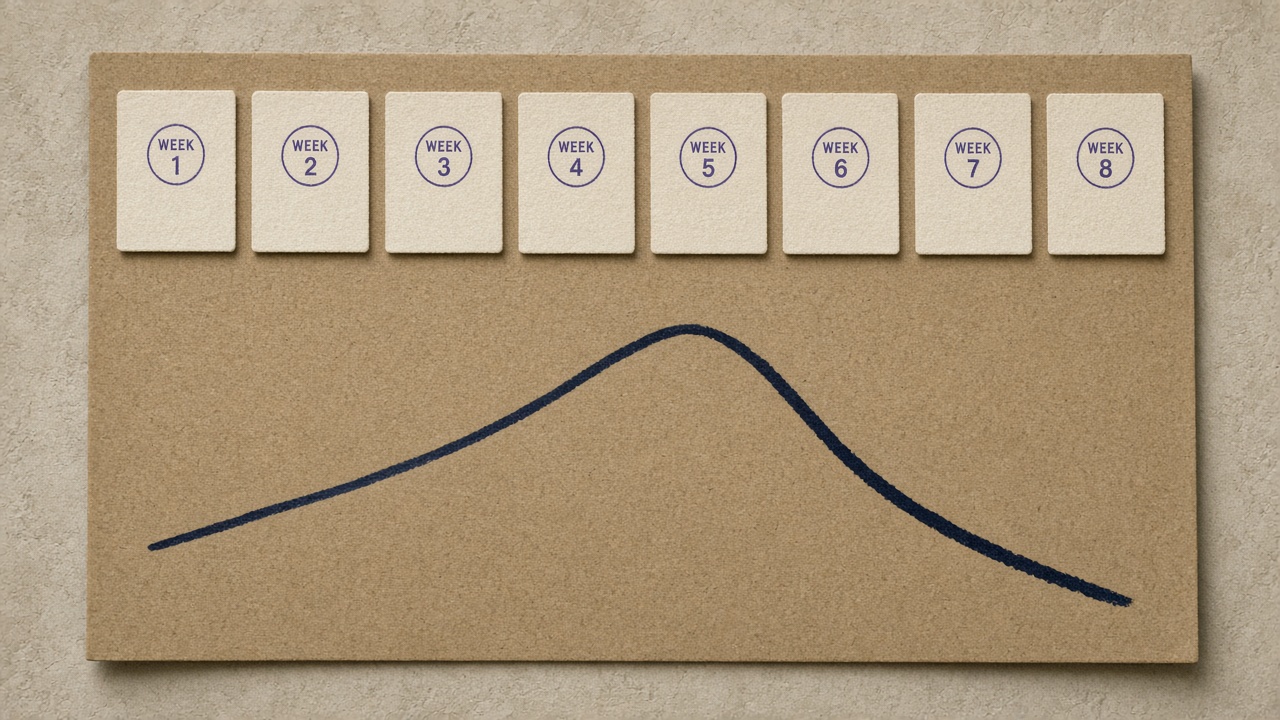
If you publish every week, run a content performance review monthly on priority URLs, not across the whole library every time you ship. Weekly checks are only for pages you are already refreshing, or during a known Google update window. Publishing weekly does not slow decay on older pages in the same cluster. A new post beside an old URL does not reset either clock.
Borrow a detection rhythm instead of building another calendar: monthly decay detection, a quarterly classification pass, a twice-yearly look at high-value pages, and an annual prune. Publishers shipping 10 or more pieces a month add the monthly check-in, because frequency should scale with publish pace, not only page count.
Small and mid-size sites can review important pages quarterly and run a broader audit every 6 to 12 months. A weekly publisher is closer to the high-volume case, so monthly monitoring of the priority set is the cadence you can actually keep.
Across 719 editorial pieces, the typical page peaked a median of four months after publishing. In that same study, the typical piece lost about 76% of peak traffic within three months of peaking. Decay speed depends on format, so one cluster cadence is a mistake. Research and data pieces peaked in a median of one month and lost 89% by month three. How-to content peaked at five months, lost 61% by month three, and retained roughly 30% of peak traffic a year later.
A twice-a-year review is the floor for high-value pages, and research pieces need a look within a month or two of publishing. That floor is not a reason to skip monthly detection when you already publish every week.
Cadence — A weekly ship line still needs a monthly content performance review of priority URLs. New posts do not slow decay on older pages in the same cluster, and format decides how fast each clock runs.
Which Search Console Dates Separate a Seasonal Dip from Decay
That review cadence only works if the dates in Search Console are wide enough to mean something. A weekly publisher should compare the last 90 days with the same 90-day period one year earlier, then read click change, impression change, and position change on that pair. Week-over-week movement, and this month versus last month, swing too hard to enter a queue.
Year-over-year comparison of that same 90-day window is the practical test that separates a seasonal dip from content decay. If this July looks like last July on the same query set, you likely have seasonality. A matching window that was already soft is not a rewrite, and it is not a reason to hold the next brief.
Do not pause the weekly publish line because one URL softened in a month that was also soft a year ago. A seasonal match stays off the queue and leaves the afternoon for the next post. A true decay signal moves to the entry bar — the drop that earns a slot — and only that kind of loss may later hold a brief. Seasonality never does.
The window — Compare the last 90 days with the same 90 days a year ago. A dip that also showed up last year is seasonality; a drop on the same query set is decay, and only that should touch the publish line.
How Big a Drop Has to Be to Enter the Audit Queue
Once a matched year-over-year window shows a true demand loss rather than a seasonal echo, size is what decides the slot. On pages that previously had 100 or more clicks, the monthly readings that count are clicks down 20% or more over 90 days, impressions down 15% or more versus the prior 90 days, or average position worse by 3 or more spots. Any one of those Search Console readings is enough to watch; none of them, by itself, is an entry or a rewrite order.
One soft month is not an entry. Flag the URL only when two or more Search Console metrics move the wrong way across two consecutive monthly reviews and the query set still matches page intent. A dip on a single metric, or a query set that no longer describes what the page is for, stays off the queue even if the percentage looks dramatic.
Entry is a queue slot, not a rewrite order. Pages that miss the bar, or that moved on only one metric once, stay on a watch list and do not spend this week's hours. The bar is deliberately fixed so a weekly publisher is not re-deciding what "bad enough" means every Monday while new briefs keep shipping.
The bar — A URL earns a queue slot only after a fixed Search Console drop—clicks down 20% or more on pages that had 100 or more clicks, impressions down 15% or more, or position worse by 3 or more spots—and only when two or more of those metrics fail across two monthly reviews with intent still intact. One soft month stays on the watch list.
Prioritize Absolute Traffic Lost, Not the Loudest Percentage
Once a URL has cleared the entry bar, do not sort the queue by the loudest percentage. Prioritize absolute traffic and lead value lost. A fall from 1,200 to 600 visits outranks an 80% drop from 5 visits to 1, because the commercial damage is the visits and leads you no longer have.
Early decay is easier to reverse than critical decay. Start with pages that previously drove the most conversions or traffic and have fallen the least, not the pages that already look dead.
What a short review can still save
Treat early decay as clicks down 10–30% with a 1–3 spot drop, and refresh it within 30 days. Active decay is clicks down 30–60% with a 3-plus spot drop and wants a major rewrite, often on a 14-day clock. The early band is what a short review can still save; active decay may not fit the hours you have this week.
That portfolio cost is real, and the same model uses 5% a month as a midpoint that nearly halves a 10,000-visit page within a year. It still does not justify rewriting the loudest percentage first. Teams fail when they open a backlog of about 200 declining pages and start alphabetically. Rank by historical peak, business relevance, and a realistic recovery ceiling, then hold the next brief when that ordered queue is already full.
Rank the loss — Score the queue by visits and lead value still recoverable, starting with early decay on pages that used to earn the most, not by the sharpest percentage on a page that never mattered.
Absolute Visits Lost, Not % Drop
Score the Queue in Three Numbers Before You Brief a New Post
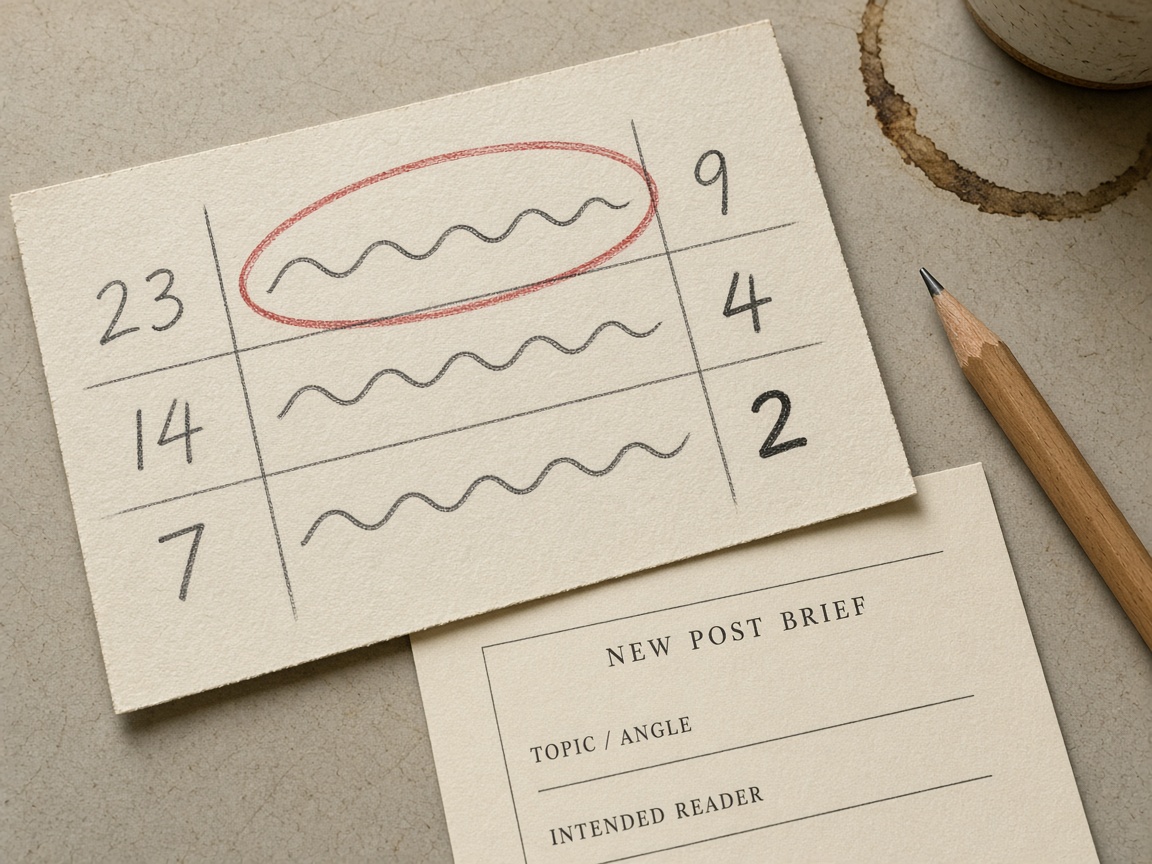
Ranking by absolute traffic lost only helps if you can finish the review in the hours you actually have. Do not score the library. Score the URLs already in the queue with three numbers: clicks previously earned, absolute clicks lost, and the hours required to fix a page that still ranks, still has authority, and sits close to revenue.
- Clicks previously earned: the historical volume that shows the page once mattered, not a percentage on a URL that never earned traffic.
- Absolute clicks lost: the visits actually gone, so a large page that slipped outranks a tiny page with a louder drop.
- Hours required to fix: only count this for a page that still ranks, still has authority, and sits close to revenue. If it fails those tests, it waits.
Which decaying pages should you fix before you brief a new post? The queued URL that already carries backlinks, internal links, and historical engagement. Refreshing that page is frequently more efficient than publishing something new, because you are working with existing equity rather than starting from zero.
Older URLs are the asset, not the leftover. HubSpot’s historical blog review found that 76% of monthly blog views and 92% of monthly blog leads came from older posts, and updating those articles produced a 106% increase in organic traffic to those pages.
Finish the three-number card in one sitting. The winning URL outranks the unwritten post for this week’s hours. The new brief does not open until that card is done.
Score first — With only a few review hours, score queued URLs by prior clicks, absolute clicks lost, and hours to fix a page that still ranks, still has authority, and sits near revenue — then refresh that URL before you brief anything new.
How Many Refreshes a Solo Month Can Ship, and When the Score Holds the Brief
A one-person stack cannot clear the backlog, so a solo month is a handful of refreshes, not a sweep. Hold the next brief when a queued URL’s score — absolute clicks at stake, still early enough to reverse, and hours that fit this week — is higher than the expected value of the unshipped post, and the remaining hours cannot cover both.
That ceiling is the plan, not a temporary slowdown. On a typical engagement the decaying population is 30 to 100 pages, while a team has bandwidth for maybe 10 to 20 refreshes a quarter. A 90-day maintain, refresh, consolidate, or prune program that starts with the ten highest-value decaying pages is claimed to win back 30 to 60 percent of lost organic traffic without a single new article. Picking those pages is the decision; the weekly line does not get to skip it.
The hold is a scheduling rule, not a publishing freeze. Once the scored refresh is shipped, or the queue drops below the entry bar, date the brief and ship it. What you do not do is open a competing URL on the same query and call the decay handled.
Hold the slot — A solo month is a handful of refreshes against a 30-to-100-page decay pile. When hours cannot cover both, the higher score keeps the new brief undated until the refresh is done or the queue releases the slot.
What the Review Must Log Before a Refresh Brief
The score only holds the next brief if the page already has a finished content performance review log. Before that log becomes a refresh brief, it has to record the URL, the paired 90-day windows, click change, impression change, position change, absolute clicks lost, whether the query set still matches intent, the outcome — refresh, monitor, consolidate, or refuse — and the hours required.
If any of those fields is blank, the brief does not open. The log is the handoff, not a scratchpad you reconstruct after someone has already started rewriting.
A lost AI citation should raise priority even if rankings still hold. Treat organic rank decay and AI citation decay as separate dimensions, and log citation loss beside clicks before you decide the page is fine. A 2026 refresh matrix queues a page when traffic is down more than 20% over 90 days or rankings drop more than 5 positions, and it still keeps citation decay on its own axis. A held rank is not a pass when the page has stopped being cited.
The outcome written on the log is the only thing that may become a brief. A date bump, or a note that says “refresh later,” is not an outcome.
Log first — A blank field blocks the brief, and a held rank does not clear a page that has stopped being cited — citation loss sits beside clicks, and only a named outcome (refresh, monitor, consolidate, or refuse) may open the work.
How Long to Wait After a Refresh, and Which Pages to Refuse This Week
Measure recovery on the clock that matches the fix you shipped, not on a bounce in the same week you published the update. An information update is typically read for a 20–40% lift in 4–6 weeks, intent realignment for 30–60% in 6–8 weeks, and a competitive upgrade for 40–80% in 8–12 weeks. A consolidated page is the outlier: it often produces a 50–150% traffic increase on that URL, and it is still not a same-week verdict.
A first wave—audit the top 30 pages, then ship low-effort fixes in weeks 2 to 4—should be read at 30, 60, and 90 days, with a target of 70–90% click recovery on those wave-one pages. Judging a refresh in the first fortnight will make you rewrite it again before the window you chose has even opened.
What to refuse this week
- Percentage-only losers with almost no absolute traffic
- Seasonal dips that fail the year-over-year test
- Pages whose queries no longer match intent
- Dead URLs with no recovery ceiling
- Any URL you cannot finish inside the hours left
A date bump is a refusal, not a refresh. If you cannot name the fix on the log, do not rewrite the page this week—monitor, consolidate, or leave it, and keep the weekly post only if the decay queue did not claim the slot. The review is finished when every priority URL has one outcome and the hours left are honest.
The clock — Wait for the recovery window that matches the fix, and refuse any rewrite you cannot name and finish this week.
Key Takeaways
Score this month’s decay queue on absolute clicks lost and hours left, then hold the next brief until that card is finished.