Content Governance for AI Publishing: Who Can Approve, Edit, or Kill a Draft

Content governance is the framework of policies, roles, processes, and standards that decides who can create, edit, approve, publish, update, and retire content. It sits above style guides, QA checklists, and a single sign-off button. A style guide does not answer who may advance a draft, who may change it, or when it should be killed. That gap shows up in results, not in drafting speed. Content Marketing Institute’s 2026 B2B research, as reported by ContentStudio, found that 95% of organizations use AI-powered applications. Among organizations using AI for content creation, 87% reported improved productivity and only 39% reported improved content performance. Faster drafts without named rights to approve, edit, or stop them do not become better pages. This article treats governance as one usable policy: one accountable person per content type, a clear split between reviewers and approvers, risk tiers that raise the human gate, and an audit log of person, action, version, and time. AI may draft and flag gaps. It does not get the last word on what goes live.
- Content governance names who may create, edit, approve, publish, update, or retire content—not just how a draft is written.
- Reviewers comment; one named approver makes a binding advance, hold, or kill. The drafter should not be the only publisher.
- AI use is nearly universal and often faster, but better performance is much rarer without decision rights.
- A write-capable agent is a publishing system: generation and publication stay separate, and anything user-visible needs a human before it goes live.
- Governance continues after publish through a named owner, a review date, a correction path, and the right to retire thin content.
What Content Governance Is — and Why It Isn’t a Style Guide or a QA Checklist
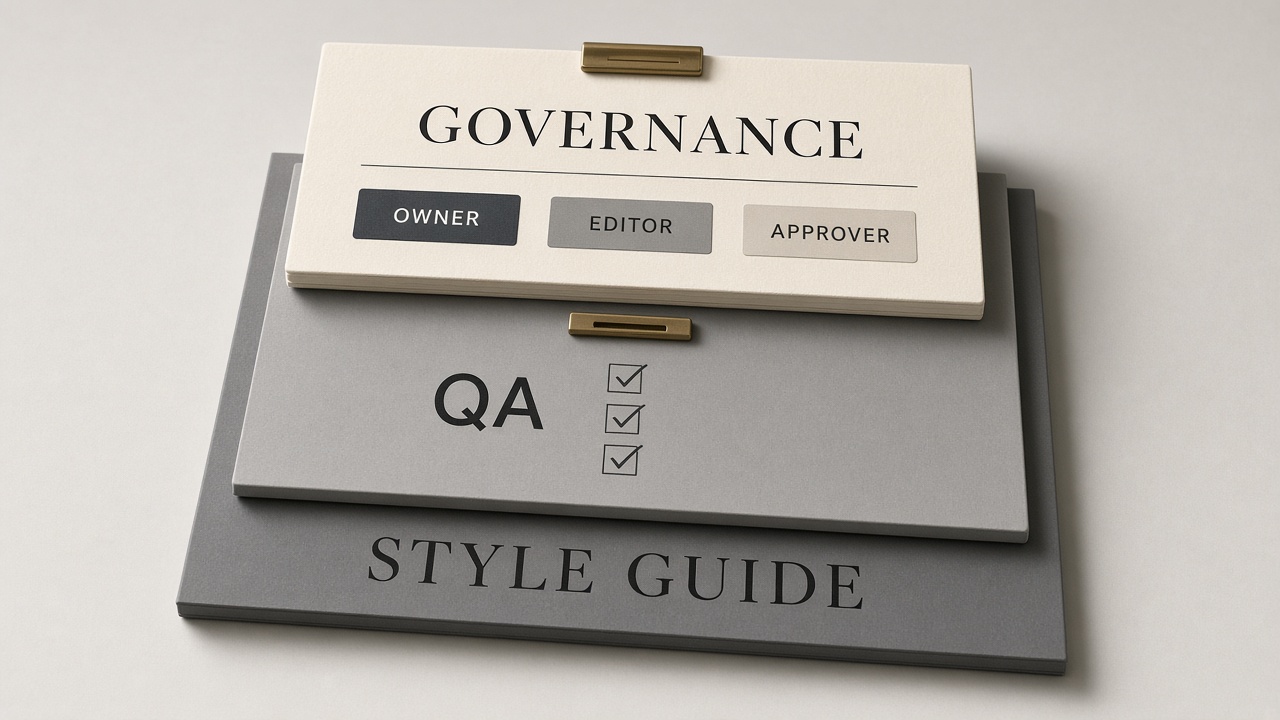
The handoff is where this policy is real. A draft moves only when the person accountable for that content type records an advance, hold, or kill. A reviewer note, however thorough, is not that record. If the name is missing, the queue has comments and no decision.
A QA checklist tests a draft against criteria such as claims, links, and metadata. Passing that list does not grant anyone the right to push the page live, hold it, or kill it. Those rights live in governance, with an escalation rule for exceptions so a missing approver does not stall the queue or let an unowned draft ship.
Treat this article as the policy those execution checklists should link up to, not as another checklist. Style and QA still matter; they only work once someone is named to use them and to decide what happens when a draft fails.
Decision rights — Governance names who may create, edit, approve, publish, update, or retire content. A style guide shapes how it reads; a QA checklist tests the draft. Neither assigns the right to advance, hold, or kill it.
Who Can Approve an Automated SEO Draft, and Who May Only Comment?
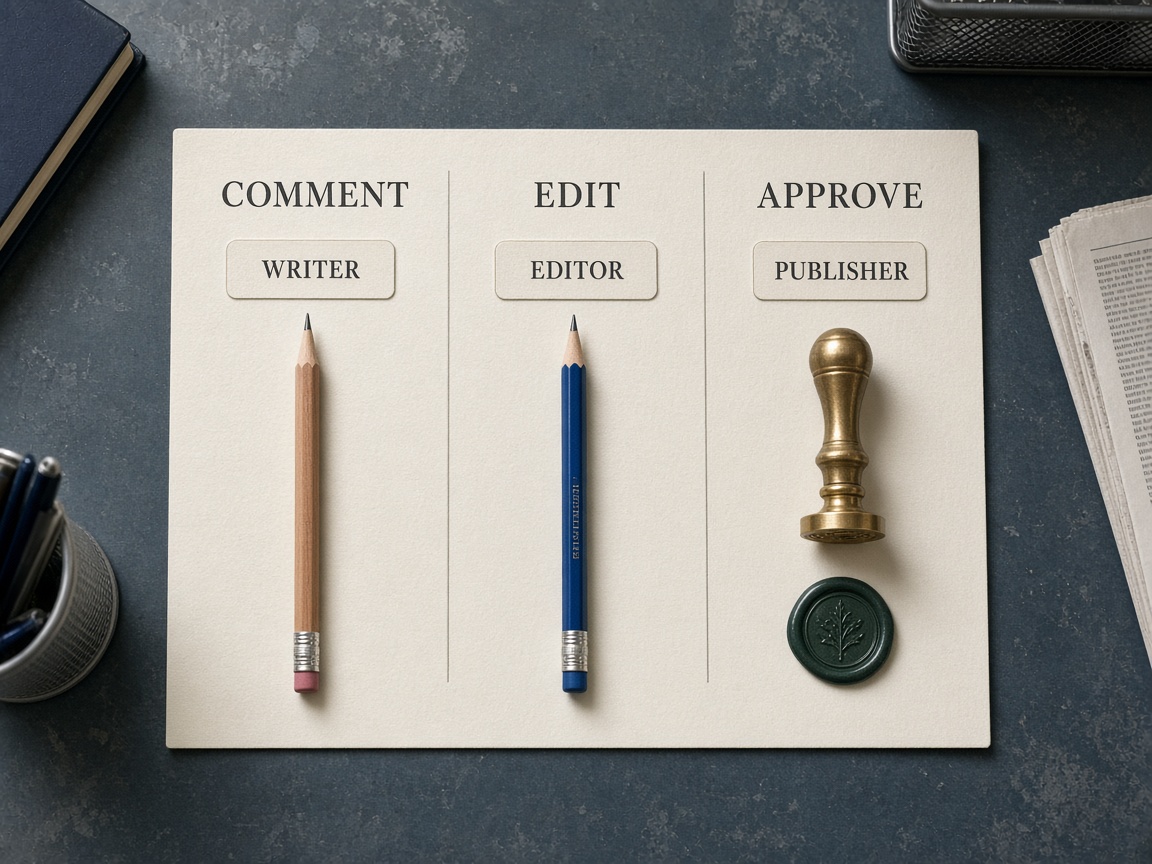
Approval is a named right, not a group chat. One person per gate may advance, hold, or kill an automated SEO draft. Reviewers leave feedback that does not block progress, and they cannot publish.
An editor may change the draft inside an agreed scope — facts, headings, internal links — without becoming the publisher. A commenter may flag a claim or a thin section, but may not rewrite, approve, or push the page live. The person who queued the draft should not be the only publisher.
Put the rights on a decision card
Write five names before the next automated draft is queued, not after the comments pile up.
- Owner: accountable for the content type after it goes live.
- Editor: may revise inside scope, and cannot publish alone.
- Commenter: non-blocking notes only — no rewrite, no approve, no push live.
- Approver: the single binding decision to advance, hold, or send the draft back.
- Kill authority: who may retire a draft instead of polishing it, named even if that person is also the approver.
Unclear decision rights stall adoption. IBM research cited by Inriver found that 68% of executives say AI adoption has slowed because decision rights and escalation pathways are unclear. Name the approver, and the backup, before the queue moves.
Structured roles also cut review thrash. Monotype’s 2025 Scaling Creative Operations survey of 1,008 creative professionals, cited by Ziflow, found that 57% spend more than a quarter of their time on non-creative work, and structured workflows can reclaim up to 35% of creative time. That gain is real, and it does not replace the human gate. The model may draft. Only the named approver may publish.
Decision rights — One named approver per gate may advance, hold, or kill an automated SEO draft. Editors revise in scope, commenters do not publish, and unclear rights are what stall the next draft — not the model.
When Should a Human Kill a Draft Instead of Rewriting It?
Once approve, edit, and comment rights sit on the decision card, the named approver still has to know when advance is the wrong call. Kill the draft when it has no information gain, no source pack, the wrong intent, or would only add another thin page. Do not rewrite it into compliance theater.
A kill is a governance action, not a workflow failure. Record the reason against the content type and pull the draft out of the queue. Silence is not a green light for the next automation cycle.
What a kill looks like in practice
- No new information a reader could not already find on a stronger page you already own or a better source already ranks.
- No source pack the approver can check before anything goes live.
- Intent that does not match the query the page was meant to serve.
- A near-duplicate that would only thicken a cluster of thin pages.
Volume is not a reason to rescue the file. Graphite’s study of 55.4k English Common Crawl articles found primarily AI-generated articles at 50.9% in the fourth quarter of 2025 and 49.9% in the first quarter of 2026—near half of new articles, and plateauing there. Despite that volume, primarily AI-generated articles largely do not appear in Google or ChatGPT.
Fail closed. A missing source pack, an unanswered review, or a detector score is a hold or a kill, not permission to tidy tone and publish. The human who owns that content type makes the call. The model does not.
Kill, don’t polish — If a draft has no information gain, no source pack, the wrong intent, or would only add a thin page, kill it, log why, and take it out of the queue—do not rewrite it into something that merely looks approved.
Can the Person Who Prompted the Draft Also Publish It?

A logged kill only holds if the same person cannot quietly put the next draft live. As a standing rule, no: the person who prompted the draft should not be the only publisher. Generation and publication stay separate. Prompting, revising in scope, and signing off are different acts, even when one small team wears every hat.
If an AI tool can change anything user-visible, treat it as a publishing system, not an assistant. Scoped credentials, a human approval before the change goes live, and a rollback path if the page is wrong are the minimum. A write-capable agent that can edit titles, body copy, or metadata is already inside the publishing stack.
On a solo team, split the acts in time. Prompt and draft in one session; come back later and approve against the checklist, or name a backup approver who can hold or kill. A prompt, a model score, or an empty review slot is not a signature.
Separate the acts — The person who prompted a draft must not be its only publisher. A write-capable tool needs human approval, scoped credentials, and rollback.
What Risk Level Changes the Approval Path?
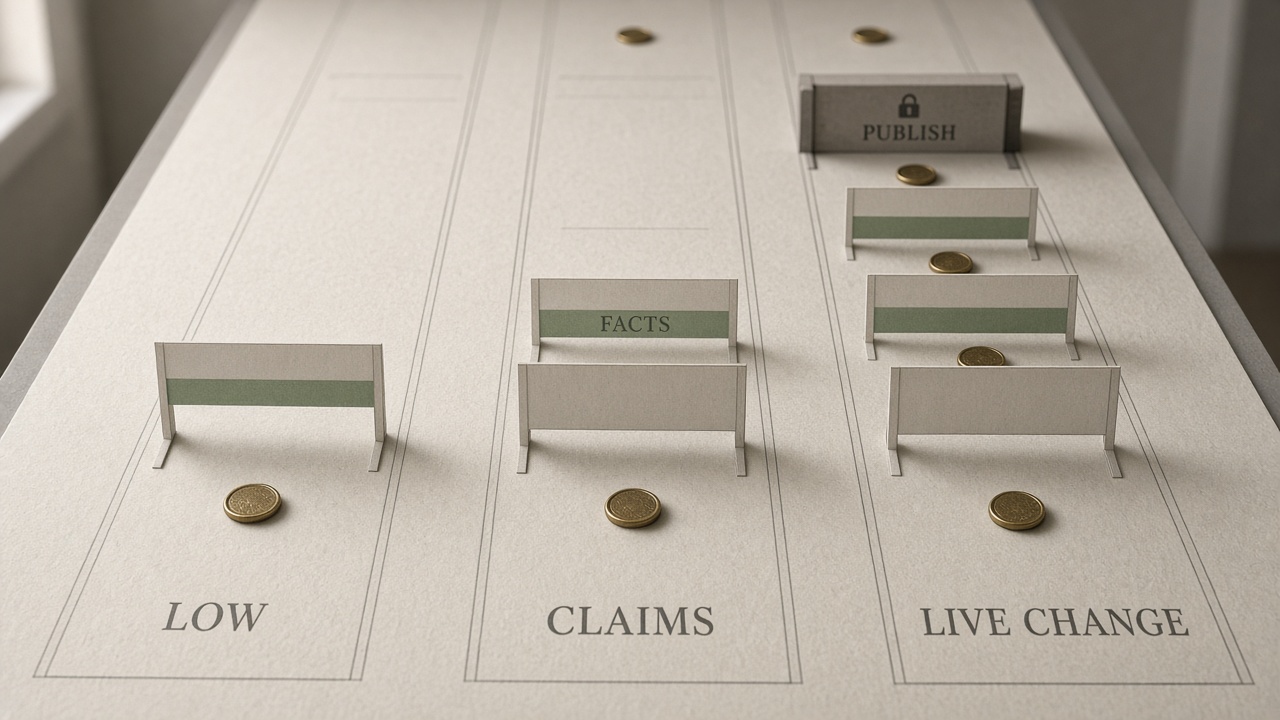
The split between prompting and publishing stays fixed. What changes is how heavy that second act has to be. The risk tier picks the path, not the model: a capable generator does not earn a lighter gate. Consequence does.
Low-risk explainers—pages that teach a process without a claim someone might act on—need a light named human gate, one person who can advance, hold, or kill. Claims, YMYL topics, legal copy, and regulated pages need a stricter named review before any live change. Inaccuracy is the risk operators should plan for first. McKinsey’s 2026 AI trust survey of about 500 organizations, as cited by Inriver, found 74% identify inaccuracy as a highly relevant AI risk, and nearly two-thirds cite security and risk as the top barrier to scaling agentic AI. Unsupervised departmental use is a reason to raise the tier, not skip the gate. Contently cites an EY survey finding more than half of departmental AI projects happen without proper supervision, and almost four out of five leaders cannot keep up with risks from using AI too quickly.
Anything an agent can write that users will see follows the higher path: a named human approves before the change goes live, and a rollback owner can pull that version if it is wrong. Write the three consequence tiers on the same decision card so a new content type does not invent its own process.
Classify the content type once, on that card, before the next draft is queued. If the page mixes tiers, the stricter path wins. A model score does not move a page down a tier.
Path follows consequence — Risk tier, not model quality, chooses the approval path—and user-visible agent output always takes the higher path, with a human before the change and a rollback owner after it.
Can AI Review or Approve Its Own Content?

A risk tier only holds if the model cannot close its own gate. AI may draft, extract claims, and flag gaps. It must not be the final approver of its own page, title, or metadata. A second pass by the system that wrote the draft is a note, not a signature.
Most AI users already check by hand. In Ahrefs’ August 2026 survey of about 300 marketers, 89% of AI users manually check generated content, up from 80%, and only about 3% trust the text without further human review. A growing minority still ships unedited output: 7% say more than three-quarters of what they publish is pure AI, up from 4% a year earlier. This policy forbids that path.
Even when drafting is automated, these decisions stay human:
- Advance, hold, or kill
- Fact claims
- YMYL and legal judgment
- Disclosure
- Unpublish
- Any override of an AI recommendation
Teams that perform well write rules for when to follow, challenge, or escalate AI, and they reward people who surface errors. IBM found those rules at 91% of top performers, and 79% of top performers reward employees who surface and correct AI issues. The missing piece is the name: 35% of executives still do not know who may challenge or override an AI recommendation, and only 32% of enterprises expect those rights codified by a mature 2028 organization. Put that name on the decision card. No name means the recommendation holds.
Human gate — AI may draft, extract claims, and flag gaps. Advance, hold, kill, claims, disclosure, unpublish, and any override stay with a named person.
What Must the Approval Log Record Before a Page Goes Live?
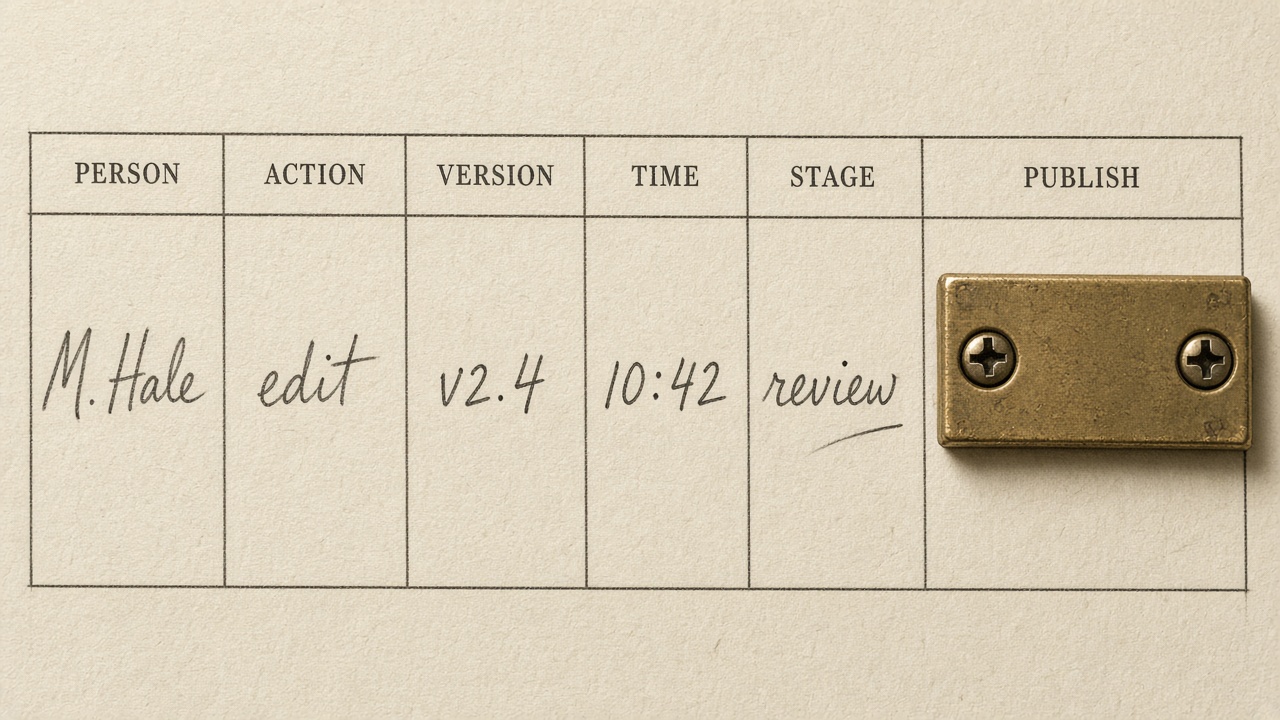
A named human gate is only as real as the record behind it. Before a page goes live, the approval log must show who acted, the action—advance, hold, or kill—a timestamp, the exact version, and the stage.
Approving a title, a score, or “the latest draft” without that version is not an audit trail. A useful audit trail records who acted, when, and on which version of the asset; otherwise the cleared text and the live text can part ways, and no later editor can tell what was signed.
Store source-pack status and the risk tier on the same record, so a later editor can see why this version passed: whether sources were attached, and whether the path was a light gate or a stricter claims review.
No log line, no publish. If the named approver field is empty, the stack should fail closed and hold the draft rather than treat silence as consent.
No record, no live page — Go-live requires a log line naming who acted, the action, the time, the exact version, and the stage—plus source-pack status and risk tier. An empty approver field must block publish.
What Google Requires Before AI Pages and Metadata Go Live
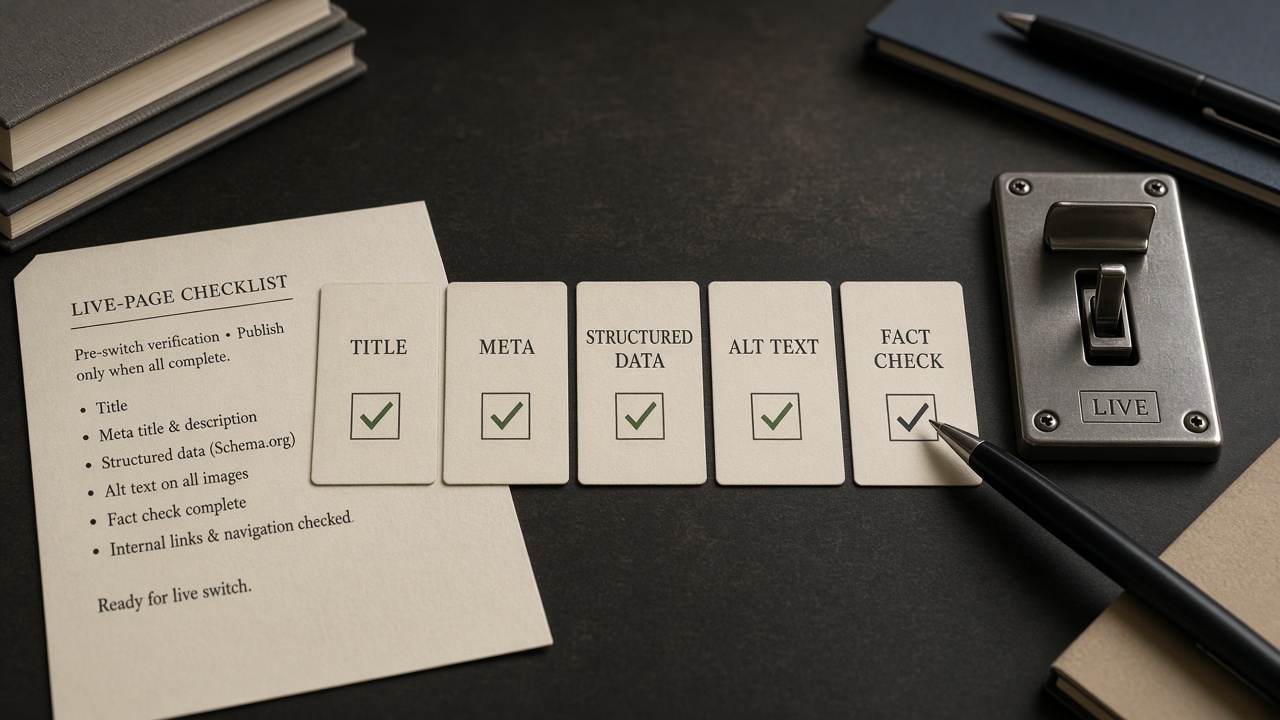
A complete approval log still has to clear rules that sit outside your workflow. Google’s generative AI guidance, last updated 1 October 2026, requires a human to manually fact-check and review all AI-generated content before publishing — the page itself and the metadata that travels with it, including titles, meta descriptions, structured data, and image alt text. A model draft of a title or alt string is not reviewed because the body was reviewed.
Those external dates are not the same gate as your named approver. They mark when transparency and search guidance became binding on the publisher, not when a model earned the right to sign off.
Volume without user value still fails this policy, regardless of who — or what — wrote the page. A logged advance of thin pages does not clear that failure. The kill right on the decision card is how governance refuses that volume before it becomes a live site.
Does the EU AI Act replace the named approver?
No. Article 50’s transparency duties, in force since 2 August 2026, are not a human editorial review and not a substitute for the named approver. Disclosure is a human decision recorded on the decision card — whether readers are told the page was AI-assisted, and in what form — not a footer the model may add or skip. Transparency and editorial sign-off are different gates: one says how the content was made; the other decides whether it may go live.
Two gates — Google requires a human fact-check of the page and its metadata before publish; the EU transparency duty does not appoint the approver or let the model decide disclosure.
Who Owns a Page After It Is Published, and Who Can Unpublish It?
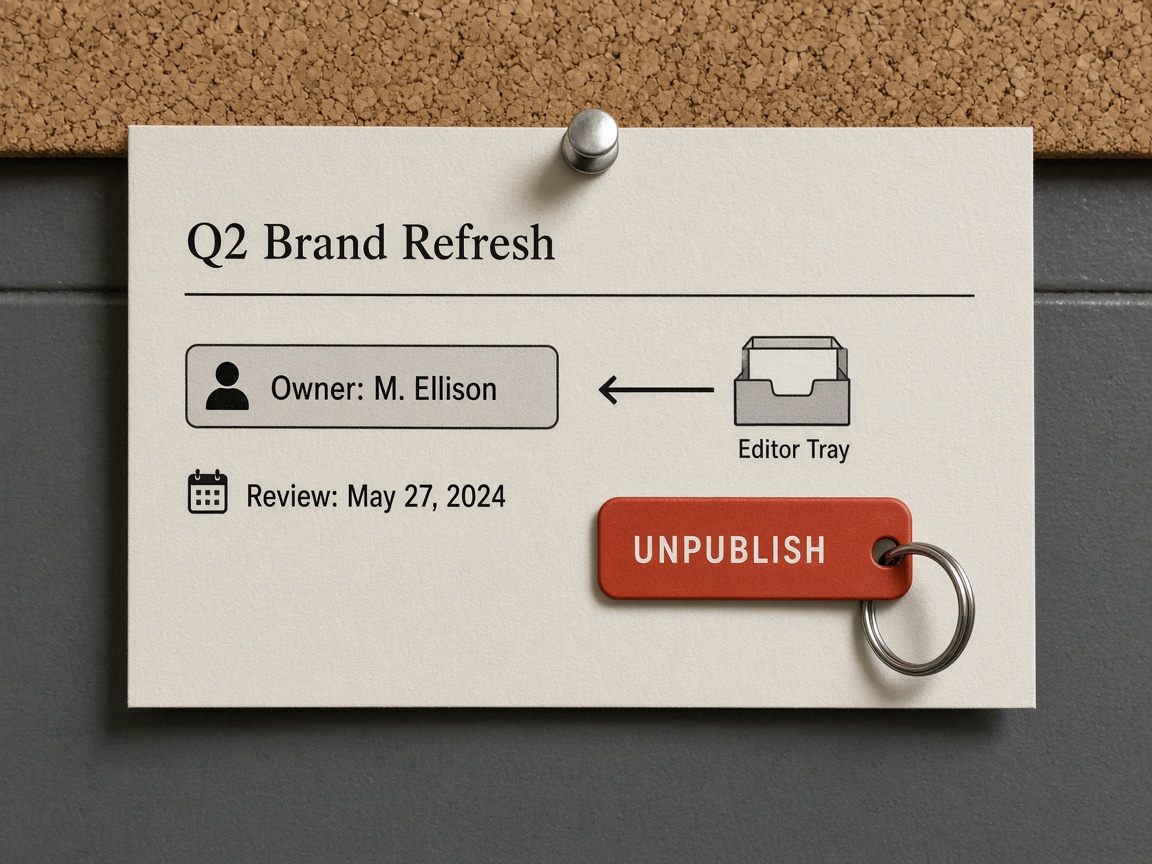
That named approver does not step off the page the moment it goes live. Publish does not end governance. The decision card still needs an owner, a review date, a correction path, and a named person who may unpublish.
Only the owner or a named deputy may take a page down or ship a material update. Commenters can flag a stale claim or a broken source; they cannot retire the URL or push a rewrite live. A correction follows the same rights as the original gate: edit in scope, then a binding advance, hold, or kill from someone who is allowed to make it.
If the named approver is unavailable, the backup approver on the card decides—or the draft, and any post-publish change, stays held. Do not let the queue auto-advance because someone is on leave, offline, or simply slow to reply. Write the backup into the same artifact as the primary approver so absence is a planned path, not an emergency exception. An empty deputy field fails closed the same way an empty approver field does: no signature, no live change.
Still owned — After publish, a named owner, review date, correction path, and unpublish right stay on the card; if the approver is out, the named backup decides or the change stays held.
How Do You Measure Whether Content Governance Is Working?
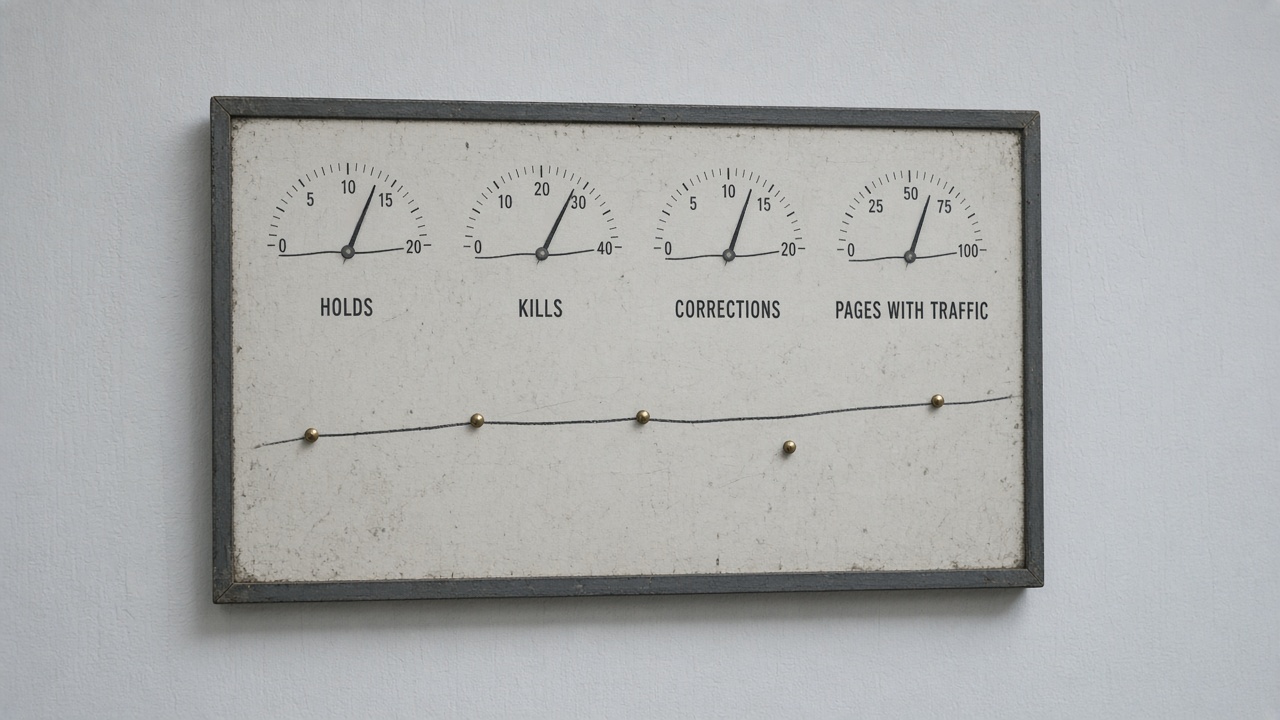
Ownership after publish only counts if you can see whether those rights change outcomes. Measure holds, kills, corrections, and pages that earn useful results — not drafts shipped. Faster drafting is not better performance.
RWS’s Content Unlocked survey of 200 senior enterprise content leaders found 85% use generative AI for ideation and 77% for content creation, while only one in six say their tech stack is fit for purpose. HubSpot’s 2026 State of Marketing, cited by Contently, found 86.4% of marketing teams use AI and 42.5% report extensive use for content creation — more drafts than those teams can review. A stack that is not fit for purpose, paired with a review queue that cannot keep up, means the policy is not enforced.
Link the policy to the gates already on the site
This policy sits above the execution layer. Those articles run the gates; this one decides who may pass them. Point every automated path at:
- Sign-off roles on the decision card — owner, editor, commenter, approver, and kill authority.
- The pre-publish QA checklist, which tests a draft but does not grant advance, hold, or kill rights.
- The automation workflow, the quality checklist, and originality checks that feed the same named gate.
Review the card when a content type, risk tier, or tool with write access changes. If the named approver, kill conditions, or log fields no longer match the live path, the policy has drifted — hold the queue until the card is updated. Governance is working when fewer thin pages go live, exceptions are logged, and the pages that remain are ones a human was willing to own.
Measure the gate — Working governance shows up in holds, kills, corrections, and pages that earn useful outcomes — not in how fast drafts ship.
AI Content Use vs Outcomes
Key Takeaways
Put a decision card on the next automated draft before it is queued, with a named approver, kill authority, risk tier, and rollback owner.
Frequently Asked Questions
You Might Also Like
- Workflows Content Automation Workflow: Research, Draft, QA, Publish
- Workflows SEO Workflow Management: How to Run Content From Brief to Publish
- Automation Content Automation: What to Automate in Your Publishing Stack
- Governance Support Article vs Blog Post: Which URL Should Answer the Query
- AI Search When an AI Citation Should Trigger a Content Refresh