AI Overview Citation Patterns: What Gets Quoted vs Ignored
People chasing AI overview citations usually reach for schema, a longer page, or a higher Domain Rating. The pattern that holds in the 2025–2026 studies is narrower: rank gets you into the pool, and a short answer near the top of the page is what gets lifted.
In Ahrefs’ March 2026 update, only 37.9% of URLs cited in AI Overviews also appeared in the first 10 SERP blocks, across 863,000 keyword SERPs and 4 million AI Overview URLs—down from about 76% in July 2025. AI Overviews have been powered by Gemini 3 since January 2026, and Google has confirmed that AI features run query fan-out, so the cited set is no longer “whatever already ranks for the head term.”
Once a page is in that pool, the quote is a separate decision. TripleDart’s tracing found 64% of citations in the first 40% of the page and a median matched passage of about 28 words. At the same rank, word count, FAQ schema, and Domain Rating did not separate cited pages from skipped ones. The rest of this piece sorts what gets quoted from what gets ignored, then states the hold rule: put a liftable answer early, and do not sell schema or authority as the citation lever.
- Rank still helps a page into the citation pool, but most AI Overview citations now sit outside the organic top 10.
- The quoted passage is short and early: about 28 words, and usually in the first 40% of the page.
- Comparison and definition pages are cited more often than pricing pages; a comparison table is the on-page feature that stayed positive after rank controls.
- Extra words, FAQ schema, and Domain Rating do not decide the quote among pages at the same rank.
- A citation is not proof the overview used the page accurately—about 11% of verifiable claims were unsupported or contradicted the source.
The Top 10 No Longer Owns the Citation Pool
Older overlap figures no longer describe who gets quoted. Date the break to March 2026: only 37.9% of URLs cited in AI Overviews also appeared in the first 10 SERP blocks, down from about 76% of cited pages coming straight from the original SERP in July 2025.
The citations that missed those first 10 blocks split almost evenly: 31.2% from positions 11–100 and 31.0% from beyond the top 100. Part of the drop is better citation parsing, not only a new taste in sources. Gemini 3 was already powering AI Overviews by January 2026, and Google positioned it for long-tail questions. Read the shift as a wider pool. Rank still gets a page considered; it no longer decides the quote by itself.
Pool change — Top-10 overlap fell from about 76% to 37.9%, but that is a wider citation pool—partly cleaner parsing and a long-tail model—not a reason to abandon rankings.
Rank Still Helps, and Still Misses Often
A wider citation pool does not mean organic position stopped mattering. In a 1,000-keyword US B2B SaaS study, position was the only tested signal that cleared the noise: position 1 was cited 55% of the time and position 9 was cited 34%. Both still miss often.
The first-listed source is a different case from the full set. It ranked in the organic top 10 82% of the time, versus 30% for sources below it, and it was usually shorter. Only 37% of all cited sources ranked in the top 10, so 63% came from outside page one. Overviews on 959 of those 1,000 keywords cited about 10 sources, only about four from the top 10.
Keep WashU separate. Across 61,212 citations, 29.8% of cited domains were not on the first page, and an average overview cited about eight sources. Rank is an entry ticket into the pool, not a hold-or-publish decision.
Entry ticket — Position 1 is cited more often than position 9, but most sources in the full set still sit outside page one. Rank gets a page considered; it does not decide what gets quoted.
What Gets Quoted: A Short Answer Near the Top
Rank gets the page into the pool. The quote comes from a short answer near the top: 64% of traced citations from the first 40% of the page, 35% from the first 15%, and only 13% from the last third. The first 100 words were about 4% of a typical cited page and produced 15% of citations. The median matched passage was about 28 words. Write that block on the passage guide, and place it using the structure guide.
Format does the rest of the sorting. Comparison pages were cited 56.2% of the time and definition pages 55.3%. Listicles (48.6%) and how-tos (47.0%) sat in the middle; pricing pages trailed at 40.2%. A comparison table, on 23.0% of cited top-10 pages versus 17.8% of skipped ones, was the only on-page feature that stayed positive after rank was controlled. Surfer’s April 2026 lifts—a confirming first paragraph (cited 22.3% more often), intent alignment (22.2%), and an early answer (18.9%)—are opening factors, not a substitute for top-10 overlap. CXL’s smaller check of 100 citations, with 55% of passages in the first 30% and 21 citations from the bottom 40%, corroborates early placement. It is not a second headline.
Quoted early — The quote is a short, early answer—median about 28 words, mostly in the first 40% of the page—and comparison or definition pages lead the format split.
What Gets Ignored Once Rank Is Equal
That leaves the other half of the comparison: pages that already share the same rank and still get skipped. Holding rank constant, the checklist most teams still optimize does not separate cited top-10 pages from skipped ones. Word count, heading counts, lists, links, meta length, alt text, schema, FAQ schema, Domain Rating, and backlinks all failed that test.
The near-ties are what kill the myths. FAQ schema sat on 19.5% of cited pages and 19.3% of skipped ones, a gap the study called no effect. Median Domain Rating was 79 versus 78, so authority at the same rank did not decide the quote. Cited pages averaged 2,924 words and skipped pages 3,055, which means the longer group was the one left out.
Author bios, tables of contents, and FAQ sections ranked near the bottom of factors that split cited pages from ranked-but-ignored ones, at 5.8%, 3.7%, and 2.6%. Keep schema for classic rich results. Do not sell it as a citation lever.
Ignored anyway — At the same rank, extra length, Domain Rating, backlinks, and FAQ schema do not earn the quote—the gaps are a word or two of authority and a fraction of a point on schema.
Fan-Out Lifts Odds; Most Citations Still Sit Outside

Rank being equal still leaves fan-out, off-SERP pages, and age. Google has confirmed query fan-out: AI features split the search into related sub-queries and cite pages that appear in those results. A 10,000-keyword analysis found pages ranking for a fan-out were 161% more likely to be cited than pages ranking only for the main query, with a Spearman correlation of 0.77. That lift does not own the pool. About 68% of cited pages did not rank in the top 10 for the head term or any extracted fan-out, while pages ranking for both accounted for 51% of citations.
Among citations outside the top 100, 18.2% were YouTube URLs—5.6% of all cited URLs. YouTube is the most-cited domain and grew 34% over the prior six months. Outside-top-10 cited pages were richer in tables (44% versus 33%) but weaker on median Domain Rating (71) and traffic (about 1).
Freshness is a slope, not a cutoff. Citation rate climbed from about 26% for 2018 pages to 50–54% for 2023 and later. Cited pages were a median of 373 days old, versus 450 for skipped ones.
The gap — A fan-out ranking raises citation odds sharply, but most cited pages still miss the top 10 for the head term and its fan-outs—filled by off-SERP sources such as YouTube and by newer pages, not by a hard age cutoff.
Hold Until the Quote Can Actually Land
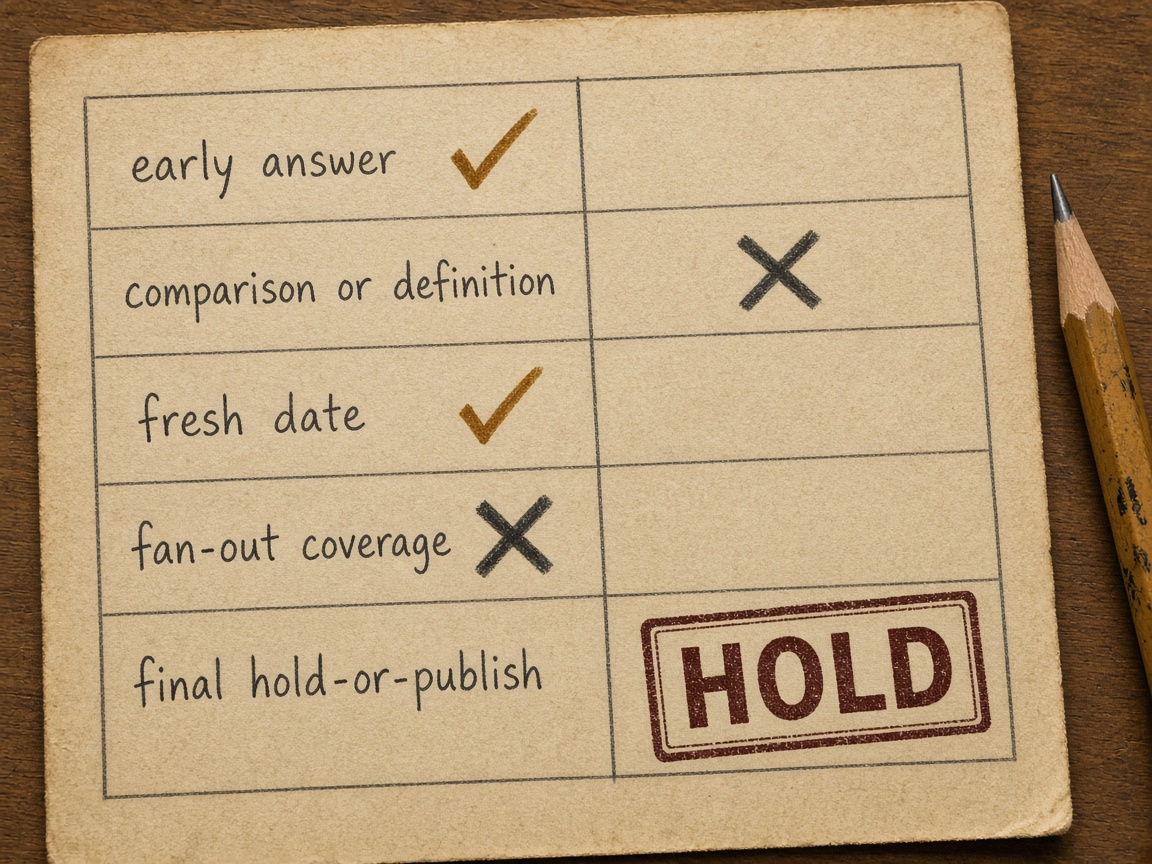
Rank and a fan-out only get a page into the pool. Whether an overview fires, and whether the quote is used accurately, are separate tests—and either one can fail a page you were ready to ship.
On 55,393 trending searches in spring 2026, overviews appeared on 13.7% of queries: nearly 65% of questions, versus 9.5% of other searches. Among non-questions, activation rose from 9.9% at one word to 38.7% at six words or more. Hobby and leisure reached 46.1% and science 39.9%; politics was 7.5% and law and government 9.6%.
A citation is not proof the claim was used as written. Of 98,020 verifiable claims, about 11% were missing from the collected text (7%) or contradicted the source (4%), and only 41.9% of overviews were fully grounded. Spot-check the quote before you treat a citation as a win.
Page structure, the short passage itself, and quoted-versus-skipped logging belong in the page-structure guide, the writing guide, and the AI visibility definition and checker. Use those; this gate only decides whether to ship.
Hold rule — Ship only when an overview is likely, the page is already in the pool, and a short, checkable answer sits near the top—not because the page is long or marked up.
Key Takeaways
Before you add length or schema, check that a short comparison or definition answer can actually be lifted from the top of the page, then log what gets quoted versus skipped.
Frequently Asked Questions
You Might Also Like
- AI Search AI Overview Optimization: How to Structure Pages Google Can Quote
- AEO How to Add Citation-Ready Answers Without Keyword Stuffing
- AEO How to Write SEO Articles That Survive AI Overviews
- AEO AI Visibility Checker: How to Audit Whether AI Engines Cite You
- AEO Answer Engine Optimization (AEO): How to Get Cited by AI Search