Answer Engine Optimization (AEO): How to Get Cited by AI Search

Search is no longer only a ranked list of links. People now put a question into ChatGPT, Perplexity, Google AI Overviews, and similar systems and get a synthesized answer with a short set of citations. You can still win classic rankings and remain invisible where the question is actually resolved—if the model never lifts your page as a source.
Answer engine optimization (AEO) is the work of making your content extractable, trustworthy, and easy to cite. It does not replace SEO. Crawling, indexing, internal linking, and technical health still decide whether you exist in the corpus. Generative engine optimization (GEO) names the same shift toward AI-written results. AEO is the operator version of that shift: write and structure pages so an answer engine can pull a clean claim, attach it to a real entity, and keep citing you as queries change.
This article is a playbook, not a glossary. It explains how answer engines tend to select sources, what a citation-ready page looks like, how to track AI visibility without vanity screenshots, and how to bake those fields into briefs, topic clusters, and automated publishing so every article ships ready to be cited instead of retrofitted after it goes live.
- AEO makes pages extractable and citable in AI answers; it sits beside SEO, it does not replace crawls, rankings, or technical health.
- Answer engines favor question-led structure, clear entities, attributable facts, authority signals, and freshness they can lift without guessing.
- Citation-ready pages lead with a direct answer, then proof: sourced claims, schema, and E-E-A-T a model can attribute to you.
- Track AI visibility through mentions, share of answer, and referral patterns, then feed what you learn back into the next brief.
- Bake AEO fields into clusters and automated publishing so citation readiness is an input, not a cleanup pass.
What Answer Engine Optimization Is — and How It Differs From SEO and GEO
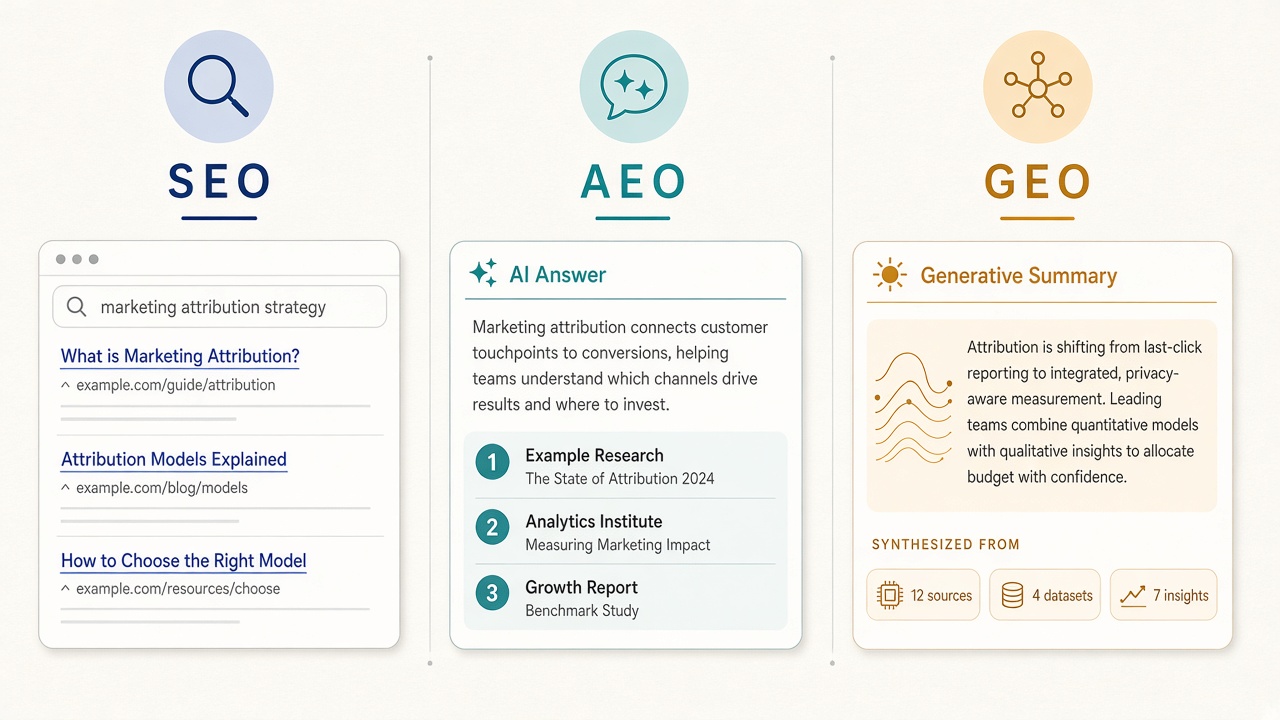
That work starts by treating the citation itself as the discovery event. You are not chasing a higher blue-link slot so much as becoming the named source inside the generated reply—clear enough to extract, trustworthy enough to attribute, and stable enough that engines keep returning to you as queries shift.
Rank-and-click versus named-source
Classic SEO still matters. Crawlability, topical authority, and matching intent remain the foundation—if a page cannot be fetched, understood, or trusted, no engine will cite it. The difference is the win. SEO is built around rank and click. AEO is built around extraction and attribution. AI search visibility is whether your page is named when an answer is synthesized, not whether it occupies position one.
A page can rank well and never be quoted. Another can sit lower in classic results and still be the passage an engine lifts because it states a complete claim, names its entities, and can be attributed without guesswork. That is the practical aeo vs seo difference: the same crawl and authority work, a different unit of winning.
Where generative engine optimization fits
Treat GEO as the category label for generative surfaces. Keep AEO as the practical operator frame: structure, proof, and briefing so pages get cited across engines, not a separate playbook for each product.
The job from here is not theory. It is appearing when answer engines synthesize results. Next comes how those engines actually choose and cite sources—so you can write for selection, not just for rank.
AEO vs SEO — SEO still earns crawl, authority, and clicks; AEO earns the named citation inside the generated answer. GEO names the generative surface; AEO is the practical work of becoming the source those engines extract.
How Answer Engines Select the Sources They Cite
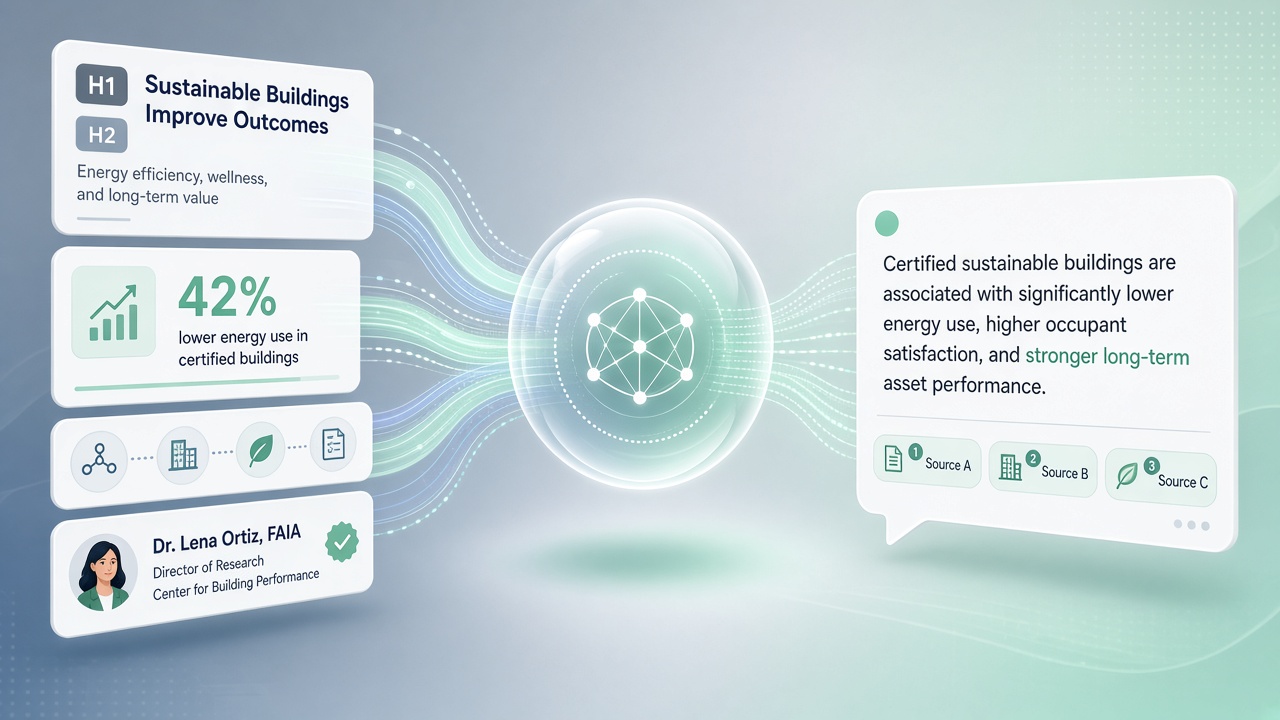
Selection is not the same as ranking. After retrieval, answer engines look for passages they can extract as complete, attributable answers—then they attach a name. You raise those odds by making the page easy to trust, easy to parse, and hard to misquote.
The signals operators can influence
- Topical authority — a coherent set of pages that cover the subject in depth, so the engine can treat you as a reliable node rather than a one-off mention.
- Clear entity identity — the same brand, product, and person names, used consistently, so a citation has somewhere definite to land.
- Factual density — definitions, constraints, and specific claims instead of padded narrative.
- Original data or first-hand observation — material that is not a remix of the same consensus paragraph every competitor already published.
- Unambiguous answers — a sentence that could stand alone as the reply to a real question.
Those signals land faster when the page is shaped for extraction. Question-led headings, short definition blocks, compact tables, and claim-plus-evidence paragraphs give the model a clean boundary. A heading that restates the query, followed by one or two sentences that still make sense if lifted in isolation, is far easier to attribute than a long essay that buries the point.
Freshness and update hygiene matter for the same reason. Stale pages drop out of the candidate set even when they were once definitive. Engines often blend several sources and favor pages that match consensus in plain language, without fluff or contradictory asides.
You improve eligibility—you do not force a cite
You cannot force ChatGPT, Perplexity, or an AI Overview to name you on demand. You improve eligibility across surfaces, then watch which pages get mentioned and which claims get reused. Named authors with real expertise, a clear About and organization page, outbound citations, and consistent brand entities are the E-E-A-T-style cues that make a citation feel safe when several passages are equally extractable.
Citation eligibility — Answer engines lift complete, attributable passages from pages that are authoritative, extractable, and current. You raise your odds across surfaces; you cannot force a single model to name you.
A Lean Checklist for Citation-Ready Pages
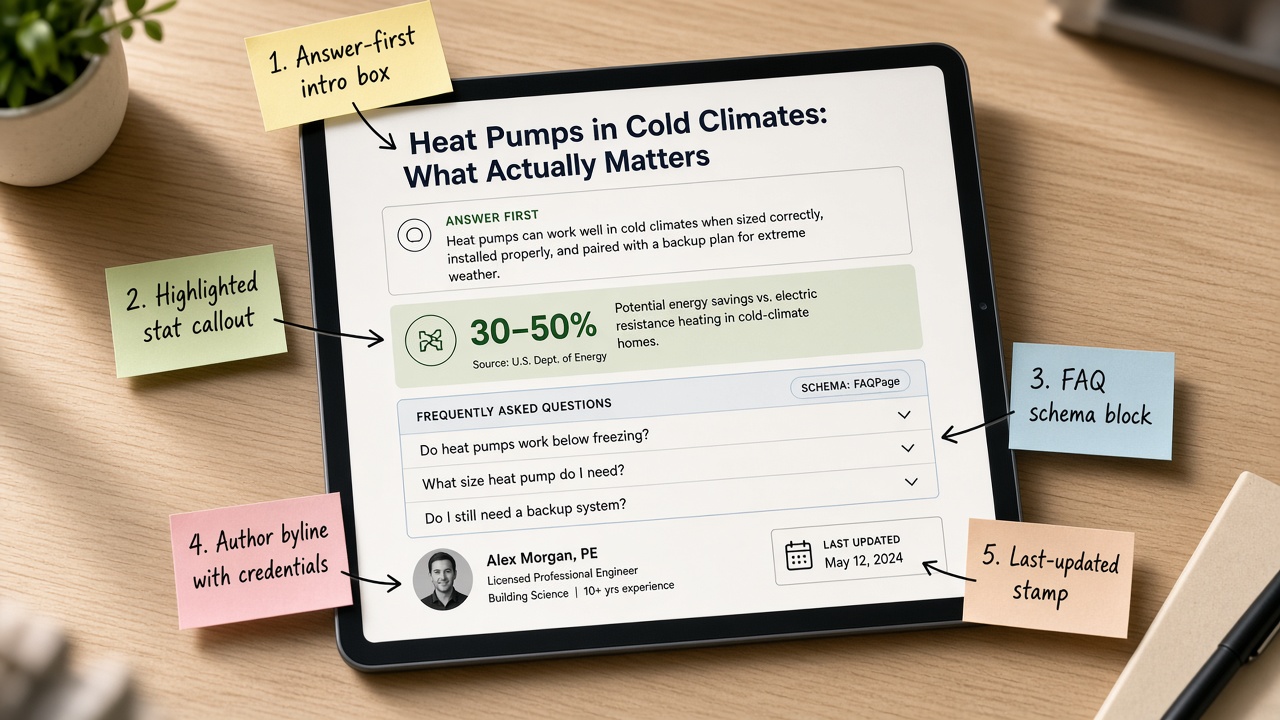
Those same trust signals only pay off when the passage itself is easy to lift. Treat the page as extractable units: a question, a short complete answer, proof a model can attribute, and markup that names who published it.
Retrieval still depends on crawlability and authority; citation favors pages that already look like answers. Lean teams do not need a new stack—they need a repeatable pass before publish.
Shape the answer first
Put the primary question in the H1 or the first H2 so intent is unambiguous. Directly beneath it, write a short answer that could stand alone—subject, claim, and any essential caveat in one breath. Supporting bullets should extend that answer, not delay it. Add FAQ blocks only where the intent is genuinely a set of follow-ups; decorating every URL with FAQs dilutes the extractable core.
Put proof where a model can grab it
Prefer claims that can be verified in place. Use original or clearly sourced figures and add a dated methodology note so each number has a timestamp and a method. Comparison tables beat long prose when the question is which, versus, or how they differ. Give every core term a one-sentence definition in the body; those lines get reused because they are complete and unambiguous.
Markup and trust that travel with the URL
- Matching schema — Article for the piece, plus FAQ, HowTo, or Organization when those blocks are real.
- Stable canonicals — one durable URL the engines can keep citing.
- Credentialed byline — an author bio with credentials that match the person named on the page.
- Freshness cues — a visible last-updated date.
- Hub links — internal links to the cluster hub so brand and topic entities stay consistent.
Before anything goes live, run a short QA. It catches the failures that make an otherwise well-outlined page unsafe to cite.
Apply this pass to every URL you expect to be retrieved, not only pillar pages. The work to optimize content for answer engines is mostly editorial discipline: one question, one extractable answer, proof, markup, then the check.
Extractable answer first — citation-ready pages lead with a short standalone answer, attach dated proof and matching schema, then pass a QA that removes buried ledes, contradictions, and filler.
How to Track AI Search Visibility—and Iterate When Rivals Get Cited
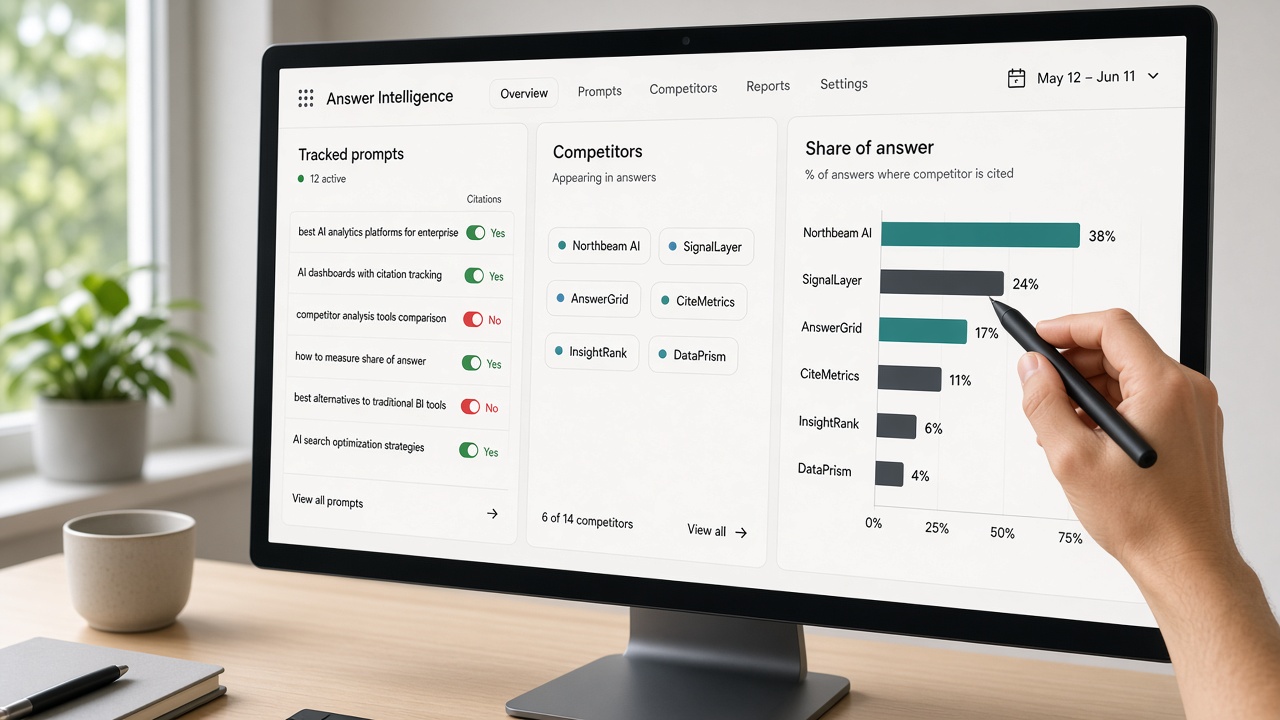
That check tells you a page is eligible. It does not tell you whether an answer engine used it. Rank reports still matter for crawl and retrieval, but AI search visibility is a different ledger: whether you are named, quoted, or listed as a source when people ask the questions you exist to answer.
A lean set of visibility metrics
Skip the hunt for one perfect tool. Operators can run a small panel that answers four questions: Are we showing up? Are we attributed? Where do we sit in the source list? Who appears instead of us?
- Branded and unbranded prompt panels — a fixed list of queries with your name in them, and the same jobs-to-be-done without it.
- Citation and mention logs — named and attributable versus paraphrased with no clear source, or total absence.
- Position in source lists — where you sit when the engine shows citations at all.
- Competitor co-occurrence — who is extractable on the same intent when you are not.
Re-run that panel on a cadence across ChatGPT, Perplexity, Google AI Overviews, and other surfaces your audience actually uses. Combine manual sampling with AI Overview and SERP features, then pair the notes with analytics. Referral spikes from generative surfaces still mark when a citation landed, even if attribution is lumpy. Branded-search lift, direct traffic after a data drop or PR hit, and off-site “as cited in” mentions are lagging confirmation—not the weekly scoreboard.
Iterate on the page, not the prompt
When a rival is cited and you are not, refresh dated figures, tighten the extractable answer so it lifts cleanly, strengthen the entity page that proves who you are, and expand the cluster where their coverage is denser. Keep it lightweight: a fixed prompt list, a spreadsheet or simple dashboard, named owners, and a ship cadence—weekly samples, monthly refreshes. The loop is eligibility, observation, then a surgical edit where the engine already prefers someone else.
AI visibility is a citation panel — run branded and unbranded prompts, log named cites versus silence, and edit the page where competitors co-occur instead of you.
Bake AEO Into Briefs, Clusters, and the Publishing Pipeline
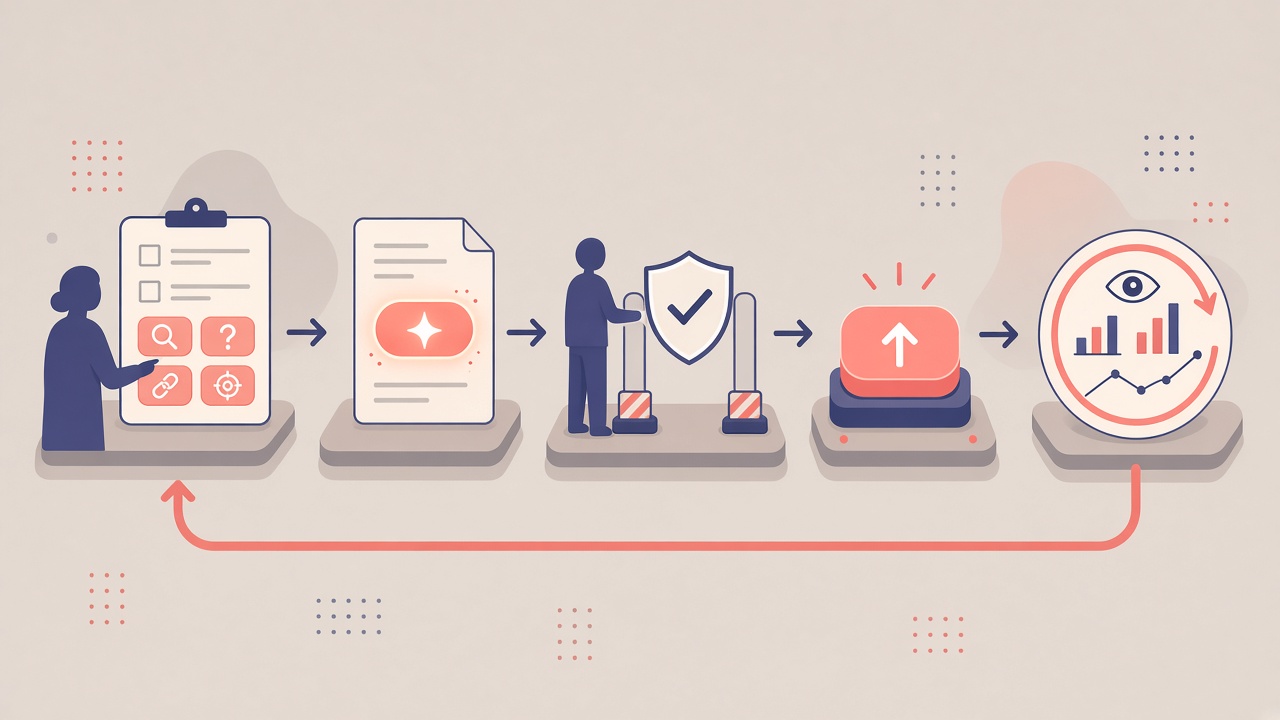
That edit is cheaper when the page was built for citation in the first place. Once eligibility, observation, and a surgical refresh are routine, the leverage moves upstream: the brief, the cluster map, and the publishing template. Writers and pipelines should ship extractable, attributable drafts by default—not as a retrofit after a rival already owns the answer.
Put citation fields in every brief
A ranking-first brief still asks for keywords, length, and a title. A citation-ready brief asks for the answer an engine can lift without hunting. Lock these fields before anyone drafts:
- Target questions — the primary query plus a few close variants this URL will actually answer, not a keyword dump.
- Answer capsule — a short, self-contained answer that can stand alone if an engine extracts only that block.
- Entities — brand, product, person, and concept names that must match hub pages and About copy.
- Must-include proof — original data, dated methods, or clearly sourced claims the writer cannot skip.
- Schema type — the one type that fits the page, not every available type at once.
- Citation assets — tables, definition blocks, comparison rows, and outbound sources worth attributing.
- Refresh trigger — the date, event, or data update that reopens the page instead of letting it go stale.
Those fields travel with the draft. Editors check them; templates require them. A wall of prose with no capsule, no proof, and fuzzy entity names is not finished work—it is a page an answer engine has little reason to name.
Give each cluster URL one question to own
Hub-and-spoke maps fail when sibling pages restate the same definition. Engines then blend sources or cite a rival that drew a cleaner line. Assign one primary question per URL: the hub owns the category frame and how the pieces fit; spokes own comparisons, procedures, and edge cases. If two briefs produce overlapping capsules, merge or differentiate before you publish. Duplicate answers cannibalize citations the same way near-identical titles cannibalize rankings.
Scale with gates, not thin volume
Automated publishing helps only when it enforces uniqueness, proof blocks, and those AEO fields. Templates should refuse a draft that lacks a capsule or entity list. Uniqueness gates should catch cluster siblings that answer the same question. Autoblogging that skips those checks fills the index with interchangeable intros and leaves nothing extractable to attribute. Volume without those gates does not raise eligibility—it dilutes it.
Lean teams keep citation standards when output rises by treating the brief and the workflow as the product. If you need the operational layer next to this, start with an SEO content brief template, then programmatic SEO without thin content, SEO automation workflows, and a clear take on what autoblogging is. FlowCrews-style ops exist for that handoff: scale without abandoning extractability.
AEO in the pipeline — bake target questions, answer capsules, entities, proof, schema, citation assets, and refresh triggers into every brief; give each cluster URL a distinct question; and let automation enforce uniqueness and proof—not mass thin pages.
Risks, Failure Modes, and Guardrails That Keep You Citable

That last clause is the whole risk surface. Even extractable pages can be misquoted. Models invent citations, pin your brand to a claim you never made, or flatten a caveat into a false absolute. Publish precise, attributable statements, keep sources visible on the page, and periodically check how you are described so you can correct the record on your own site first.
Thin volume still fails both engines
AEO is not a loophole for doorway-style URLs, spun cluster clones, or answer capsules with nothing behind them. Unoriginal, low-value scaled content fails classic search and it fails extraction. If a URL would not deserve a click or a named cite on its own merits, shipping more of it only multiplies the miss.
Do not bet the program on one prompt hack, either. Citation eligibility is surface-specific: a page that appears in AI Overviews may never surface in a chat tool or a Perplexity-class engine. Spread the questions you answer, the formats you ship—definitions, tables, dated methods—and the engines you sample.
Guardrails worth shipping with every brief
- Human editorial review on every factual claim before publish.
- Dated, attributable sources—and a hard ban on fabricated statistics.
- A corrections policy you actually use when a page or a model is wrong.
- Refusal to ship unverified automations that cannot check quotes, numbers, or entity names.
Operators still ask the same three questions. Answer them honestly so the program does not rest on false promises.
Citation is eligibility plus time plus the luck of retrieval—not a switch you flip. Treat AEO as a discipline you maintain, not a campaign you win.
Guardrails over hacks — Models can invent or mis-attribute citations, and thin scaled pages fail both search and answer engines. Stay citable with precise sourcing, human review, and diversification across surfaces—not a promised ChatGPT cite.
Key Takeaways
Add an answer capsule, proof assets, and schema type to your next brief, then use FlowCrews to scale unique, citation-ready pages without thin content.