Automation
AI Content Refresh Automation: Scaling Updates for Autoblogged SEO Articles in 2026

Autoblogged SEO libraries once felt like a finished asset: publish at scale, collect rankings, move on. In 2026 that assumption is expensive. AI search systems reward freshness far more aggressively than classic organic results, so pages can still hold Google positions while quietly losing citations, impressions, and revenue. Most teams do not notice content decay until they have already lost 40, 50, sometimes 80% of a page's traffic.
The fix is not another wave of net-new articles. It is a maintenance engine—AI content refresh automation—that continuously detects semantic gaps, intent drift, and outdated claims, then regenerates targeted sections while preserving URL equity, internal links, and voice. Refreshes consistently deliver up to 70% better ROI than creating new posts because they ride existing backlinks, authority, and index history instead of starting from zero.
This article shows how to install that engine for autoblogged libraries: why decay accelerates under AI citation bias, the economics that make refresh the higher-leverage move, how reader chat signals become live prioritization data, cascade pipelines that push updates into the CMS, hybrid human-AI gates that keep quality high at volume, and the cadence metrics that prove recovery. If you already publish with AI SEO automation, the next competitive edge is keeping every URL alive.
TL;DR
- AI search freshness bias means pages can rank on Google while losing AI citations and traffic—decay often goes unnoticed until 40–80% of traffic is gone.
- Content refreshes deliver up to 70% better ROI than new posts by leveraging existing authority, backlinks, and index history.
- Reader AI chat signals (questions, dwell, monetization interactions) are high-intent triggers for which sections to refresh first.
- Cascade pipelines plus hybrid quality gates let agents update 2–3 articles daily while humans protect E-E-A-T and brand voice.
- Aim for continuous or quarterly micro-updates; content lifespans have compressed to a 6–12 month clock in the AI era.
The Autoblog Decay Paradox: Why Rankings Hold While AI Visibility Dies
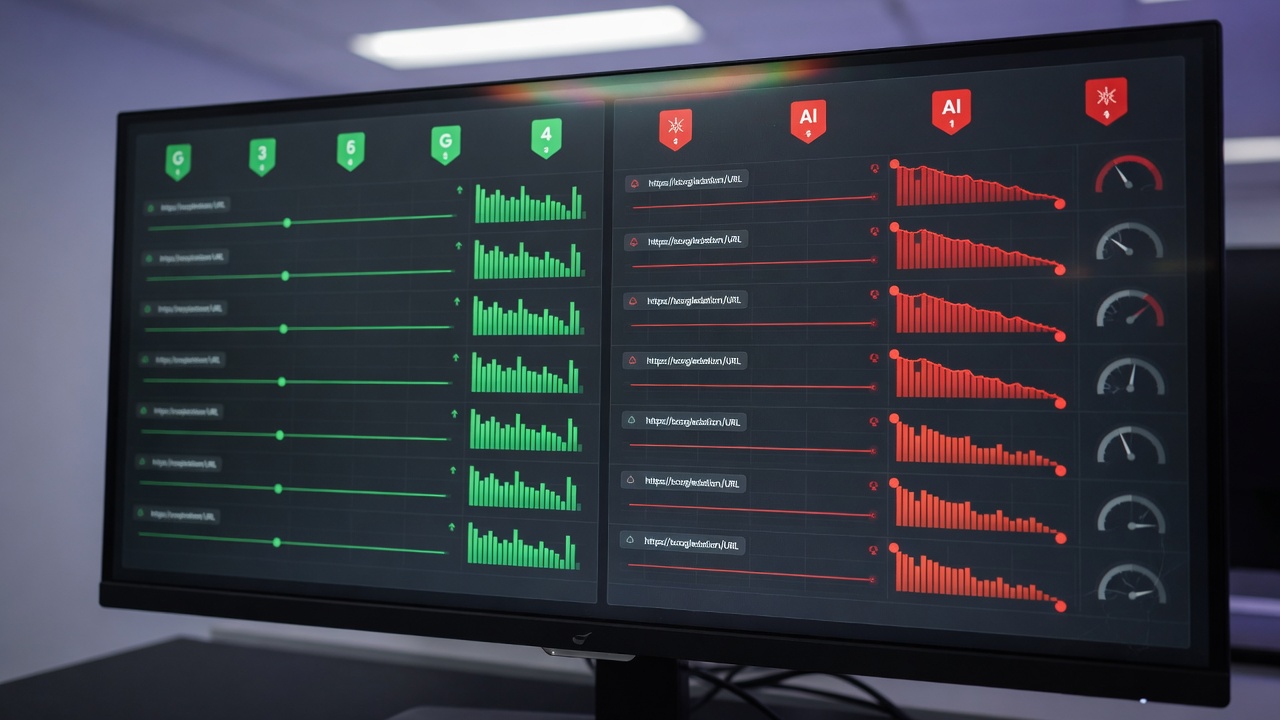
run an autoblogged library at scale, the first failure mode to understand is not a sudden ranking collapse. It is quieter, and far more expensive: pages keep their classic organic positions while quietly falling out of AI citation windows. That is the decay paradox. Google can still surface a URL that once earned links and topical authority, even as assistants and answer engines stop quoting it. The page looks “fine” in Search Console. Assistant traffic, branded mentions inside AI answers, and referral paths from chat products erode anyway.
AI search applies a sharper freshness bias than traditional results. Ahrefs analysis found AI-cited content is 25.7% fresher than what ranks in classic organic listings. ChatGPT, for its part, cites URLs that are 393–458 days newer than the pages holding the same queries on Google. Roughly 50% of Perplexity’s citations come from current-year content, and 65% of AI bot crawl activity concentrates on pages from the past 12 months. Rankings can lag; citation eligibility does not.
Autoblogged libraries are uniquely exposed. Volume is the point of the system—hundreds or thousands of URLs generated on topical clusters—so manual editorial review never keeps pace. Stats, product examples, screenshots, and “as of” framing age in batches. When a how-to cluster or best-of series ships in the same quarter, the entire cohort crosses the freshness cliff together. Content that once held rankings for years now runs on a compressed clock: best-of lists often last 3–6 months, statistics pages 6–9 months, how-to guides 12–18 months, with an overall 6–12 month maintenance window in the AI era. Set-and-forget publishing turns a library into a depreciating asset on a schedule you cannot see from rankings alone.
Why the damage stays invisible until it is large
Classic rank trackers and even healthy organic sessions mask the loss. AI answer share is a different surface. Across five B2B SaaS brands studied in recent refresh research, even the best-performing brand was absent from 71.5% of relevant AI answers; the worst was missing from over 90%. Teams rarely instrument citation share the way they instrument position, so decay registers only when downstream traffic finally drops. By then, most teams have already lost 40%, 50%, sometimes 80% of a page’s traffic. Detection that waits for that cliff is too late for efficient recovery—especially when the library’s size makes spot-checking impossible.
The practical implication is structural, not motivational. Freshness bias, batch aging, and invisible citation loss mean autoblogged SEO cannot be maintained with quarterly manual sweeps. Proactive, automated detection—and a refresh cadence wired to real signals—is the only way a large library stays inside the windows assistants actually cite. The economics of that choice, and why updating existing URLs beats shipping net-new posts, are where the leverage shows up next.
Decay paradox — Autoblogged pages can hold classic rankings while losing AI citations because assistants prefer content that is materially fresher; without automated detection, teams often notice only after 40–80% of traffic is already gone.
Refresh Economics: Why Updating Existing URLs Beats Shipping New Posts

That leverage is straightforward once you look at what a refresh actually inherits. An existing autoblogged URL already carries domain authority, accumulated backlinks, historical crawl data, and an index footprint that search engines and AI assistants recognize. A brand-new post starts at zero on every one of those dimensions and must earn them all over again. At library scale the difference is decisive: it is often 5x more cost-effective to optimize a live URL than to generate and promote a fresh one from scratch.
The performance gap shows up just as clearly in traffic and ROI. Content refreshes consistently deliver up to 70% better ROI than creating new posts. In one analysis of more than 50,000 ecommerce pages, refreshed content produced 268% organic click growth while new pages managed only 22%. Comprehensively updated posts average a 106% traffic increase, and updating older material proves two to three times more effective than publishing thin new pieces. Even a single well-timed refresh has been shown to reverse an average weekly decay rate of –1.21%, adding more than 30,000 pageviews and lifting weekly traffic 55%. Sixty-two percent of top-performing blogs already run a deliberate refresh strategy for exactly these reasons.
Multiplying prior spend instead of discarding it
For an autoblogging stack the arithmetic compounds further. Every URL that was generated, edited, interlinked, and indexed represents sunk generation cost. When that page slips outside the freshness windows assistants prefer, the original investment quietly evaporates. A targeted refresh recovers the asset: the same backlinks keep working, the same crawl equity is reused, and the prior generation spend is multiplied rather than written off. Continuous net-new production, by contrast, keeps adding to the decaying pile while the older inventory goes silent.
The practical implication is a shift in how libraries are valued. High-volume automated catalogs stop being disposable output and become a portfolio of recoverable equity. Prioritizing live URLs that already sit in striking distance or that once earned solid impressions turns maintenance into the highest-ROI activity on the calendar. That is the economic case for wiring detection and update pipelines directly into the publishing system itself.
Refresh economics — Updating existing autoblogged URLs is routinely 5x more cost-effective and up to 70% better ROI than net-new posts, because refreshes inherit authority, backlinks, and crawl history while multiplying prior generation spend instead of discarding it.How In-Article AI Chat Becomes Your Real-Time Refresh Sensor
That wiring starts with a signal source most publishing systems still treat as pure monetization: the in-article AI chat. Once readers can ask questions inside the piece itself, the conversation stops being a side feature and becomes the earliest, most precise detector of decay. Rank trackers and crawl logs only see what the SERP already knows. Chat hears what the page fails to answer.
Embedded chat surfaces live gaps that classic SEO data simply never registers. A reader asks whether a claim still holds after a product update, requests a comparison the original draft never included, or voices a sub-intent that only appeared months after publish. Each of those exchanges maps a concrete hole—outdated statements, missing sections, shifted language—without waiting for impressions to slide or AI citations to vanish. The system now knows exactly which passage needs attention before traffic metrics ever flinch.
From repeated friction to high-confidence triggers
Single questions are noise. Patterns are signal. When the same unanswered or low-satisfaction query clusters around a specific section, the platform treats that cluster as a high-confidence refresh trigger. The automation can isolate the weak paragraph, regenerate it with fresher evidence or clearer structure, and push the update while the rest of the URL stays untouched. No full-page rewrite required—just the precise patch the readers already told you they needed.
Dwell and paid interactions set the priority queue
Not every page earns equal urgency. Longer dwell inside the chat window and any paid interactions that keep a reader exploring both flag URLs already proving commercial or engagement value. Those pages move to the front of the maintenance queue so the assets that convert or retain attention stay sharp first. The rest of the library can follow on a normal cadence; the high-signal pages never wait.
Closing this loop reframes the entire widget. Instead of a monetization silo bolted onto static posts, the chat becomes the sensor layer of content automation. Reader behavior continuously tells the publishing system what to update, when, and where—feeding the cascade pipelines that keep entire topic clusters current and compounding rather than silently decaying.
How Cascade Refresh Pipelines Keep Entire Topic Clusters Aligned
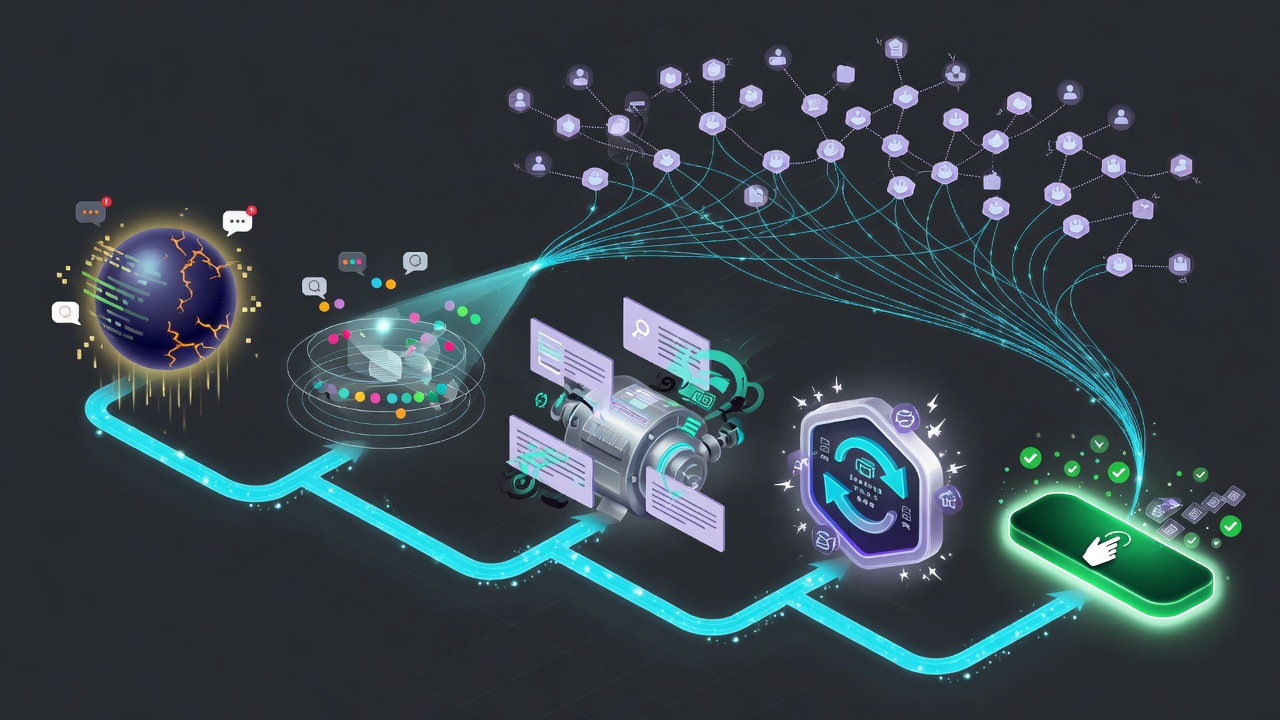
Those cascade pipelines are the mechanism that turns isolated chat signals into cluster-wide currency. Refresh a single money page in isolation and the supporting articles around it begin to drift: entity definitions diverge, statistics fall out of sync, internal links point to stale anchors, and the topical graph that search systems and AI assistants rely on starts to fray. Cascade jobs prevent that fracture by treating the cluster as one living unit—when a core page moves, every related URL that shares entities, claims, or link equity moves with it in a coordinated pass.
The practical wiring is deliberately short so updates never stall in ticket queues. Detection (rank shifts, chat-flagged gaps, freshness decay) feeds section-level regeneration; regenerated sections then receive an automated link-and-schema pass that rewrites internal anchors, updates FAQ or HowTo markup, and refreshes dateModified signals; the finished package publishes straight into the CMS. With 86% of SEO professionals already integrating AI into their workflows, manual editing loops are no longer viable at library scale—the pipeline has to run end-to-end without human hand-offs for every change.
Once the pipe is live, daily or weekly micro-update agents keep the library moving without heroic batch jobs. AI agents can automatically research recent information, add value, and signal freshness on 2–3 articles per run while preserving the original voice and URL equity. Over a month that cadence quietly refreshes dozens of pages inside priority clusters instead of letting an entire topical neighborhood age out together.
Programmatic prioritization inside each cluster should surface three signals first: pages sitting in striking distance, URLs that already earn high impressions yet low CTR, and any article repeatedly flagged by in-article chat. Those three filters concentrate regeneration effort where recovery is fastest and where reader intent has already declared the gap. The result is a continuous maintenance rhythm that keeps entities, stats, and internal links aligned across the whole topic graph rather than letting supporting content silently diverge from the money pages it is supposed to reinforce.
Cascade pipelines treat topic clusters as single living units—detection triggers section regeneration, a link/schema pass, and direct CMS publish—so daily agents can keep 2–3 articles current without letting supporting pages drift from money URLs.
Hybrid Quality Gates That Keep Automated Refreshes Safe at Scale
That continuous rhythm only compounds if every regenerated section clears a quality bar high enough to protect rankings and AI visibility rather than erode them. Speed without gates is how high-volume libraries quietly trade short-term freshness for long-term trust damage. The fix is not slower publishing—it is hybrid quality control wired directly into the cascade so updates stay fast, attributable, and penalty-safe.
Unreviewed pure-AI rewrites are the common failure mode. Even though 67% of bloggers now use AI writing tools, pure AI-generated content underperforms human-written pages by 23% in organic rankings after twelve months. The gap widens on YMYL-adjacent topics—finance, health, legal, B2B decision content—where thin claims, missing nuance, or contradictory stats trigger both classic quality systems and AI citation filters. AI-assisted work still wins on productivity; the difference is the human (or agentic) checkpoint that catches drift before publish.
Lightweight gates that scale without bottlenecking
Full editorial review on every micro-update is impossible at library scale. What works is a short, deterministic gate stack that runs after section regeneration and before the CMS write:
- Fact spot-checks — verify every new number, date, product name, and named claim against a trusted source list; flag anything that cannot be grounded.
- Brand-voice diffs — compare regenerated passages against a locked style sample so tone, terminology, and point of view stay consistent with the rest of the cluster.
- Media and structure integrity — confirm embeds, images, tables, internal links, and schema still resolve and still support the updated claims rather than contradicting them.
These checks are deliberately lightweight. They do not rewrite the piece; they accept, reject, or route a section for a short human pass. That keeps throughput high while blocking the thin, contradictory, or off-voice updates that invite helpful-content risk.
Preserve the asset, do not scrape-and-replace it
A safe refresh never treats the page as disposable. The URL stays fixed so equity, crawl history, and backlinks continue to compound. Experience signals are strengthened—clearer first-hand framing, updated examples, tighter structure—not stripped for keyword density. Embeds, internal links, and rich modules remain intact; the pipeline regenerates the outdated sections and re-threads the supporting graph rather than performing a full-page scrape that severs those connections. The result reads as a living document, not a new thin URL wearing an old slug.
Hybrid controls are what let autoblogging teams run continuous maintenance without inviting quality or helpful-content exposure. Detection and regeneration stay automated; the gates enforce the floor. That combination turns the cascade from a risk vector into a compounding engine—fresh enough for AI citation windows, solid enough to keep classic rankings and reader trust.
Hybrid gates beat pure automation — pure AI rewrites lag human content by 23% after twelve months; lightweight fact, voice, and media checks let high-volume refreshes stay fast while protecting URL equity and helpful-content safety.Cadence and Recovery Metrics: The Loop That Turns Refreshes into Compounding Assets
With quality gates locking in safety, the remaining lever is cadence—how often you run the pipeline, which URLs jump the queue, and how you know a refresh actually moved the needle. Annual cleanups made sense when content lifespans stretched years; once AI citation windows compress into months, that rhythm is too slow.
Quarterly-or-faster cadences beat annual sweeps once AI visibility is in scope. Quarterly refreshes yield 42% better results than annual refreshes, and that gap widens when freshness bias decides who gets cited. For large autoblogged libraries, continuous micro-updates—weekly or daily agent cycles that touch only the sections that need it—outperform big-bang overhauls. Small, targeted patches keep topic clusters aligned without flooding the CMS or burning crawl budget.
Score the queue by signal, not age
Publish date is a weak proxy. Build a simple priority score from the signals the earlier sections already surface:
- Impressions and position band — high-impression pages sitting in positions 6–20 repay the effort fastest
- CTR gap — pages underperforming expected click-through for their rank
- Chat friction — repeated unanswered or low-satisfaction questions from the in-article assistant
- Cluster importance — supporting URLs that prop up money pages or hub content
A two-year-old article still collecting volume and chat flags outranks a fresh post with no traction. Age only matters when it correlates with one of the signals above.
Match update depth to the gap, then measure in weeks
Not every refresh needs a full rewrite. Use micro-updates for stale statistics, outdated examples, thin FAQs, and missing comparisons—the fast regenerations that preserve structure, embeds, and URL equity. Reserve deeper rewrites for clear intent shifts, lost SERP features, or structural drift the cascade cannot fix alone. After publish, judge success on three recovery signals inside two to four weeks: organic position and traffic rebound, AI citation re-entry, and assisted-traffic lift from chat and related pages. Winners that recover get reinvested—extra internal links, expanded sections, or satellite pieces—so the library compounds instead of merely stabilizing.
How often should autoblogged libraries refresh once AI search is in scope?
Quarterly is the new baseline and already delivers 42% better results than annual cycles; large libraries do best with continuous micro-updates on weekly or daily agent cadences so citation windows never fully close.
What should prioritize a page over simple publish age?
Impressions, position band (especially 6–20), CTR gap versus expected, in-article chat friction, and importance inside the topic cluster. Age alone is a weak signal.
When is a micro-update enough versus a deeper rewrite?
Micro-updates handle stats, examples, and FAQs. Deeper rewrites are reserved for intent shifts, structural losses, or SERP-feature drops that section-level regeneration cannot repair.
Wire the cadence, score the queue by live signals, match depth to the gap, and feed recovery data straight back into the next cycle. That closed loop is what turns an autoblogged library from a decaying archive into a compounding asset—fresh enough for AI citation windows, authoritative enough to hold classic rankings, and continuously improved by the readers already on the page.
Continuous compounding cadence — Run quarterly-or-faster micro-updates scored by impressions, position, CTR gap, chat friction and cluster importance; measure organic recovery, AI citation re-entry and assisted-traffic lift within weeks, then reinvest the winners.Key Takeaways
Wire reader chat signals, cascade pipelines, and hybrid gates into your autoblog stack now so every URL compounds instead of silently decaying.
Frequently asked
AI search systems heavily favor fresh sources—AI-cited content is 25.7% fresher than traditional organic results, and ChatGPT cites URLs that are 393–458 days newer than what ranks on Google. Pages can hold classic rankings while losing AI citations and traffic.
Yes. Content refreshes consistently deliver up to 70% better ROI than new posts; analysis of 50K+ ecommerce pages found refreshed content produced 268% organic click growth versus 22% from new pages. It is often 5x more cost-effective to optimize an existing URL.
Agents combine SERP and NLP analysis for semantic gaps, intent shifts, and outdated stats with live reader chat signals—repeated questions, low dwell, or monetization drop-offs—to prioritize high-impression or striking-distance pages automatically.
With 86% of SEO professionals integrating AI, pure manual editing does not scale. Hybrid gates keep humans on brand voice, factual accuracy, and E-E-A-T while agents handle research, section regeneration, date signals, and CMS publishing for 2–3 articles daily.
Content that once held rankings for years now operates on a 6–12 month clock. Quarterly refreshes yield 42% better results than annual ones; continuous micro-updates driven by chat and performance signals keep pages inside AI citation windows.
Yes. Roughly 50% of Perplexity's citations come from current-year content, and 65% of AI bot crawl activity targets pages from the past 12 months. Fresh, well-structured updates improve the odds of being cited where even strong brands are absent from 71.5% or more of relevant AI answers.
You Might Also Like