AI Agents vs SEO Automation Tools: Hybrid Workflows for 2026

The era of choosing between manual SEO execution and rigid, one-click automation is officially over. As we look toward 2026, the brands dominant in organic search aren't just using basic tools to schedule posts; they are deploying dynamic systems that adapt to search engine algorithms in real time. The secret lies in understanding the critical distinction between traditional automation and autonomous AI agents.
Traditional SEO tools have always excelled at structured, repetitive tasks. This shift from static scripts to autonomous decision-making changes how we scale content. Instead of spending hours manually mapping search intent, marketing teams can now let AI agents handle keyword research, cluster topics by difficulty, and generate on-page optimization suggestions in minutes.
But scaling successfully in 2026 doesn't mean removing humans from the loop entirely. In fact, the most sustainable growth comes from a hybrid human-agent model. This framework automates the tedious aspects of data analysis and monitoring, resulting in a 60-80% reduction in manual workload. This automation frees up human experts to inject vital creativity, strategic thinking, and nuanced contextual judgment into the process.
When you transition to this hybrid approach, your team's day-to-day work shifts dramatically. Data shows that the most successful implementations assign 20-30% of traditional SEO team time to oversight and strategy, with 70-80% of execution automated. The payoff for making this transition is massive: early adopters have achieved remarkable milestones, including a +340% organic traffic increase in just 90 days for B2B SaaS companies. Let's dive deep into how these two technologies differ and how you can build a hybrid workflow that scales your organic traffic without risking search penalties.
- 1
Traditional SEO tools execute single predefined tasks, whereas AI agents autonomously observe, analyze data, and make real-time decisions.
- 2
A hybrid workflow reduces manual workloads by 60% to 80%, allowing human experts to focus on strategy and creativity.
- 3
Successful SEO teams in 2026 automate 70% to 80% of execution while dedicating 20% to 30% of their time to strategic oversight.
- 4
Implementing autonomous agent pipelines has demonstrated rapid scaling, driving up to 340% organic traffic growth in 90 days.
Why Rigid SEO Automation Alone Risks Your Search Rankings
To avoid these penalties, we must first dissect where traditional automation falls short in the modern search landscape. Many marketing teams treat standard SEO automation and advanced AI agents as interchangeable terms. However, conflating the two is precisely what puts your organic visibility at risk. Standard automation is built on rigid, linear logic: if X happens, do Y.
This rigidity is the fundamental limitation of legacy software. When you rely solely on traditional, fixed tools to push out content or optimize pages, you are executing a static playbook in a dynamic environment. These tools cannot adapt when search engine algorithms shift or when a competitor changes their strategy mid-campaign.
On the other hand, deploying pure AI agent stacks without human oversight introduces a different kind of risk. Completely autonomous agents, while highly capable of generating vast amounts of content, often ignore critical E-E-A-T (Experience, Expertise, Authoritativeness, and Trustworthiness) and quality signals. Without a human expert in the loop to inject real-world insights, proprietary data, and brand voice, pure agent outputs quickly devolve into generic, synthesized noise that search engines are actively training their algorithms to filter out.
The key to scaling safely is not choosing between rigid automation and unguided AI agents. Instead, it requires a structured framework that merges the best of both worlds, organizing your operations into distinct layers of control.
Rigidity vs. Autonomy — Traditional SEO tools are too rigid to adapt to algorithmic shifts, while unsupervised AI agents risk triggering quality penalties by neglecting vital E-E-A-T signals.
The Hybrid Engine: Dividing Strategy and Execution for 2026
This layered approach divides your SEO operation into two distinct engines: a strategic intelligence layer and an autonomous execution layer.
At the foundation, traditional platforms like Semrush and Ahrefs supply high-level competitive data, domain health metrics, and seed keywords. Rather than expecting AI to guess your market positioning, you feed this hard strategic data into the system. Once the direction is set, autonomous AI agents take over the heavy lifting. Instead of requiring a human to manually map out every step, these agents dynamically handle keyword clustering, content optimization, and continuous rank monitoring.
In a legacy workflow, teams spend days manually grouping keywords, drafting briefs, and updating old content. In the modern hybrid workflow, traditional tools establish the parameters, while autonomous agents execute the creation and real-time optimization loop instantly under human guardrails.
The Shift from Manual Labor to Strategic Oversight
This shift fundamentally redefines the role of the SEO professional. Most successful SEO programs assign just 20-30% of traditional team time to oversight and strategy, while automating 70-80% of the execution. By delegating tedious data analysis, clustering, and monitoring to AI agents, this automation frees up human experts to inject vital creativity, strategic thinking, and nuanced contextual judgment into the process. Humans stop being data-entry bottleneckers and instead become directors of an automated engine.
This balance of high-level strategy and automated execution is particularly powerful when launching targeted campaigns, such as dominating specific keyword segments.
The Hybrid Model — True SEO scale in 2026 isn't about replacing humans, but shifting their role: traditional tools define the strategy, AI agents execute the bulk of the work, and human experts spend 20-30% of their time on creative oversight.
Dominating the Low-Difficulty Long Tail: Scaled Execution with Guardrails
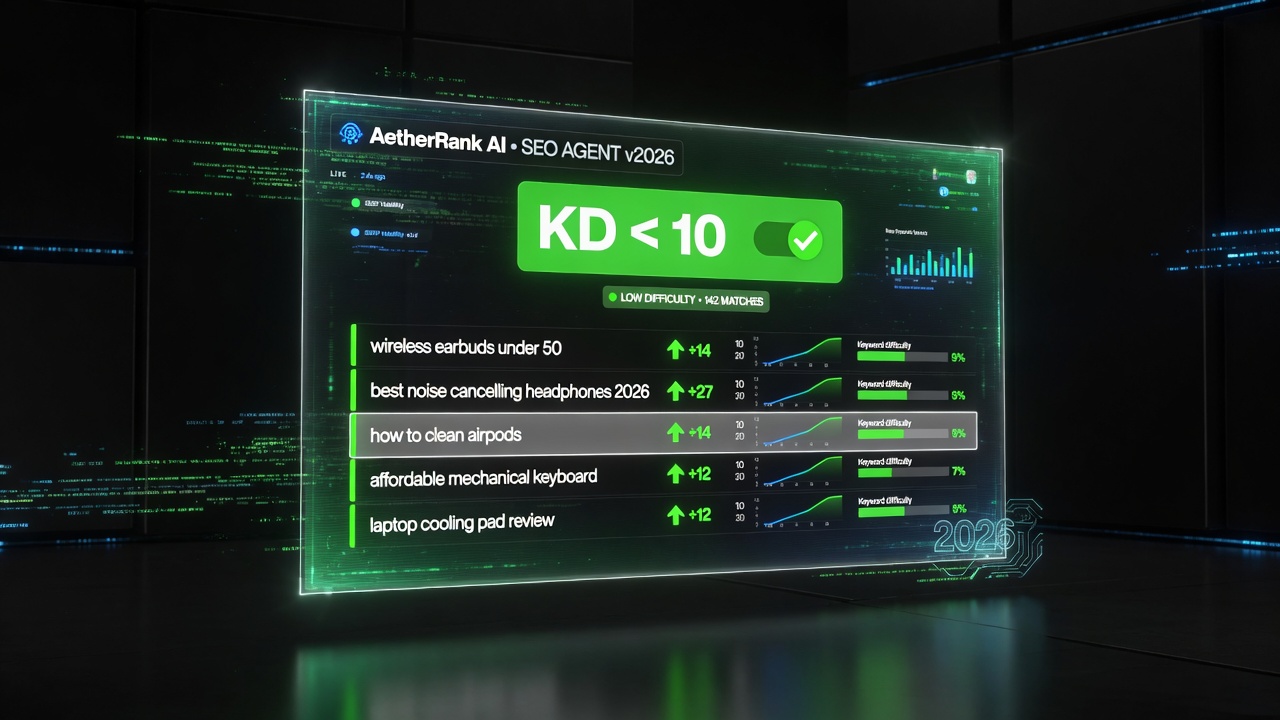
To make this dominance a reality, the smartest starting point is targeting low-difficulty keywords at scale. By focusing on search queries with a Keyword Difficulty (KD) score under 10 to 30, you minimize immediate competition and secure quick wins. Historically, building out hundreds of niche pages for these long-tail opportunities was too resource-intensive for human teams to justify. Today, AI agents flip that equation completely.
Instead of spending days manually digging through spreadsheets, an agent connected to live SEO data can automate keyword research, clustering by difficulty, search volume, and intent in minutes instead of hours. They map out the exact semantic structure required to rank and even generate on-page optimization suggestions instantly. This rapid execution means a strategy that once took weeks to map out is now ready for deployment almost immediately.
Securing the Pipeline with Quality Checklists
However, scaling rapidly across dozens of low-difficulty terms comes with a major caveat: the risk of creating thin, repetitive content that search engines reject. To prevent this, successful hybrid setups implement strict quality checklists within the agent's workflow. These checklists act as guardrails, ensuring that every generated page meets high editorial standards.
- Intent Alignment: Verifying that the content directly answers the specific user query rather than generic industry terms.
- E-E-A-T Integration: Injecting unique data points, expert quotes, or structured schema to prove real-world expertise.
- Formatting Rules: Enforcing clear heading structures, bullet points, and internal linking to keep readers engaged.
By combining autonomous speed with human-defined quality standards, you can capture significant organic traffic without risking algorithmic penalties. To put this theoretical engine into practice, you need to know how to connect these pieces together.
Smart scaling — Targeting low-difficulty keywords (KD under 10-30) using AI agents allows you to capture massive search volume quickly, provided you use strict quality checklists to prevent thin content.How to Build Your First Hybrid SEO Pipeline
Setting up this engine doesn't require a background in software engineering. Instead, it is about establishing a clear, step-by-step pipeline where raw data moves effortlessly from your analytics platforms to your AI agents, and ultimately through a human editor.
By establishing this pipeline, you eliminate the tedious manual tasks of keyword grouping and draft generation. Your marketing team shifts from being copywriters to editors-in-chief, focusing their energy on refining the narrative and validating strategy rather than staring at blank documents. This balance keeps your brand safe while allowing you to scale your search footprint efficiently.
With this operational pipeline in place, the next logical question is: what kind of performance can you actually expect when you turn it on, and how do you protect your site from algorithmic volatility?
Control the pipeline — Build hybrid workflows that automate data feeds and content drafting, but always route the final output through human review gates to protect brand integrity.
Real-World Performance: Driving Traffic Gains While Neutralizing Search Volatility
The answer lies in the data of teams already running hybrid workflows. When you combine the strategic guardrails of human editors with the relentless execution of autonomous agents, the results are both rapid and resilient. Instead of triggering search engine spam filters with low-quality, programmatic content, hybrid systems deliver highly targeted, value-first pages that search engines favor.
In practice, deploying this model leads to a dramatic drop in operational overhead. Teams implementing these pipelines report a 60-80% reduction in manual SEO tasks. This shift frees up marketing managers from the grueling monotony of manual keyword clustering and draft formatting, allowing them to focus entirely on brand messaging and strategic direction. Meanwhile, the AI agents handle the heavy lifting of real-time optimization.
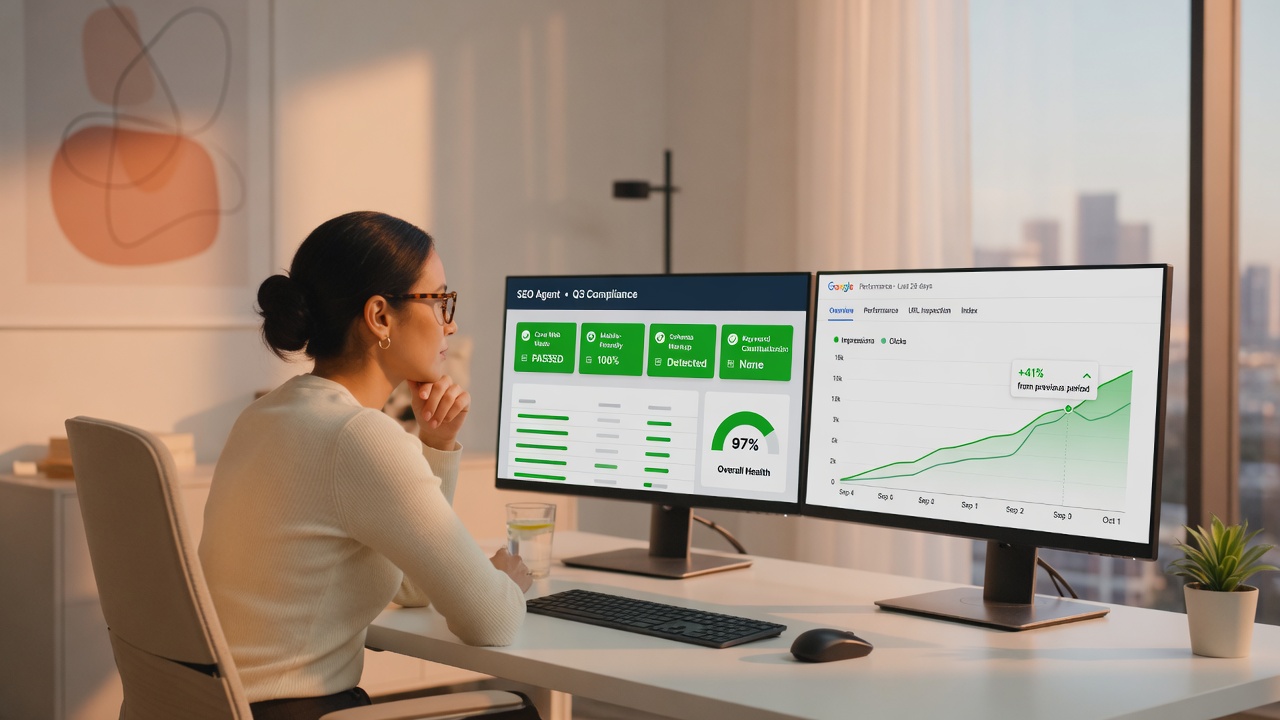
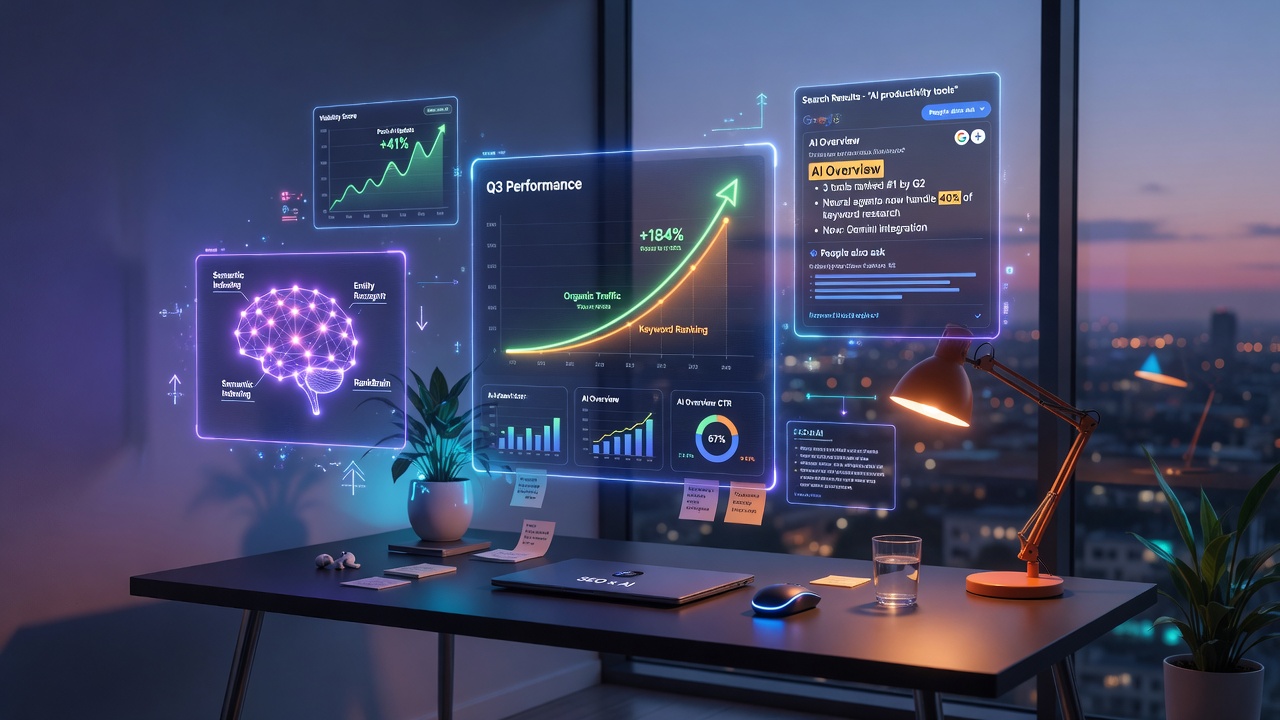
But does this efficiency translate to actual rankings? The evidence points to a resounding yes. Case studies show that businesses leveraging autonomous agents for content and optimization have achieved an impressive +340% organic traffic growth in 90 days. This rapid scaling is made possible because agents can identify search intent gaps and publish optimized content at a velocity that manual teams simply cannot match.
The biggest concern for any brand scaling their organic footprint is search engine volatility. Algorithms are increasingly sophisticated, designed to weed out over-optimized, artificial-sounding text. This is where real-time monitoring becomes your shield.
Unlike rigid, legacy automation tools that blindly push out content regardless of performance shifts, AI agents continuously monitor live search engine results pages (SERPs). If a search engine adjusts its ranking signals, the agents detect the shift and self-correct. They prevent over-optimization by adjusting keyword density, internal linking structures, and readability scores dynamically before any penalty can be triggered. By keeping a human in the loop to validate the final output, you build a moat of credibility that protects your site from algorithmic swings.
As we look ahead, the brands that thrive won't be those that rely on pure volume, but those that master this balance of speed and safety.
Hybrid efficiency drives growth — Combining autonomous execution with human editorial gates can unlock up to +340% traffic growth in 90 days while slashing manual workloads by 60-80% and safeguarding against penalties.
Key Takeaways
Discover how Flows can automate your publishing pipeline and elevate your reader experience with built-in AI chat features today.
Frequently Asked Questions
Unlike traditional automation tools that perform one predefined task, AI agents are designed to observe, store data, make decisions, and execute actions across systems. This allows agents to handle complex, multi-step workflows autonomously.
A hybrid workflow reduces tedious data analysis and monitoring workloads by 60-80%. This automation frees up human experts to inject vital creativity, strategic thinking, and nuanced contextual judgment into the process.
Most successful implementations assign 20-30% of traditional SEO team time to oversight and strategy, while 70-80% of the day-to-day execution is fully automated by AI agents.
Yes, real-world case studies show that autonomous agents used for content and optimization can drive up to +340% organic traffic growth in as little as 90 days.
An AI agent connected to live SEO data can complete complex keyword research, clustering, and on-page optimization workflows in minutes instead of hours.