Building E-E-A-T into AI Autoblogged Content for SEO Success in 2026

AI autoblogging can produce volume at a pace no editorial team can match—but volume alone no longer wins rankings. Pure AI content ranked 23% lower on average than human-written articles across a 16-month study of 4,200 pieces, acquired 61% fewer editorial backlinks, and carried 3.2x higher deindexation risk after spam updates. The gap is not “AI versus human.” It is missing E-E-A-T signals: no bylined credentials in 89% of AI-only articles, original research in only 4%, expert quotes absent in 94%, and first-person experience in just 2%.
Google’s systems reward original, high-quality content that demonstrates expertise, experience, authoritativeness, and trustworthiness regardless of how it is produced. Appropriate use of AI or automation is not against the guidelines when it is not used primarily to manipulate rankings. Using AI gives no special boost and no automatic penalty—it is simply content. If it is useful, helpful, original, and satisfies E-E-A-T, it can perform. AI-drafted pieces with substantive human editing already land within 4% of fully human content on median ranking position.
That is the practical opening for publishers running autoblogging stacks in 2026. The winning move is not abandoning automation; it is installing a post-draft signal-injection workflow that systematically adds the Who, How, and Why Google looks for—clear authorship, process transparency, people-first purpose—plus real experience, credentials, primary-source citations, and trust schema. Trust remains the most important E-E-A-T pillar. This article shows how to build those signals into scaled AI pipelines with tiered human review, proprietary data layers, and on-page expertise surfaces so automated content closes the ranking gap instead of widening it.
The Ranking Penalty of Pure AI Autoblogs Without E-E-A-T
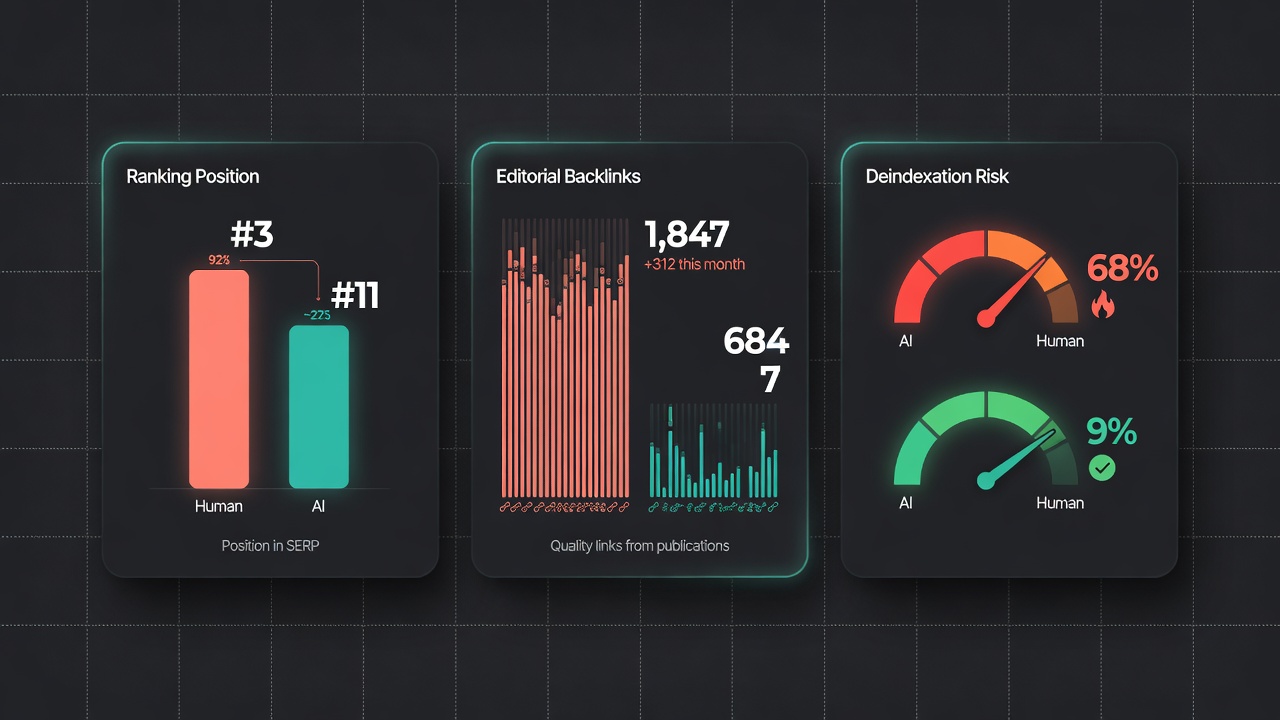
Yet without those layers, the cost shows up fast in the SERPs. Shipping unedited AI drafts at volume feels efficient on a content calendar, but large-scale ranking data reveals a consistent performance tax. Across a 16-month study of 4,200 articles, pure AI content ranked 23% lower on average than human-written pieces covering comparable topics. The gap widens further on competitive keywords, where thin experience signals leave automated pages unable to hold position against pages that demonstrate real authorship and original insight.
The damage is not limited to position. Editorial backlinks—the kind that actually move authority—arrive far less often for AI-only pieces, and the same pages carry sharply higher exposure when Google rolls out spam or helpful-content updates. Those three pressures compound: weaker ranks, thinner link equity, and elevated risk of sudden visibility loss.
In practical terms, every dollar spent spinning up more AI pages without closing the E-E-A-T gaps is partially wasted. The content may index, but it under-earns traffic, attracts fewer natural citations, and remains fragile when algorithms tighten. That is not a tooling problem; it is a signal-injection problem. Generators produce fluent drafts. They do not automatically produce verifiable experience, expert attribution, original data, or the trust schema that both classic rankings and AI Overviews reward.
The rest of this article treats that gap as fixable infrastructure rather than another generator bake-off. It lays out a post-draft system—tiered human review, proprietary data layers, clear Who/How/Why surfaces, and structured expertise markup—so scaled AI pipelines stop widening the ranking gap and start closing it.
Pure AI at scale carries a measurable tax — 23% lower rankings, 61% fewer editorial backlinks, and 3.2× higher deindexation risk mean unfixed E-E-A-T gaps erode every dollar spent on autoblogging volume.
What Google Rewards: People-First Content, AI-Assisted or Not
That system only works when operators first lock onto what the ranking systems actually score. Google’s ranking systems aim to reward original, high-quality content that demonstrates E-E-A-T—expertise, experience, authoritativeness, and trustworthiness—regardless of how the words were produced. The creation method itself is not the ranking signal. A draft that began inside an AI generator is eligible for the same visibility as one typed by a human subject-matter expert, provided the finished piece still delivers original, helpful value that people can trust.
The bright line Google draws is not “AI versus human.” It is “useful publishing versus scaled manipulation.” Appropriate use of AI or automation is not against Google guidelines when it is not used to generate content primarily to manipulate search rankings. Mass-producing thin, interchangeable pages solely to occupy SERP real estate is scaled content abuse and remains spam. Automating the first draft so a qualified reviewer can add first-hand insight, proprietary data, and clear attribution sits on the legitimate side of that line.
In short, AI is neutral tooling. Using AI doesn’t give content any special gains. It’s just content. If it is useful, helpful, original, and satisfies aspects of E-E-A-T, it might do well in Search. Usefulness and demonstrated E-E-A-T decide the outcome; the tool that produced the first pass does not. For autoblog operators building pipelines that must survive 2026 ranking systems and AI surfaces such as Overviews, the practical expectation is clear: every automated draft must leave the generator and enter a deliberate post-draft layer that injects verifiable experience, expert identity, and trust signals before it ever goes live. Volume without those signals keeps widening the gap. Volume plus those signals starts closing it.
People-first decides — Google rewards original, helpful content that shows E-E-A-T whether AI-assisted or not; AI is neutral tooling, and only scaled manipulation for rankings crosses into spam.
The Four E-E-A-T Gaps That Define AI-Only Content
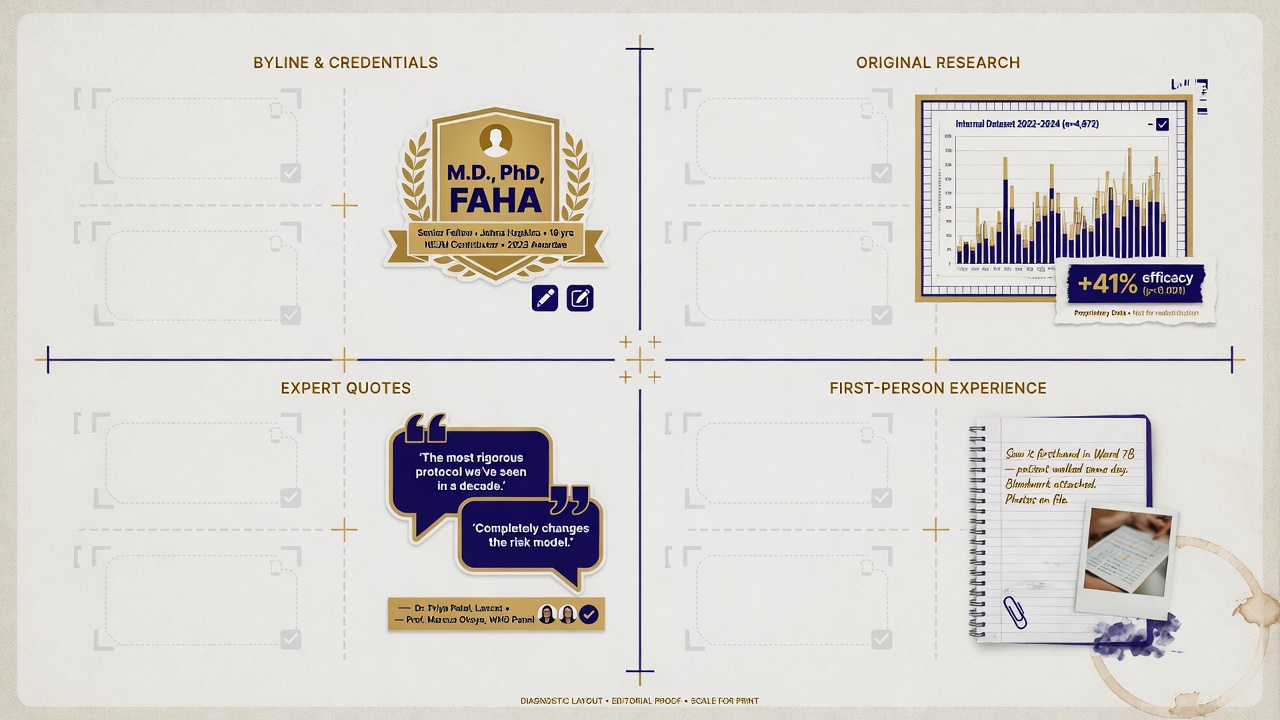
Those signals map to four predictable failure modes that dominate pure AI corpora. Before redesigning any autoblogging workflow, treat them as a diagnostic checklist: scan a sample of drafts and score how many of these gaps still appear. Closing them is what turns volume into ranking and trust equity instead of a growing liability.
Credentials, original data, expert voices, and lived experience
Across AI-only articles the pattern is stark. No bylined author with verifiable credentials appears in 89% of pieces. Original research or proprietary data is cited in only 4%. External expert quotes are absent in 94%. First-person experience narratives show up in just 2%. Each missing signal damages a different part of the trust stack that search systems and human readers both evaluate.
- Missing credentials and bylines leave the page without an accountable expert, so ranking systems cannot attach authority and readers cannot decide whether to believe the claims. Link prospects skip pages that look anonymous.
- No original data makes the piece interchangeable with every other summary of the same public sources. Editors have nothing unique to cite, so editorial backlinks stay scarce and the content never becomes a primary reference.
- Absent expert quotes strip away third-party validation. Without named practitioners confirming or challenging the advice, trust perception stays low and the article fails the “would I stake my reputation on this?” test.
- Zero lived experience is the newest and often decisive gap. Google added Experience to the former E-A-T framework, explicitly rewarding first-hand, real-world knowledge—personal product use, site visits, campaign results, client outcomes. Pure model output cannot supply that texture, so it underperforms in any niche where practical proof matters.
These four gaps compound. Weak credentials and missing Experience hurt topical authority signals. Lack of original data and expert voices suppress both ranking potential and natural link acquisition. Together they explain why unfixed AI drafts keep widening the performance gap even when the prose itself is fluent. Run the checklist on your next batch of drafts; the score tells you exactly where the post-draft signal layer must intervene before anything ships.
Four diagnostic gaps — AI-only content almost always lacks credentials (89%), original data (only 4%), expert quotes (94% absent), and first-person experience (2%). Google’s addition of Experience makes the last gap especially costly; fix all four before scaling.
The Post-Draft Signal-Injection Workflow: From AI Draft to Credible Article
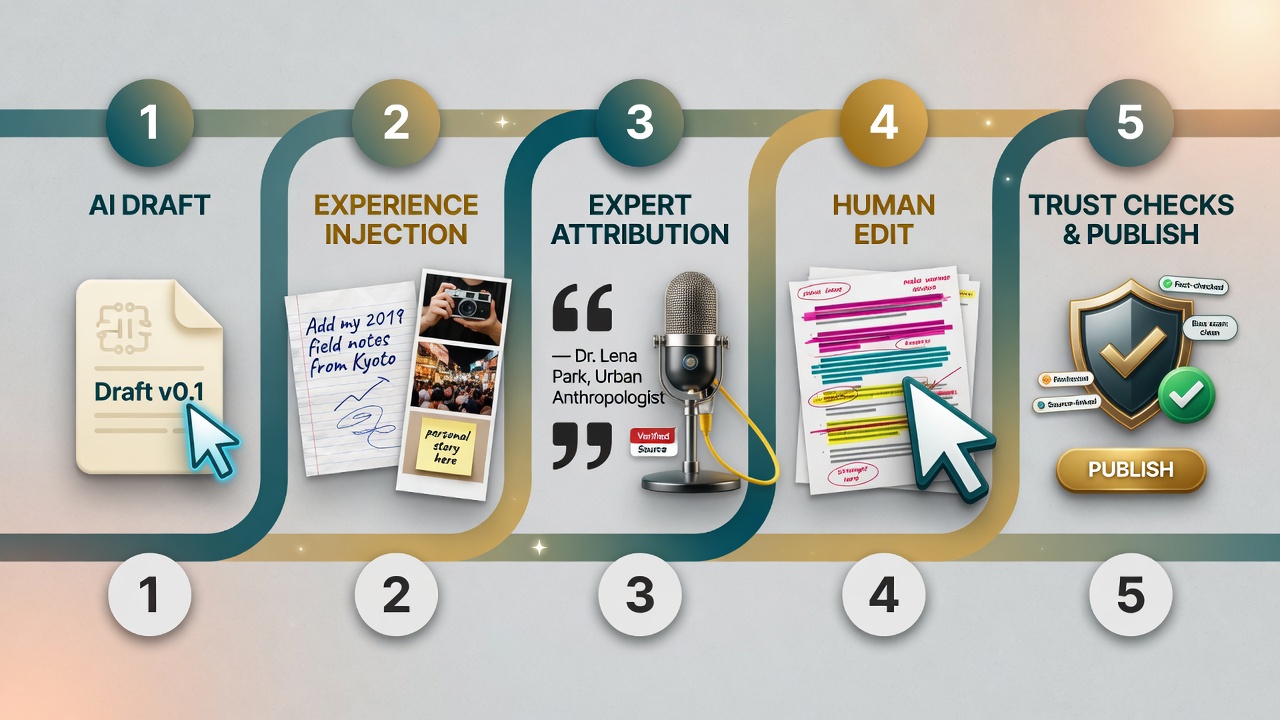
That score is your cue to run a fixed post-draft pipeline rather than hoping the next model update magically supplies Experience or Authority. The intervention itself is a repeatable signal-injection workflow that sits cleanly after your autoblogging tool generates the draft and before anything reaches publish: start with the AI structure, infuse verifiable experience and data, apply a substantive human edit, then finish with an accuracy pass.
Because every stage is modular, the same pipeline works inside existing content-automation stacks. You can trigger the infusion layer by webhook, drop drafts into a shared review queue, and still maintain publishing velocity on lower-difficulty informational terms while reserving deeper passes for competitive commercial pages.
The four-stage pipeline
“Substantive” is the decisive word. It means the human editor rewrites enough of the draft—voice, structure, evidence, and lived detail—that the finished hybrid no longer reads as generic model output. AI-assisted content with that substantive human editing performs within 4% of fully human-written content on median ranking position. Light copy-edits alone never close the gap.
Practical infusion tactics keep the second stage fast and repeatable rather than turning every article into a one-off rewrite:
- Drop in short case notes or anonymized client outcomes that only someone who did the work would know
- Add product-use anecdotes drawn from real internal testing or customer support logs
- Route the draft to a subject-matter expert for a 10-minute review and one or two attributed pull-quotes plus credentials
- Replace generic claims with primary-source citations, proprietary data points, or simple original analysis
- Surface author credentials and a brief “how we know” disclosure so Experience and Authority are visible on the page
None of these steps require abandoning the autoblogging tool that produced the first draft. They simply insert a controlled human-and-expert layer that converts fluent but empty copy into people-first content Google can trust. Run the pipeline consistently and the ranking and backlink deficits that pure AI drafts accumulate stop compounding.
Signal injection, not rewrite-from-scratch — A modular four-stage pipeline (AI structure → experience/data/expert infusion → substantive human edit → accuracy pass) lets autoblogged drafts reach within 4% of fully human median rank while remaining compatible with existing content-automation tools.
Trust Infrastructure: Who/How/Why Disclosures, Schema, and Entity Proof
That conversion only sticks when the finished page also carries a durable trust layer Google’s systems can parse. After the experience, data, and expert signals are in place, the next job is to make authorship, process, and purpose explicit—and to encode the same facts in structured data so entity understanding stays consistent site-wide.
Operationalize Who, How, and Why on every piece
Google’s own guidance is direct: evaluate content through the lens of Who, How, and Why to stay aligned with what ranking systems reward. In practice that means a named author with a real bio and credentials, a short process note when AI assisted the draft, and a clear people-first purpose statement that explains why the page exists for the reader rather than for rankings. These disclosures turn anonymous automation into accountable publishing. Place the byline and bio where readers expect them, add a concise AI-assistance note in the methodology or footer, and open or close with a purpose line that frames the reader benefit. None of this requires reinventing the CMS—templates can pull author objects, inject the process note, and surface the purpose statement automatically once the hybrid edit is complete.
Automate entity schema and keep signals consistent
Machine-readable proof multiplies the value of those human signals. Generate Person, Organization, and Article schema on publish so the same author credentials, organization details, and article metadata travel with every URL. Keep entity names, sameAs links, and job titles identical across the site; fragmented or conflicting markup dilutes the very expertise you just injected. When the autoblogging stack already knows the author ID and organization profile, schema generation becomes a deterministic post-step rather than a manual chore—locking experience and authority into the knowledge graph that both classic search and AI Overviews consult.
Prioritize trust mechanics—especially on YMYL and commercial stakes
Of the E-E-A-T aspects, trust is the most important; the others ultimately feed it. Accuracy checks, transparent editorial and correction policies, clear contact and privacy pages, and secure UX (HTTPS, clean forms, no deceptive patterns) are therefore non-negotiable infrastructure, not optional polish. Systems already give even more weight to strong E-E-A-T on topics that could significantly affect someone’s health, financial stability, or safety—YMYL and high-stakes commercial queries. For those pages the full hybrid pipeline plus visible trust mechanics is mandatory; lighter informational pieces can run a thinner version of the same disclosures and schema without skipping the trust baseline.
When Who/How/Why statements, consistent entity schema, and core trust surfaces ship with every autoblogged URL, the post-draft work stops looking like cosmetic editing and starts functioning as ranking-relevant proof.
Trust infrastructure — Named authors, AI-process notes, people-first purpose statements, automated Person/Organization/Article schema, and visible trust mechanics turn hybrid drafts into durable E-E-A-T signals, with even heavier expectations on YMYL and high-stakes commercial topics.
Scale Smart: Risk-Tiered Effort and Live Expertise Layers
That proof, though, does not have to land at the same depth on every URL. The practical way to keep signal injection sustainable—and clear of scaled-content spam patterns—is to tier editorial investment by keyword difficulty and business risk. High-KD commercial and YMYL terms are where thin AI drafts get punished hardest in the SERPs, so those pages receive the full hybrid pass: experience notes, original data or SME review, substantive rewrite, and complete trust infrastructure. Lower-stakes informational clusters can ship with a lighter package that still closes the most glaring gaps without exhausting the team.
A lightweight package is enough for many supporting articles: a named byline with credentials, a short How/Why disclosure, and one concrete proof block—either a first-hand observation, a primary-source citation, or a brief proprietary data point. That combination turns a generic draft into something that demonstrates people-first intent and basic Experience without requiring a full expert rewrite on every cluster page. The goal is consistent signal density scaled to opportunity, not identical effort on every URL.
Live expertise probes, used sparingly
Interactive Q&A or on-page chat overlays can act as live expertise layers when they let readers surface real clarifying questions and receive answers grounded in the same author or SME knowledge that shaped the article. Used this way they support dwell time and reinforce Experience signals. They should remain secondary and sparse—never the main content strategy and never a forced monetization detour that pulls the piece away from usefulness. If the chat cannot answer from the article’s established expertise, it weakens rather than strengthens trust.
A simple measurement cadence
Teams know the injection system is working when a short recurring check shows movement on the right proxies: ranking stability or gains on the tiered high-risk set, growth in editorial (not spam) referring domains, lower refresh-driven deindexation or manual-action flags, and qualitative reader signals such as time on page and return visits on pages that received deeper experience and expert layers. Review the tier rules quarterly, tighten full-hybrid criteria where competition rises, and keep lighter packages honest. Done this way, autoblogging stays a production advantage instead of a ranking liability—closing the trust gap at a pace the operation can actually sustain.
Risk-tiered injection — Match full hybrid depth to high-KD and high-stakes URLs, ship lighter byline-plus-proof packages on informational clusters, add chat only as genuine expertise support, and track rankings, editorial links, and engagement so the system stays effective without tipping into scaled spam.Key Takeaways
Audit your next AI draft against the four E-E-A-T gaps and inject verifiable experience, expert attribution, original data, and trust schema before you publish so your autoblog pipeline ranks and earns trust in 2026.
Frequently Asked Questions
No. Google’s guidance states that appropriate use of AI or automation is not against the guidelines when it is not used primarily to manipulate rankings. Content is evaluated on helpfulness, originality, and E-E-A-T regardless of how it was produced.
Studies show pure AI content ranked 23% lower on average, largely because it systematically lacks E-E-A-T signals: verifiable bylines, original research, expert quotes, and first-person experience. Those absences also reduce backlinks and raise deindexation risk after spam updates.
It is a workflow that keeps AI for speed on the base draft, then deliberately injects experience anecdotes, expert attribution, proprietary data, author credentials, Who/How/Why disclosures, fact-checking, and trust schema before publish—so the finished piece carries the signals ranking systems reward.
AI-drafted content with substantive human editing, original data, and expert attribution has performed within 4% of fully human-written content on median ranking position. Full hybrid effort is best reserved for high-difficulty commercial terms; lighter enhancement can suffice for lower-competition informational pages.
Trust is the most important pillar. Support it with clear authorship and credentials, first-hand experience or case studies, primary-source citations, subject-matter expert input, accurate facts, process transparency, and entity/schema signals for authors and organizations.
Invest full hybrid review, original data, and expert attribution on high-keyword-difficulty commercial and YMYL topics. Apply lighter signal injection—bylines, disclosures, citations, and light editorial passes—on lower-difficulty informational content to scale efficiently without uniform over-investment.
You Might Also Like