AI Agents for SEO in Hybrid Automation Workflows

Search engine optimization has crossed a critical threshold, shifting from reactive, prompt-driven writing assistants to autonomous, goal-oriented systems. Modern seo agents do not merely wait for instructions; they chain complex tasks together—from keyword research and SERP analysis to real-time optimization, auto-publishing, and continuous ranking recovery. By integrating these ai agents for seo into structured, programmatic pipelines, brands can transition away from slow, manual editorial processes.
This transition is highly lucrative. According to BCG research, AI-powered workflows cut low-value work time by 25-40 percent, allowing editorial teams to focus on high-level strategy and brand voice. When these workflows are fully optimized, the speed gains are massive: a full agentic SEO pipeline reduces time per article from 9-14 hours of manual labor to just 30-60 minutes, representing a 90%+ reduction in production time. By letting specialized agents handle repetitive, data-heavy tasks while human editors maintain creative control, marketing teams running agentic workflows ship 4-10x the content of teams running manual workflows.
As we navigate this new era, success requires a dual-pronged approach. Publishers must optimize content for traditional search engines while simultaneously preparing for Generative Engine Optimization (GEO). Because 38 percent of Google AI Overview citations come from pages already ranking in the top 10 search results, establishing strong organic rankings remains the ultimate prerequisite for AI visibility. Below, we break down the exact blueprint for deploying hybrid multi-agent systems, targeting low-difficulty keyword clusters, and embedding interactive AI chat directly inside your automated articles to drive deeper user engagement and new monetization channels.
- 1
AI agents for SEO autonomously chain multi-step keyword, writing, and publishing tasks, moving far beyond simple prompt-based content generation.
- 2
An agentic pipeline reduces production time per article by over 90 percent, shrinking manual timelines down to just 30 to 60 minutes.
- 3
Hybrid workflows deliver optimal results by combining agentic speed for data tasks with human oversight for brand quality and editorial ethics.
- 4
Securing a top-10 organic ranking is crucial for generative engine visibility, as 38 percent of Google AI Overview citations originate from those top results.
- 5
Integrating interactive AI chat within auto-published articles improves reader navigation while unlocking new affiliate, subscription, and ad revenue streams.
Why Pure Automation Fails and Hybrid SEO Agents Win for AI Publishing Platforms

The dream of pushing a button and letting an AI engine generate thousands of flawless SEO articles is a dangerous illusion. Pure, unchecked content automation inevitably produces thin, formulaic, and highly repetitive text. These patterns quickly trigger search engine quality penalties and fail to secure coveted placements in Google's AI Overviews. To win in modern search, publishers must transition from simple prompt-based generators to autonomous, multi-agent SEO pipelines that work in tandem with human editors.
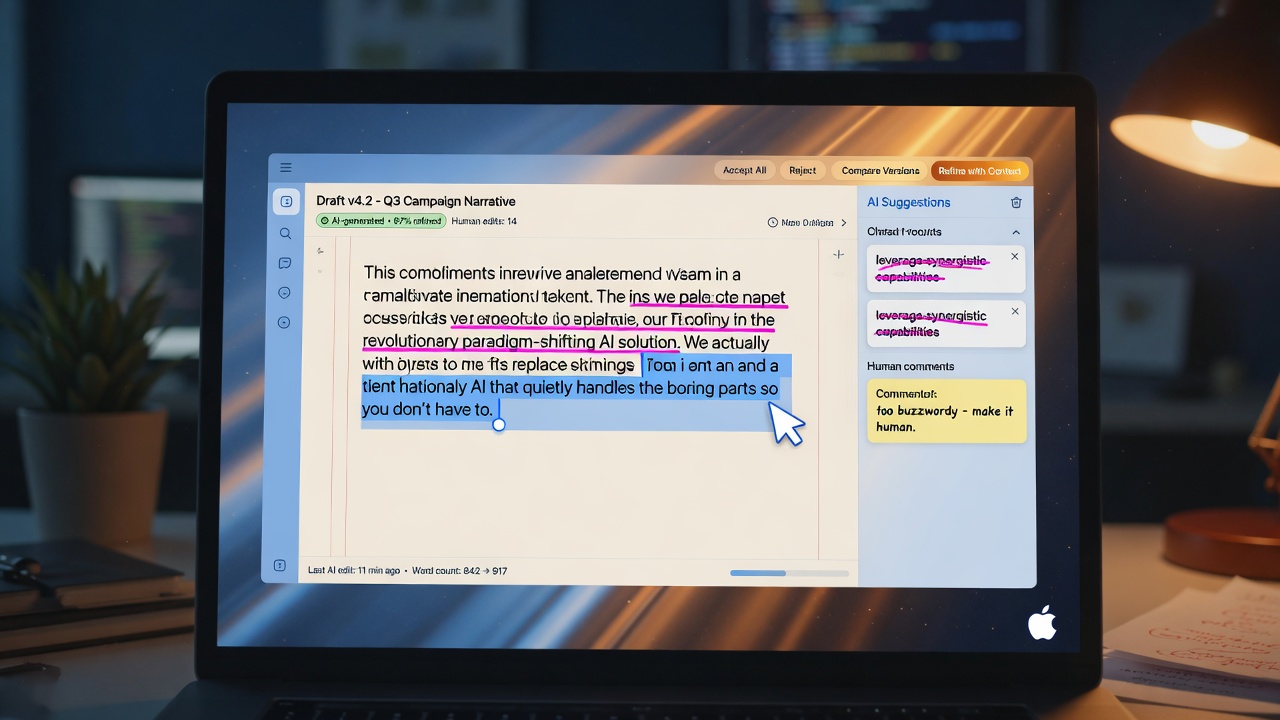
AI agents for SEO are goal-oriented systems that chain complex tasks together—such as keyword clustering, competitive gap analysis, and programmatic schema generation. However, the most reliable setups are hybrids: agents run the routine and repetitive tasks, while humans handle the ambiguous, creative, and emotional ones. In this model, intelligent agents handle the heavy lifting of data analysis and initial drafting, while human oversight ensures brand voice consistency, factual accuracy, and creative flair.
The economic impact of this hybrid approach is staggering. Research shows that AI-powered workflows cut low-value work time by 25 to 40 percent. For instance, a leading consumer packaged goods company deployed intelligent agents to create blog posts, reducing costs by 95 percent and improving creation speed by 50x. These efficiency gains do not require a compromise on quality when human guardrails are in place. By automating the repetitive mechanics of SEO, teams can scale content velocity without risking algorithmic penalties.
Ultimately, keeping humans in the loop is not just a safety measure; it is a primary revenue driver. Organizations leading in agentic AI adoption achieve five times the revenue gains of laggards. By combining the scale of multi-agent orchestration with human strategic intuition, publishers create a high-performance content engine that satisfies both search algorithms and human readers.
Hybrid SEO workflows are essential — While pure automation triggers quality penalties, pairing autonomous SEO agents with human strategic oversight cuts costs by 95% and helps leading organizations capture 5x the revenue gains of competitors.
The 2026 Search Shift: Why SEO Agents Must Target AI Overviews and Answer Engines
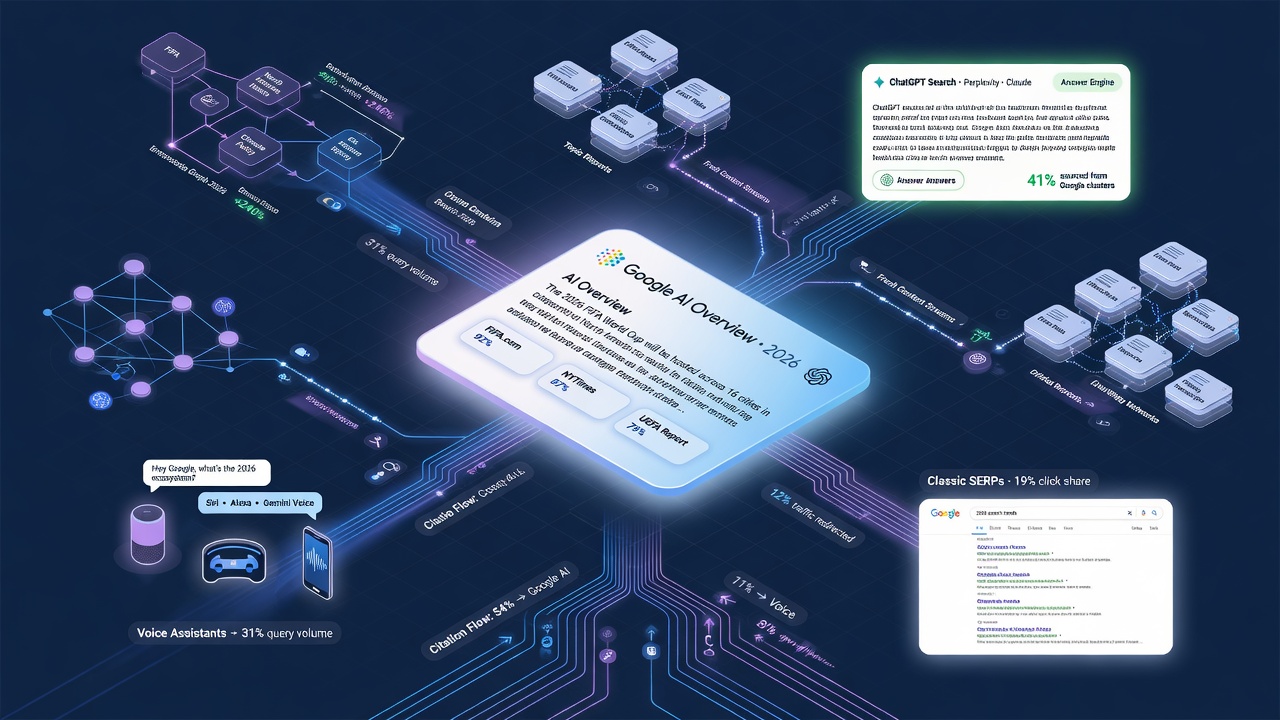
This high-performance content engine is no longer just about ranking in the traditional blue links of yesteryear. The search landscape has fundamentally fractured. Today, users increasingly bypass standard search results entirely, turning to conversational platforms and generative summaries that synthesize web information on the fly.
The New Destination: AI Overviews and ChatGPT
To capture organic traffic now, publishers must optimize for generative engine touchpoints. Google’s AI Overviews heavily favor established authority, pulling a large share of their citations directly from pages already ranking in the traditional top 10 search results. Securing these top slots requires a level of content depth and technical precision that manual teams struggle to scale.
Concurrently, conversational platforms have evolved into full-fledged search engines. ChatGPT alone processes roughly 2.5 billion prompts per day, with an estimated 65 percent of those interactions functioning as search queries. Traditional keyword stuffing cannot penetrate these neural-network-driven answer engines; instead, publishers need highly structured, entity-rich content that AI models can easily parse and cite.
The Rapid Rise of Agentic Marketing
Because the optimization criteria have grown so complex, relying on static tools is no longer viable. The industry has responded with a massive shift toward autonomous workflows. In fact, 90.3 percent of marketing organizations already use AI agents somewhere in their stack, leveraging them to handle iterative, data-heavy tasks.
This widespread adoption is fueling an unprecedented economic boom. The global AI agents market, valued at approximately $7.6 billion in 2025, is projected to reach $182.9 billion by 2033, growing at a compound annual growth rate (CAGR) of 49.6 percent. In this hyper-competitive climate, deploying hybrid SEO agents is no longer a forward-looking luxury—it is the baseline requirement to remain visible in a search ecosystem dominated by generative engines.
Generative Visibility — Modern SEO requires optimizing for AI Overviews and answer engines like ChatGPT. Deploying hybrid SEO agents is essential to handle the structured, entity-rich content demands of platforms processing billions of search-intent prompts daily.The Agentic Blueprint: Cracking Low-KD Keyword Clusters at Scale
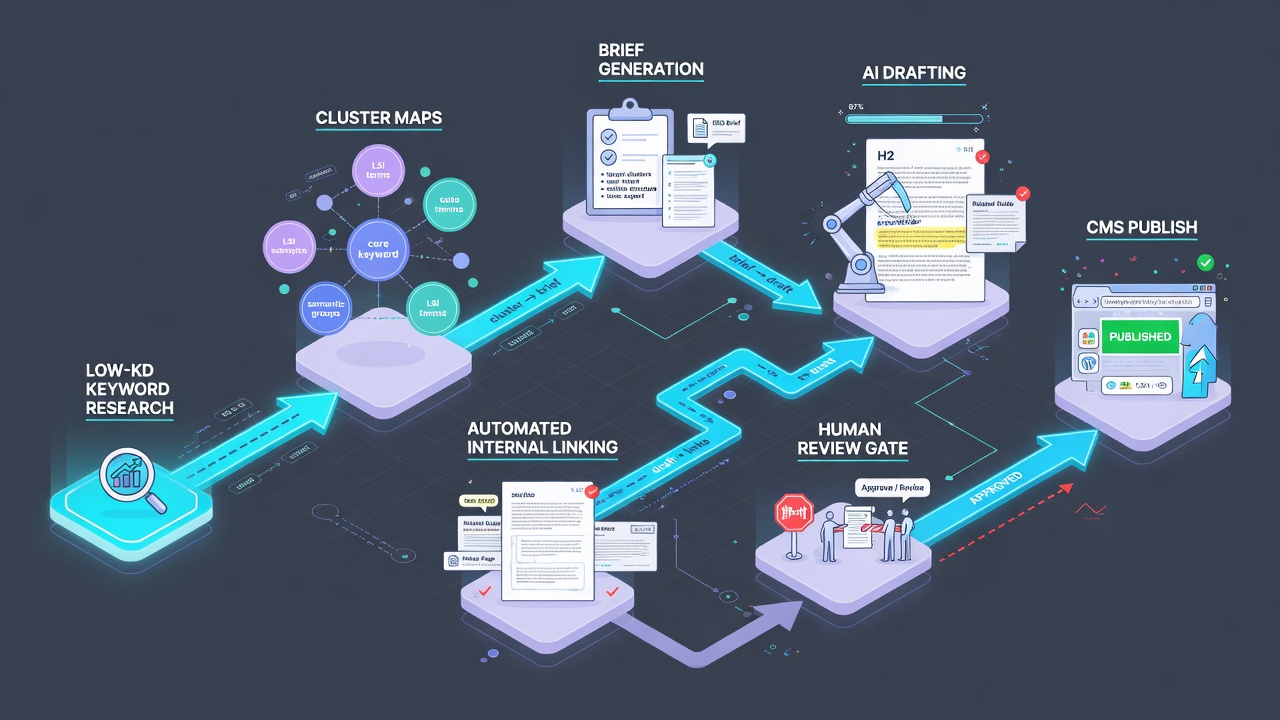
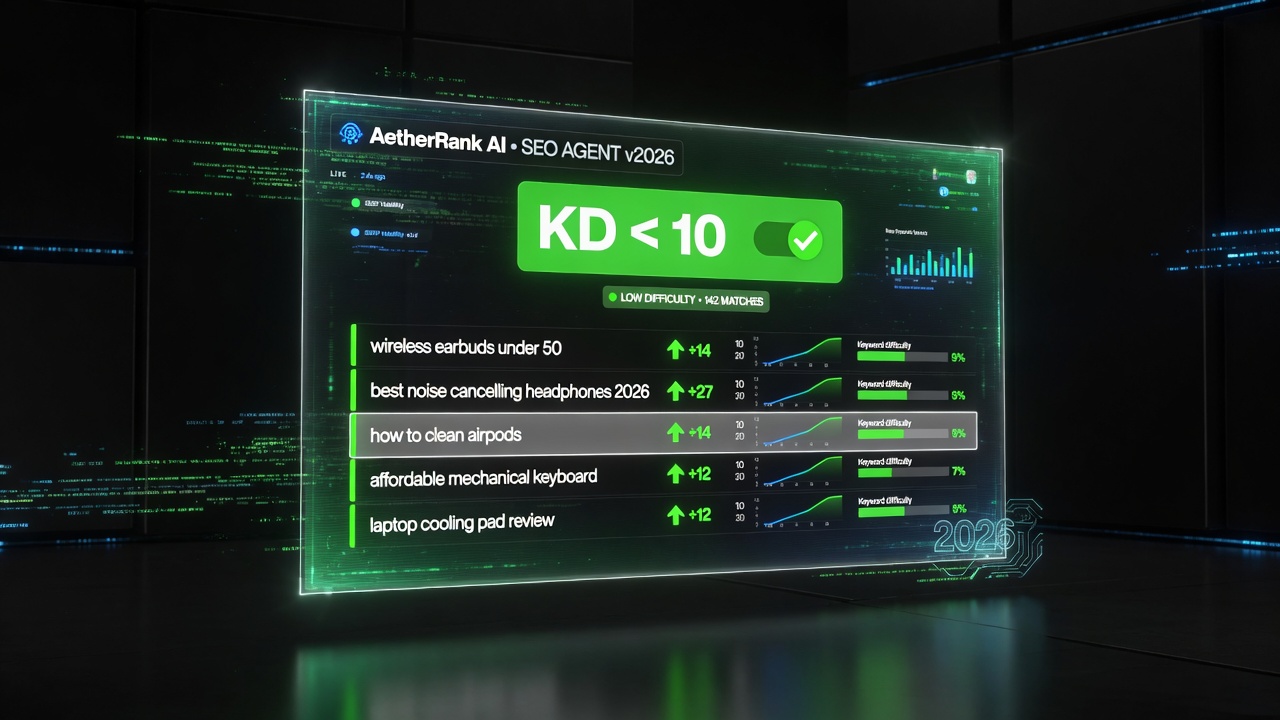
To outpace traditional competitors in this new search landscape, publishers must shift from targeting high-volume, hyper-competitive keywords to dominating highly specific, low Keyword Difficulty (low-KD) clusters. SEO agents excel at this by autonomously scanning search data, grouping related queries by intent, and mapping out complete topical authority maps without manual intervention. By targeting these smaller, highly intent-driven search pools, publishers can establish rapid search engine trust and capture highly qualified traffic.
When deployed within a programmatic scaling framework, AI agents for SEO systematically address the primary bottleneck of content publishing: execution speed. Manual workflows are inherently slow and expensive, whereas an automated, multi-agent pipeline collapses the entire lifecycle from keyword research to final draft.
The operational impact of this shift is profound. Implementing a full agentic SEO pipeline reduces the average time required to produce a single article from 9-14 hours of manual effort down to just 30-60 minutes, representing a 90%+ reduction in production time. Because of this massive efficiency gain, marketing teams running agentic workflows routinely ship 4-10x the content of teams relying on manual workflows, allowing them to capture entire niches before competitors can draft a single brief.
Crucially, this programmatic volume does not result in isolated, orphan pages. As the agents publish new assets, they continuously analyze the existing catalog to build automated internal links. This turning of individual, low-KD posts into highly organized, durable topical clusters signals deep expertise to search crawlers, elevating the organic authority of the entire domain.
Topical Authority Scaling — By leveraging SEO agents to target low-KD clusters and automate internal linking, publishers can reduce article production times by 90%+ and scale content output by 4-10x, building resilient search authority.The Dual-Engine Mandate: Running SEO and GEO Optimization Agents in Parallel
This collective domain authority is no longer judged solely by traditional search engine algorithms. As generative search engines and AI-assisted answer engines capture more user queries, modern content must perform a double duty. AI agents for SEO excel here by running parallel optimization passes: one focused on traditional Search Engine Optimization (SEO) signals, and another tailored for Generative Engine Optimization (GEO).
Rather than treating these as separate workflows, autonomous agents optimize for both simultaneously. This dual approach is critical because the two environments are deeply intertwined. For instance, 38 percent of AI Overview citations come from pages already ranking in the top 10 Google results. If your content cannot rank on the traditional SERP, its chances of being cited by an AI agent drop significantly. Dual optimization is not a luxury; it is a baseline requirement for visibility.
How Agents Secure AI Overview Citations
To satisfy generative engines, agents systematically adjust specific structural and semantic elements within the draft. They do not just write readable prose; they format it for machine extraction by executing several precise steps:
- Maximizing Entity Density: Agents identify and naturally integrate relevant entities, synonyms, and LSI keywords that map directly to the search engine's knowledge graph.
- Structuring Clear, Direct Answers: The system automatically formats concise, direct answers immediately following target headings to feed AI summary boxes.
- Deploying Clean Markup: Agents auto-inject structured schema and push clean, highly semantic HTML directly into the CMS, removing any code bloat that could confuse web crawlers.
Turning Traffic into Conversations: In-Article AI Chat for Engagement and Monetization

Once your SEO agents have successfully secured high-ranking positions and pulled qualified traffic to your site, the battle shifts from acquisition to retention. Traditional static content often suffers from high bounce rates as readers skim for a single answer and depart. By integrating contextual, in-article AI chat agents directly into the page, publishing platforms can transform passive reading into an interactive dialogue.
These specialized chat agents are trained on both the specific article content and your broader site knowledge base. When a reader has a follow-up question or needs clarification on a complex point, they do not need to head back to a search engine; they simply ask the embedded agent. This immediate, high-utility interaction keeps readers on-page longer, signaling deep user engagement to search engines and reinforcing the content's ranking authority and eligibility for AI citations.
Unlocking Native Monetization and Conversational Conversions
Beyond simple navigation and clarification, this conversational layer serves as a highly targeted monetization engine. Because the agent understands the context of the user's query in real time, it can naturally introduce relevant monetization touchpoints without disrupting the reading experience:
- Contextual Affiliate Recommendations: Suggesting specific tools, products, or services that directly solve the reader's active problem.
- Gated Value Additions: Offering high-value resources, templates, or PDF guides in exchange for an email address.
- Newsletter and Community Captures: Seamlessly inviting highly engaged readers to subscribe to updates or join private communities.
This interactive, monetization-ready layer represents a massive shift for hybrid AI publishing platforms. While generic agent guides focus solely on content generation, sophisticated workflows recognize that the ultimate goal of SEO automation is not just publishing words, but capturing and converting attention.
Conversational Monetization — Embedding contextual AI chat agents within articles transforms static content into an interactive experience, boosting on-page engagement metrics while naturally driving affiliate revenue and lead generation.Multi-Agent Networks: Continuous Monitoring and Automated Ranking Recovery
To maintain this level of engagement and protect your traffic, SEO automation cannot end at the publish button. Search landscapes are inherently volatile; algorithmic shifts, competitor updates, and answer engine citation decays require constant vigilance. Relying on a single, generalist AI prompt to handle both creation and maintenance inevitably leads to performance degradation. Instead, sophisticated publishers deploy networks of specialized, autonomous agents that operate in continuous loops.
By dividing labor among specialized agents—such as dedicated research, writing, optimization, and monitoring agents—platforms achieve far greater precision than any single-agent setup can provide. This multi-agent architecture is rapidly becoming the industry standard for enterprise-grade AI operations.
In these advanced workflows, Watchdog agents run silently in the background, continuously tracking keyword rankings, organic CTR, and AI Overview citations. When a decline is detected, the Watchdog does not just sound an alarm; it automatically triggers a recovery workflow. It tasks a research agent to scrape the newly ranking competitors, instructs an optimization agent to identify semantic gaps, and queue up precise content refreshes.
At the same time, dedicated internal linking agents analyze the entire site topology. When a new article is published or an old one is updated, they programmatically inject relevant anchor text links across the domain, keeping content clusters healthy and contextually connected without requiring a single minute of manual developer or editor time.
Multi-agent recovery loops — Deploying specialized monitoring and optimization agents ensures your content library is autonomously updated, internally linked, and defended against ranking decay without manual intervention.
Human-in-the-Loop: Guardrails and Risk Mitigation for Sustainable Scaling
While autonomous multi-agent networks eliminate the manual bottlenecks of search optimization, scaling without boundaries introduces existential risks. Running AI agents for SEO without strict guardrails can lead to budget runaway, off-brand messaging, or inaccurate legal claims. To build a sustainable, future-proof publishing engine, organizations must implement hybrid automation workflows that pair machine speed with human strategic oversight.
Establishing human-in-the-loop (HITL) checkpoints is the most effective defense against hallucinations and spam signals. By requiring manual approval for high-stakes content elements—such as final editorial reviews, compliance checks, and sensitive data verification—publishers ensure their content remains authoritative. These documented human loops are not just an internal quality standard; they are increasingly necessary to satisfy emerging global compliance frameworks that mandate clear transparency and risk management for automated decision-making systems.
The Competitive Edge of Managed Autonomy
The organizations that successfully balance autonomy with control are already pulling away from the competition. Future-built AI firms expect twice the revenue increase and 40 percent greater cost reductions than laggards in the areas where they apply AI. This massive performance gap exists because structured guardrails allow teams to safely scale their programmatic output without risking search engine penalties or brand erosion.
Managed Autonomy — Combining autonomous SEO agents with structured human oversight loops minimizes brand risk and regulatory compliance issues while unlocking double the revenue growth and 40% greater cost efficiencies.Key Takeaways
Transform your search visibility and scale your content engine by deploying Flows to automate your SEO pipelines and engage readers with interactive in-article AI chat today.
Frequently Asked Questions
Standard AI writing tools require constant, manual prompts for every single paragraph or outline. In contrast, ai agents for seo are goal-oriented systems that autonomously chain multiple complex tasks together—including search intent analysis, internal linking, and publishing—with minimal human intervention.
Deploying a full agentic SEO pipeline reduces the time spent per article from 9-14 hours of manual work down to just 30-60 minutes. This represents a 90%+ reduction in production time, enabling lean marketing teams to scale their publishing output by 4x to 10x.
Hybrid setups are the most reliable because they combine the strengths of both worlds. Autonomous agents handle routine, repetitive, and data-heavy tasks, while human editors focus on ambiguous, creative, and emotional elements to ensure brand compliance and prevent search engine penalties.
SEO agents target high-quality, structured content optimization because 38 percent of AI Overview citations come from pages already ranking in the top 10 Google results. By securing high organic positions, agents naturally position your content to be cited by generative engines.
You Might Also Like