Optimizing SEO Agents for Low-Difficulty Keyword Targeting in 2026
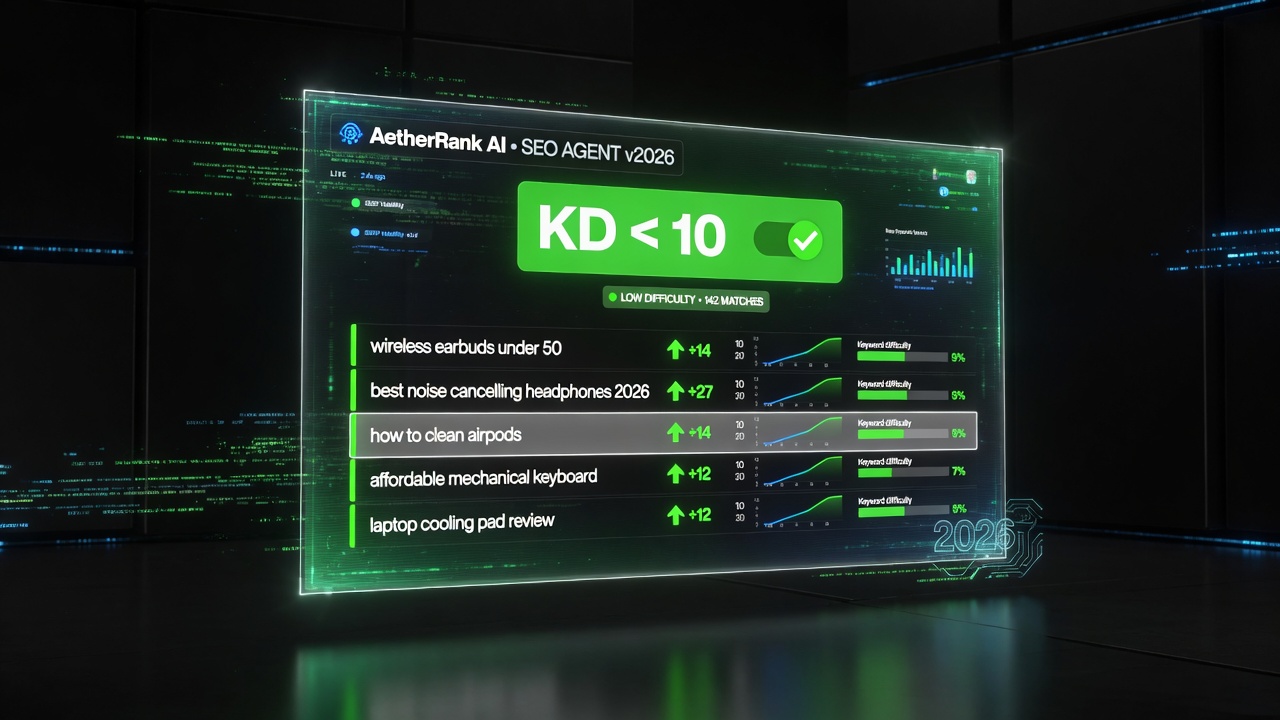
The organic search landscape has shifted dramatically, and manual keyword research can no longer keep pace with the speed of AI-driven search engines. In 2026, the most successful brands are leveraging autonomous SEO agents to find and exploit untapped search queries before their competitors even notice them. By automating the discovery of low-competition keywords—specifically those with a Keyword Difficulty score under 30 in tools like Ahrefs or Semrush—publishers can secure fast page-one rankings without relying on massive, expensive link-building campaigns.
To turn this into a repeatable growth engine, modern SEO strategy focuses on prioritizing realistic targets, particularly long-tail terms with a Keyword Difficulty under 30 and a monthly search volume of 100 or more. Leading full-stack AI SEO agents, such as Frase, now automate all 6 out of 6 critical pipeline stages, seamlessly handling everything from initial keyword research to deep content optimization. However, scaling content with agents is not just about chasing easy wins. A balanced mix of difficulty levels is essential to maintain both short-term traffic gains and long-term topical authority.
This guide provides a practical blueprint for configuring your autonomous agents to safely hunt, validate, and scale content for these low-difficulty opportunities. Let's start by looking at what makes a low-difficulty keyword so valuable in today's search ecosystem and how to identify them with precision.
- 1
SEO agents can automate the discovery of low-competition keywords with Keyword Difficulty scores under 30 for rapid page-one rankings.
- 2
Targeting long-tail terms with a difficulty under 30 and volume over 100 provides realistic, highly profitable SEO targets.
- 3
Top-tier AI SEO agents like Frase now automate all 6 pipeline stages from research to final content optimization.
- 4
A balanced strategy that mixes low-difficulty targets with broader authority building ensures both immediate wins and sustainable long-term growth.
The Power of Ultra-Low Difficulty: Why Targeting KD Under 10 is the Ultimate Fast Track
In the traditional SEO playbook, low-competition keywords have Keyword Difficulty (KD) scores below 30 in tools like Ahrefs or Semrush. For a new or mid-authority site, targeting these terms is the standard advice for ranking on page one without a years-long link-building campaign. But when you are deploying autonomous SEO agents to scale your content, you can afford to be much more precise—and much more aggressive.
While the standard "under 30" benchmark is a great starting point, configuring your AI agents to hunt for the most attainable low-KD scores unlocks a completely different level of growth. At this threshold, search intent is highly specific, and the ranking barriers are virtually non-existent. To build a realistic and highly profitable SEO target list, you should program your agents to prioritize long-tail and low-difficulty terms with a KD under 30 and a monthly search volume of 100+.
SEO agents excel at automating this tedious filtering process. Instead of a human analyst spending hours filtering databases in Semrush or Ahrefs, an agent can instantly parse thousands of long-tail variations, cross-reference them with search intent, and queue up the best opportunities. By targeting these specific thresholds, your content automation engine doesn't just write blindly; it builds a foundation of quick-win rankings that feed immediate traffic to your site while establishing early topical authority.
But finding these golden opportunities is only half the battle. To scale this process without human bottlenecking, you need to set up your automation tools with exact rules. Let's look at how to configure your SEO agents for this strict filtering process.
Target low difficulty — Focus your SEO agents on long-tail keywords with a KD under 30 and at least 100 monthly searches to secure fast, predictable rankings without heavy link-building.
Setting the Rules: How to Configure Your SEO Agents for Strict KD Filtering
To make this setup work, your AI agents need clear, non-negotiable guardrails. If you leave an agent to explore keywords without strict parameters, it will inevitably drift toward high-volume, high-competition terms that your site has no topical authority to rank for yet. The goal is to program the agent to act as a strict gatekeeper, automatically discarding any keyword that doesn't fit your exact low-difficulty profile.
Choosing a Full-Stack Agent
When selecting your tooling, look for platforms that handle the entire content lifecycle rather than just a single step. In 2026, Frase ranks as the top full-stack AI SEO agent, covering all 6 pipeline stages including research and optimization. In comparison, other popular tools like Surfer SEO and Semrush only cover 3 out of 6 stages. Utilizing a full-stack agent allows you to pass filtered keyword data seamlessly into the drafting and optimization phases without manual exports or API duct-tape.
Implementing the KD Filter
Once your agent is selected, the first step is building repeatable filters that exclude any keyword with a difficulty score above 30. While a KD under 30 is generally acceptable for manual campaigns, configuring your automated agents to target within this range ensures reliable results for rapid indexing and ranking. You can feed your agent a seed list of core topics, then instruct its discovery module with three hard rules:
- Exclude any keyword with a KD score greater than 30.
- Require a minimum monthly search volume of 100.
- Group accepted keywords into tight semantic clusters before triggering the outline generator.
By locking in these strict parameters, your AI SEO agent can run continuously in the background, mining hundreds of hyper-targeted opportunities while you focus on quality control. However, automated filtering is only half the battle; you must also ensure the generated content meets search engine standards.
Strict filtering guardrails — Utilizing full-stack agents like Frase to target KD scores under 30 ensures your SEO automation scales safely with predictable, high-ranking results.
The Human Touch: Designing Validation Gates to Protect Your Rankings
This is where human-in-the-loop validation comes into play. Even with the most sophisticated AI SEO agents scouring the web, letting an automated system publish hundreds of pages without human oversight is a recipe for indexation issues, low-quality content flags, or search engine penalties. To safeguard your domain authority, you need to establish strict validation gates that verify both the quality of the keyword intent and the strategic value of the content before anything goes live.
The first step is to implement manual review gates. While an agent can identify low-difficulty keywords with high accuracy, it cannot always grasp the subtle nuances of human search intent or brand alignment. By inserting a quick manual check, you can filter out irrelevant keywords, refine the generated briefs, and ensure that every piece of content serves a distinct user need.
Beyond avoiding automated spam penalties, validation is about strategic alignment. A low-KD keyword might be incredibly easy to rank for, but if it exists in a vacuum, it won't help your site build long-term authority. Your AI SEO agent must be instructed to map every low-difficulty target back to a broader topical cluster. By grouping these quick-win, long-tail keywords around high-value parent topics, you create a structured, semantic web of content. This interlinked structure signals to search engines that your site is a comprehensive resource on the subject, boosting the rankings of both your low-difficulty pages and your harder-to-rank pillar pages. When your agent links low-difficulty child pages back to your primary pillar pages, you pass valuable link equity upward, turning easy wins into a foundation for competitive search terms.
Guardrails prevent penalties — Always pair your AI SEO agent with manual validation gates to ensure low-KD targets map directly to broader topical clusters, securing both quick rankings and long-term domain authority.
Scaling Without Spam: Ramping Up Production Safely with SEO Agents
With this internal linking structure mapped out, the logical next step is scaling your content engine. However, when you give an SEO agent the green light to produce dozens of articles a week, the temptation to focus solely on effortless, low-difficulty targets can backfire.
While low-KD keywords (under 30) are excellent for capturing fast rankings, relying on them exclusively won't sustain a mature brand. A balanced mix of difficulty levels helps maintain both short-term wins and long-term growth [e3]. Your AI agent should be configured to split its output: generating quick-win content to capture immediate traffic while simultaneously drafting comprehensive, authority-building resources for more competitive terms.
Guardrails Against Over-Automation
Scaling this hybrid approach requires careful guardrails. If an agent is left entirely on autopilot, it risks generating repetitive layouts, shallow content, or over-optimized text that search engine algorithms easily flag as low-quality spam. To prevent these quality penalties, you need to establish strict automation thresholds.
To scale safely, configure your SEO agents to follow a three-step quality check before any post is scheduled:
- Fact-checking and data validation: Ensure any claims, statistics, or industry references are accurate and properly sourced.
- Brand voice alignment: Inject proprietary insights, personal anecdotes, or unique brand perspectives to differentiate the content from generic AI outputs.
- UX and formatting pass: Add relevant internal links, callouts, and clean formatting to make the page highly readable for human visitors.
Using tools like Semrush or Ahrefs to feed your agent accurate difficulty metrics, combined with optimization platforms like Frase to refine the drafts, ensures that your scaled output remains highly competitive. This hybrid setup turns your SEO agent from a simple content generator into a high-precision publishing partner.
But scaling is only half the battle. To ensure these newly published pages actually climb the SERPs and maintain their positions, you must continuously track their performance and feed those insights back into your agent's configuration.
Smart scaling — Maintain a balanced mix of quick-win low-KD targets and high-authority pillars, and enforce human editorial gates to keep content quality high and avoid spam flags.Continuous Feedback: How to Monitor, Refine, and Update Your SEO Agents
This feedback loop is what separates set-it-and-forget-it automated sites that eventually crash from resilient, long-term organic traffic engines. Once your SEO agents have deployed content targeting low-difficulty keywords, the next step is establishing real-time monitoring. In 2026, keyword difficulty (KD) isn't static; a keyword that was a KD 8 yesterday could easily spike if a major competitor suddenly targets it. By setting up automated alerts for KD drift and ranking volatility, you can instantly flag when a previously "easy" keyword is becoming highly contested, allowing you to adapt your content or double down on internal linking before your rankings slip.
Quarterly Refreshes for Peak Performance
Beyond immediate alerts, your overall agent configuration needs routine maintenance. Search engine algorithms shift, and the natural language patterns that worked six months ago might lose their edge. Implementing a quarterly audit to refresh your agent's core prompts, filtering criteria, and guardrails ensures your automated workflows stay aligned with current SERP standards. During these quarterly refreshes, analyze which automated pieces performed best and use those as new "few-shot" examples in your agent's system prompts.
Ultimately, SEO is a dynamic game. By treating your SEO agent as an evolving digital team member rather than a static tool, you ensure your content pipeline remains sharp, highly relevant, and consistently ahead of the competition.
Iterative refinement — Continuously monitor ranking volatility and update your SEO agent's prompts and filters quarterly to maintain an agile, high-performing organic strategy.
Key Takeaways
Ready to automate your organic growth? Start using Flows today to deploy smart AI SEO agents that find, target, and capture low-difficulty keywords for your business.
Frequently Asked Questions
Low-competition keywords are search terms with a Keyword Difficulty (KD) score under 30 in tools like Ahrefs or Semrush. These terms allow new or mid-authority sites to rank on page one quickly without intensive link-building campaigns.
Frase ranks as the top full-stack AI SEO agent, covering all 6 out of 6 pipeline stages including research and optimization. Other popular tools like Surfer SEO and Semrush automate 3 out of 6 stages of the content pipeline.
No, a balanced mix of difficulty levels in your keyword research helps maintain both short-term wins and long-term growth. Combining low-difficulty targets with higher-competition terms builds comprehensive topical authority over time.
For realistic and achievable SEO targets, you should prioritize long-tail terms that feature a Keyword Difficulty under 30 and a minimum search volume of 100 or more.