Avoiding Penalties When Scaling with SEO Agents

Scaling content production has never been faster, but doing it blindly with SEO agents is a quick path to losing search visibility. Many publishers worry that using AI agents for content creation will trigger automatic penalties. However, Google has clarified its stance. According to Google Search's guidance about AI-generated content, "Appropriate use of AI or automation is not against our guidelines. This means that it is not used to generate content primarily to manipulate search rankings."
The real danger lies in scaled content abuse and low-value automation. As highlighted in Does Google Penalize AI Content? Myths & Facts, "Google will penalize AI content if it violates its spam policies such as using AI-generated content to manipulate search rankings, provide low-quality, misleading, or irrelevant information." To scale safely, publishers must shift from raw volume to strategic quality.
Success in 2026 requires a structured approach. As noted by Ranking Risks and Detection Myths As AI writing tools, "Publishers who combine AI efficiency with human insight are seeing the most stable long-term SEO performance." According to the Google Penalty in SEO: Types, Causes & Recovery Guide, this means "Prioritizing content quality over scale, Building natural, authority-driven backlinks, Maintaining strong technical SEO foundations, Aligning with Google’s E-E-A-T framework." Let's dive into how you can deploy AI agents responsibly while keeping your rankings safe.
- 1
Google does not penalize AI content itself, only low-value content designed to manipulate rankings.
- 2
A hybrid workflow combining AI efficiency with human insight yields the most stable search performance.
- 3
To avoid penalties, publishers must prioritize E-E-A-T, factual accuracy, and technical SEO foundations.
Google's Real Rules: When Does AI Automation Cross the Line?
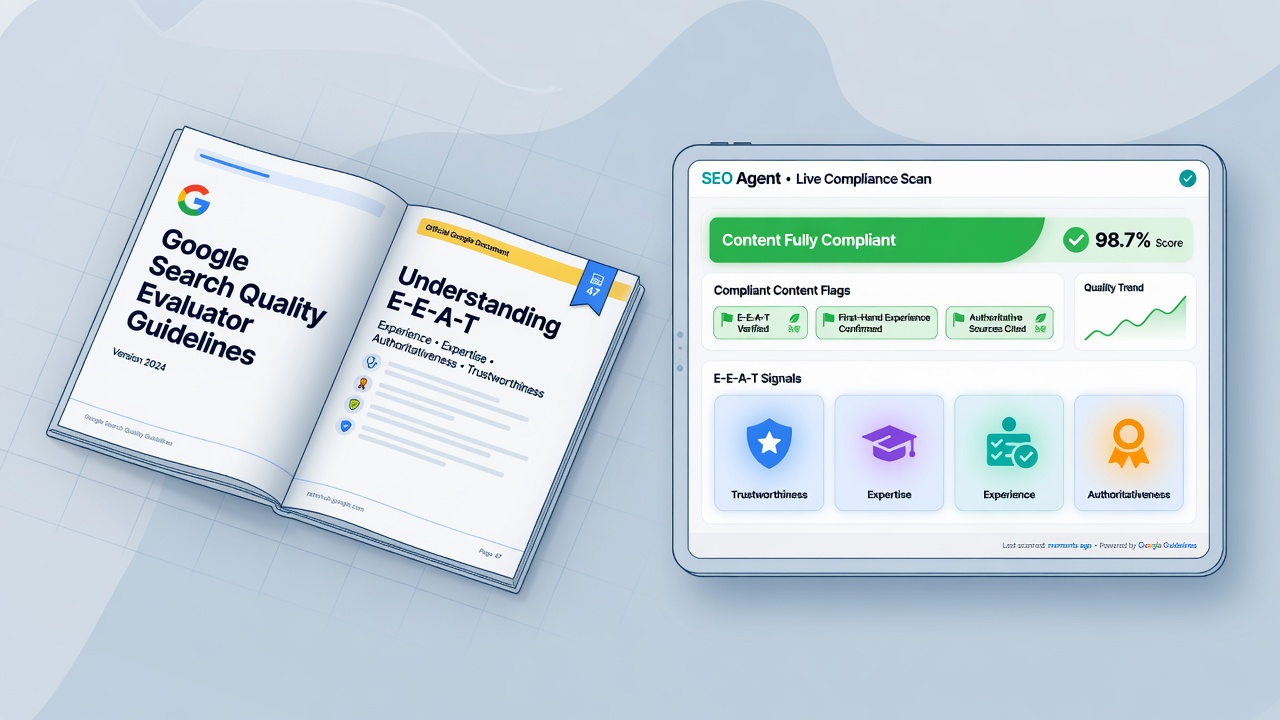
To scale content safely, we first need to dispel a common myth: Google does not hate AI. In fact, Google has explicitly stated that "appropriate use of AI or automation is not against our guidelines." The search giant does not penalize content simply because it was generated by a machine; it cares about why that content was written and who it serves.
The dividing line between safe SEO automation and a penalty risk comes down to intent. Helpful automation enhances the user experience by organizing complex data, streamlining research, or translating content. Manipulation, on the other hand, involves flooding search results with thousands of low-quality, generic pages solely designed to game algorithms. When you deploy AI agents without human oversight, you risk producing repetitive, low-value material that triggers Google's spam filters.
Intent dictates safety — Google permits AI-generated content as long as it serves genuine user needs rather than attempting to manipulate search rankings through low-quality, high-volume automation.
The Spam Triggers: What Actually Gets Scaled Content Penalized?

These filters are programmed to detect specific patterns of automation abuse. Google penalizes AI content only when it violates spam policies, such as using AI-generated content to manipulate search rankings or providing low-quality, misleading, or irrelevant information. When AI agents are left to publish without oversight, they easily fall into these patterns.
The most common triggers that draw search engine scrutiny include:
- Information regurgitation: Generating pages that simply rehash existing search results without adding new data, expert commentary, or unique perspectives.
- Topical mismatching: Rapidly publishing articles on unrelated subjects solely to capture high-volume search terms.
- Factual negligence: Allowing unverified AI hallucinations or outdated information to go live, which directly harms user trust.
Ultimately, it is not the sheer volume or speed of publication that triggers penalties, but the lack of intrinsic value. If your automated pipeline is just generating noise, the algorithms will treat it as spam. To safely scale without losing search visibility, publishers must transition from pure automation to structured, human-led systems.
Value over volume — Google targets mass-produced, low-quality content designed solely to manipulate rankings, meaning your AI scaling strategy must prioritize depth and accuracy over raw output.
The Hybrid Blueprint: Blending AI Scale with Human Oversight

This transition requires more than just hiring proofreaders. It demands a systematic framework where SEO agents handle the heavy lifting of data gathering and structural drafting, while human experts inject the real-world authority search engines crave.
By positioning AI as a collaborative partner rather than an autonomous replacement, publishers can maintain strict editorial standards. In fact, research shows that publishers who combine AI efficiency with human insight are seeing the most stable long-term SEO performance.
With the hybrid workflow established, maintaining this standard at scale requires continuous oversight. To keep this engine running smoothly, publishers must implement systematic audits to catch errors before search engines do.
Hybrid workflows are essential — Relying solely on automated AI agents risks search penalties, but combining their speed with human subject matter expertise creates a highly defensible, high-ranking content engine.
The Audit Engine: Bulletproofing Your AI Content Pipelines

These systematic audits aren't just about catching typos; they are the ultimate defense against programmatic decay. When scaling with SEO agents, it is easy to fall into the trap of overproduction. However, prevention strategies in 2026 demand a strict pivot toward prioritizing content quality over raw scale.
A robust auditing system must look beyond the written word. To safeguard your domain, your quality control checklist should focus on three critical pillars:
- E-E-A-T Alignment: Reviewing AI drafts to ensure they offer genuine, expert-level insights rather than generic summaries.
- Technical SEO Foundations: Ensuring rapid content publishing does not create crawl errors, duplicate pages, or orphan URLs.
- Natural Backlinks: Monitoring how your scaled assets attract authority-driven backlinks naturally, rather than relying on artificial schemes.
By running these ongoing reviews, you ensure your automated engine remains aligned with search engine expectations, protecting your organic visibility from sudden algorithmic shifts. This proactive stance prepares you to monitor and adjust your strategy in real-time.
Systematic Auditing — Safeguarding scaled content in 2026 requires continuous quality control that prioritizes content quality over scale, aligns with E-E-A-T, and maintains strong technical SEO foundations.The Feedback Loop: Real-Time Monitoring and Adaptive Scaling
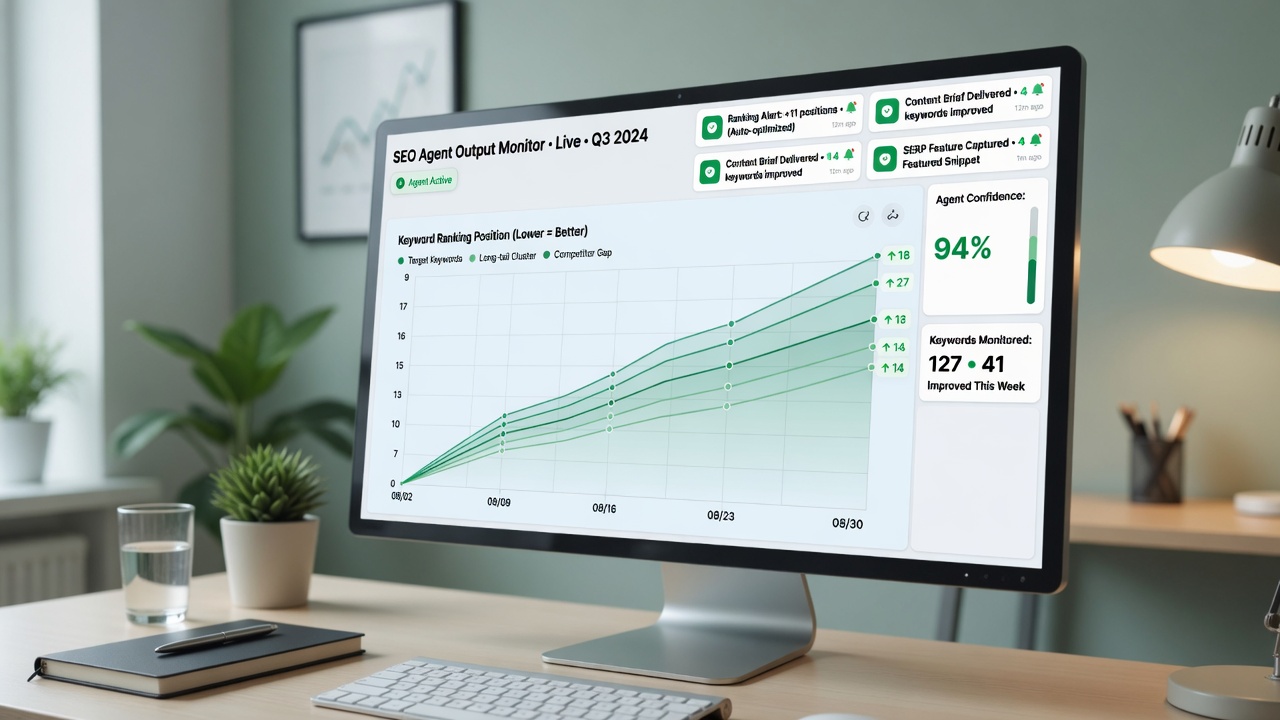
Scaling with SEO agents is not a "set-and-forget" operation. To safeguard your search footprint, you must establish immediate feedback loops. Setting up automated ranking and traffic alerts allows your team to spot anomalies the moment they occur. If a cluster of automated pages experiences a sudden dip in impressions or a volatile shift in keyword positions, these alerts serve as your first line of defense, signaling that search engines might be re-evaluating your content's helpfulness.
Early Warning Playbooks
Instead of reacting with panic during a core update, prepare clear adjustment playbooks for early warning signs. If an alert triggers, your playbook should dictate immediate actions: pause the specific agent pipeline, initiate a manual human review of the affected URLs, and inject deeper first-hand expertise or original media. This agile, data-driven response ensures your automated SEO engine remains resilient, highly qualitative, and continuously optimized for real human readers.
Adaptive Scaling — Continuous monitoring and rapid-response playbooks protect your SEO agent pipeline from sudden algorithmic shifts.Key Takeaways
Scale your search presence safely and efficiently by using Flows to automate your SEO pipelines with built-in quality controls and interactive reader features.
Frequently Asked Questions
No, Google does not automatically penalize AI content. According to Google Search's guidance about AI-generated content, using AI or automation is acceptable as long as it is not used primarily to manipulate search rankings.
AI content gets penalized when it violates spam policies. As noted in Does Google Penalize AI Content? Myths & Facts, penalties occur if AI is used to produce low-quality, misleading, or duplicate content to manipulate search rankings.
Publishers can scale safely by combining AI efficiency with human editorial insight. This hybrid approach ensures content meets E-E-A-T standards, remains highly accurate, and serves real user needs.
According to the Google Penalty in SEO: Types, Causes & Recovery Guide, safe scaling in 2026 requires prioritizing quality over scale, building natural backlinks, maintaining strong technical SEO, and aligning with E-E-A-T.