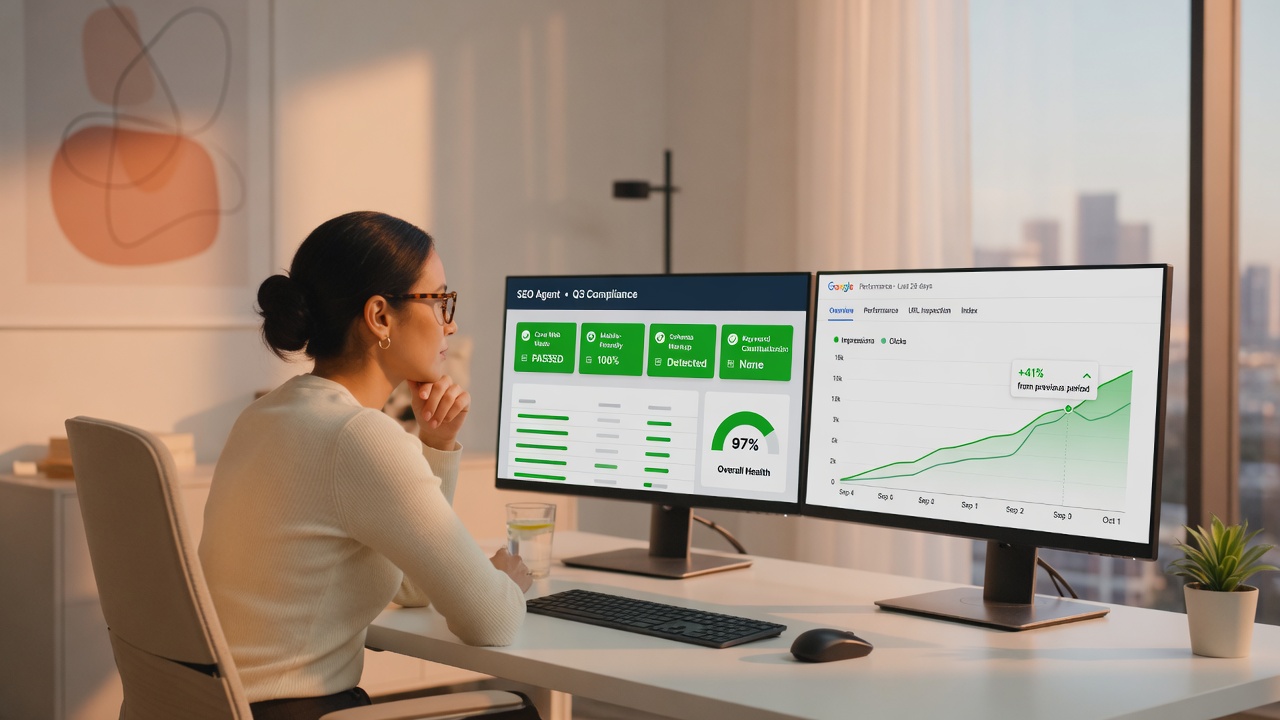
Deploying AI Agents for Real-Time SEO Adjustments
For years, search engine optimization has been a game of historical analysis and delayed reactions. SEO teams typically run weekly or monthly audits, identify declining performance, and manually queue up content updates—often weeks after a shift in search behavior has already occurred. However, the rapid evolution of autonomous technology is shifting the industry toward a continuous, live optimization model. According to a projection by Gartner, 40% of enterprise applications will feature integrated, task-specific AI agents by the end of 2026, marking a massive surge from less than 5% in 2025.
This shift is fundamentally changing how websites maintain search visibility. Rather than relying on static tools, modern search strategy leverages autonomous software capable of monitoring rankings, identifying visibility drops, and making immediate on-page corrections. Market data highlights the massive scale of this transition, with the global AI agents market projected to expand from USD 7.84 billion in 2025 to USD 52.62 billion by 2030, representing a compound annual growth rate (CAGR) of 46.3%.
At the core of this technological leap is the ability of AI algorithms to supply real-time analytics and performance metrics. This allows systems to track organic performance instantly and execute data-driven optimizations on the fly. For instance, instead of waiting for a manual audit, an active agent can continuously monitor store pages, detect declining search visibility, uncover fresh keyword opportunities, and automatically update product metadata to capture immediate demand. However, achieving sustainable success requires more than just unleashing autonomous software. The industry standard has settled on a hybrid execution model: AI agents accelerate operational throughput and handle data-dependent tasks, while human professionals retain ownership of high-level strategy, factual validation, and brand differentiation.
- 1
Enterprise adoption of task-specific AI agents is projected to rise to 40% by the end of 2026.
- 2
AI agents enable continuous, real-time SEO adjustments by monitoring rankings and updating metadata on the fly.
- 3
The global AI agents market is growing at a 46.3% CAGR, expected to reach USD 52.62 billion by 2030.
- 4
Successful SEO automation relies on a hybrid model where AI handles operational speed and humans manage strategy and validation.
The Rapid Rise of Task-Specific AI Agents
This hybrid framework is no longer a futuristic concept; it is rapidly becoming the operational standard for modern digital marketing. As enterprises struggle with the sheer volume of search data and search engine algorithm updates, the infrastructure supporting search engine optimization is shifting toward intelligent automation. This transition is fueled by a massive influx of capital and rapid enterprise adoption of specialized autonomous software.
This enterprise-level adoption is mirrored by explosive financial growth in the broader technology sector, creating new infrastructure for continuous SEO operations.
What This Shift Means for SEO Teams
For search marketing departments, this technological surge changes how daily operations are prioritized. Instead of dedicating valuable human hours to manual keyword tracking, metadata adjustments, and basic site audits, teams are deploying specialized agents to handle these high-volume, sequential workflows. Because these agents can monitor performance and execute adjustments in real-time, SEO shifts from a monthly retrospective reporting cycle to an active, continuous optimization loop. The human role shifts from executioner to editor, focusing on creative direction, brand voice, and high-level strategic alignment.
Autonomous scalability — The rapid rise of AI agents, backed by a 46.3% CAGR, is shifting SEO from slow, manual cycles into continuous, automated optimization, allowing human teams to focus entirely on high-level strategy.
The Mechanics of Real-Time SEO: How Agents Automate Adjustments
Operating in this continuous loop requires a system that moves faster than traditional manual workflows allow. Traditional search engine optimization relies on retrospective audits—looking at what went wrong last month and attempting to patch the holes. Task-specific AI agents turn this model on its head by executing real-time SEO adjustment mechanisms directly on your active web properties.
Continuous Monitoring and Performance Tracking
At the foundation of real-time optimization is the ability to process live search data as it happens. By leveraging sophisticated AI algorithms, these agents provide real-time analytics and performance metrics that allow teams to track the immediate effectiveness of their search efforts. Instead of waiting for weekly rank trackers to update, these algorithms monitor user engagement, search positioning, and search engine crawler behavior on the fly, transforming raw data into immediate, actionable adjustments.
Automated Metadata and Visibility Recovery
When search engines update their ranking algorithms or competitor activity spikes, organic visibility can drop overnight. AI agents act as an automated first-line of defense by continuously monitoring site pages for declining visibility. Once a drop or a new search trend is detected, the agent autonomously executes targeted recovery protocols:
- Declining Visibility Alerts: Instantly flagging pages experiencing sudden traffic or ranking decay before the loss impacts monthly revenue.
- Keyword Opportunity Discovery: Identifying emerging search terms and semantic gaps based on real-time user queries.
- Automated Metadata Updates: Writing and deploying updated title tags, meta descriptions, and structured data directly to the CMS to regain lost search relevance.
The Deployment Playbook: Building a Secure, Real-Time SEO Loop
Moving from theoretical capabilities to an active, real-time SEO system requires a structured deployment strategy. Because AI agents operate autonomously, they cannot simply be turned loose on a production website without clear boundaries. A successful deployment balances the speed of automation with the safety of human oversight, establishing a secure feedback loop that continuously optimizes search performance.
This hybrid workflow ensures that your SEO strategy remains incredibly agile without exposing your site to the risks of unvetted AI decisions. By handling the heavy lifting of data processing and draft generation, agents allow human strategists to focus entirely on high-level validation and strategic direction. As these workflows mature, organizations can gradually automate low-risk changes entirely while maintaining strict approval gates for core landing pages.
Operationalize with guardrails — Deploying AI agents for SEO is not an all-or-nothing choice; it requires a three-step process of connecting data, setting strict trigger rules, and enforcing human-in-the-loop validation to scale optimizations safely.Shielding Your Site: Guardrails and Penalty Avoidance in Agentic SEO
Transitioning low-risk updates to autonomous systems does not mean handing over the keys to your domain without a roadmap. To prevent search engines from flagging rapid, automated adjustments as manipulative or spammy, organizations must establish strict guardrails. This begins with defining clear frequency limits and operational thresholds.
AI agents should never be allowed to rewrite the same page's metadata or internal linking structure multiple times a week. Instead, set systemic pacing limits—such as a mandatory cooling-off period of 14 to 30 days between updates on any single URL—to allow search engines time to crawl, index, and stabilize rankings before further tweaks are made.
The Three Pillars of Safe Automation
- Strict Tiering: High-traffic revenue-generating pages require mandatory human sign-off, while programmatic blog posts or deep-tail e-commerce pages can run on automated approvals within tight parameters.
- Comprehensive Audit Trails: Maintain a centralized, immutable ledger of every change made by an agent, including the original state, the modified state, the timestamp, and the triggering metric.
- Anomaly Detection: Implement automatic rollbacks if an agentic change correlates with a sudden drop in click-through rates or organic impressions over a 48-hour window.
By treating AI agents as highly efficient assistants that operate within a sandbox rather than unchecked administrators, you protect your domain authority. If an algorithm update or an unexpected ranking shift occurs, a detailed audit trail allows your engineering and SEO teams to instantly revert changes sitewide, restoring the previous baseline in a single click.
Systemic Guardrails — Safe agentic SEO requires cooldown periods between page updates, mandatory human validation for high-value URLs, and a robust change ledger to prevent search engine penalties and enable instant rollbacks.Quantifying the Impact: How to Measure the ROI of Agentic SEO
Once your safety guardrails and deployment pipelines are active, the focus shifts to measuring performance. Evaluating the return on investment for autonomous SEO agents requires moving beyond traditional traffic metrics to focus on the operational efficiencies and speed advantages that automation introduces.
Key Metrics for Agentic SEO Performance
To accurately assess the impact of your AI agents, track these three operational and performance-focused dimensions:
- Ranking Velocity: Measure how quickly newly optimized or updated pages move up search engine results pages compared to historical manual updates.
- Time-to-Adjustment Tracking: Calculate the hours saved between detecting a search trend, technical error, or drop in ranking and deploying a live, human-approved fix.
- Cost-per-Optimization: Compare the resource cost of manual metadata adjustments, schema deployments, and link fixes against the computational and review costs of agentic workflows.
By shifting the focus from simple traffic volume to these velocity and efficiency gains, businesses can clearly see how task-specific agents protect search visibility while dramatically lowering the overhead of site maintenance.
Operational SEO ROI — Measuring agentic SEO success requires tracking ranking velocity, time-to-adjustment, and cost-per-optimization to quantify how automation drives faster organic growth at a fraction of manual labor costs.Key Takeaways
Supercharge your organic search strategy by automating your optimization workflows with Flows today.
Frequently Asked Questions
The AI agents market is expected to grow from USD 7.84 billion in 2025 to USD 52.62 billion by 2030. This expansion represents a compound annual growth rate (CAGR) of 46.3%.
According to Gartner, 40% of enterprise applications will feature integrated, task-specific AI agents by the end of 2026, which is a significant increase from less than 5% in 2025.
AI algorithms provide real-time analytics and performance metrics that allow systems to execute data-driven optimizations on the fly. This enables continuous monitoring of store pages, identification of declining visibility, and automatic updates to metadata.
The most durable workflow is a hybrid execution model. Under this framework, AI agents accelerate operational throughput and handle high-volume technical tasks, while human experts oversee strategy, factual validation, and brand voice.