Agentic SEO: How SEO Agents Automate Continuous Optimization for AI-Generated Content

The traditional search landscape is undergoing a permanent structural shift. As search engines transition into answer engines, publishers face a compounding double-sided challenge: the sheer volume of web content is exploding due to generative AI, while organic real estate is shrinking. According to research on modern search behavior, 58.5% of Google searches now end without a click, a trend accelerated by the introduction of generative summaries that capture user attention directly on the search engine results page. When an AI Overview is present, users click on a traditional search result link in only 8% of all visits, compared to 15% of visits when no summary appears. For publishers relying on legacy search traffic, this shift represents an immediate threat to visibility, with the presence of an AI Overview correlating with a 58% lower average clickthrough rate for the top-ranking page.
To survive this transition, forward-thinking marketing organizations are moving beyond basic AI writing tools and adopting agentic SEO. While standard AI tools require constant human prompting to generate single-step outputs, autonomous SEO agents operate on a different paradigm: they are goal-oriented, self-correcting software systems designed to execute complex, multi-step optimization workflows without needing manual intervention at every turn. Today, adoption of these technologies is already widespread, with 90.3% of marketing organizations using AI agents somewhere in their technology stack. By delegating repetitive, data-heavy analysis to specialized multi-agent systems, organizations can cut low-value work time by 25-40%, allowing human strategists to focus entirely on high-level positioning and brand authority.
The business impact of this operational shift is stark. Organizations leading in agentic AI integration achieve five times the revenue gains and three times the cost reductions of laggards. This massive performance gap exists because agents do not just produce content; they continuously monitor its performance, analyze competitor shifts, inject real-time structured data, and automatically update outdated information to maintain search relevancy. In the following sections, we will explore how hybrid multi-agent systems operate, how they protect your site's E-E-A-T, and how you can deploy an autonomous optimization loop that keeps your content visible across both traditional search indexes and emerging AI answer engines.
- 1
Traditional organic search visibility is declining as over half of all Google searches now end without a click.
- 2
SEO agents differ from basic AI tools by autonomously executing multi-step, goal-oriented optimization tasks without continuous human prompting.
- 3
Implementing agentic workflows reduces low-value operational tasks by 25% to 40%, freeing up human teams for strategic work.
- 4
Organizations adopting advanced agentic AI models achieve five times the revenue gains of companies slow to adopt the technology.
- 5
Successful agentic SEO relies on hybrid loops where autonomous agents handle scale and data while humans provide critical editorial judgment.
Why AI-Generated Pages Decay and Lose Visibility Without Continuous Agents
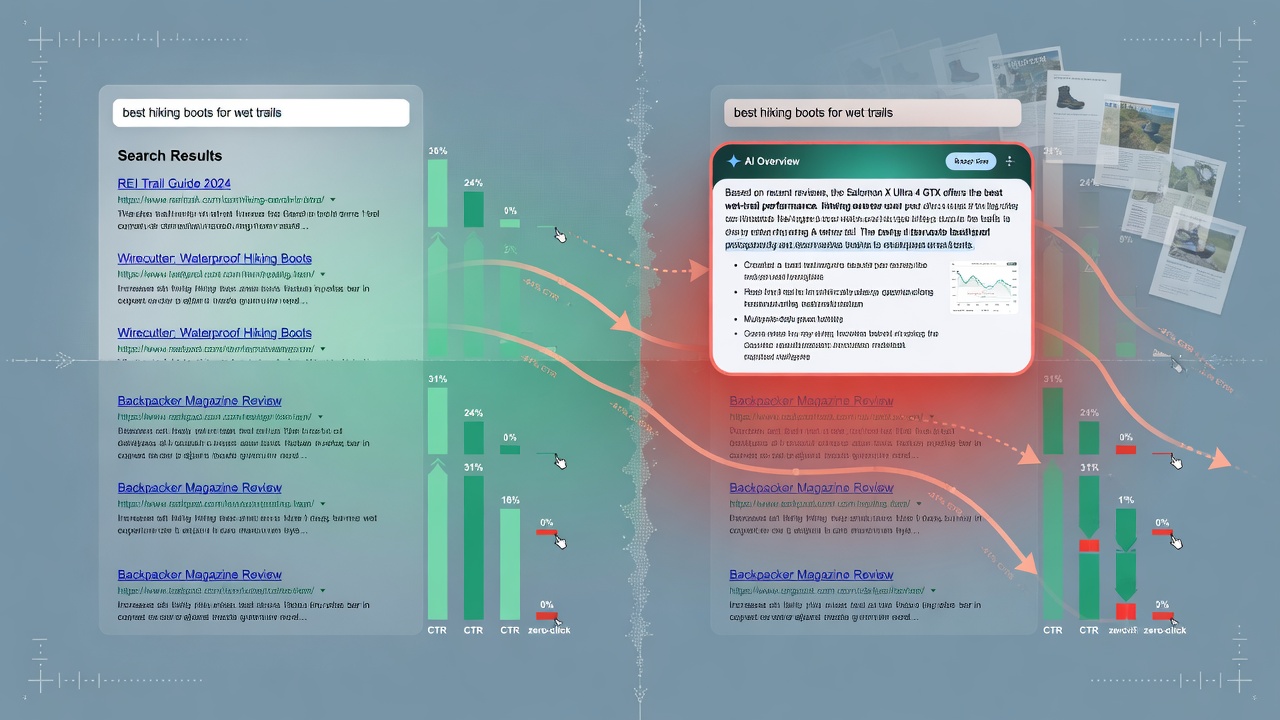
The traditional lifecycle of publishing content—where a piece of writing is researched, drafted, optimized, and then left to sit in an archive—is fundamentally broken. In a landscape dominated by generative search features, static pages are highly vulnerable. When search engines change how they present information, or when competitors update their schema, static content quickly loses its competitive edge.
The Zero-Click Reality and AI Overviews
The rise of generative search has drastically altered user behavior, making traditional organic visibility harder to sustain. When search engines answer queries directly on the results page, users have fewer reasons to click through to external websites.
This shift means that even a top-ranking page can experience a dramatic drop in traffic. Without continuous monitoring and rapid adjustments to target specific generative search fragments, publishers cannot maintain their organic search footprint.
The Decay of Static Evergreen Content
Beyond layout changes, the content itself begins to decay the moment it is published. AI-generated evergreen content is particularly susceptible to rapid obsolescence if it is not actively maintained. This decay happens across several critical vectors:
- Entity Relationships: Search engines constantly update their knowledge graphs. If your content fails to reference newly established entities or shifting industry terminology, its relevance score drops.
- Schema and Structured Data: Search markup requirements evolve. Missing out on new schema properties prevents search crawlers from accurately parsing your page context.
- Internal Link Desynchronization: As new pages are added and old ones are archived, static content quickly becomes isolated, diluting your site's internal PageRank distribution.
- User Intent Shifts: The search intent behind a target keyword can shift overnight, rendering previously optimized content misaligned with what searchers actually want.
Publish-and-forget pipelines create massive, fragile content portfolios. Over time, these unmanaged pages turn into thin, outdated clusters that invite site-wide quality penalties from search engines. Continuous SEO agents solve this by treating post-publish life as the primary optimization surface. Rather than viewing optimization as a periodic cleanup task, agents run continuous feedback loops to keep every page aligned with real-time search engine requirements.
Continuous optimization is mandatory — Static publishing pipelines cannot survive in an era where AI Overviews reduce position-one CTR by 58% and 58.5% of searches end without a click. Deploying continuous agents is the only way to defend visibility against automated decay.Beyond Static Automation: Defining Agentic SEO and the Self-Optimizing Pipeline
To understand how this shift occurs, we must define the technology driving it. An AI agent for SEO is software that autonomously executes multi-step SEO work without continuous human prompting; its defining property is goal-orientation. Unlike standard AI tools that require a human to input a prompt, copy the output, and paste it into a content management system, an agentic system is designed to achieve an outcome—such as maintaining a top-three ranking for a high-value search cluster—and will autonomously plan, execute, and adjust its tactics until that goal is met.
This distinction is critical when discussing agentic SEO, which is the use of proactive AI agents to continuously optimize digital content for discoverability across traditional search engine results pages (SERPs) and AI-driven platforms like generative engines. It is not a collection of disconnected software tools or a simple programmatic template. Instead, it is a closed-loop system integrated directly with your publishing calendar, technical infrastructure, and quality gates.
How SEO Agents Go Beyond Content Creation
While early generative AI adoption focused almost entirely on drafting initial articles, agentic SEO takes ownership of the entire content lifecycle. For large, AI-generated libraries, agents operate across several critical vectors:
- Real-Time Monitoring: Tracking position changes, indexing status, and search intent shifts.
- Entity and Fact Refreshing: Scanning pages to update outdated statistics, brand names, and industry facts to maintain topical authority.
- Dynamic Schema Markup: Injecting and adjusting structured data to match evolving search engine requirements.
- Internal Link Orchestration: Analyzing the entire site architecture to programmatically build and repair internal link equity.
- Automated Recovery: Detecting sudden drops in traffic and deploying targeted optimizations to reclaim lost visibility.
The Continuous Optimization Loop: How SEO Agents Execute Post-Publish Defenses
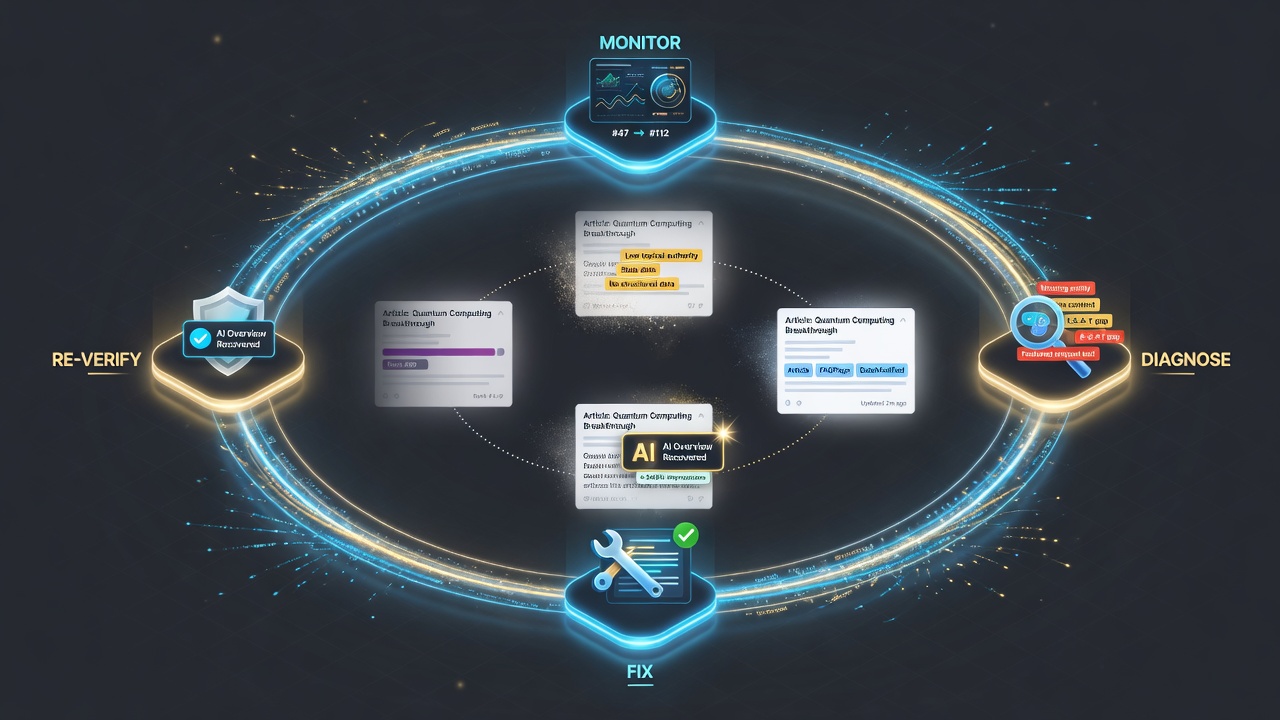
Rather than treating publication as the finish line, modern SEO agents operate in an endless post-publish cycle. Traditional workflows leave content to age and decay, but an autonomous multi-agent system treats every published asset as a living document that must adapt to real-time search engine results page (SERP) fluctuations and shifts in user intent. By establishing a continuous feedback loop, agents ensure that your content library remains optimized without requiring constant manual auditing.
This continuous loop fundamentally alters the economics of content maintenance. By taking over the tedious processes of rank tracking, gap analysis, and content refreshing, a full agentic workflow reduces article production and upkeep from 9-14 hours of manual effort down to just 30-60 minutes per asset. This represents a 90%+ reduction in production time per article, allowing human strategists to focus on direction rather than manual execution.
To maintain editorial integrity and avoid search penalties, this automated loop must operate with guardrails. Every programmatic change—whether it is an updated paragraph, a new internal link, or an altered meta description—is logged in a central audit trail. This allows human editors to easily review, approve, or instantly reverse any automated edits that do not align with brand voice or quality standards.
Continuous loop automation — Deploying autonomous loops that monitor, cluster, prioritize, and fix live content reduces production and maintenance time by over 90%, turning static archives into self-defending assets.The Rise of Specialized Multi-Agent Systems: Navigating Ranking Recovery and GEO
This absolute transparency is what makes scaling an automated optimization strategy possible. Rather than relying on a single, overburdened generalist model to handle everything from technical audits to editorial rewrites, modern architectures deploy specialized multi-agent systems. This specialization is a major industry focus: 45% of organizations identify multi-agent systems as the GenAI development they are most interested in, largely because this approach directly mirrors the division of labor found in high-performing human marketing teams.
In a mature multi-agent setup, distinct SEO agents are assigned precise, narrow objectives to ensure depth and precision across the entire digital footprint:
- The Intent & Keyword Refresh Agent: Scans for declining search queries and updates outdated sections to match current user intent.
- The Technical Specialist Agent: Constantly audits and repairs broken redirects, core web vitals issues, and indexation blockers.
- The Entity & Schema Architect: Evaluates the semantic structure of a page, injecting structured data markup and reinforcing entity relationships to help search engines parse the content.
- The Link-Building Agent: Scans the entire site index to discover contextual opportunities for internal linking, establishing strong topical authority.
- The Competitor Gap Agent: Analyzes newly ranking competitor pages to identify missing subtopics and content gaps that need to be addressed immediately.
Defending Visibility in AI Overviews and GEO
Beyond traditional search engines, specialized agents are now critical for Generative Engine Optimization (GEO). These GEO-focused agents monitor how content is cited within LLM-driven answer engines and AI summaries. When an agent detects a drop in generative citations, it automatically restructures the text—adding clear, source-backed definitions, bulleted takeaway summaries, and direct answers to complex queries—to make the content highly extractable for AI crawlers.
To prevent these specialized agents from stepping on one another's toes, strict orchestration rules are enforced. These rules act as traffic control, preventing multiple agents from making conflicting edits on the same URL simultaneously, ensuring that a schema update does not disrupt an ongoing intent rewrite.
Multi-agent specialization — Deploying dedicated, coordinated SEO agents for specific tasks like intent refreshes, internal linking, and GEO ensures deeper optimization and prevents the performance bottlenecks of single-agent systems.Human-in-the-Loop: Establishing Judgment Gates to Prevent Search Penalties
While orchestration rules keep multi-agent systems from conflicting with one another, maintaining search safety requires a different kind of traffic control: human judgment. Deploying autonomous agents does not mean handing over the keys to your entire domain without supervision. Instead, the goal is to shift human intervention away from repetitive manual labor and toward high-impact strategic guardrails.
"The agent does not need a human in the loop at every step. It needs a human in the loop at the points that actually require judgement"— AI Agents for SEO: The 2026 Guide to Agentic SEO Workflows
To keep content penalty-safe, organizations must gate high-risk actions. While an agent can autonomously update schema markup or fix broken internal links, any action that fundamentally alters the user experience or search compliance must pass through a human editor. These high-risk gates include:
- Mass Rewrites: Algorithmic overhauls of entire content hubs that could trigger spam or quality-fallback flags.
- YMYL Claims: Any medical, financial, or legal advice that requires strict subject-matter expert verification.
- New Money Pages: High-intent commercial landing pages where brand voice and conversion design are critical.
- Large Internal-Link Graph Changes: Structural changes that radically redistribute PageRank across the domain.
Furthermore, building these systems requires a deep understanding of the underlying mechanics. To build a good AI agent, you must first be an expert in the SEO task you’re teaching it. If you do not master the manual execution of keyword clustering, entity injection, or search intent analysis, you risk encoding bad habits and scaling flawed processes at an unprecedented rate.
To prevent these human gates from becoming operational bottlenecks, teams must establish clear approval Service Level Agreements (SLAs). For example, setting a 24-hour window for human editors to review and approve agent-proposed intent updates ensures that continuous optimization stays fast and responsive without devolving into unsupervised spam.
Judgment Gates — Keep autonomous SEO agents safe by restricting high-risk actions like YMYL claims and mass rewrites to human-in-the-loop approval, ensuring scale never compromises brand safety.Closing the Loop: Syncing SEO Agents with CMS and Reader Chat
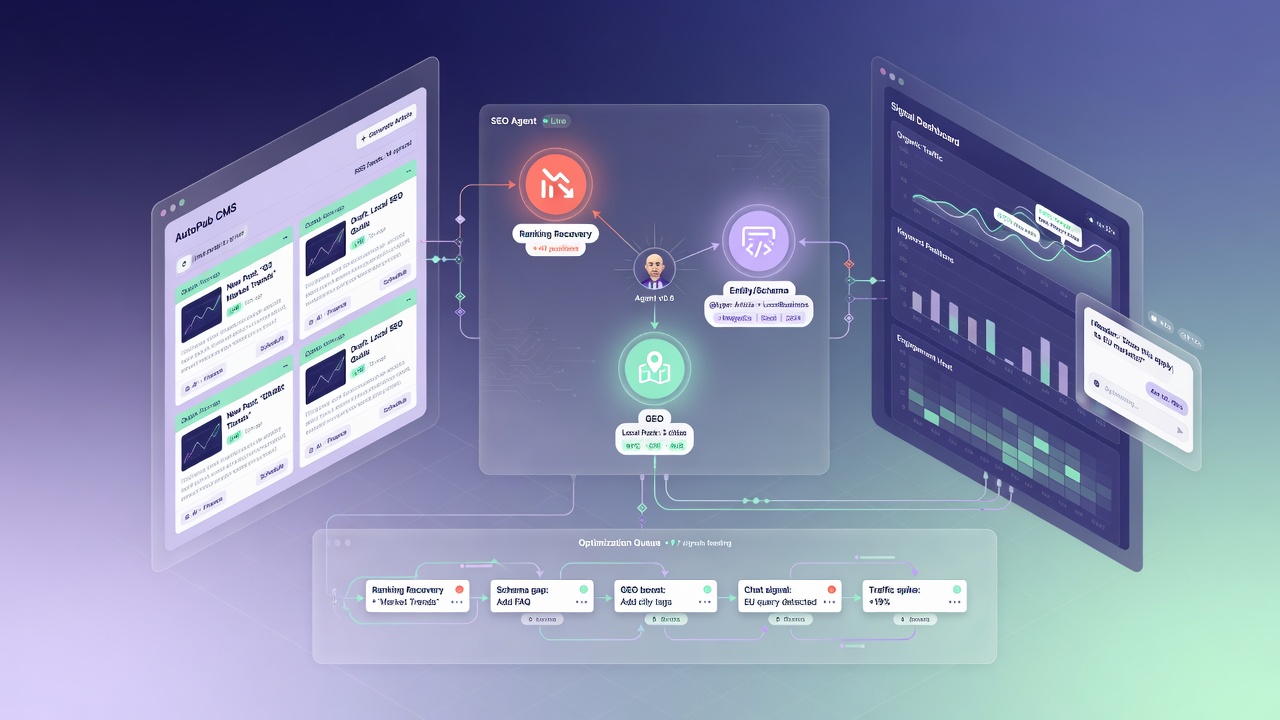
While 90.3% of marketing organizations already use AI agents somewhere in their stack, and the overall adoption of AI among marketers has grown to 91%, very few companies actually close the loop. They use agents to generate drafts or run keyword research, but they leave those assets isolated once they hit the CMS. To unlock the real power of agentic SEO, publishing platforms must be directly wired to your monitoring agents, turning a static blog into a self-defending content ecosystem.
When a new article is published, the CMS should automatically ping the SEO agent, placing the live URL directly into a continuous monitoring queue. Instead of waiting for a manual audit three months later, the agent begins tracking rankings, indexing status, and search intent shifts immediately. When performance dips or search intent evolves, the agent triggers updates without human prompting.
This integration should also extend to the front-facing reader experience. Integrating an interactive AI chat widget directly into your articles does more than answer reader questions; it acts as an active engagement and data-harvesting tool. The chat assistant surfaces related internal content to keep users on-site longer, boosting critical dwell-time signals.
More importantly, every question asked by a reader in that chat is a direct, unfiltered signal of search intent. By treating these chat transcripts as proprietary data feeds, SEO agents can analyze real-time user queries to identify content gaps. If readers repeatedly ask the chat assistant for clarification on a specific nuance, the agent automatically flags that gap and proposes an update to the core article, keeping your content permanently optimized.
Connected Pipelines — True agentic SEO requires connecting your publishing platform and reader-facing AI chat directly to your optimization agents, converting real-time user interactions into automated content updates.Measuring the Impact: The Real ROI of Continuous Agentic SEO
Transitioning from a static content library to an autonomous, agentic system is more than a technological upgrade—it fundamentally reshapes your marketing unit's bottom line. While standard AI-powered workflows cut low-value work time by 25-40%, deploying fully autonomous multi-agent loops pushes these savings even further. By shifting the burden of continuous monitoring, schema injection, and ranking recovery to specialized SEO agents, organizations slash per-article production and upkeep times by over 90%. This structural shift allows human teams to transition from manual execution to high-level system supervision.
The financial divide between early adopters and laggards is widening rapidly. Organizations leading in agentic AI achieve five times the revenue gains of their slower competitors. In fact, research indicates that 40% of marketers have seen a 6-10% increase in revenue after implementing AI in their SEO efforts, while future-built companies achieve five times the revenue increases and three times the cost reductions that other companies get from AI. These asymmetric gains are captured by companies that treat search visibility as a dynamic, living asset defended by continuous software agents.
Modern Performance Indicators for Agentic Systems
Measuring the success of an agentic SEO framework requires moving past simple keyword tracking. To evaluate the true health and efficiency of your autonomous pipeline, focus on these four critical metrics:
- Mean Time to Recovery (MTTR): How quickly your agents detect a drop in rankings or a search engine layout change, apply a content refresh or schema update, and restore lost visibility.
- AI Overview (AIO) Share of Voice: The percentage of target search terms where your content is successfully cited inside generative search summaries and answer engines.
- Assisted Conversion Velocity: The rate at which reader-facing chat interfaces guide users from search landing pages to completed product actions or qualified leads.
- Human-in-the-Loop Review Load: The ratio of automated edits approved without modification versus those flagged for manual rewriting, indicating the growing accuracy of your agentic guardrails.
Ultimately, the greatest return on investment comes from what you do with the time saved. By offloading keyword clustering, technical fixes, and decay prevention to autonomous agents, marketing leaders can reinvest their human capital into high-value creative strategy, original primary research, and building the deeply authoritative, real-world E-E-A-T assets that AI agents cannot invent.
Agentic ROI — Deploying autonomous SEO loops moves search marketing from a cost center to a high-yield asset, driving up to five times the revenue gains of laggards while cutting operational maintenance costs and manual labor by over 90%.Key Takeaways
Transform your search strategy from static publishing to autonomous growth by integrating Flows AI SEO automation and interactive reader chat into your content pipeline today.
Frequently Asked Questions
Agentic SEO is the use of proactive AI agents to continuously optimize digital content for discoverability across traditional search engines and AI-driven platforms. Unlike static tools, these agents autonomously monitor search visibility and execute multi-step optimizations without continuous human prompting.
By automating complex, repetitive tasks like keyword clustering, technical auditing, and content updates, AI-powered workflows cut low-value work time by 25-40%. This allows human marketers to focus on high-level strategy and creative direction.
No. An effective AI agent does not need a human in the loop at every single step, but it absolutely requires human intervention at points that demand editorial judgment, brand voice alignment, and deep subject-matter expertise.
Organizations leading in agentic AI adoption achieve five times the revenue gains and three times the cost reductions of laggards. This is driven by their ability to scale content optimization and maintain top search rankings continuously.