AI Automation
How SEO Agents Automate Content Creation and Ranking

For years, search engine optimization meant jumping between fragmented tools: one for keyword research, another for writing, and yet another for publishing. Today, that disjointed workflow is obsolete. The rise of autonomous SEO agents has shifted the industry from simple AI writing assistants to fully integrated systems that manage the entire content lifecycle without human handoffs.
According to research from AI Agents for SEO: The Complete Guide to Agentic Content Automation (2026), modern SEO agents autonomously research, optimize, publish, and recover rankings, covering all 6/6 pipeline stages. Rather than just spitting out generic text, these agents execute complex, multi-step workflows. This level of automation is highly efficient; implementing these systems can save marketing teams over 50 hours a week by handling everything from strategy to CMS publishing, as noted in the 7 Best AI Agents for SEO Optimization in 2026 report.
But the real breakthrough lies in what happens after publication. By embedding real-time AI chat directly inside articles, brands can now help readers navigate complex topics, answer follow-up questions, and drive conversions instantly. To understand how this technology transforms search visibility, we must first look at how these autonomous agents function under the hood.
- SEO agents autonomously manage the entire search pipeline, from initial keyword research to live publishing and ranking recovery.
- By executing multi-stage workflows, these agents save marketing teams over 50 hours per week compared to traditional, manual processes.
- Unlike basic AI writers, advanced SEO agents connect directly to your CMS and monitor search engine results pages 24/7.
- Integrating interactive AI chat within published articles enhances reader engagement and opens new monetization opportunities.
The End-to-End Revolution: Why Traditional SEO Tools Fall Short
To understand this "under the hood" transformation, we have to look at how traditional, fragmented SEO tools compare to fully integrated agents. Historically, marketers have relied on a disjointed stack of single-purpose software. You would use one tool for keyword research, another to generate briefs, a third to draft the copy, and yet another to optimize it before manually uploading everything to your CMS. This disconnected approach creates massive bottlenecks and leaves critical gaps in the content lifecycle.
Modern AI SEO agents break down these silos by chaining multi-stage workflows into a single, cohesive engine. Instead of requiring human handoffs at every step, agentic SEO platforms run the entire cycle autonomously—from initial data gathering to live optimization.
The Pipeline Coverage Gap
Traditional platforms, while helpful, only assist with isolated parts of the process. Most tools cover only 2 or 3 out of 6 pipeline stages. This leaves the user to manually handle the rest of the workflow, such as publishing, real-time monitoring, and interactive reader engagement. In contrast, advanced agents like Frase cover all 6 out of 6 stages of the SEO content pipeline.
By integrating directly with your CMS and embedding interactive features like real-time AI chat within the published articles, these agents do more than just write. They actively manage the content's performance, update outdated information, and guide readers through the conversion funnel without human intervention.
Autonomous integration — Transitioning from fragmented, 3-stage SEO tools to 6-stage autonomous agents eliminates manual bottlenecks by linking research directly to CMS publishing and on-page interactive chat.
From Keywords to Live URLs: Inside the Zero-Touch SEO Pipeline
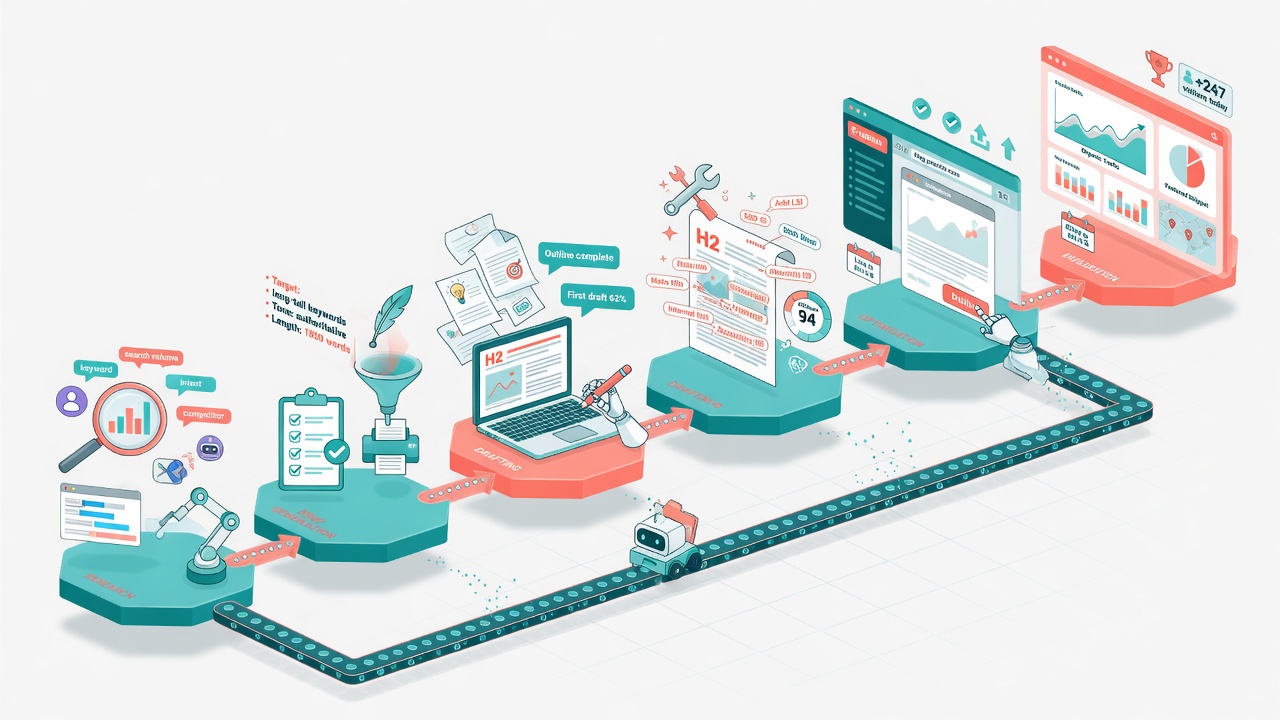
This hands-off management is made possible by chaining what used to be isolated tasks into a single, continuous loop. In traditional setups, a content team moves a piece of content through a series of manual handoffs: a strategist pulls keywords, a writer drafts the copy, an editor optimizes it using a third-party tool, and a webmaster manually uploads it to the CMS. Each handoff introduces friction, delays, and room for human error.
Modern ai seo agents eliminate these bottlenecks by automating the entire lifecycle. Instead of acting as isolated assistants that require constant prompting, these agents execute multi-stage workflows autonomously. This means they can handle all 6 out of 6 pipeline stages—from initial research and optimization to direct publishing and ongoing ranking recovery—without requiring a human to copy-paste data between different software platforms.
How the Zero-Touch SEO Pipeline Works
- Autonomous Research and Briefing: The agent scans search engine results pages (SERPs) in real-time to identify search intent, analyze competitor structures, and extract semantic keywords, bypassing hours of manual analysis.
- Context-Aware Drafting and Optimization: Using the generated brief, the agent writes high-quality, SEO-optimized copy, continuously scoring the draft against live competitor data.
- Direct CMS Integration: Once optimized, the agent formats the content—complete with headers, lists, and metadata—and pushes it directly to your CMS as a live post or a polished draft.
- Continuous Monitoring and Recovery: The agent monitors SERP movements 24/7. If a competitor updates their page or search trends shift, it executes updates to recover lost rankings autonomously.
By handling these high-volume, sequential, and data-dependent tasks, agentic SEO platforms allow marketing teams to scale their production without scaling their headcount. However, publishing the content is only half the battle; keeping readers engaged once they land on the page requires a new kind of interactive experience.
Zero-touch execution — True SEO agents eliminate manual handoffs by chaining all six pipeline stages together, allowing content to flow autonomously from initial keyword research directly to CMS publishing and ongoing SERP optimization.Turning Passive Readers into Active Participants: The Power of On-Page AI Chat
Once a newly optimized article goes live, the traditional content journey ends and the waiting game begins. But in the era of agentic SEO, publishing is just the starting line. By embedding real-time AI chat assistants directly into published articles, platforms like Flows transform static text into dynamic, two-way conversations. Instead of scrolling passively and leaving when they cannot find a specific detail, readers can ask questions directly to the page itself.
"The future of search optimization isn't just about getting the click; it's about what happens after the click. Keeping a user deeply engaged on your page is the ultimate signal to search engines that your content solved their problem."
— SEO Strategy Lead, Flows
How Engagement Signals Drive Search Rankings
This interactive layer does more than just delight readers—it directly feeds the metrics that search engines use to measure content quality. When visitors interact with an on-page AI chat, their dwell time naturally increases, and bounce rates plummet. Search engine algorithms interpret these extended, active sessions as a strong signal of high-quality, relevant content, which helps sustain and boost the article's organic rankings over time.
- Extended Dwell Time: Readers spend minutes conversing with the chat rather than seconds skimming the page.
- Reduced Bounce Rates: Direct navigation assistance keeps users exploring other areas of your site instead of bouncing back to the search results.
- Contextual Relevance: The AI resolves complex queries instantly, ensuring the user gets value without needing to search elsewhere.
By closing the loop between publishing and active reader engagement, autonomous SEO agents ensure that your content doesn't just rank—it performs. This continuous interaction also sets the stage for a natural transition from helpful conversation to direct revenue generation.
Interactive engagement wins — Embedding real-time AI chat inside automated articles keeps readers on-site longer, turning passive traffic into active engagement that signals high quality to search engine algorithms.
Beyond Pageviews: How AI SEO Agents Monetize the Reader Journey in Real Time
This transition is where traditional, non-automated SEO strategies usually fracture. In a manual setup, monetization remains passive and static: a reader lands on a page, skims past generic affiliate banners or outdated links, and exits. If you want to pitch a specific product or capture a lead, you have to manually build landing pages, set up complex pop-up triggers, or simply hope the reader clicks a call-to-action that may or may not align with their immediate search query.
Aligning Intent with Action in Real Time
AI SEO agents change this dynamic entirely by turning static articles into active sales funnels. Because an autonomous agent manages both the publishing of the content and the live, on-page AI chat widget, it can dynamically align monetization features with the reader's real-time intent. For instance, if a reader engaging with an automated article asks the embedded chat assistant how to solve a specific problem, the assistant doesn't just answer—it can instantly recommend your product, offer a customized discount, or book a demo directly within the chat interface.
- Contextual Product Matching: The agent analyzes user chat queries to recommend the exact product tier or tool they need at that moment.
- Frictionless Lead Capture: Instead of forcing readers to navigate to a separate contact page, the agent collects emails and schedules meetings mid-conversation.
- Dynamic Offers: The system serves personalized incentives based on how deeply a user interacts with the page content.
By automating both the attraction and monetization of search traffic, these agents do more than just free up your marketing budget—they fundamentally redefine how lean teams scale their operations.
Intent-driven monetization — AI SEO agents turn passive readers into active customers by using real-time chat interactions to pitch relevant products, capture leads, and trigger personalized offers exactly when intent is highest.
Reclaiming the Calendar: Exactly How Much Time Do SEO Agents Save?

This scale isn't just a theoretical advantage; it translates directly to hundreds of hours returned to marketing calendars. When lean teams no longer have to manually coordinate every step of the search pipeline—from keyword discovery to publishing—their operational capacity multiplies. By automating the mechanical steps of SEO, organizations can run sophisticated, high-velocity campaigns that would otherwise require an entire agency.
These savings are particularly evident in the initial stages of content planning, which are traditionally notorious for slowing down execution. For instance, an SEO Content Brief Agent alone saves 10+ hours per week simply by scraping SERPs and identifying critical content gaps [e2]. When you scale this level of autonomy across the entire publishing pipeline, the organizational impact is even more dramatic. Comprehensive platforms like NoimosAI save marketing teams over 50 hours a week by managing everything from initial research to direct CMS publishing [e3]. This means campaigns launch in days rather than months.
Where Agents Excel: High-Volume, Data-Dependent Tasks
To achieve these efficiency gains, organizations must deploy agents where they perform best. Specifically, SEO agents are most useful for work that is high-volume, sequential, and data-dependent [e5]. Instead of replacing the human touch, they excel at removing the repetitive, analytical heavy lifting that usually bogs down marketing departments.
- Continuous Site Audits: Constantly crawling pages to flag broken links, indexing issues, and schema drift.
- Automated Content Updates: Refreshing outdated statistics, updating product links, and adjusting copy to maintain search relevancy.
- Keyword Gap Analysis: Scraping competitive SERPs to find immediate keyword opportunities.
As these hours accumulate and workflows streamline, the ultimate question shifts from how we build content to how we lead our industries in an AI-driven search landscape.
Operational leverage — SEO agents shift teams from manual execution to strategic oversight by automating sequential, data-dependent tasks, reclaiming over 50 hours a week for core business growth.
Key Takeaways
Start scaling your organic traffic and on-page conversions effortlessly by letting Flows handle your entire SEO pipeline from research to interactive reader chat.
Common questions
An SEO agent is an autonomous AI system that chains complex search marketing workflows together. According to AI Agents for SEO: The Complete Guide to Agentic Content Automation (2026), these agents autonomously research, optimize, publish, and recover rankings across all 6/6 pipeline stages.
An SEO Content Brief Agent alone saves 10+ hours a week by scraping SERPs and identifying content gaps, according to the 2026 Marketer's Guide to AI Agents for Marketing Operations. For full marketing teams, end-to-end automation can save over 50 hours a week, as reported in the 7 Best AI Agents for SEO Optimization in 2026.
While standard tools only generate text based on prompts, advanced agents like Frase cover all 6/6 pipeline stages, whereas most traditional tools only cover 2 or 3 stages, according to Best AI SEO Agents in 2026 (Ranked by What They Cover).
SEO agents are most effective when applied to work that is high-volume, sequential, and highly data-dependent, such as technical site audits, bulk keyword mapping, and automatic content updates, as detailed in AI Agents for SEO: What They Are, How They Work, and Examples.