SEO Strategies
Measuring ROI from SEO Agents

You’ve implemented AI SEO agents to automate research, content creation, and optimization. But are they actually driving business results—or just burning budget? Without a clear ROI measurement, you’re navigating in the dark, unable to scale wins or cut losses.
Measuring the return from SEO agents isn’t just about a single number; it’s about understanding which parts of your AI-driven SEO machine are generating real value. In this article, we’ll give you a practical, no-fluff framework to calculate that ROI. We’ll cover the essential formula, the costs that often get overlooked, the metrics that matter, and realistic timelines you can actually plan around.
Whether you’re using dedicated SEO agent platforms or stitching together AI tools, you’ll walk away knowing exactly what to track, how to attribute results, and what a healthy return looks like. Ready to turn guesswork into measurable growth? Let’s start with the formula that forms the backbone of your ROI analysis.
TL;DR
- SEO ROI = (Revenue from SEO – Cost of SEO) / Cost of SEO
- Track organic traffic, conversions, and revenue from AI-generated content
- Common costs: tool subscriptions, setup, content, monitoring
- Realistic ROI timelines: 6-12 months initial, 300-500%+ at 18-24 months
- Use attribution tools like Google Analytics to connect AI efforts to revenue
The Core Equation Behind Every SEO Agent Investment
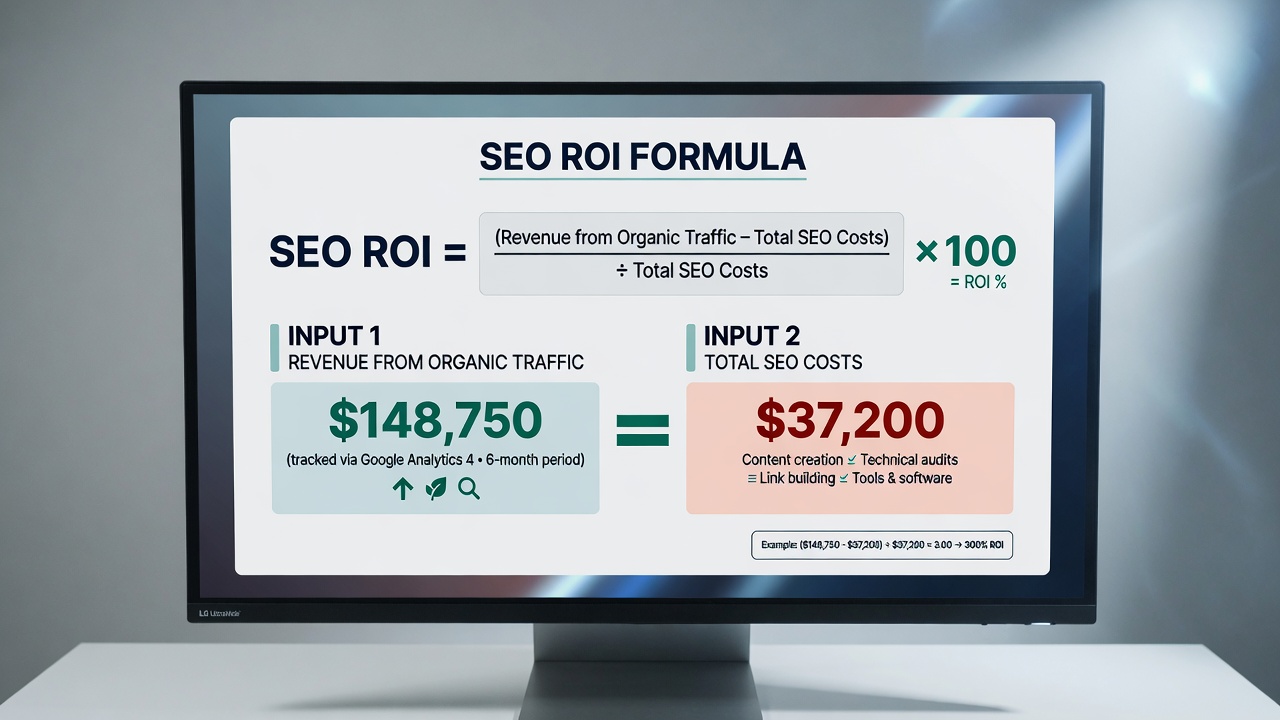
At its heart, measuring the return from an SEO agent distills to a single, elegant equation: (Revenue from SEO – Cost of SEO) / Cost of SEO. Multiply by 100, and you have a percentage; leave it as is for a ratio. It’s the same foundational formula you’d use for any marketing channel, but with SEO, the revenue attribution demands a sharper lens.
Revenue here means the incremental organic revenue directly traced to the agent’s work—whether that’s repurposed content that climbs rankings faster, or audits that fix critical technical gaps. Costs, on the other hand, encompass the full picture: the agent subscription fee, the time your team spends on setup and training, and any ancillary tools or content production expenses it pulls from your budget.
For instance, if your AI-powered SEO efforts generated $50,000 in additional revenue last quarter, and total costs were $10,000, your ROI sits at 400%—a 4:1 return. That clarity replaces hunches with hard numbers, giving you the confidence to scale what’s working.
Of course, nailing those cost inputs is where things get interesting—especially with SEO agents, which blur the line between tool and team. In the next section, we’ll break down the unique cost categories you need to track to make this formula work.
Formula First — The SEO ROI calculation ((Revenue – Cost) / Cost) turns nebulous organic gains into a concrete percentage or multiple, provided you accurately attribute revenue and capture all-in agent costs.
The Real Cost Drivers Behind an AI-First SEO Workflow
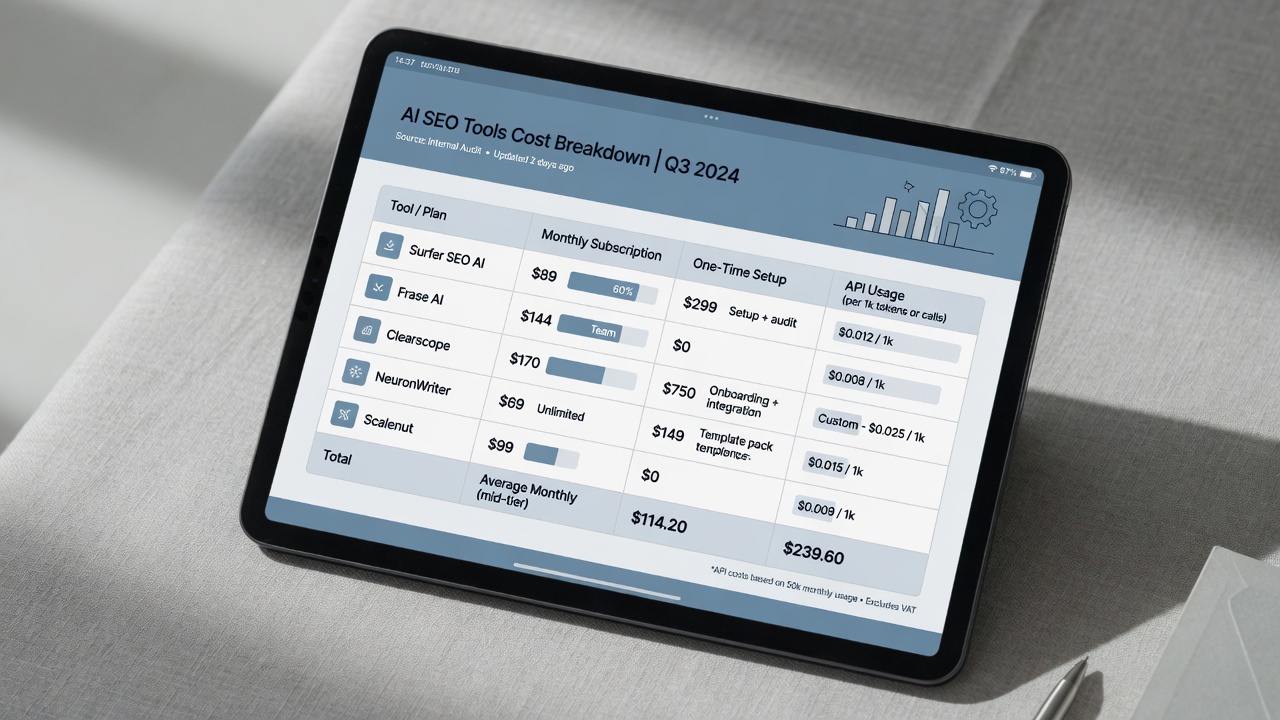
Unlike a typical agency retainer or a standalone tool subscription, an SEO agent blends several cost categories into one service. The most obvious is the subscription itself—usually a monthly or annual fee tied to usage, site size, or the number of AI generations. But that’s just the sticker price.
Hidden underneath are setup costs: training the agent on your tone of voice, target keywords, and competitive landscape. Many platforms also require a chunk of time for integration—linking with your CMS, analytics, and existing tool stack. Then there’s the ongoing human oversight. Even the sharpest AI needs a marketer to review briefs, approve content, and monitor performance. This blended model often reduces total headcount cost compared to hiring a full-time SEO specialist or paying an agency, but it shifts spend toward technology and supervision.
Now, let’s put numbers on it. A recent internal analysis by Flows shows how the cost profile compares:
For context, a traditional SEO agency often bundles strategy, content, and reporting into a single opaque retainer. You’re paying for people, not just output. An SEO agent flips that model, prioritizing automation and self-service, which can slash variable content costs without sacrificing volume—as long as you maintain the human quality gate.
Cost transparency is the foundation of ROI — knowing your exact cost line items, from subscription fees to oversight hours, turns the ROI formula from guesswork into a performance lever.
The Metrics That Actually Prove ROI from Your SEO Agent
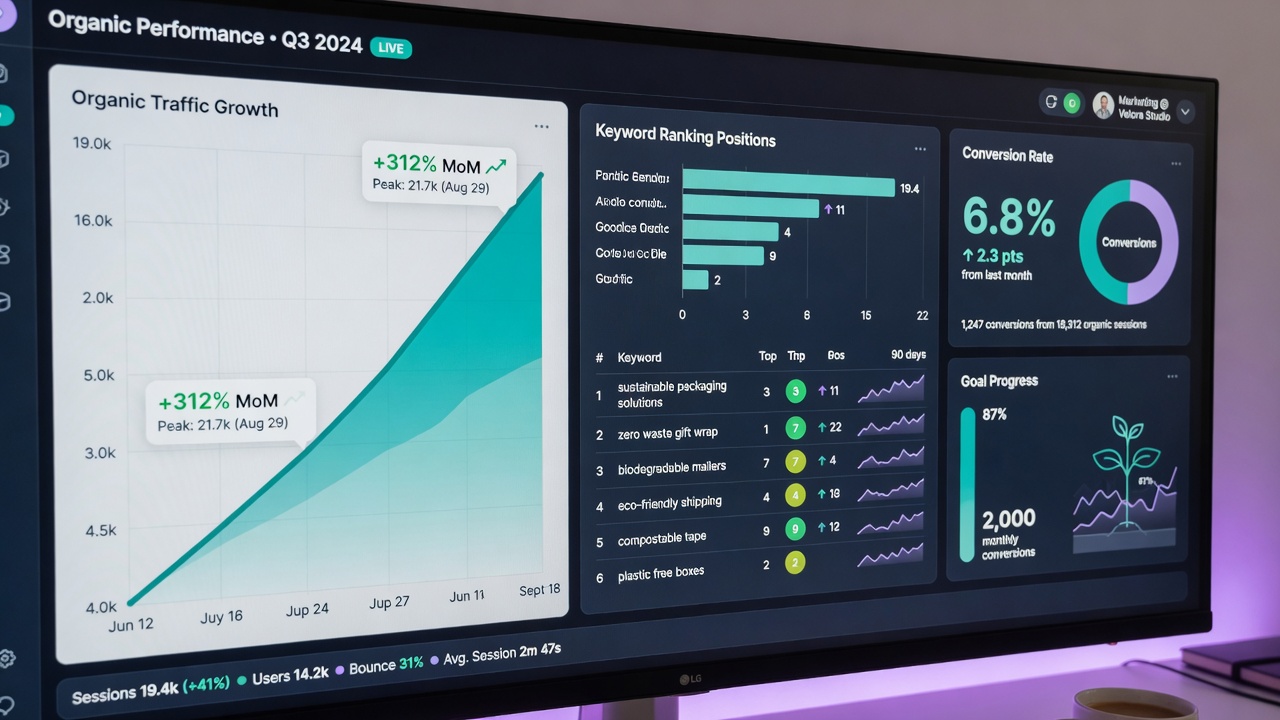
Now that you’ve trimmed the cost side of the equation, the real question becomes: which numbers truly prove your SEO agent is driving business, not just vanity spikes? The metrics that matter tie organic performance directly to revenue outcomes. Start with organic traffic growth, but don’t stop at sessions—look at the segment landing on pages your AI agent created or optimized. Next, track keyword rankings for high-intent terms that signal buying readiness; a jump from page two to the top three for “enterprise SEO audit” means more than a dozen long-tail advances nobody searches for. These early signals tell you if the agent’s output is gaining traction.
Then comes the critical layer: conversions and revenue attribution. For every AI-generated article or automated meta refresh, you need to see form fills, demo requests, or purchases attributed back to organic search. Tools like Google Analytics 4 with UTM parameters and conversion tracking let you tie an agent’s content output to real pipeline. This is where the ROI formula gets its teeth—without attribution, your revenue figure stays guesswork. Realistic timelines? Rankings can shift in 3–6 months, but meaningful ROI from AI SEO often materializes at the 12-month mark once content compounds and attribution data solidifies.
Revenue attribution is non‑negotiable — tracking organic traffic and rankings means nothing unless you link the agent’s work to conversions and sales, which is what feeds the ROI formula.
Where the Hours Vanish: Automation’s Direct Impact on ROI

While that 12-month window remains a useful benchmark, automation fundamentally alters the efficiency picture—and not just on the content side. The manual tasks that eat up agency retainers or in-house hours—keyword research, content briefing, technical audits, page-level fixes—become near-instant when an AI agent takes the wheel.
How much time? Research that used to consume a full morning surfaces in minutes. A content brief that took three hours writes itself while you approve strategy. Auditing a 10,000-page site, a weeks-long slog manually, now completes overnight with fixes queued for review. Across routine SEO work, expect a 60–90% reduction in tactical labor per task.
These efficiency gains feed directly into the ROI formula. Lower costs sharpen the ratio for any given revenue lift. And faster execution means pages go live sooner, rank sooner, and compound sooner—accelerating the revenue side as well. That’s how AI SEO agents transform a decent return into a standout one: by stripping out the repetitive, slow-moving labor that drags on performance.
Automation advantage — Tactical SEO hours drop by 60–90% with an AI agent, directly reducing costs and speeding up revenue timelines to compound ROI.From Early Signals to Standout Returns: What Timelines Actually Look Like
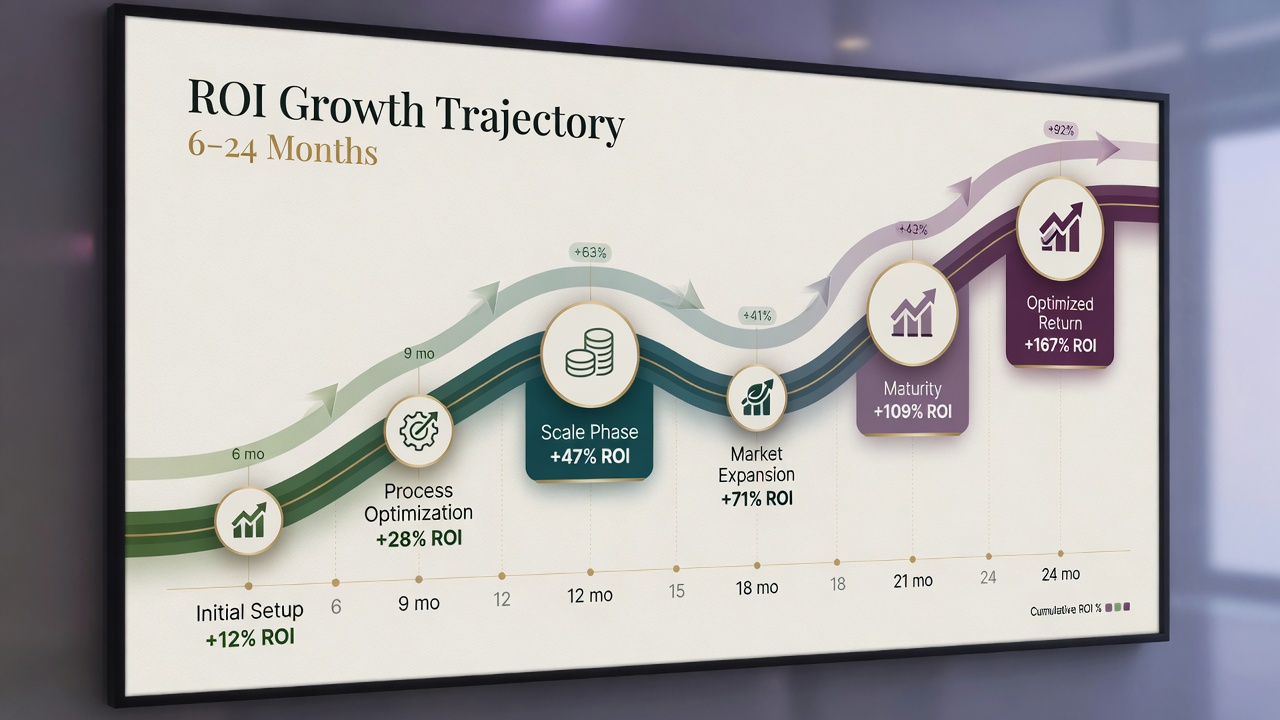
But how does that translate to your bottom line over time? The ROI timeline for an SEO agent isn’t flat—it’s a curve that starts slow and steepens as momentum builds.
In practice, most teams see initial wins—like ranking improvements for long-tail keywords or upticks in organic impressions—within the first six to twelve months. That’s when the agent’s on-page optimizations, content velocity, and technical fixes start feeding Google’s index. But the real payoff comes later. B2B companies, for instance, often report ROI figures climbing from break-even to 300%–500%+ between months 18 and 24. Why? Because SEO is a compounding channel. The pages the agent published a year ago have now built authority, earned backlinks, and started driving consistent, high-intent traffic that converts.
Case studies from businesses using AI-first SEO workflows bear this out. Some have documented 4x ROI within two years, while others point to organic traffic lifts of 150%–300% after the first 12 months—all attributed directly to the agent’s output. These aren’t outliers; they’re what happens when you combine automation speed with strategic patience.
To stay on track, you need clear attribution. Tools like Google Analytics 4 let you segment organic landing pages tied to agent-created content and follow the user journey through to revenue. Without that, you’re flying blind. But with it, you can map cost savings from earlier sections to exact revenue gains and watch your ROI ratio improve quarter by quarter.
Patience compounds returns — expect initial SEO agent results in 6–12 months, with ROI potentially reaching 300–500%+ over 18–24 months when backed by solid attribution and consistent execution.Key Takeaways
Start your ROI calculation by setting up conversion tracking in GA4 and benchmarking your current organic metrics today.
Frequently asked
SEO ROI quantifies the net profit from organic search efforts relative to the total cost, expressed as a percentage or ratio. It matters because it helps marketers justify budgets and optimize strategies based on what truly drives revenue.
Calculate it by subtracting all AI SEO agent costs (subscriptions, setup, content) from the revenue directly attributed to those agents, then divide by the costs. The formula is (Revenue – Cost) / Cost × 100, applied over a defined period.
Include tool subscription fees, initial setup and training time, content generation costs, and ongoing monitoring or optimization expenses. Don’t overlook the human oversight time required to manage the agents.
Most businesses see initial signals within 6–12 months, but a strong positive ROI (300–500%+) typically materializes in 18–24 months as organic traffic compounds and conversions ramp up.
Yes, basic ROI can be calculated using Google Analytics and spreadsheet models to tag AI-generated pages and track conversions. For deeper attribution, consider tools like Google Search Console and UTM parameters.
Focus on organic traffic growth, keyword ranking improvements, conversion rates from AI-optimized pages, and the attributed revenue. These metrics directly feed into your ROI calculation.