What Is Autoblogging? How Automated SEO Publishing Actually Works

People searching for autoblogging usually want a clean definition: is it a writing tool, a spam tactic, or a legitimate way to scale SEO pages? The useful answer is none of those slogans. Autoblogging is an index-facing publishing model—a pipeline that takes demand (queries, entities, clusters), produces pages a crawler can fetch, and tries to earn a place in search results over time.
That distinction matters because most stacks now include an AI writer, a CMS, and a sitemap, then still stall. Search engines do not rank a generation job; they rank a URL with a title, internal links, freshness signals, and enough uniqueness to survive duplicate and thin-content filters. If the pipeline stops at draft text, you have content production, not automated SEO publishing.
This article stays evergreen on purpose: the tooling will change, the crawl–index–rank loop will not. You will see how a real pipeline is supposed to work, where it typically breaks (clustering, uniqueness, canonicals, crawl budget, and measurement), and how to judge whether a system is actually publishing for the index or just filling a blog.
- Autoblogging is a publishing system aimed at crawlable URLs, not a synonym for an AI writer.
- The pipeline only works if demand mapping, uniqueness, internal linking, and indexation are treated as first-class steps.
- Most failures happen after generation: thin duplicates, weak canonicals, and pages that never get discovered.
- Judge a stack by whether new URLs are fetched, indexed, and useful—not by how many drafts it can emit.
- Evergreen practice is the same loop: map intent, publish a distinct page, help crawlers find it, measure the index.
Autoblogging Is a Publishing Model, Not a Writing Feature
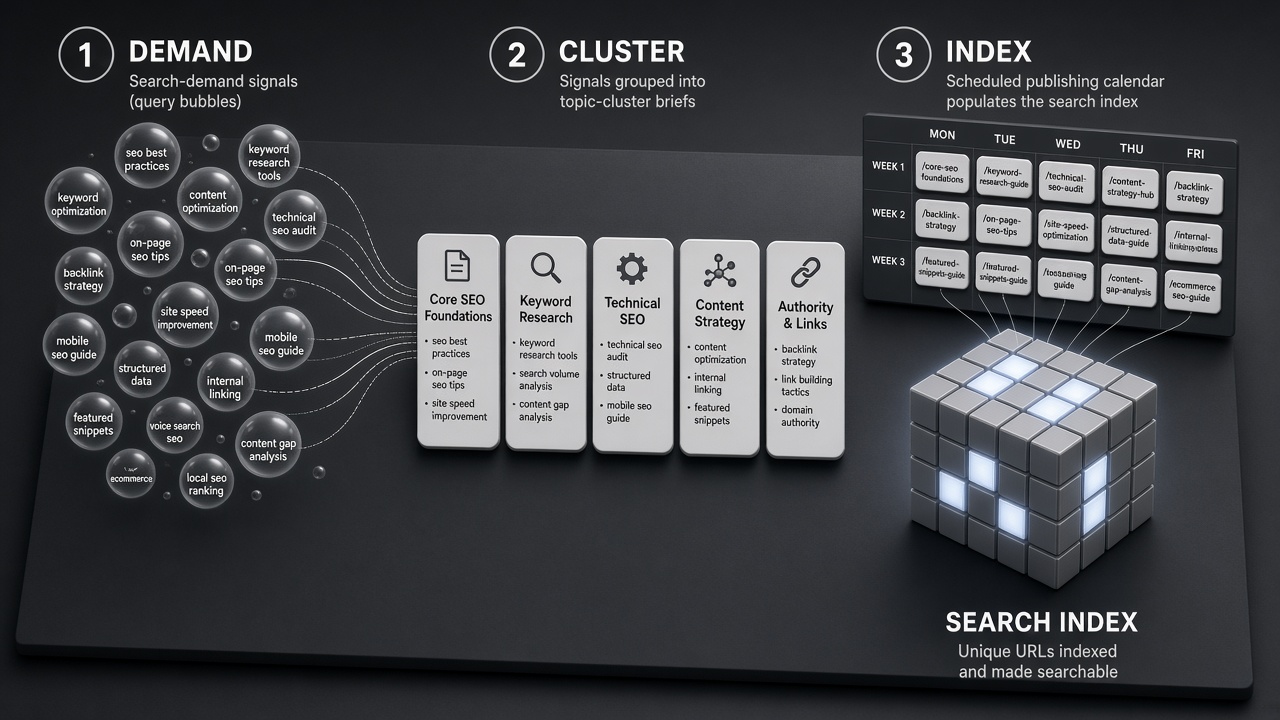
Most people hear “autoblogging” and picture a box that writes posts. Writing is only one move in a longer chain. Autoblogging is a production model: it maps a demand cluster, turns it into a brief, generates a unique page, then ships a crawlable URL on a cadence—with metadata, internal links, sitemap signals, and a publish schedule that search engines can actually discover. Treat generation as the product and you get a pile of drafts. Treat the URL as the product and you have a publishing system.
Three jobs get collapsed into one word, which is why the market feels noisy. Research and briefing decide what the page is for: which queries, which entities, which angle that is not already covered on the same domain. Generation turns that brief into prose and structure. Publish-to-index operations do the unglamorous work that makes the page exist for crawlers—canonical tags, titles, schema where it helps, internal linking, scheduling, and sitemap or crawl submission. Skip any one of those and you do not have autoblogging; you have a half-finished workflow wearing a marketing name.
Why a writer or an auto-poster is not the same system
A tool that only outputs drafts is an assistant, not autoblogging. The sentences may be fluent, but nothing has been committed to a URL, nothing is unique against your existing inventory, and nothing is queued for discovery. A plugin that only auto-posts is not SEO publishing either. It can dump content onto a live path without a demand map, without uniqueness checks, and without the indexation hygiene that keeps thin or duplicate URLs from competing with pages you already rank. One side never ships; the other ships without knowing why the page should exist.
The useful question is therefore not how the sentences get written. It is what happens between a mapped demand cluster and a live, attributable URL: who owns the brief, how uniqueness is enforced, how the page is assembled for crawlers, and whether publishing is a system or a one-off paste. That is the model. Generation is a step inside it, not the definition of it.
The real unit of work — Autoblogging is the full path from demand cluster to indexed URL. Draft tools and auto-posters each cover only one job, which is why they fail as a publishing model on their own.
From RSS scrapers to AI pipelines: two eras, two different risks
What people still call autoblogging is not one practice that got smarter. It is two eras sharing a nickname, and treating them as the same product is how operators inherit yesterday’s spam fingerprints while taking on a new kind of site-wide risk.
The old failure mode was mechanical: duplicate clusters, spun phrasing, scraped headlines, and networks that looked like one operator wearing many domains. Search systems learned those patterns. The new failure mode is quieter. Pages can read cleanly in isolation and still be unoriginal at scale—thin restatements of the same cluster, shallow coverage of adjacent intents, and a site that trains crawlers to expect filler rather than attributable answers. Reputation damage is no longer a handful of spammy posts; it is the whole indexable surface looking interchangeable.
Leftover vocabulary hides that shift. “Autoblog,” “auto poster,” and plugin-era labels still imply a feed that republishes someone else’s item. Today’s economics are inverted: generation is cheap, review is expensive, and the spam surface is uniqueness and indexation, not just stolen RSS. If you still shop for a writer that posts itself, you will miss that the product is a publishing system—and that treating generation as the product is exactly how the second era fails.
Same label, new failure — The word stayed; the risk did not. Early autoblogs failed as duplicate and spun footprints. Modern pipelines fail as unreviewed volume that looks original page-by-page and thin across the site.
The SEO layer most autoblogs never actually build
That shift in risk is exactly why the next layer matters more than the generator. Automated SEO publishing only works when search demand is clustered into entities and jobs-to-be-done—not dumped as a flat keyword list where each phrase becomes another near-duplicate URL. A cluster is a map: one hub that owns the entity, supporting pages that answer distinct intents (compare, setup, troubleshooting, alternatives), and language that does not collide. A spreadsheet of head terms with no entity model just mints siblings that compete with each other and with the rest of the site.
The unglamorous work sits underneath that map. Canonicals have to be decided before generation, not patched after duplicates ship. Slugs must stay stable so a rewrite does not orphan equity. Pagination, if it exists, needs a crawlable pattern rather than infinite parameter soup. Sitemaps should list what you actually want indexed, not every draft the pipeline ever emitted. Crawl paths from hubs to leaves—and internal links that express the topic graph, not a random “related posts” widget—are what tell a crawler this is a system, not a pile. Without that graph, each new URL is an island.
Update the hub before you mint another URL
Cadence is not the same as volume. When the demand cluster already has a live page, the right move is often update-in-place: expand the hub, refresh examples, tighten the entity coverage, and keep the same address. Endless new posts on overlapping queries fragment authority, split internal links, and train crawlers to treat the site as a content mill. Republishing and deepening a canonical hub beats minting another URL whenever the job-to-be-done has not changed—only the depth of the answer has. New URLs belong to new entities or genuinely new jobs, not to synonym drift.
That discipline is what separates automated SEO publishing from generic auto-posting. Generation is easy to demo: paste a prompt, watch a page appear. Discovery clustering, uniqueness against the existing graph, slug and canonical policy, sitemap hygiene, and index-facing internal links are what actually turn mapped demand into crawlable, attributable URLs. Vendors lead with the writer because it looks like the product; they show this layer last because it is the system.
The real product — Automated publishing succeeds when demand is clustered into a topic graph with stable URLs, canonicals, and update-in-place hubs—not when every keyword becomes a new post.
Why search treats unhelpful scale as a site problem

That graph of hubs, stable slugs, and internal links is what crawlers actually meet. Generation quality still matters, but indexers do not grade a mill one URL at a time and then forget the rest of the domain. When a large share of what you ship is unhelpful, overlapping, or interchangeable with every other page on the same cluster, the pattern becomes a property of the site: discovery slows, trust in the host drops, and stronger URLs in the same property get treated as part of the same factory.
The practical translation is blunt. Volume is not a ranking tactic; it is a reputation surface. A handful of thin pages can be ignored. A cadence that floods the index with pages nobody would bookmark, cite, or return to trains the system to spend less attention on everything you publish. Operators who treat each article as an isolated experiment miss that the penalty is often site-wide: fewer impressions on the good work because the crawl has already classified the host as a low-value publisher.
Crawl budget is not free advertising
Auto-published URLs that never earn impressions still get discovered, fetched, and rechecked. That work is not infinite. Every dead-end URL consumes discovery that could have gone to a hub you actually maintain, a product page that converts, or an update that deserved a recrawl. Worse, overlapping titles and near-duplicate intents dilute the pages that should rank: the crawler sees many candidates for the same job-to-be-done and is less sure which one is canonical in practice, even if your tags say otherwise. Shipping more addresses is not the same as earning more index slots.
Attribution is how the index assigns blame
When a page is wrong, someone has to own it. Bylines, named sources, first-hand proof, and a visible editorial owner are not decoration; they are how readers and systems decide whether the host is accountable. That matters most on YMYL-adjacent topics—money, health, legal status, safety—where a fluent but unattributed answer is a liability, not a feature. Automation does not remove the need for a responsible party. It makes the absence of one more obvious at scale: if no person can stand behind the claim, the page is easier to discount as machine filler.
None of this is a ban on automation. Pipelines that map demand, write with uniqueness, cite what they used, and keep URLs crawlable and current are doing publishing. What the index is trained to push down is indistinguishable, low-value scale—pages that exist because the queue was full, not because a searcher needed a better answer.
Site-level, not URL-level — Search does not outlaw automated publishing; it discounts sites that flood the index with interchangeable, unattributed pages and waste crawl on URLs that never earn attention.
Compounding systems versus content mills: the structural tells
Once you accept that search scores the whole site, mill-versus-compounding stops being a branding debate. The same publishing stack can mint thin URLs or grow a topic graph. What changes is not whether a model writes the draft. It is which constraints sit around generation, indexation, and cleanup.
What a mill looks like in the graph
Mills optimize for throughput. The dashboard celebrates posts per day. Titles collide on the same intent. Internal links are leftover related-posts widgets rather than a designed path. Nobody owns a factual error after publish. There is no prune plan, so weak URLs stay live and keep competing with pages that could have ranked.
- Output KPIs (volume and cadence) sit above coverage quality.
- Overlapping titles and near-duplicate briefs for one job-to-be-done.
- Weak or random internals, no owner for errors, no prune or merge path.
What compounding looks like before a word is generated
A compounding system starts with cluster coverage goals: which entities and jobs still lack a unique, crawlable URL. Each URL is assigned one angle that neighboring pages are not allowed to steal. The link graph is sketched first so generation fills slots, not a dump folder. Human review capacity is a hard rate limiter. Rankings and engagement feed the next brief, including updates in place instead of minting cousins.
- Coverage goals and a unique angle per URL, decided before generation.
- Internal links designed as a topic graph, not as an afterthought.
- Review bandwidth caps publish rate; performance loops back into briefs.
Vendor labels will not diagnose this. Ignore “AI writer,” “autoblog,” and “GEO assistant” stickers. Walk the structure: Does a new URL fill a mapped hole or clone a neighbor? Is someone accountable if a claim is wrong? Can the system merge or noindex a loser? If those answers are missing, you are running a mill no matter how the pipeline is branded. If they are present, automation is just the shipping layer on an index-facing system.
Structure, not stickers — The same model of software can mill or compound; diagnose your stack by constraints—coverage goals, unique angles, a designed link graph, review as a rate limiter, and prune/feedback loops—not by whether AI is in the chain.
A go/no-go test before you turn the pipeline on
Once you can tell a compounding system from a mill by its structure, the remaining question is whether you should run the pipeline at all. Autoblogging is not a feature you enable; it is a bet that you already own a bounded topic, can make each URL distinct, and can keep a named person in the loop at the cadence you intend to publish. If any of those are missing, generation will only mint more of the same site-level problem search already discounts.
Work through the test in order. First: is there a finite cluster you can actually own—entities, jobs-to-be-done, and adjacent questions you can cover without inventing overlapping titles? Second: can every URL carry a unique angle, not a synonym of the last one? Third: can a named reviewer keep up with claims, sources, and takedowns at the planned rate, not glance at drafts as a checkbox? Fourth: will you measure rankings, usefulness, and whether pages earn links and engagement—or only how many URLs shipped? Fail any one of those and you do not have a publishing system; you have a volume habit.
Human control is ownership, not a glance
Review that matters is ownership of what the page asserts. Someone accountable must be able to stand behind sources, correct errors, and pull a URL when it is wrong or harmful. A workflow that marks a draft as “seen” does not meet that bar. Throughput should be capped by that person’s real capacity, not by how fast the model can fill a template. The index-facing layer—clusters, canonicals, stable slugs, sitemaps, and the internal link graph—has to exist before generation starts, or the queue will invent pages the site cannot defend.
This model fits sites that already have authority and need repeatable informational coverage inside a topic they can finish. It quietly bankrupts new domains that treat volume as a substitute for expertise: they spend crawl, dilute whatever thin trust they have, and never build a graph worth ranking. The pipeline only holds when a reviewer’s real capacity—not the generator—sets the pace.
Go or no-go — Turn the pipeline on only when a bounded topic, unique URLs, named review at cadence, and usefulness metrics are already in place—and keep throughput below that quality ceiling.
Key Takeaways
Design the discovery, uniqueness, and indexation layer first, then cap throughput to the quality you can actually own.
Frequently Asked Questions
You Might Also Like
- Comparisons AI Blog Writer vs Autoblogging: Which Model Scales Content?
- Automation WordPress Auto Blogger: What It Is and When to Use One
- Guides What Is Programmatic SEO? Definition, Examples, and Risks
- Automation Programmatic SEO: How to Scale Pages Without Thin Content
- Strategy How to Scale Content Marketing Without Diluting Quality