What Is Programmatic SEO? Definition, Examples, and Risks

If you have searched for programmatic SEO, you have probably seen two stories: a growth hack that publishes thousands of URLs overnight, and a warning that search engines will punish exactly that. Both miss the useful definition. Programmatic SEO is not “more pages.” It is a repeatable page that answers one clear search intent, filled from a structured data source so each URL is specific, accurate, and worth ranking.
That is why location pages, product-and-attribute combinations, glossaries, and comparison matrices show up so often. The template is the system; the data is the differentiator. When the source is thin or the layout is a near-duplicate, you do not have programmatic SEO—you have scaled low-value content, and quality systems treat it accordingly.
This guide defines the practice in plain English, walks through patterns that actually work, names the risks lean teams cannot ignore, and shows how to judge success by indexation, engagement, and conversions rather than raw page count.
- Programmatic SEO uses templates, structured data, and automation to publish many unique, useful pages instead of writing every URL by hand.
- The core pieces are a reliable data source, a template with real variables, uniqueness and value gates, and technical SEO hygiene.
- Strong patterns include location pages, product or attribute combinations, comparison matrices, and resource hubs with genuine differentiation.
- The main failure modes are thin or duplicate content, doorway-page patterns, wasted crawl budget, and quality updates that hit scaled low-value pages.
- Measure index rates, organic traffic per template type, and conversions—not how many URLs you published.
What Programmatic SEO Actually Means
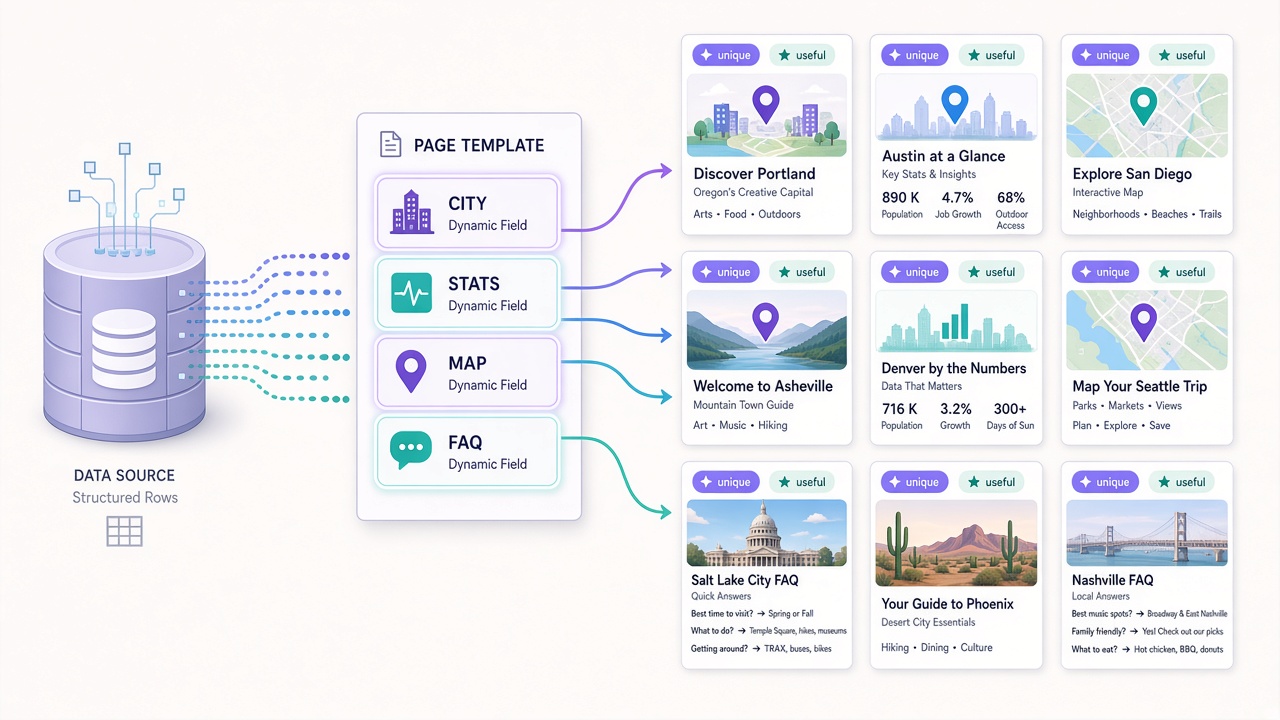
Strip away the hype and the definition is operational. Programmatic SEO uses templates, structured data, and automation to produce many unique, intent-matched pages—not thousands of near-identical spins. If two URLs could swap titles and still read the same, the system has already failed.
It is a content architecture pattern, not a product. The same idea can live in a spreadsheet, a CMS, or a custom pipeline. What matters is the contract: structured data in, differentiated pages out.
That is a different job from writing one editorial article at a time. It is also different from broader SEO automation—crawling, reporting, or generating content briefs. Those systems help teams work faster. Programmatic SEO changes how the site itself is composed.
The success bar stays human. Each URL should answer a real query with differentiated value—something a reader could not get from a sibling page or a generic landing template. Page count is not the goal; useful coverage is.
Success bar — Every generated URL has to answer a real query with value a sibling page cannot provide—otherwise you have scaled thin content, not programmatic SEO.
The Five Parts Every Programmatic SEO System Needs

That architecture is only as good as the system that runs it. Five parts have to stay in lockstep: the data that feeds each URL, the template that renders it, the gates that stop thin pages from going live, the technical controls that keep crawlers honest, and measurement that looks past raw page count.
None of these parts is optional. Skip the gates and you get thin or doorway-like pages. Skip the technical layer and you waste crawl budget. Skip template-level metrics and you scale a pattern that never should have shipped.
The system — Programmatic SEO scales only when data, templates, quality gates, technical hygiene, and template-level measurement all run together—page count is never the score.
What Strong Programmatic Pages Look Like in Practice
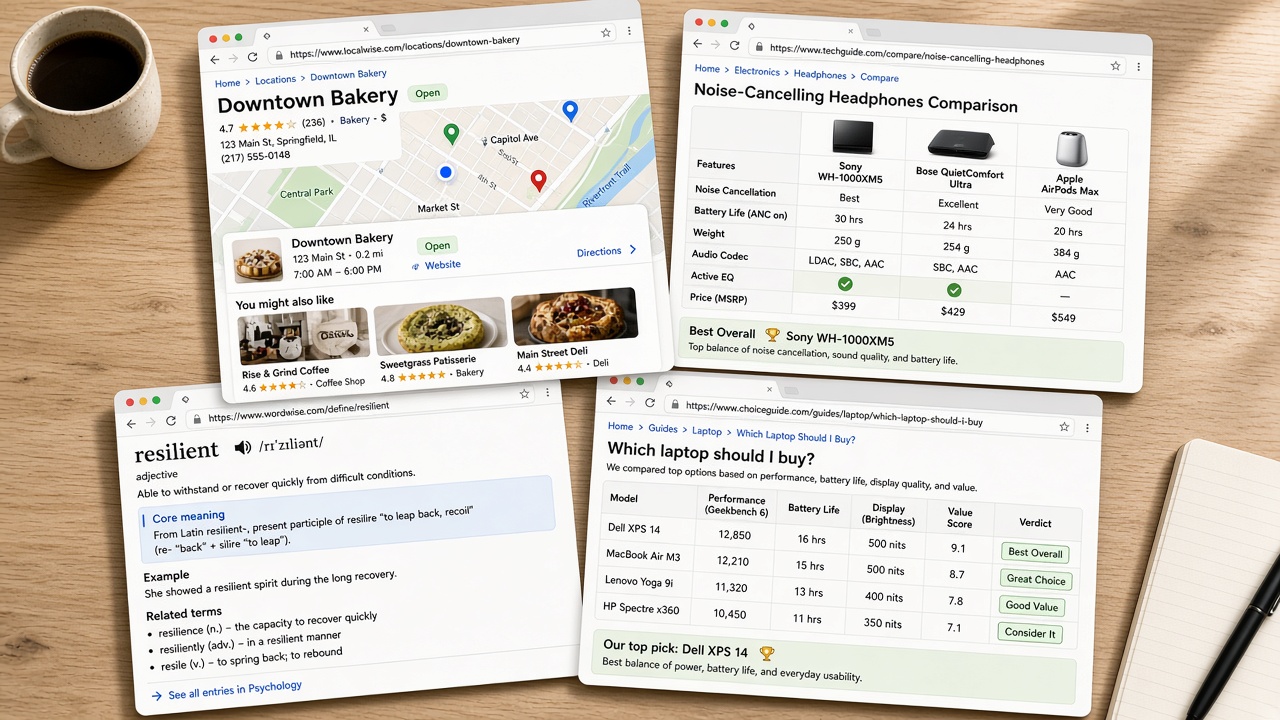
Once those pieces are in place, the pages themselves have to earn the crawl. Useful programmatic SEO is not a template multiplied by a thousand cities or SKUs. It is a family of URLs where each instance carries proof a reader would notice if they opened two pages side by side. The template supplies structure; the data and enrichment supply the reason to stay.
Four patterns tend to help users when they are built that way:
- Location or service-area pages with local proof: hours, reviews, neighborhoods, staff, photos, and FAQs that only make sense in that market—not a city name dropped into identical boilerplate.
- Product × attribute or integration matrices with real specs, compatibility notes, and use cases, so an “X + Slack” page is not a renamed “X + Teams” page.
- Glossary or definition networks with original explanations, examples, and cross-links that form a genuine reference rather than a synonym-spun dictionary.
- Comparison or alternative pages grounded in criteria people actually weigh—price, limits, support, migration effort—with honest differences instead of two names in the same paragraph.
The weak pattern is easy to spot: one token changes, the rest of the body is identical, and there is no unique entity, original media, or reason to prefer this URL over a parent hub. Those pages behave like doorways—they intercept queries instead of answering them. If two generated URLs still read as the same article after you hide the variables, the template is scaled thin content, not a system worth indexing.
The test — A strong programmatic page is a data-rich instance of a template. If swapping the variables leaves the same article, it will not help users—and it will not hold up as search coverage.
How Programmatic SEO Turns Thin—and When to Stop Scaling

Those single-token clones are not a small quality miss. They are how a sound template becomes thin content: pages that look unique in a spreadsheet and interchangeable in search.
Four risks follow. Thin or duplicate URLs fail to serve a distinct query. Doorway patterns send people to the same destination with only a keyword change. Crawl budget is spent on URLs that will never earn a lasting impression. Quality systems then reassess the whole template class as scaled, low-value pages.
Raw page volume fails for the same reason empty boxes fail a warehouse: the template never added unique value or experience signals. Without first-hand data, original copy modules, or clear expertise, each extra URL is just another permutation of the same sentence.
A pre-publish checklist
- Intent fit: the data can actually answer the query this URL targets.
- Differentiation versus siblings: a user would notice if they landed on the neighboring page.
- Internal links that place the URL in a meaningful, crawlable cluster.
- Indexation monitoring so ignored templates get fixed or noindexed.
- Engagement that shows people stay, click through, or convert—not bounce from a stub.
Skip programmatic when the data is sparse, there is no path to enrich each row, or the plan is pure keyword permutations. Those URLs should be written by hand—or not published at all.
The real limit — Programmatic SEO fails when templates scale URLs faster than they scale uniqueness, enrichment, and technical hygiene.
Where Programmatic SEO Fits in Your Publishing Stack

Knowing when not to scale still leaves a placement question. Programmatic SEO sits beside research, briefs, autoblogging, and QA. It is the layer that turns structured data into pages after those steps have done their jobs—not a replacement for editorial judgment.
Launch one template, then expand
- Pick one template type with a real enrichment path.
- Prove that sibling URLs differ in substance, not a swapped token.
- Ship a small pilot and measure indexation and engagement.
- Expand the matrix only after that pattern earns attention.
Human-defined templates and enrichment rules remain non-negotiable. Automation can fill variables and push pages live; it cannot set the uniqueness bar. Treat AI-answer and citation readiness as a quality lens—whether a page is worth quoting—not a volume race. Operational detail on scaling without thin content, and on SEO automation around briefs and QA, belongs in those playbooks rather than here.
Stack, not substitute — Programmatic SEO belongs next to research, briefs, and QA: human-defined templates and a proven pilot first, then expansion—never a volume race for citations or index share.
Key Takeaways
Pilot one template against real structured data, prove uniqueness and indexation on a small set, then expand only the patterns that already earn engagement.
Frequently Asked Questions
You Might Also Like
- Automation Programmatic SEO: How to Scale Pages Without Thin Content
- Automation SEO Automation: Tools, Workflows, and What to Automate First
- Automation What Is Content Automation? A Plain-English Definition
- Strategy Keyword Clustering: How to Group Keywords into Rankable Topics
- Comparisons Best SEO Automation Tools in 2026 (Compared by Job-to-Be-Done)