Programmatic SEO: How to Scale Pages Without Thin Content

Programmatic SEO is a production system, not a shortcut for flooding the index. You map a real search intent to a page template, feed that template with structured data, and generate many URLs that each answer a specific query with facts a hand-written article could not cheaply cover—locations, SKUs, attributes, comparisons, glossary terms, directory rows.
The reason operators fail at it is almost never “not enough pages.” It is thin or near-duplicate content: the same boilerplate with a city name swapped, no unique data, no reason for a human or an answer engine to prefer that URL. Those patterns waste crawl budget, look like doorway pages, and collapse when quality systems (and users) compare the page to better sources.
Useful scale looks different. Every page needs a uniqueness job—numbers, localization, inventory, eligibility rules, side-by-side attributes, or FAQs that only make sense for that entity. You then add controls: quality scores before publish, indexation rules so junk never ships, internal links so templates form a site rather than a pile, and measurement that tracks indexation, traffic per template, and conversions instead of URL count.
This article is the operator version of that system: what programmatic SEO actually is, how to design templates that stay evergreen, how to keep automation from becoming spam, and how to run a small high-intent pilot before you multiply pages. If you came here to understand content scaling that still deserves to rank, start with the definition and the quality bar—then the stack and the rollout follow naturally.
- Programmatic SEO generates many intent-matched pages from templates plus structured data, not from writing each URL by hand.
- Scale fails when pages are thin or near-duplicate; each URL needs unique facts, comparisons, localization, or entity-specific answers.
- The core stack is a clean data source, templates, dynamic internal links, and publish/indexation quality gates.
- Judge success by indexation rate, organic traffic and conversions per template, and manual audits—not by how many pages you shipped.
- Start with one high-intent template and a small pilot; expand only after engagement and rankings hold.
What Programmatic SEO Is—and What It Isn’t
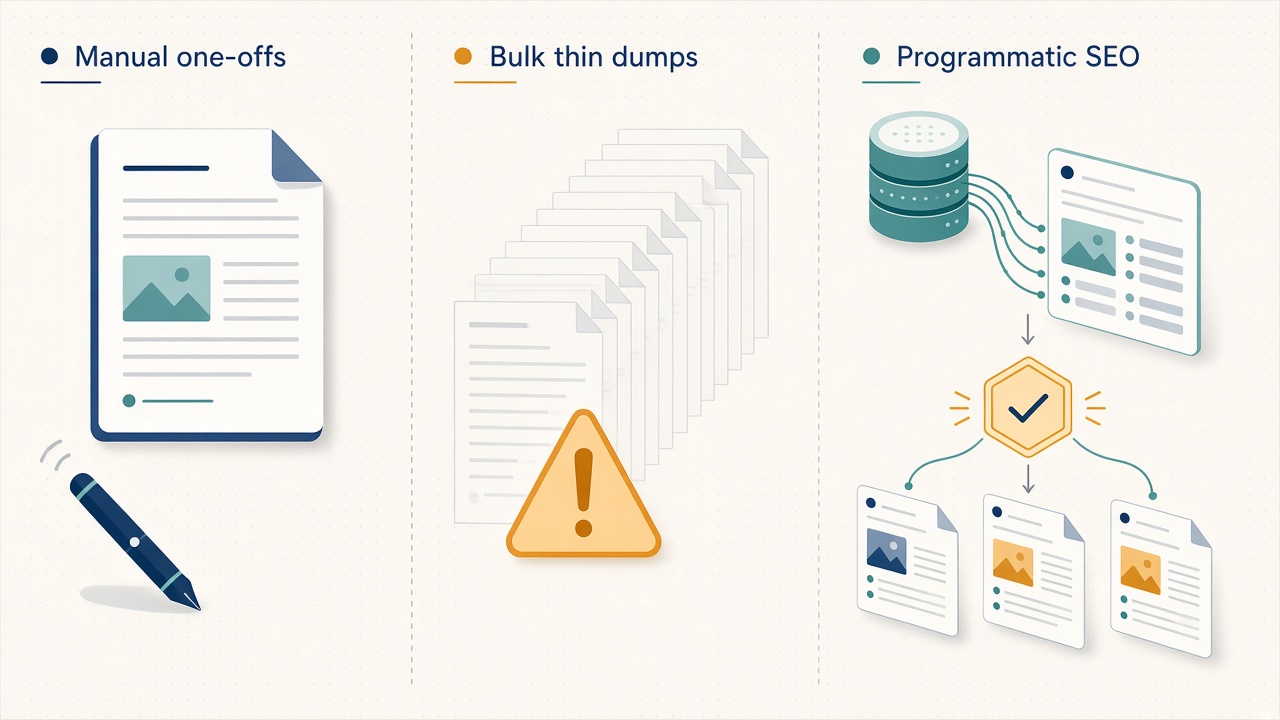
Programmatic SEO is the systematic generation of many intent-matched pages from structured data and reusable templates—not a backlog of one-off manual drafts. You map a repeatable search job (a place, an attribute, a comparison, a definition) to a page pattern, then fill that pattern with facts that only that entity can own. The programmatic piece is the pipeline: clean data in, a distinct URL out. The SEO piece is whether each URL still deserves to exist once a person lands on it.
Uniqueness lives in the entity, not the synonyms
Thin content appears when the template is the product. Real uniqueness comes from entity-specific data—localization, specs, comparisons, FAQs, and modules pulled from a source of truth—not from spinning the same paragraph with different adjectives. If two URLs still read as the same article after you swap a city or SKU name, you do not have programmatic SEO. You have a near-duplicate pattern that will waste crawl budget and fail quality reviews. Content scaling only holds when every page can answer a query the others cannot.
Not SEO automation, and not autoblogging
General SEO automation handles tasks: audits, reporting, internal-link suggestions, publishing workflows. It can sit beside this work without generating a single page. Full research-to-publish autoblogging tries to invent articles from prompts and hope they rank. Programmatic SEO sits between those poles. People design the intent, the template, and the quality gates; machines assemble pages only where structured data can make each one useful. Content automation is a means, not a license to ship volume. Without editorial standards—uniqueness gates, intent checks, a hard no on near-duplicates—“programmatic” is just multiplication.
Success is not URL count. It is useful pages that earn engagement, links, and citations because they solve a specific job. Indexation and traffic follow that bar; they do not replace it. Once the definition and the quality line are clear, the high-intent patterns worth scaling become the next decision—not the first.
Programmatic SEO — many intent-matched URLs from structured data and templates, unique because of entity-specific modules—not synonym spinning, task automation, or autoblogging. Volume without a quality bar is not the strategy.
High-Intent Use Cases That Earn a Unique URL
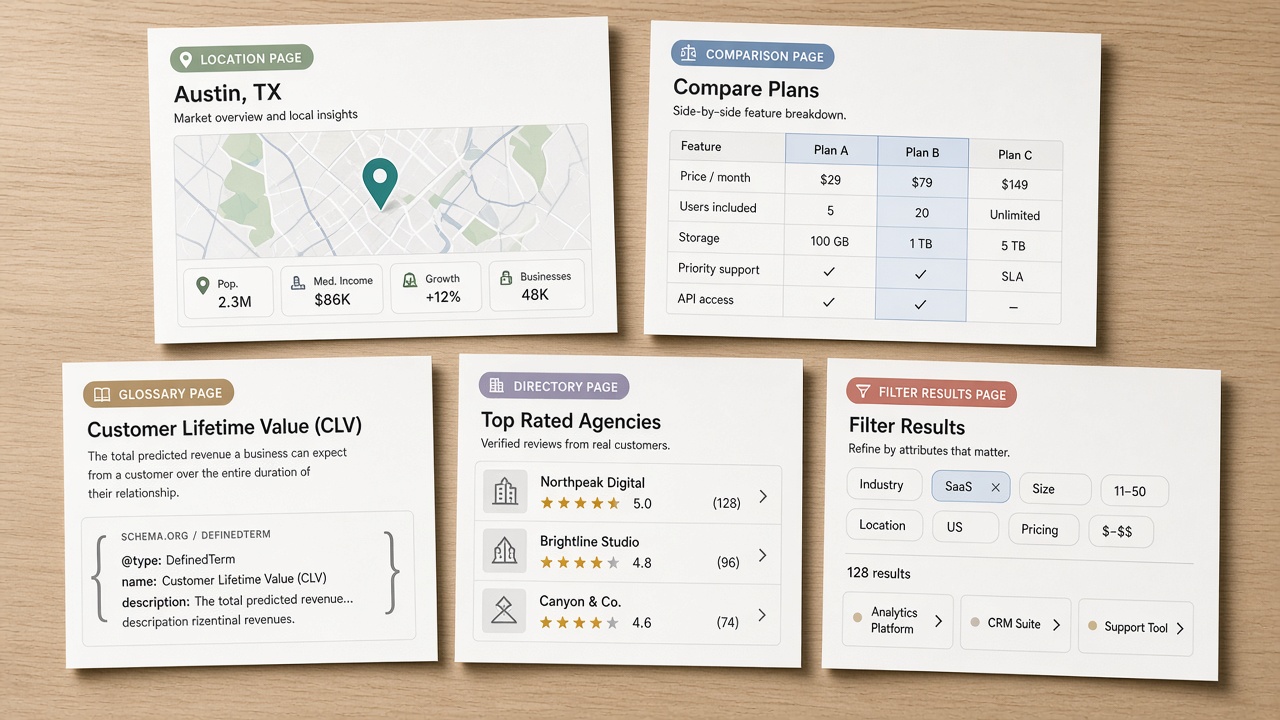
Those patterns are not every URL you can stamp from a spreadsheet. They are templates where each record already carries facts a searcher would miss if you merged the pages—hours, inventory, specs, local proof, or attributes that change the comparison.
Patterns that earn their own URL
- City or service pages — NAP, hours, coverage, reviews, and local proof a generic service page cannot carry.
- SKU or feature matrices — specs, compatibility, stock, and variant details that make two products different landing surfaces.
- Integrations directories — setup notes, supported objects, and limits unique to each pairing.
- Pricing-by-segment — plan limits and who it is for, so a mid-market page is not a starter page with a swapped H1.
- Definition hubs with real depth — entity-specific examples, related terms, and FAQs beyond a one-line glossary.
Each pattern works only when those unique fields actually exist in the data. If the template cannot fill them, you do not have a page—you have a keyword wrapper.
Intent decides whether that uniqueness is worth ranking. Transactional and commercial-investigation queries—near me, versus, pricing, integrations, best for a segment—give the fields a job. Pure informational fluff at scale usually produces interchangeable copy.
A simple go/no-go filter keeps the program honest: fill the template for two entities. If the copy is near-identical once the names swap, do not scale that pattern.
That is also how lean teams use programmatic SEO. You cannot hire a writer for every city, SKU, or integration, but you still need conversion-ready landing surfaces. One high-intent template and only the patterns that pass the uniqueness test is how a small team ships them without pretending each page was written by hand.
Scale the data, not the duplicates — A pattern deserves a unique URL only when entity-specific fields and transactional or commercial-investigation intent would make two filled templates genuinely different.
The Uniqueness Budget That Stops Thin Programmatic Pages

Passing that uniqueness test is an operations problem, not a writing problem. Thin content in programmatic SEO is interchangeable body copy, a weak intent match, no original data on the page, and no reason to prefer this URL over the parent hub. If a visitor would be better served by the category page, the child URL should not ship.
What thin content looks like in a template
The failure mode is almost always the same: the slug and a handful of nouns change, and the rest could sit on any sibling. That pattern does not earn engagement, links, or citations, and it spends crawl attention on pages nobody needed. Intent mismatch makes it worse—an explainer where the searcher wanted a comparison, a price, or a local fact. Volume is not a defense.
Spend a uniqueness budget on every URL
Treat uniqueness as a budget you allocate before generation, not as a rewrite you hope will appear later. Shared chrome—navigation, legal, generic brand lines—does not count. Spend the budget on material a sibling page cannot reuse:
- Entity-specific facts — specs, compatibility, hours, inventory, regulated attributes, and other fields that actually change.
- Localized or segment-specific proof — evidence that belongs to this place, plan, or audience, not the whole catalog.
- Dynamic tables or matrices — comparisons driven by real attributes, not a static paragraph with a swapped name.
- First-party or user data — reviews, usage, availability, or internal measurements only you can show.
- Differentiated FAQs — questions whose answers change with the entity, not a name-swap in the heading.
If a field is identical across the set, it belongs in the template shell—not in the budget.
Modules that carry intent, not filler
Build the page as a stack of modules with jobs, not a wall of prose. Lead with a hero answer that states this entity’s specific outcome in one or two sentences—that is what answer engines can lift. Follow with comparison blocks, fact callouts reserved for data you actually hold, related-entity rails, schema-ready Q&A, and a call to action matched to the template’s commercial or transactional intent. Cut any module that stays identical once the entity changes. That is how you scale pages with programmatic SEO without multiplying thin URLs.
Freeze generation until operators can score a candidate the same way every time. Use this pre-publish gate on the pilot set and on every URL the template later produces.
The fear behind programmatic SEO without thin content is that templates will outrun judgment. They will, if you scale first. Kill any URL that fails uniqueness, intent match, and on-page value; prove the template on a pilot; then multiply. Indexation and conversions confirm it later—page count never does.
Uniqueness budget — A programmatic URL earns its place only when entity-specific data, a distinct intent, and modules a sibling cannot reuse all appear on the page. Fail that test and do not publish.
The Operator Stack That Turns a Pilot Into a Pipeline

The moment a pilot earns the right to multiply, the work shifts from judgment to operations. You are no longer asking whether the pattern is valid; you are asking whether every new URL can be produced the same way without sliding into interchangeable copy. That takes an operator stack: clean structured data, templates with locked sections, generation rules, a publish path, and monitoring. Miss one layer and you scale defects as efficiently as you scale pages.
Data, templates, and the publish path
Keep those five layers in one pipeline so a filled row cannot bypass the rules that made the pilot worth repeating.
- Structured data as the source of truth. Every entity lives in a spreadsheet, database, or CMS collection with the identity, attributes, proof, and locale fields the page will actually render. Incomplete rows never become URLs.
- Locked templates and generation rules that map a row to a slug, skip records missing required fields, and fill fixed slots—hero answer, spec or comparison table, FAQs, related entities, CTA—so the layout cannot wander.
- A CMS collection or static publish path, plus monitoring that treats the template as a product: which URLs index, which earn engaged sessions, which convert.
Internal links that pass context, not clutter
Dynamic linking should reconstruct a real architecture, not dump the inventory in a footer. Parent hubs collect a family of entities. Each child links up to its hub and across to a few siblings that share a meaningful attribute—same service cluster, same integration category, same segment. Breadcrumb logic should match that hierarchy so readers and crawlers can place the URL. Automated related modules work when they pass the shared field and a short reason to click; they fail when they spray unrelated URLs that add no context.
Briefs, tools, and gates before go-live
When AI assists the copy, keep it on a short leash. A research brief for the template—who the page is for, the question it must answer, which claims are allowed—plus locked fields so the model can only expand facts that exist in the row. That brief discipline is what keeps generation on-intent at volume instead of drifting into filler.
Choose tools by job, not by logo. Spreadsheets and databases store entities. Templating engines merge data into locked layouts. CMS collections or static generators ship URLs. Crawlers catch missing modules, broken links, and near-duplicates before they go live. Search Console and index APIs confirm what actually entered the index. The stack you can maintain beats the one with the most features.
Between generation and live, gates do the remaining work. Sample a slice of every batch for human review. Run automated uniqueness and similarity checks against the parent hub and siblings. Block publish when required data is missing or stale. Stage first—preview, a limited live set, then the rest—so a bad rule cannot flood the index.
Operator stack — Multiply a proven template only through clean data, locked layouts, contextual internal links, and staged publish gates. Tools are interchangeable; those jobs are not.
Risks, Quality Controls, and Indexation Hygiene

That staging step is not optional, because once a bad rule is live the failure is a cluster, not a page. Programmatic SEO tends to break in the same ways: duplicate families that cannibalize one query, doorway-page patterns that shuffle users toward a conversion without a distinct answer, soft-404s where the entity has almost nothing useful to say, crawl waste on parameters and leftover drafts, and exposure when a quality update treats interchangeable copy as thin.
The failure modes that look like scale
- Duplicate clusters — siblings that share intent, modules, and nearly the same facts after the template fills.
- Doorway-page patterns — many near-identical landings that exist mainly to funnel users to one destination.
- Soft-404s — published URLs whose entity data is too sparse to satisfy the query.
- Crawl waste — parameters, faceted pagination, and leftover drafts that consume crawl without earning impressions.
- Quality-update vulnerability — interchangeable copy with no original data and no reason to prefer the URL over a parent hub.
Those are control failures, not synonym problems. The live pipeline needs the same rigor you used to stage the first set.
Mitigation controls and kill switches
- Similarity thresholds that block or noindex a page too close to a sibling or the hub.
- Minimum content and data requirements so missing fields cannot be padded with boilerplate.
- Sample human audits on every template change and on a rotating slice of live URLs.
- Kill switches that unpublish or noindex a whole template family when engagement or rankings collapse.
Indexation hygiene
Treat the sitemap as a controlled surface, not a dump of every collection. Generation only stays healthy if indexation is equally strict.
- Segment sitemaps by template and freshness so you can watch indexation per family.
- Canonicalize to the entity URL you want ranked; do not leave filtered copies self-canonical.
- noindex sparse entities that fail the uniqueness budget rather than hoping they fill in later.
- Handle pagination and parameters with consistent canonicals or noindex so facets do not multiply indexable URLs.
- Fix orphan URLs with parent-hub, sibling, and breadcrumb links.
Cite-worthiness is the other half of hygiene. Lead with a clear answer block. Use FAQ or HowTo structure only when the query actually asks for it. Keep entity names and facts consistent across the cluster, and put checkable details in the template instead of filler. E-E-A-T at this scale is editorial ownership of the template, real business details on the page, and transparent sourcing of every programmatic field so a reviewer can see where a claim came from.
Quality gates beat page count — keep programmatic URLs out of trouble with similarity checks, minimum-data rules, noindex for sparse entities, and a kill switch on any template that cannot prove unique intent.
Pilot One Template, Then Scale Only What Earns Its Keep

That ownership only proves out if the first publish is a test, not a flood. Start with one high-intent template, audited structured data, and a small contained pilot set. Run every quality gate you already defined—uniqueness checks, broken-data blockers, sample human review, staged publish—then wait. Crawl, indexation, and engagement arrive after the pages exist in the wild, not the moment you hit generate.
Measure the template, not the URL count
Judge the pilot on indexation rate, organic clicks and impressions per template, engagement, conversion rate, and the share of sampled URLs that pass a manual quality review. Total URLs live is a production count, not a success metric. A cluster that barely indexes or earns no clicks is still thin content, even when every field filled cleanly.
Scale content marketing with programmatic SEO only after that template beats a manual control set—or a clear baseline you already have for similar landings. If generated pages cannot match a writer-built page on usefulness and conversion, you are multiplying a weaker asset, not building a pipeline.
Expand, add a template, or sunset the pattern
- Expand entities on the same template when indexation, engagement, and conversions hold and uniqueness checks still pass.
- Add a second template only when the first pattern is stable and a new intent has its own data fields.
- Sunset weak patterns: noindex or unpublish clusters that stay interchangeable, unindexed, or conversion-dead.
That loop is how content automation stays brand-safe for startups and agencies: you automate after evidence, not instead of it. Each new URL still needs a distinct intent, a uniqueness budget, and an owner who can kill the pattern. Programmatic SEO scales without thin content only when the next batch is earned by a pilot that already did the job.
Pilot before volume — ship one high-intent template at a contained size, score it on indexation, engagement, and conversions—not URL count—and expand, add a second template, or sunset the pattern only after it beats a real baseline.
Key Takeaways
Run one high-intent template through a uniqueness-gated 25–100 page pilot, then scale only the pattern that already beats your baseline.