AI Blog Writer vs Autoblogging: Which Model Scales Content?

Most people searching for an AI blog writer are not trying to chat with a model. They are trying to ship search-visible articles on a schedule without hiring a newsroom. The real choice is between a prompt-to-draft tool and autoblogging: an end-to-end path from keyword cluster to researched, optimized, published, internally linked page.
A standalone writer is enough when a human still owns the brief, the facts, the links, and the CMS. It stops being a scaling model the moment volume outruns that layer. Then you get thin pages, factual drift, orphan URLs, and weak experience signals—the same problems search systems and answer engines both ignore or punish. Autoblogging only wins when those gates live in the pipeline, not in a last-minute edit pass.
This is an operator scorecard, not a feature bake-off. You will get a clean definition of each model, when a writer is enough, the quality risks that actually tank visibility, a research-to-publish map lean teams can run, and a decision matrix built on volume, headcount, brand voice, CMS, and measurement—including whether pages are ready to be cited, not just crawled.
- An AI blog writer is a prompt-to-draft tool; autoblogging is research, brief, write, optimize, publish, and internal linking as one system.
- Standalone writers fit one-off posts and human-heavy editing; they fail when volume outruns briefs, facts, and links.
- Autoblogging wins for topical clusters when quality gates sit in the pipeline, not in a last-minute edit pass.
- Thin pages, factual drift, missing internal links, and weak experience signals kill visibility—not the fact that AI was used.
- Choose on volume, team size, brand voice, CMS, and measurement of both rankings and answer-engine visibility.
What an AI Blog Writer Is—and What Autoblogging Actually Means
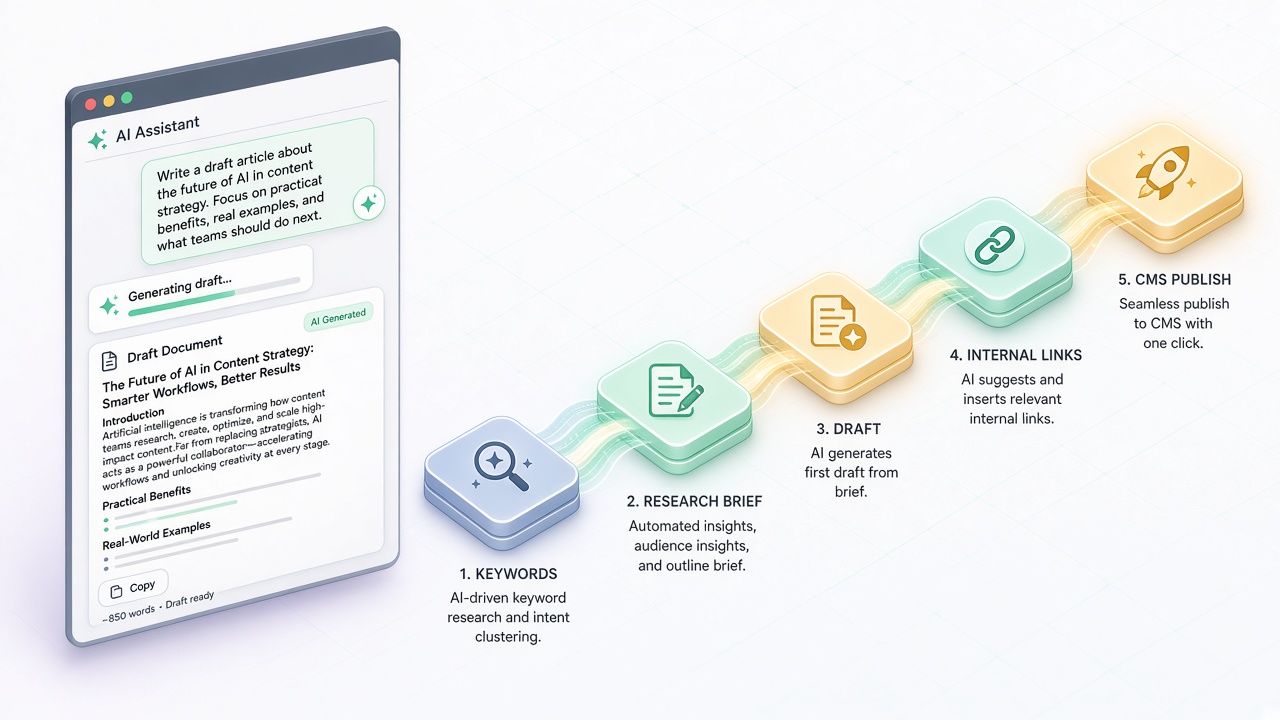
The names overlap. The jobs do not. An AI blog writer is a generation layer; autoblogging is a research-to-publish system. Mixing them up is how a team buys a drafting tool and still owns every brief, CMS upload, internal link, and quality check—then wonders why rankings did not scale with the word count.
The AI blog writer is a generation layer
An AI blog writer—or AI article writer—takes a brief or a prompt and returns a draft. That is the whole contract. Research, search structure, internal links, CMS publishing, and QA stay with people. It scales first drafts. It does not, by itself, scale a content operation.
Autoblogging is the end-to-end loop
Autoblogging clusters keywords, builds briefs, produces researched drafts, applies on-page and AEO optimization, schedules publish, and weaves internal links so topical clusters hold together. Volume is the point—but only because the ranking work rides along with the words instead of being bolted on later.
Content automation and SEO automation can sit on either model: auto-outlines around a writer, auto-meta after an editor. Those layers are useful. They are not the same as owning the loop. Only autoblogging bakes research through publish and linking in by default. Deeper primers on autoblogging and content automation live elsewhere; here the useful split is simple.
The real split — An AI blog writer scales first drafts. Autoblogging scales rankings, because clustering, briefs, optimization, CMS publish, and internal links stay in one system.
Volume, Quality, and the Ops Load Nobody Prices In
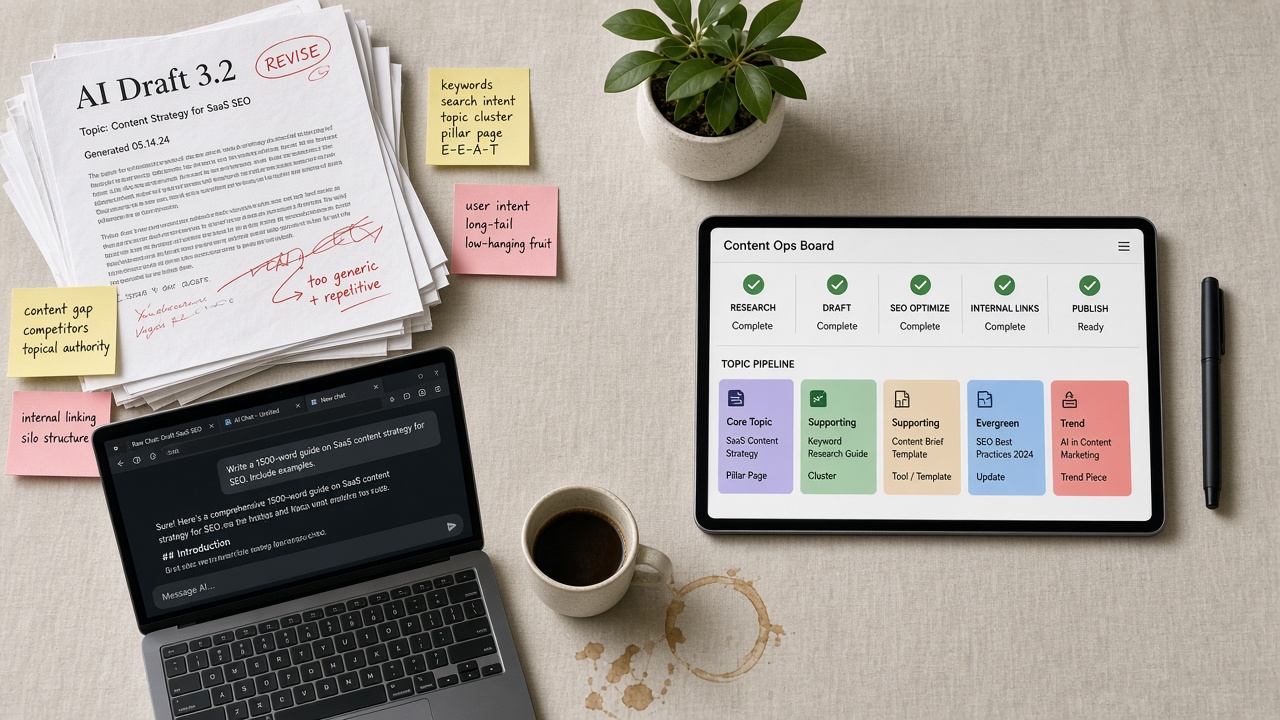
With those definitions in hand, the useful comparison is not a feature list. It is what happens when you turn the volume knob. An AI blog writer still wins on raw draft speed: brief in, copy out, often before a meeting ends. Autoblogging trades that instant typing for consistent cluster coverage, uniqueness gates, and a publish cadence that does not stall in an export queue.
The hours hide in operations. After a generation-only writer, someone still edits, fact-checks, steers brand voice, uploads to the CMS, writes metadata, sources images, and places internal links. Skip a step and you scaled words, not live pages. Autoblogging keeps humans on exceptions and voice calibration because research, on-page structure, scheduling, and linking already sit in the loop.
- AI blog writer: the draft is the deliverable. Editing, CMS upload, metadata, images, and internal links remain a queue.
- Autoblogging: the live, structured post is the deliverable. The queue shrinks to QA and brand-voice exceptions.
WordPress, and what “done” actually means
On WordPress and similar CMSs, writers typically export a draft for someone to paste. Autoblogging systems push the optimized post with headings, metadata, and internal links already applied. That is the commercial test. Scale is not a monthly word quota. It is complete clusters and citation-ready URLs going live on a cadence you can keep.
Scale — Rankings and citation-ready pages come from a research-to-publish loop, not from faster first drafts.
Where Pure AI Writers Break at Scale

Once you treat rankings and citation-ready pages as the real output, a generation-only writer fails in familiar ways. Prompt-to-draft still fills the page. It does not hold a cluster together: thin generic copy, duplicated angles across related URLs, factual drift where no brief pinned the claims, and a brand voice that shifts with every prompt.
Search and answer systems see the same gaps. Entities stay shallow, evidence is weak, internal links are not systematic, and the page seldom matches the specificity snippets and AI Overviews tend to cite. Helpful-content expectations make volume without uniqueness look like doorway-style bulk—many URLs, little distinct value.
That is not an argument against automation. It is an argument for gates, whether people apply them after the draft or the pipeline applies them before publish:
- Source checks so claims stay tied to research, not pattern completion
- Originality thresholds so cluster posts do not cannibalize one another
- Human review triggers when voice slips or facts look thin
- Brand and style locks so later posts still sound like you
An AI blog writer leaves that work on the team. Autoblogging only scales rankings if those gates live inside the research-to-publish loop.
The break point — Draft speed without uniqueness, entity depth, and systematic links does not scale rankings—it scales thin, unciteable pages.
Which Model Fits Your Team
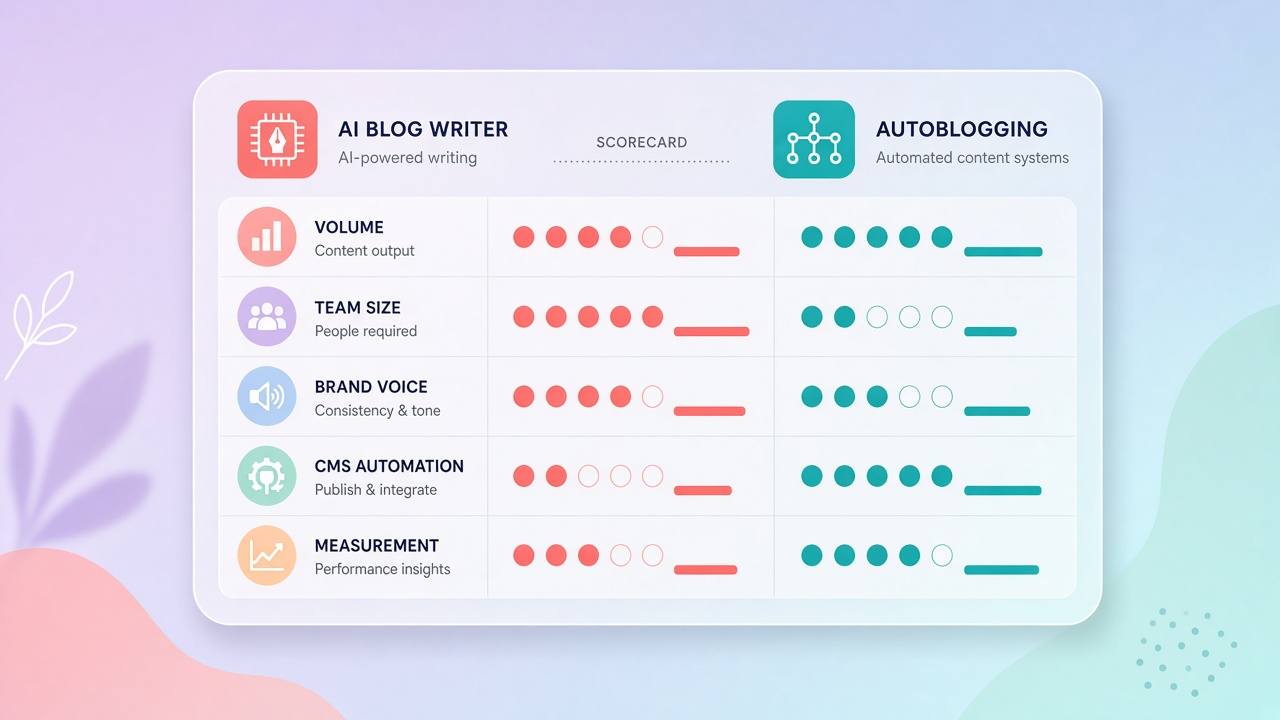
Quality gates do not pick the model. Cadence, headcount, voice strictness, CMS, whether topical clusters are the job, and whether you measure rankings plus AI visibility—not draft count—do.
A practical scorecard
| Factor | AI blog writer fits | Autoblogging fits |
|---|---|---|
| Monthly publish | Low, irregular, or a few flagship posts | Steady cadence across a cluster |
| Headcount | Strong editors who can research through ship | Small team; no writer bench to hire |
| Brand voice | Every line heavily human-led | Voice locks plus exception review |
| CMS | Paste-in drafts are acceptable | Scheduled, optimized publish |
| Topical clusters | Standalone or one-off pieces | Interlinked coverage is the job |
| Measurement | Page-level craft | Rankings and AI visibility |
Choose an AI blog writer when volume is low, editors are strong, and posts are one-off or heavily human-led. People still own research, structure, links, CMS, and QA; the tool only scales the first draft. Choose autoblogging when the work is continuous cluster coverage, automated SEO publishing, and the same gates without a large writer bench—the loop holds briefs, researched drafts, on-page and AEO optimization, scheduled output, and internal links.
If the cluster plan is still forming, choose both in sequence: keep the writer inside a human workflow now, then graduate pipeline stages as volume rises.
Graduate a stage when drafts outrun the humans who still own research, uniqueness, and shipping—not because full automation sounds efficient on a slide.
The filter — Use an AI blog writer to scale drafts on a strong editorial desk; use autoblogging when clusters, gates, CMS output, and internal links have to move together if rankings are the point.
What to Automate First—and What to Leave Until Last

That sequential path only works if you automate in the right order. Whether the middle of the stack is an AI blog writer or a full autoblogging loop, put scaffolding on rails first.
- Keyword clustering so every post sits in a topical map
- Brief templates that lock intent, entities, and evidence before generation
- On-page checks for titles, headings, metadata, and snippet-ready structure
- Internal-link suggestions that connect the cluster instead of leaving orphans
- Scheduled publishing into the CMS so cadence does not depend on paste-in work
Do not automate raw bulk generation before research and uniqueness gates. Volume without those checks is how thin, duplicated, doorway-style pages reach the CMS. Generation is cheap; holding a cluster together is not.
The sequence that scales rankings is the same at any volume: clusters, then briefs, then researched drafts, then SEO and AEO optimization, then publish and internal linking. Editors stay on voice and exceptions. The system holds structure, quality gates, and CMS output.
Tie the work to indexation health, cluster rankings, and AI-answer citation readiness. Those signals—not unpublished word count—show whether content scaling is actually working.
Order of operations — Automate clustering, briefs, on-page checks, internal links, and publish cadence before bulk drafts. Rankings scale from a gated research-to-publish loop, not from word volume.
Key Takeaways
Match your publish target and topical clusters to a research-to-publish loop, then put quality gates in place before you raise generation volume.
Frequently Asked Questions
You Might Also Like
- Automation What Is Autoblogging? How Automated SEO Publishing Actually Works
- Automation SEO Automation: Tools, Workflows, and What to Automate First
- Automation What Is Content Automation? A Plain-English Definition
- Automation Programmatic SEO: How to Scale Pages Without Thin Content
- Automation Content Marketing Automation: A Practical Playbook