WordPress Auto Blogger: What It Is and When to Use One

Most people who search for a WordPress auto blogger want a machine that turns topics into live posts without a full editorial team. The useful definition is tighter than a plugin that dumps AI drafts into Drafts: it is software or a stack that researches, drafts, optimizes, and publishes to WordPress, with only the manual steps you deliberately leave in.
On one end sit RSS importers and one-click AI writers. On the other sit full autoblogging systems with keyword clustering, briefs, scheduling, canonicals, and quality gates before anything is public. That gap is not marketing language. It is the difference between compounding informational clusters and quietly accumulating thin-content debt that both readers and helpful-content systems notice.
This guide treats auto-blogging as an operator decision. You will see when high-volume informational clusters, programmatic templates, and lean teams justify the stack; when human oversight is mandatory; and how REST API or plugin hooks, Yoast or Rank Math, and a publish-and-monitor loop keep scale from drifting off-brand. First, name the stack so every later choice—setup, risk, workflow—can be judged against it.
- A WordPress auto blogger is an end-to-end research-to-publish pipeline, not merely an AI draft box.
- Simple plugins and full autoblogging stacks sit on a spectrum; quality gates decide which side you are on.
- Automation fits high-volume informational clusters and lean teams; brand-sensitive and high-stakes pages still need humans.
- Durable setup includes REST API or plugin hooks, SEO plugin compatibility, scheduling, canonicals, and thin-content filters.
- Duplicate content, hallucinated facts, and helpful-content risk are operational problems with mitigations, not a reason to dismiss the category.
What a WordPress Auto Blogger Actually Is

Once you look past the product names, the useful definition is operational. A WordPress auto blogger is software—or, more often, a connected stack—that can research topics, draft, apply on-page SEO, and publish or schedule to WordPress with few manual clicks. The publishing hop is the line that matters. A one-off AI draft you paste into the editor is a writing aid. A system that lands the post through the WordPress REST API, a plugin, or a publishing connector is doing the auto-blogger’s job: keyword or brief in, URL out, without the copy-paste shuffle.
Readers use the same idea under several labels—wordpress auto blogging, automate wordpress blog posts, autoblogging. They all describe one job inside automated SEO publishing, not a set-and-forget content strategy. The stack can move volume; it cannot, on its own, decide what deserves to go live. Without quality gates, that volume becomes thin, off-brand posts. Treat the auto blogger as the research-to-publish pipe, and keep governance as the valve.
The distinction — An auto blogger is the research-to-publish connection into WordPress; an AI draft you paste is not. Scaling SEO still depends on quality gates, not volume alone.
From RSS plugins to a full autoblogging stack

What still needs mapping is the tooling, because the market uses one label for several different jobs. A basic plugin that ingests RSS or drops an AI draft into WordPress is not the same system as a full autoblogging stack that clusters keywords, builds a brief, drafts, weaves internal links, runs uniqueness checks, then publishes or schedules through the REST API or a connector. Treat those layers as interchangeable and content scaling turns into thin, off-brand posts.
That is the practical split: an AI writer is generation-only, so the research, structure, and publish steps stay human. A WordPress auto blogger owns more of the loop. Operators should insist on SEO-plugin compatibility, native scheduling, canonicals, and thin-content filters—not raw post count. Those checks are how you scale without the site sounding like a different brand on every URL.
The real split — An AI writer generates copy; a WordPress auto blogger owns research through publish—and volume only stays on-brand when SEO compatibility, scheduling, canonicals, and thin-content filters travel with every post.
When a WordPress Auto Blogger Actually Wins

With that frame in place, the practical question is when the stack actually wins. It wins on high-volume informational SEO—how-tos, definitions, and comparisons—where entities are clear and the page shape repeats. Readers want the same kind of answer across many queries, so a governed auto blogger can fill a consistent outline without inventing a new format every time.
That same pattern is why programmatic-style templates and cluster expansion work. Unique data inputs plus uniqueness gates keep supporting pages useful as a cluster grows, instead of spinning near-duplicates. Solopreneurs and small SEO teams feel this most: they get content scaling and seo automation without hiring a writing bench.
The conditions that make volume pay off
- Brand voice rules that stay stable enough for the stack to follow without drifting off-brand.
- A publish cadence someone still watches, so volume does not outrun review.
- Post-publish performance loops that promote, rewrite, or stop pages after they go live.
Hold those, and the stack compounds. Drop them, and you are only publishing faster.
Fit, then govern — A WordPress auto blogger scales SEO when demand is high-volume and structured—and when voice, cadence, and performance loops stay in charge of that volume.
When Not to Fully Automate—and How to Contain the Risk
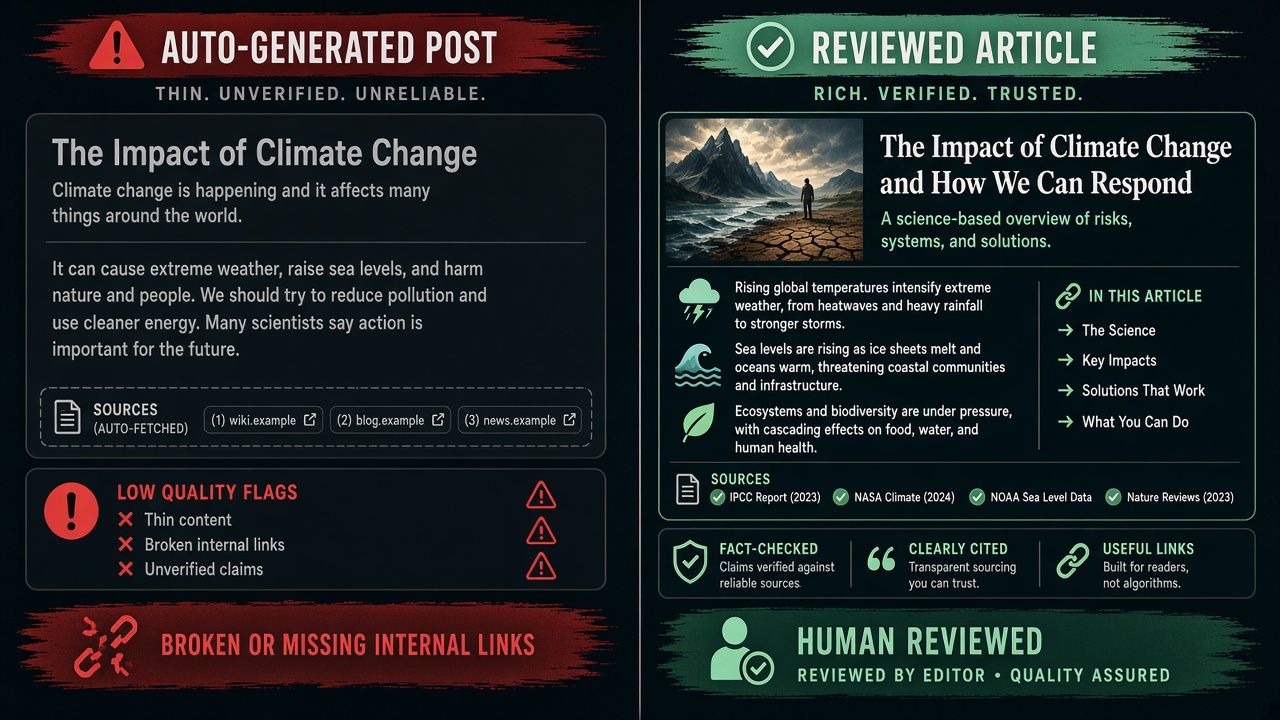
Those wins assume informational pages with a repeatable shape. Point the same stack at work that has to earn trust and it will scale the wrong thing: interchangeable posts that look busy in a queue and costly in search.
Keep humans mandatory for YMYL topics, thought leadership, original data, sensitive claims, and anything that defines brand trust. Those pieces are not a throughput problem. They are the reputation of the site.
What unattended pipelines actually produce
- Duplicate or near-duplicate pages that cannibalize your own URLs
- Hallucinated facts that readers—and reviewers—will catch
- Weak internal linking that never builds a real cluster
- Helpful-content and thin-content debt that compounds with every publish
Contain that with source-backed briefs, uniqueness thresholds, fact-check samples, a canonical strategy, crawl and index monitoring, and staged rollouts. Treat auto-blogging as assisted publishing with gates—not an unattended spam pipeline.
Assisted, not unattended — A WordPress auto blogger only stays useful when humans own YMYL, original, and trust-defining work, and quality gates stop volume from becoming thin, duplicate, or invented content.
The Setup That Keeps Auto Blogging Governed
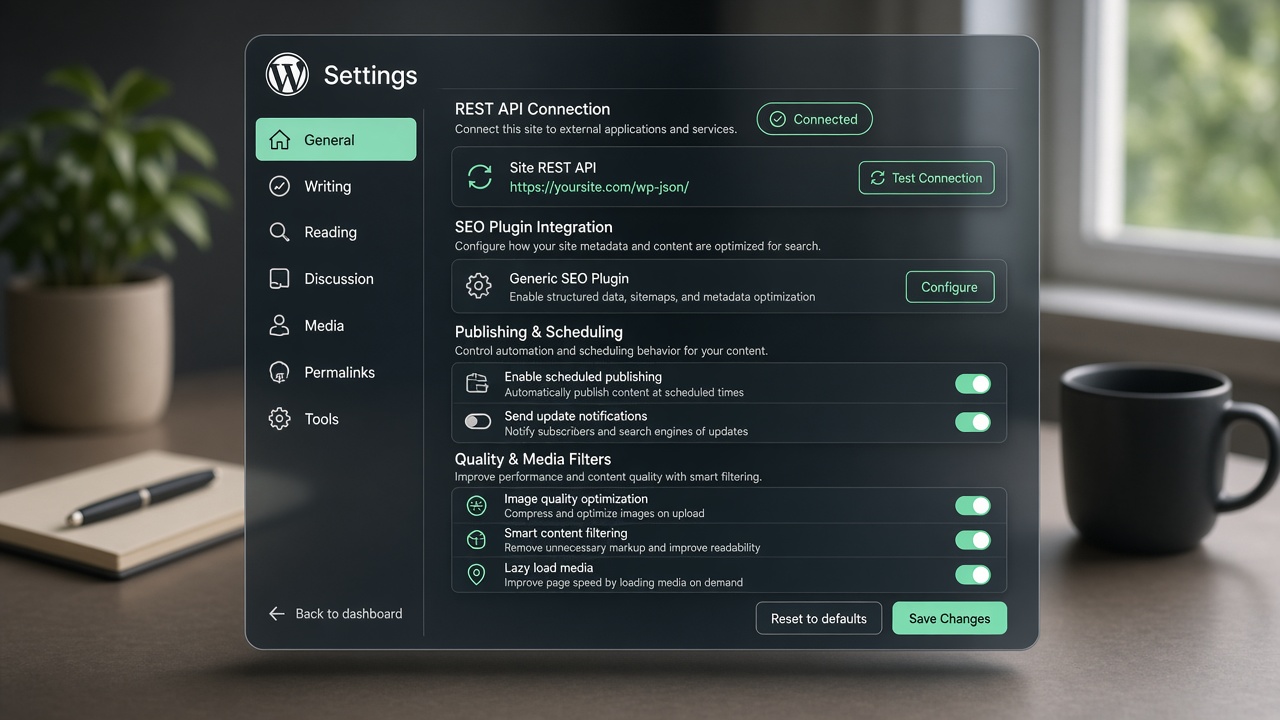
Those gates only hold if WordPress is wired for control: how posts arrive, which fields get written, and what you watch after they go live.
Treat the first live posts as a staged check, not a finished install. If coverage or engagement weakens, tighten the filters before you raise volume.
Govern the pipe — A WordPress auto blogger only stays a governed stack when API access, SEO-plugin mapping, rejection filters, and post-publish monitoring are in place before volume ramps.
A Decision Checklist and a Gated Starter Workflow
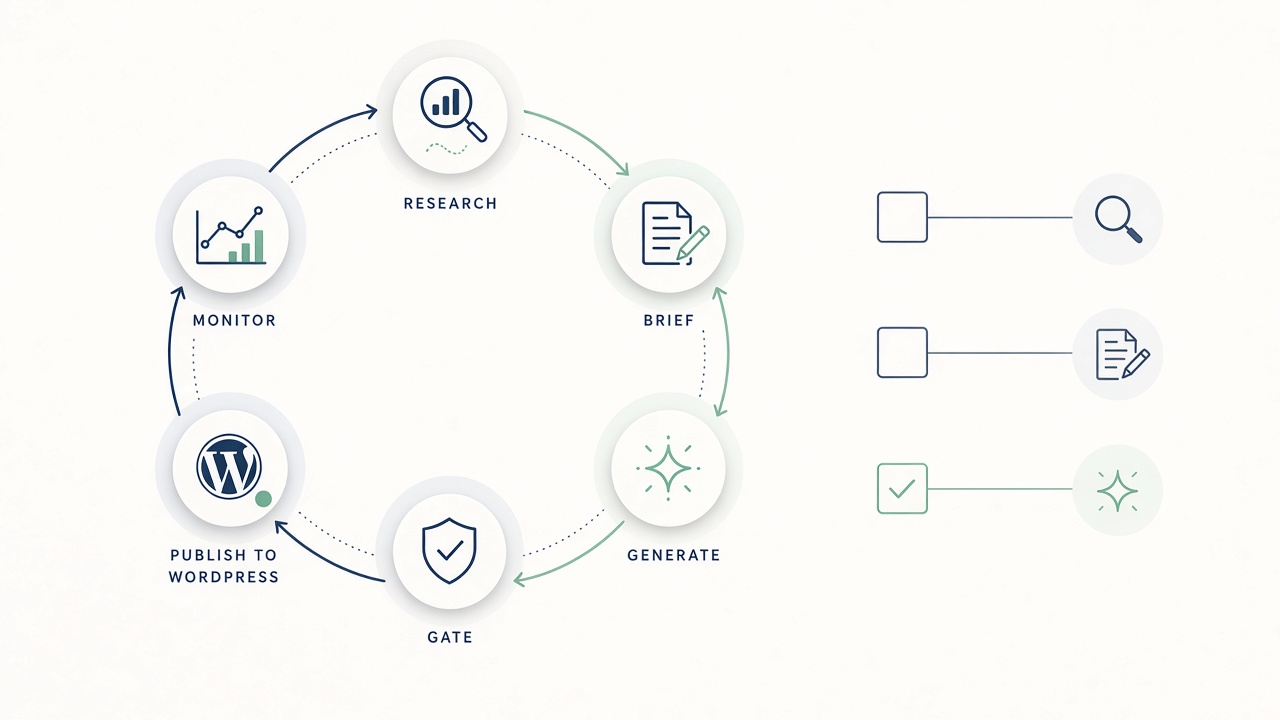
Once those gates and monitors are in place, decide whether to raise cadence at all. A WordPress auto blogger only belongs on topics you can govern—not on every URL you wish you had.
Decision checklist
- Topic type: repeatable informational pages (how-tos, definitions, comparisons)—not YMYL, original research, or flagship brand pieces.
- Volume need: a real backlog humans cannot cover without dropping quality.
- Brand risk: voice rules and sample reviews that can actually contain drift.
- Uniqueness plan: source-backed briefs and checks so posts are not interchangeable.
- WordPress readiness: REST or a trusted connector, SEO-plugin mapping, draft-by-default, and scheduling.
- Owner for spot-checks: a named person who samples live posts, not an unattended queue.
If those are not honest yeses, keep humans in the loop. WordPress autoblogging tools sit after research automation—they publish a strategy you already chose. They do not invent clustering, intent, or brand rules.
Starter workflow
- Cluster keywords around a clear informational intent.
- Brief each URL with sources and uniqueness notes.
- Generate the draft.
- Run quality gates (voice, facts, length, internal links).
- Schedule in WordPress—draft first, then go live.
- Monitor rankings, coverage, and engagement, and fix what fails.
Judge the loop by usefulness and brand fit, not post count. Volume without those checks is thin content with a faster pipeline.
Governed volume — A WordPress auto blogger scales SEO only when research comes first, quality gates stay on, and you measure usefulness and brand fit—not how many posts it ships.
Key Takeaways
Run the decision checklist on one informational cluster, then start a draft-by-default gated auto-blogger workflow and raise volume only after indexation and brand-fit checks hold.
Frequently Asked Questions
You Might Also Like
- Automation What Is Autoblogging? How Automated SEO Publishing Actually Works
- Comparisons AI Blog Writer vs Autoblogging: Which Model Scales Content?
- Automation SEO Automation: Tools, Workflows, and What to Automate First
- Automation What Is Content Automation? A Plain-English Definition
- Strategy Keyword Clustering: How to Group Keywords into Rankable Topics