What Is Autoblogging? The Complete 2026 Guide to AI-Powered Automated Blogging That Actually Ranks

Most people still hear autoblogging and picture a plugin that scrapes a feed, spins a paragraph, and dumps a thin page onto the internet. That version of the idea earned the term its penalty-shaped reputation. It is also not what ranks anymore.
Modern autoblogging is an end-to-end ranking loop: cluster real demand, write machine-readable briefs, generate and refresh with specialized agents, block anything that fails uniqueness and technical gates, then keep the live page useful with structured data, GEO for AI answers, and in-article chat. The public artifact is still a blog post. The operating system behind it is not a firehose.
If you came here to understand automated blogging—and whether AI blog automation can scale a niche site without turning it into scaled junk—this is the operational definition. The rest of the guide walks the pipeline, the quality and E-E-A-T controls that keep it penalty-resistant, when to stay hybrid versus full auto, and the ranking and monetization paths that only work when readers actually stay and trust the page.
- 1
Autoblogging is no longer auto-posting spun or scraped pages; it is an AI-driven pipeline from research through publish gates and live-page optimization.
- 2
Pages that rank treat briefs, multi-agent generation, technical SEO, GEO, and in-article chat as one closed loop, not a generate-and-dump tool.
- 3
Quality control, unique-value templates, and hybrid human oversight are what separate a ranking system from scaled-content risk.
- 4
Full automation fits high-volume, low-competition niches; competitive or YMYL topics stay hybrid.
- 5
ROI comes from time saved, rankings on reachable terms, longer dwell from chat, and monetization hooks inside useful articles.
Why Generate-and-Publish Autoblogging Stopped Ranking
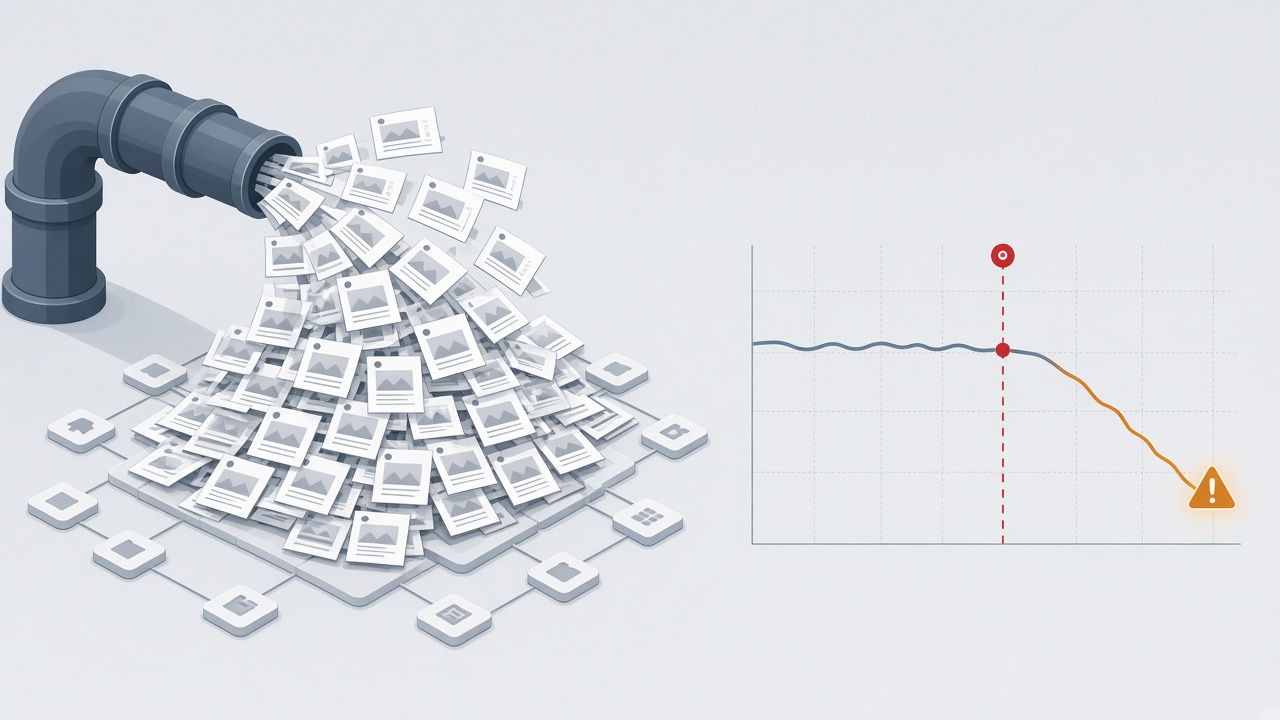
That distinction is the whole problem. For years, autoblogging meant an unattended pipe: ingest a feed, spin or lightly rewrite the copy, schedule the post, and treat search as a numbers game. When models became good enough to draft full articles, the pattern barely changed. Operators swapped RSS and synonym wheels for a keyword dump and a single prompt, then let the model firehose pages onto the site. The machine got faster. The system stayed generate-and-publish.
Two things that share a name
Legacy autoblogging is RSS syndication, spun rewrites, calendar auto-posting, and raw model dumps with no brief, no gate, and no reason the URL should exist besides an available keyword. Ranking-oriented automation still uses models, and it still publishes faster than a lone editor. The job, though, is different: clustered research, a brief the model cannot ignore, technical and quality gates before anything goes live, and an on-page experience that gives a reader a reason to stay. Collapse those into one product category and you will buy speed while you ship sameness.
Why volume-only pipelines stall
Search no longer treats “more pages about the same query” as a strategy. Scaled-content and helpful-content expectations ask whether a URL adds something a competent result set does not already cover. A draft that restates the pages already ranking—no fresher observation, no clearer structure, no better experience—does not become useful because you published fifty neighbors that read the same way. The model is not the failure mode. The missing loop is. Nothing in a firehose pipeline asks whether the last ten URLs earned trust, satisfied the query, or should have been merged, refreshed, or killed.
The gap feature lists leave open
This is the operator pain that low-competition niches still hide. Keyword difficulty can look inviting while every surviving query already has a stack of near-duplicate explainers. What those niches still demand is differentiation, freshness, and an experience that holds someone long enough to trust the page. More interchangeable drafts do not close that gap. They advertise that nobody read the output.
Definition posts and platform roundups rarely help. They inventory generators, schedulers, and CMS plugins. They do not describe the architecture—the clustering, the machine-readable brief, the publish gates, the feedback from what actually ranked or got ignored. That is the open gap this guide fills: not another feature list, but the closed loop that decides whether automation produces a ranking asset or a penalty surface.
Generate-and-publish is not a ranking system — unattended volume ships near-duplicates that fail helpful-content expectations; what ranks is a loop of research, briefs, gates, and on-page experience.
The Closed-Loop Ranking OS Behind Autoblogging That Actually Ranks

That loop is the actual product. Once you stop treating autoblogging as “AI wrote the post and a cron job hit publish,” the work becomes orchestration: demand sensing, clustered research, a machine-readable brief, agent crews that draft and check, technical and E-E-A-T gates, a publish decision, then engagement, GEO, and refresh signals that rewrite the next brief. The output is not a pile of URLs. It is a ranking asset with a feedback path—or it is a penalty surface. The architecture is what decides which.
A modern autoblogging stack is therefore defined by planes, not by vendor features. Each plane has a job, a required input, and an auditable output. If a stage cannot show its output, you do not have automation—you have a firehose with extra steps. That distinction is what lets a niche portfolio or a small agency run the same process every week without reinventing prompts.
The loop, plane by plane
Walk the sequence in order. Skip a plane and you are not “moving faster”—you are back to generate-and-publish with extra UI.
Notice what that sequence refuses to do: treat generation as the product. Generation is a middle plane, boxed in by a brief on one side and gates on the other, then judged by what happened after publish. Hybrid oversight belongs in the gates and the refresh queue—as a decision right to ship, hold, or send work back with a reason the next agent can read—not as a last-minute polish pass.
Audit your stack against the OS
If you run a niche portfolio or a small agency desk, these are the questions that tell you whether you have a ranking OS or a writing tool:
- Can you point to the opportunity queue that fed this URL, or did someone type a title into a prompt?
- Does the brief exist as structured data an agent can fail against, or only as a paragraph of wishes?
- Is generation allowed to publish, or only to submit work to gates?
- Do those gates block on technical SEO, uniqueness, and E-E-A-T evidence—or only on “does it look like an article”?
- After publish, which engagement, ranking, and GEO signals write the next brief and the refresh queue?
A one-off prompt can still make a strong page. It cannot make a system that learns which clusters earned impressions, which URLs were cited in AI answers, which in-article chats covered the question the SERP never did, and which pages should be refreshed first. Repeatable process is the point: same planes, same gates, different niches. When you cannot name a plane’s input and output, that is the gap. The first plane—how demand becomes a cluster and then a brief a machine can execute—is where most stacks either become ranking systems or collapse back into volume.
Closed-loop autoblogging — ranks when every plane from demand sensing to refresh has a defined input, an auditable output, and a path back into the next brief. Generation is one plane inside that OS, not the system itself.
How Demand Becomes a Cluster and a Brief a Machine Can Execute
That conversion is not a keyword CSV dumped into a generator. Ranking automation starts when demand is treated as a map: a pillar job, the entities that define it, the questions around it, and explicit ownership of which URL serves which intent. Skip that map and you get a stack of titles that look different and still compete for the same result.
Autoblogging that actually ranks therefore begins upstream of writing. Queries are grouped by the job the searcher is trying to finish, not by shared words. An entity map sits underneath—the products, standards, constraints, brands, and failure modes a competent page would have to mention. Cannibalization rules sit on top: one primary URL per intent, spokes that deepen a single facet, and a hard “do not target” list so two drafts cannot hunt the same SERP. Without those rules, agents will happily produce three near-duplicates because each headline sounded unique in isolation.
What belongs in a machine-readable brief
A human outline is a suggestion. A machine-readable brief is a contract. It has to be structured enough that research, writing, and QA can all read the same object and fail the same checks. The useful fields are not decorative metadata—they are the job description generation is not allowed to invent.
- Search intent and SERP job — what the winning page must do (define, compare, diagnose, convert) and which format it is allowed to take.
- Outline constraints — required section slots, what each section is for, and which claims need a proof slot instead of filler.
- Sources and proof slots — named places a spec, first-hand note, or cited fact must land, and that generation cannot skip.
- Differentiators — the angle this site uniquely owns so the draft cannot collapse into the same talking points as every competitor.
- Schema hints — which structured types the page should support, plus which facts feed them.
- Internal link targets — exact hub and spoke URLs to cite, with the job each anchor is supposed to do.
- “Do not repeat” notes — phrases, sections, and claims already published on sibling pages so the cluster stays complementary.
Structured this way, the brief cuts generic output because the model is no longer inventing the assignment. It is filling named slots. Multi-agent handoffs become reliable for the same reason: a research pass returns entities and sources into fields; a writer cannot close a section if a proof slot is empty; QA scores against the brief instead of a vibe. When the brief is a paragraph of wishes, every agent improvises, and the pipeline collapses back into volume.
Cluster shapes that work on niche sites
Niche portfolios do not need an enterprise topic graph. They need a few shapes you can repeat and audit. Affiliate explainer clusters use a hub that frames the buying problem and spokes that each own one criterion or use case, with a “do not repeat” rule so every spoke does not rehash the same three pros. Comparison spokes take one honest matchup per URL, briefed against a shared attribute set and a unique decision frame so they do not cannibalize the category hub. Update-prone money pages—product, pricing, or rule-change URLs—carry a freshness contract in the brief: what must be re-checked on a schedule, so the system knows what to refresh instead of republishing lookalikes.
Get this plane right and later agents have something to execute. Get it wrong and adding more models only accelerates sameness.
Executable briefs — ranking autoblogging starts with clusters, entity maps, and cannibalization rules, then a structured brief agents can fill and fail against. Without that contract, generation only scales near-duplicates.
One Model or a Crew: Where Autoblogging Quality Actually Breaks

That is the fork most operators miss. Once the brief is executable, the next decision is architectural: one model that tries to do every job, or a small crew with handoff checks. Stacking extra models onto a generate-and-publish pass does not fix this. It just produces fluent sameness faster.
A single-model pipeline is still the default because it is easy to run. Brief in, one long generation, an optional “make it better” rewrite, publish. That path fails in predictable ways. Claims arrive ungrounded. The outline bends when a section is hard. Titles, headings, and internal links drift from what the page was hired to do. The rewrite pads instead of tightening. Nothing can reject the draft, because the same system wrote the draft it is grading.
What a crew changes
Specialized agents treat the brief as a contract, not a prompt suggestion. A grounding pass is only allowed to fill proof slots with material that matches the SERP job. The writer is scored on outline fidelity, not length. An on-page pass applies titles, headings, schema hints, and internal link targets as a checklist. An editor rewrite is accepted only if the differentiators survived and the do-not-repeat notes were honored. Each hop is fail-closed: a dirty handoff stops the run or loops that role. That is orchestration, not a bigger prompt.
Those checks map directly to ranking outcomes. Source grounding keeps the page from reading like a remix of the current top ten. Outline fidelity is what still matches the job the SERP is hiring for. On-page consistency keeps titles, headings, and internal links aligned with the rest of the cluster instead of whatever the model invented mid-draft. Rewrite quality is the difference between a page with a reason to exist and a polished paraphrase.
The gap is easier to see than to describe. Slide a single-model draft against a crew-checked draft of the same brief: one is smooth and interchangeable; the other still carries the proof, the outline, and the link targets the rest of the site depends on.
Use that comparison as an operator test, not a demo. If you cannot tell the two drafts apart, the crew is theater. If the crew version is simply longer, the editor is failing. You want the version you can audit later without guessing what the page was supposed to be.
When a lean pipeline is enough
Not every URL needs that machinery. Low-risk support content—definitions, process recaps, cluster glue that will never carry commercial intent—can stay lean: one strong generation pass against the brief, a short QA checklist, ship. On those URLs the cost of orchestration exceeds the ranking upside.
Crews become required for money pages, YMYL-adjacent niches, and competitive SERPs. Those URLs lose on invented sources, outline drift, and thin rewrites. A single model will still give you something publishable. It will not reliably give you something that should rank. Stay hybrid there: the crew produces the candidate, a human signs the claims and the differentiator.
Treat the choice as an operations pattern, not a product feature. You decide which jobs get a specialist, which checks can stop the run, and which URLs are allowed to stay lean. That is how autoblogging stays a ranking system instead of a faster mill.
Fail-closed crews — Split generation into roles with handoff checks when the URL has to rank; keep a lean single-model path for low-risk support content.
How Publish Gates and Refresh Agents Make Autoblogging Penalty-Resistant
Those stop-the-run checks only protect rankings if they sit on the publish path itself. Penalty resistance is not a later essay about “being helpful.” It is a productized set of gates that can block, rewrite, or quarantine a URL before it ever reaches the live sitemap—and a second set of agents that keep watching after it does. Treat safety as part of the pipeline, the same way you treat briefs and handoffs, or the mill comes back the moment volume picks up.
What has to pass before a URL can go live
A ranking system treats every draft as untrusted until it clears the same checks, whether one model wrote it or a crew did. The job is not to make the page “feel safer.” It is to refuse anything that would dilute the cluster, invent authority, or ship a technical defect at scale. Those checks belong in code and checklists the publish job cannot skip.
- Thin and overlap detection against the live cluster map, so a new spoke cannot republish the same search job as an existing URL.
- Required proof blocks filled with real differentiators, examples, or constraints—not empty claim slots the model can waffle through.
- Author and trust packaging: a visible byline, credentials that match the niche, a last-reviewed date, and a disclosure that is actually true.
- Schema that validates and matches the page type, plus internal links that resolve to the targets named in the brief.
- Basic experience signals: readable layout, working media, no orphaned template chrome, and no crawl-blocking accident on the new slug.
If a gate fails, the run stops. The draft goes back for a rewrite, a human claim review, or the trash—not onto a “we’ll fix it later” staging pile that later never comes. That is how scaled publishing stays compatible with helpful-content expectations instead of hoping reviewers will catch every miss by hand.
After publish, refresh agents own the queue
Gates stop a bad first impression. They do not keep a page useful. Refresh agents watch Search Console-style feedback—impressions without clicks, sliding positions, rising exits on commercial URLs, last-mod drift versus what the SERP now rewards—and they re-prioritize the update queue. Decaying comparison pages and seasonal explainers jump the line. Stable support articles stay lean, exactly as you decided when you chose which URLs do not need a specialist. The same fail-closed rule applies on the way back out: an update that would strip proof, invent a new claim, or break schema does not ship.
The 2026 mistakes these gates are built to interrupt
Three failure modes still show up whenever automation is treated as unattended posting. Sitewide sameness is the classic tell: interchangeable intros, cloned outlines, and one synthetic “expert” voice across every niche. Uncrawled junk is the other half of the same error—auto-published drafts that never earn internal links, never get indexed, and still waste crawl budget. Fake expertise is the third: invented credentials, unsourced commercial claims, and author boxes that do not map to a real reviewer.
Each mistake has a matching interrupt. Overlap and outline-fidelity checks catch sameness before the sitemap grows. Publish only happens after internal-link and indexability gates pass, so orphan drafts never become a junk pile. Trust packaging and required proof slots stop a model from performing expertise it cannot show. Hybrid review stays on the URLs that can hurt you; the gates stay on everything else. Once a URL is live and the refresh queue is honest, the remaining work is what the page does for the reader and what the portfolio returns—not another wave of unattended posts.
Publish gates — Penalty resistance is a fail-closed product in the pipeline: pre-publish checks block thin, overlapping, untrusted, or technically broken pages, and refresh agents re-queue decaying URLs from search-performance feedback instead of hoping volume will self-correct.
What Live Pages Earn: Chat, GEO Citations, and Compounding Returns
A live URL still has two jobs left: hold the reader through the next question, and stay structured so another system can cite it without inventing a fact. Those jobs—and the economics of repeating them across a niche portfolio—are what separate a ranking operating system from another wave of unattended posts.
In-article chat is how the page covers questions the outline could not absorb without turning the article into a dump. Static copy does the primary search job. Chat handles follow-ups, definitions, and “which of these is for me” paths that would otherwise send someone back to the results. That is engagement with a purpose, and it is a monetization surface that is not an ad slot. A chat grounded in the article and its cluster can route the reader to the comparison spoke, the product page, or the next explainer—the same navigation a good internal-link plan wants, delivered when they ask.
Make the same page usable in AI answers
GEO-minded writing is the brief’s answer, entities, and proof slots made extractable. Open a section with a clear answer to the job that query actually has. Keep entities sharp—named products, processes, and roles instead of vague category language every competitor already uses. Write facts as self-contained claims a model can quote, with enough surrounding context that the claim is not misleading when lifted. Refresh cadence is part of citeability. A page that still appears in classic results but carries an outdated spec or a retired offer is a liability in AI answers. The refresh queue you already run is how you keep both surfaces current without rebuilding the cluster.
A hybrid ladder one person can run
You do not need a full crew on every URL. The same closed loop scales down to a three-rung ladder.
- You write or approve the brief; generation produces the draft from that spec.
- Support content in a settled cluster—explainers, glossary spokes, non-commercial how-tos—moves through automated gates and publishes with a light check.
- Money pages, comparisons, and advice that could mislead a buyer stay behind a human gate: you sign the claims, the differentiators, and the offer.
Fuller automation on the support layer is what buys time for that review. Risk stays where the URL can hurt you; scale stays where the cluster needs coverage.
Why the loop compounds
The unit that matters is not drafts shipped. It is cost per ranked, engaged URL, and how quickly a new page is indexed and actually used. Those costs fall when cluster maps and briefs are reused, when overlap never publishes, and when a refresh repairs a decaying URL instead of replacing it. Time-to-engage shortens when internal links, valid structure, and on-page chat are present at publish. One-off AI blogging pays the full research and recovery cost every time because nothing is remembered. A closed loop remembers the entities you own, the questions chat keeps seeing, the URLs that earned a citation or stalled, and which spoke to update before you open a new cluster.
Chat sessions, citation-ready structure, and a refresh queue that actually rewrites briefs are how live URLs pay the portfolio back. Keep those surfaces tied to the same gates and cluster map you already run, and each publish compounds; leave posting unattended and there is nothing worth engaging or quoting.
Closed-loop returns — in-article chat, citeable GEO structure, and a hybrid publish ladder turn each live URL into engagement and compounding portfolio value instead of another unattended draft.
Key Takeaways
Run your next cluster through briefs, publish gates, refresh, and in-article chat, and judge the system by ranked, engaged URLs rather than drafts shipped.
Frequently Asked Questions
Autoblogging is an automated pipeline that takes a site from keyword research and briefs through drafting, quality checks, publishing, and ongoing optimization with little manual production per page. In its modern form it is a ranking system with agents and publish gates, not a plugin that simply auto-posts thin content.
It can, when the output is specific, useful, technically sound, and clearly differentiated from commodity AI text. Search systems reward pages that satisfy intent and demonstrate real expertise; they do not reward unattended scaled filler, regardless of how it was produced.
A writing tool drafts copy. Autoblogging software runs the loop around that draft: clustering, briefs, multi-agent generation and refresh, schema and CWV checks, publishing, GEO, and often in-article chat. The differentiator is the operating system, not a single generate button.
They can if you publish interchangeable pages at volume with no unique value, weak sourcing, or no quality gates. Penalty-resistant setups use uniqueness templates, monitoring, E-E-A-T signals, and a hard refuse-to-publish checklist before anything goes live.
Full auto is a fit for large inventories of low-difficulty, well-bounded niche queries where templates can encode real utility. Stay hybrid—human briefs, edits, or spot checks—on competitive terms, original research, and any topic where a wrong answer can harm the reader.
GEO (generative engine optimization) means structuring pages so AI Overviews and answer engines can cite them: clear claims, extractable facts, schema, and scannable sections. It sits alongside classic SEO, not instead of it, and belongs in the same publish-and-refresh loop.
You Might Also Like