SEO Automation: End-to-End Playbook for AI Workflows That Scale Content, Rankings, and Revenue

Most teams treat SEO automation as a faster draft button. That is why output climbs while rankings stall, trust erodes, and revenue stays disconnected from the content calendar. The real leverage sits in a full pipeline: research and clustering, automated briefs, AI drafting behind human quality gates, technical and schema checks, publish, decay detection, generative-engine optimization, and reader chat that both clarifies the topic and attributes cash.
Demand keeps rising faster than headcount. Structured AI workflows reverse that gap—delivering 2-3x faster content production and 40-60% improvement in ranking velocity versus traditional approaches—while still protecting the originality and experience signals that keep pages citation-worthy. This playbook shows niche scalers and lean agencies exactly how to wire those stages end to end, which gates stay human, how to measure hours saved and chat-attributed revenue, and how to make every autoblogged piece win classic rankings and AI Overviews without thin-content risk.
You will leave with a practical system map, ROI math you can run on a 20-article calendar, and the hybrid checkpoints that separate durable growth from short-lived volume.
- 1
Map the full loop: clustering → briefs → gated drafting → schema/CWV → publish → refresh → GEO → chat monetization.
- 2
Hybrid human-AI gates protect E-E-A-T while unlocking 2-3x faster production and 40-60% ranking velocity gains.
- 3
Automate high-ROI stages first (briefs, on-page, decay detection); keep strategy, original insight, and final validation human.
- 4
Measure beyond traffic: hours saved, AI Overview citations, chat engagement, and chat-attributed conversions.
- 5
Encode brand voice, fact density, and entity signals so high-volume content stays algorithm-safe and citation-worthy.
The Traffic Trap: Why SEO Automation That Stops at Rankings Fails

Before you wire the full loop, you have to see why so many AI SEO setups stall out as pure traffic plays. Content demand keeps rising faster than headcount. Operators are not chasing novelty; they are forced toward AI automation simply to keep pace.
Adoption is already mainstream. The real gap is commercial design—how the workflow is closed—not access to another AI SEO tool.
Eighty percent of marketing leaders already lean on generative AI, yet most pipelines still treat publish-and-rank as the finish line. That model breaks down the moment a large share of searches never produce a click and AI answers intercept the intent. Rankings become vanity when the page never earns the engagement, the dwell, or the conversion.
Frame the failure as an incomplete loop. Automation that stops at clustering, drafting, or even first-page placement leaves engagement signals, refresh triggers, generative-engine citations, and in-article monetization uninstrumented. You scale output while revenue stays flat—or worse, you ship thin pages that never recover. The rest of this playbook maps the closed hybrid system that fixes exactly that gap.
Incomplete loops — SEO automation that ends at rankings leaves engagement and revenue unmeasured; the commercial gap is closed design, not tool access, even though 86% of SEO pros already use AI.
The Closed Hybrid Loop: From Clusters and Briefs to Chat and Revenue
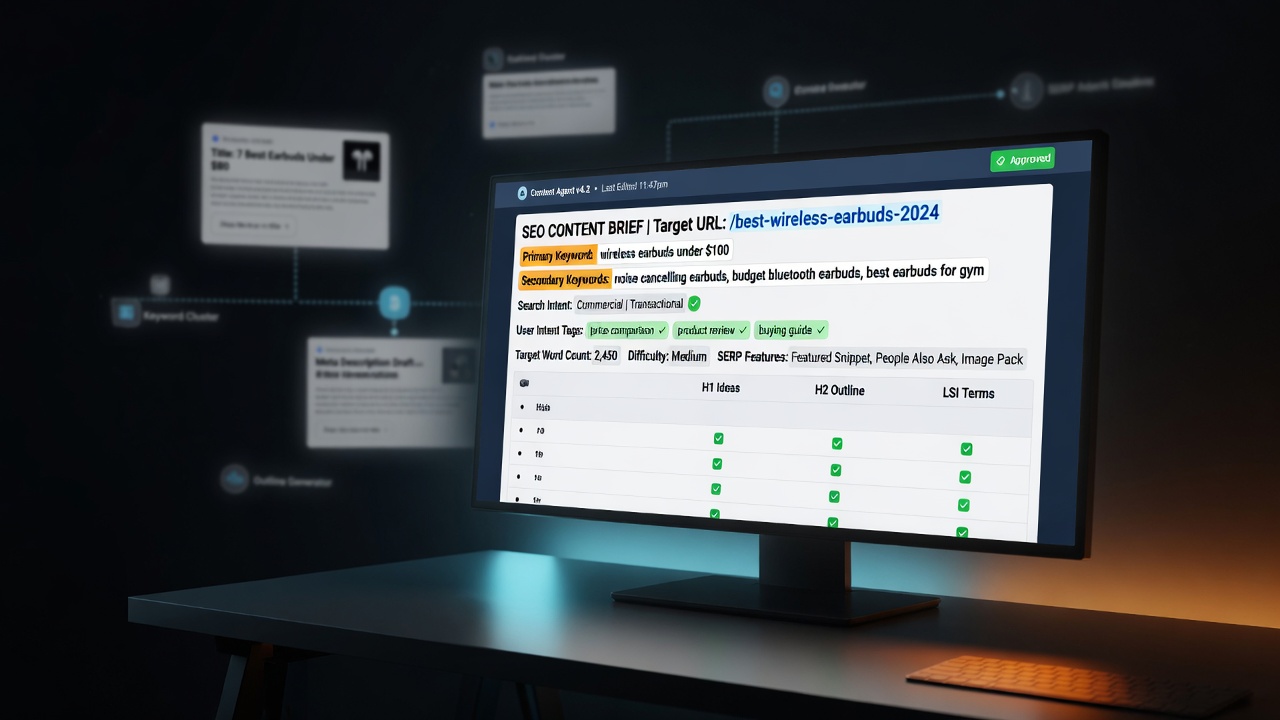
That closed hybrid system starts with an explicit map of every stage so nothing is left as an orphaned handoff. Keyword clustering feeds structured briefs; briefs constrain E-E-A-T-gated drafting; drafting only clears technical gates for schema and Core Web Vitals before publish; published pages enter continuous monitor-and-refresh cycles; those same pages surface in-article chat paths that capture intent, guide navigation, and open monetization; GEO citation signals are engineered into every piece so generative engines can quote it; and revenue attribution closes the loop by tying chat engagements and conversions back to the original cluster. When the sequence is written down and instrumented end-to-end, automation stops being a pile of disconnected prompts and becomes a commercial engine.
The decisive difference is how AI is embedded. Companies that integrate AI into redesigned, structured workflows see 40% higher productivity than teams that simply bolt prompts onto existing habits; high performers are three times more likely to have fundamentally restructured their processes rather than treating AI as an optional add-on. Bolt-on tools and one-off agents produce volume; an explicit loop produces compounding returns because every stage hands clean context to the next and every output is measured against the same revenue line.
Where humans stay in the loop
Strategy, original insight, brand-voice encoding, and final trust validation remain human-owned. AI accelerates clustering, brief assembly, first-draft generation, schema injection, decay detection, and refresh recommendations. People still decide which clusters matter commercially, inject proprietary data or lived experience, lock the voice templates that keep programmatic pages on-brand, and sign off on E-E-A-T before anything ships. That division of labor is what lets teams capture the step-change gains in production speed and ranking velocity without sliding into thin, unrecoverable pages.
Once the loop is visible and measured, production speed and ranking velocity stop being vanity metrics. Hours saved on briefs, dwell time inside the in-article chat, chat-attributed conversions, AI Overview citations, and true cost-per-published-piece all become visible levers. The blueprint is therefore not a technology shopping list; it is the operating system that turns AI SEO automation into scalable content, durable rankings, and attributable revenue.
Closed hybrid loop — Map every stage from clustering through chat monetization and revenue attribution, keep strategy and trust gates human-owned, and restructure processes around AI rather than bolting it on; only then do production-speed and ranking-velocity gains materialize.Where to Automate First: High-Leverage Stages That Pay Back in Hours and Rankings

That operating system only works when you fund the stages that actually multiply hours and rankings—not the ones that feel easiest to switch on. Keyword clustering, brief generation, on-page and schema packaging, decay detection, and refresh triggers sit at the top of the leverage stack. Each one removes repetitive work that used to burn senior time while simultaneously feeding cleaner signals into rankings and later revenue attribution.
Manual briefs alone expose the gap. An SEO lead still building them by hand typically spends two to three hours per brief. Automated brief generation compresses that work to minutes. Across a modest twenty-article monthly calendar, the difference returns forty to sixty hours—time that can move straight into strategy, original insight, or quality gates instead of template filling.
Before: an SEO lead spends 2–3 hours crafting each content brief by hand, limiting a small team to a handful of well-briefed pieces per week. After: the same brief pipeline runs in minutes, freeing 40–60 hours a month on a 20-article calendar so humans can focus on angle, evidence, and final trust checks while volume and consistency rise together.Even lean budgets see the compression immediately. When AI cuts overall content production time by roughly half, teams reclaim twenty-plus hours every week at a very low monthly tool cost. That is not theoretical efficiency; it is calendar time that compounds into more clusters processed, more decay caught early, and more pages refreshed before rankings slip.
What stays human until the gates prove stable
Full autopilot still belongs later. Angle selection, expert anecdotes, any claim that could be contested, and final publish approval should remain human-owned until the E-E-A-T, schema, and performance gates have run cleanly for long enough to trust. Automating the high-leverage production layers first builds the capacity and the measurement surface; only then does expanding autonomy become safe rather than risky.
Leverage before ease — Automate clustering, briefs, packaging, decay detection, and refresh first; those stages return the most hours and ranking power per dollar while strategy, anecdotes, and final approval stay human until quality gates are proven.Hard Quality Gates That Keep High-Volume AI Content Earnings-Safe
Those same production layers only stay safe at scale when quality itself is encoded as non-negotiable gates rather than after-the-fact polish. Brand voice rules, claim-verification requirements, mandatory unique-value blocks, and source thresholds must sit in the pipeline as hard stops before publish. If a draft fails any of them, it never reaches the live calendar—no exceptions for speed.
Pair those policy gates with automated scanners that catch the volume-specific failure modes: thin sections that lack depth, missing or weak entity coverage, titles that underperform intent, absent or incomplete schema, and near-duplicate introductions that recycle the same opening across a cluster. These checks run on every draft so the risk surface stays visible instead of surfacing only after rankings drop.
Case patterns confirm the payoff of this hybrid discipline. Bankrate generated approximately 125,000 monthly organic visits from more than 162 AI-generated articles produced in six months—all ranking on page one after consistent human review rather than raw autopublish. The drafts moved fast; the gates and review kept them citation-worthy and algorithm-safe.
Design review so one editor clears the calendar
The human layer must scale with the machine layer or it becomes the new bottleneck. Give every editor a simple rubric that scores voice fidelity, evidence density, uniqueness of insight, and source completeness in minutes. Run automated spot-checks on a fixed sample of the queue; escalate only the pieces that fail a gate or carry contested claims. Everything else clears on the rubric score alone. One focused editor can then protect an entire niche calendar without reading every sentence line-by-line, preserving production-speed gains while the earnings risk stays contained.
Hard quality gates — Encode voice, claims, unique value, and sources as publish blockers, automate thin-content and schema checks, and let one editor clear volume with rubrics and escalate-only rules so AI scale never outruns trust or revenue.
Multi-Agent Crews That Recover Rankings Continuously
With quality gates already protecting earnings, the real scale unlock comes when generation itself stops being a single black-box step. Split the work across dedicated research, brief, draft, on-page, and refresh agents, each operating under explicit handoff contracts. The research agent delivers clustered entities and SERP patterns; the brief agent turns those into angle, outline, and source lists; the draft agent produces the first pass against voice and E-E-A-T rules; the on-page agent packages schema, internal links, and markup that supports Core Web Vitals; the refresh agent owns decay response. Because every handoff is a typed contract rather than free-form chat, failures stay localized and auditable instead of cascading through an opaque generator.
Decay Alerts That Launch Refresh Crews
Continuous optimization is what turns a one-time ranking win into durable revenue. Rank and traffic decay alerts automatically trigger a refresh crew: the research agent pulls fresh entities and competitor moves, the draft agent inserts updated examples and supporting detail, and the on-page agent rewires internal links and schema. The piece republishes with a clear change log so both search engines and human reviewers see the signal of active maintenance.
Agents handle monitoring and first-pass fixes—flagging thin sections, missing entities, or outdated claims—but crawl data, log-file analysis, and link-risk decisions stay on proven SEO platforms. That division keeps the crew fast without inventing new sources of technical debt or second-guessing specialized tooling.
Generic autoblogging stacks stop at publish. Multi-agent crews form the recovery layer those stacks omit. They protect the revenue that arrives after the first ranking win by treating every live URL as a living asset that can be re-optimized the moment performance slips. In the closed hybrid loop, that continuous recovery is what converts early traffic into compounding rankings and attributed dollars rather than a one-time spike that quietly erodes.
Multi-agent crews — Specialized agents bound by explicit handoff contracts turn one-shot publishes into continuous ranking recovery, the protective layer generic autoblogging stacks leave out after the first win.In-Article Chat and GEO Signals: The Loop’s Revenue Multipliers

That living-asset mindset does not stop at refresh crews. Once a URL is ranking and recovering, the closed hybrid loop still has to convert attention into longer sessions, clearer paths, and attributed dollars—and that is where native in-article AI chat and generative-engine optimization (GEO) signals earn their place.
Treat the chat layer as infrastructure, not a gimmick widget. Embedded inside the article, it answers follow-up questions in the reader’s context, surfaces related clusters, and routes qualified intent toward demos, trials, or product pages without forcing a bounce to search again. Guided Q&A keeps the session on-site; product paths and clarification prompts turn passive skimmers into assisted buyers. The same content that won the SERP now works as a navigation and monetization surface, so dwell, pages-per-session, and assisted conversions become first-class SEO outcomes instead of afterthoughts.
Engagement lifts compound when every piece is built for both classic rankings and on-page assistance. After AI-driven keyword and content optimization, STACK Media recorded a 61% increase in website visits and a 73% reduction in bounce rate—the kind of dual movement that appears when structure, entities, and helpful on-page guidance reinforce each other. Readers who can resolve the next question without leaving stay longer; longer sessions feed stronger behavioral signals back into the ranking systems you already monitor.
Why GEO signals belong in every automated template
Zero-click pressure makes those signals non-negotiable. AI-referred sessions grew 527% year-over-year while 60% of Google searches now end without a click to any website. At the same time, deliberate strengthening of trust, structure, and schema has driven AI referral traffic from LLMs up over 700% year-over-year, with pages surfacing in as many as 157 AI Overviews. Clear entities, citeable facts, consistent schema, and visible trust pages are no longer optional extras—they must ship inside every automated template so the same brief that feeds the draft also feeds generative engines.
Finally, instrument what the loop actually produces. Track chat-assisted conversions, AI-overview appearances, and AI-referred sessions alongside classic rank and traffic. Only then is SEO automation judged on revenue contribution rather than rankings alone—and only then does the hybrid system prove it scales content, rankings, and revenue in one continuous circuit.
Chat + GEO close the loop — Native in-article AI chat turns ranked pages into navigation and monetization layers, while mandatory entity, schema, and trust signals win both classic SERPs and surging AI referrals so automation is measured on attributed revenue, not traffic spikes.The Math That Closes the Loop: ROI Benchmarks and a 90-Day Calculator
That revenue lens is what turns the hybrid loop from a content engine into a business system—and the math is straightforward enough to run before you scale any niche calendar. Anchor expectations first with what marketers already see when AI sits inside a real workflow rather than as a bolt-on.
Marketing teams using AI reclaim 5 to 12 hours per week per marketer. Sixty-eight percent of businesses report increased content marketing ROI from AI, and 65% report an uplift in SEO performance. Those figures set the floor: time returned and measurable lift are common outcomes once the loop is closed, not outliers reserved for enterprise stacks.
Public cases supply planning bands, not guarantees. Rocky Brands recorded a 30% increase in search revenue, 74% year-over-year revenue growth, and a 13% rise in new users after adopting AI SEO tools. A real-estate site grew organic traffic 80% in four months, then doubled from 2,381 to 5,442 visits in a year while placing more than 700 keywords on page one. Treat the ranges as stress-test boundaries for your own projections—useful for sizing opportunity, useless as copy-paste targets.
A one-line model that mirrors the full circuit
Build the calculator from the same stages the loop already runs:
- Hours reclaimed × loaded hourly rate
- + chat-attributed revenue
- + incremental organic and AI-referral value
- − tool stack and human review cost
The net figure is the only ROI number that matters. Plug in your actual loaded rate, the chat conversion rate you instrumented in the previous stage, and the organic lift you expect from ranking-velocity gains. Everything else—vanity traffic, raw article counts, tool feature lists—drops out of the equation.
For a low-KD niche calendar, lock four 90-day targets that keep the system honest: stable cost-per-article (tools plus review minutes), ranking velocity (share of new URLs reaching the top 20 inside the window), chat engagement rate (sessions that open the in-article assistant), and revenue per session (classic conversions plus chat-assisted). Hit those four and the closed hybrid loop has proven it scales content, rankings, and revenue in one continuous circuit. Miss them and you know exactly which gate—brief quality, E-E-A-T review, refresh cadence, or GEO packaging—needs the next iteration.
ROI is a closed-loop equation — hours reclaimed times loaded rate, plus chat and incremental organic/AI-referral value, minus tool and review cost. Use published ranges only as planning bands, then lock 90-day targets on cost-per-article, ranking velocity, chat engagement, and revenue per session.Key Takeaways
Audit one content cluster against the closed hybrid loop this week, automate its highest-leverage stage, and add instrumented in-article chat so your next publish starts compounding rankings into revenue.
Frequently Asked Questions
It is a closed workflow that moves from keyword research and clustering through brief generation, gated AI drafting, technical/schema checks, publishing, performance monitoring, content refresh, and generative-engine optimization—plus optional in-article chat for clarification and monetization—rather than isolated AI writing tools.
AI-driven SEO methodologies consistently deliver 2-3x faster content production and 40-60% improvement in ranking velocity compared to traditional approaches when quality gates stay in place.
Keep strategy, original insights, brand voice encoding, and final E-E-A-T validation human-led. Automate clustering, brief generation, on-page/schema assembly, and decay detection first so reviewers spend time on judgment, not assembly.
Track hours saved on briefs and production, cost per published piece, engagement and dwell from in-article chat, chat-attributed conversions, AI Overview citations, and ranking velocity—not vanity traffic alone.
Generative engine optimization strengthens entity clarity, structure, schema, and cite-worthy passages so content surfaces in AI Overviews and LLM answers. Baking those signals into every automated article protects visibility as more searches end without a click.
Yes. Structured pipelines compress brief work from hours to minutes, reclaim dozens of hours monthly on modest calendars, and let solopreneurs and small agencies scale topical coverage while human gates keep quality penalty-resistant.
You Might Also Like