Update vs Rewrite: A Decision Rule for SEO Articles

The useful question is not whether an old article should be touched. It is whether the page still has a sound foundation. Across 719 editorial pieces, Fractl found the typical article reached peak traffic a median of four months after publishing, then lost about 76% of that peak within three months. Decay is normal. A full rebuild is not the default response to it. Update when the bones still hold. Rewrite only when they do not. If the core argument still matches search intent and most of the page is still accurate, a surgical update on the same URL is the right job. Artikle’s salvage test is a practical line: if more than 60% of the post is still accurate and well written, update it; if less than 40% is worth keeping, a rewrite is faster than patching. A thin page that can no longer compete with the format now ranking is a separate reason to rebuild, not part of that percentage test. A changed date, a few new sentences, or a new slug is not that decision. Small edits do not count as a refresh, and a new URL throws away the equity the work is meant to protect. The rest of this article is the fail-closed rule for choosing update, rewrite, or leave alone — and for refusing automation that would publish a rebuild without a human gate.
- Default to a surgical update on the same URL when the argument, intent, and most of the page still hold.
- Rewrite in place only when less than about 40% is worth keeping, the structure is broken, or the SERP format has shifted.
- A date change or a tiny word-count tweak is not a refresh; meaningful expansion is what studies associate with gains.
- Never change the slug to start over. A same-URL rewrite can still dip for a few days while Google re-evaluates the page.
- Queue pages in roughly positions 4–20 that already earn impressions. Pages with no demand are a leave-alone or consolidate call, not a rewrite.
Update vs rewrite: what you keep
An update keeps the argument, the structure, and the URL, and replaces only what went stale. A rewrite rebuilds the piece in place because the foundation no longer matches the query. How much of the original is still worth keeping is what separates the two.
If more than 60% of the post is still accurate and well written, do a surgical update. If less than 40% is worth keeping, a rewrite is faster than editing. Refresh when the bones are solid and only examples or stats are stale. Rewrite when the structure is broken, positioning has shifted, or a thin post cannot compete with the guides now ranking.
Do not use a word-count jump alone as the test. Salvage is whether the core claim still answers the query.
The split — Keep the same URL and update when most of the page still answers the query; rewrite in place only when the foundation is broken.
When should you update a ranking page instead of rewriting it?

With that split in place, update the ranking page when search intent and the core argument still hold and the salvage test passes. Do not rebuild a sound page just because it is old. A full rewrite is the right call only when the foundation is broken.
That restraint is what the gains come from. Workshop Digital compared 95 refreshed pages with untouched controls and saw organic sessions rise from 610 to 3,341, a 447.7% lift, while controls fell 20.2%. Across 41 blog refreshes, most were not complete rewrites, and sessions rose 545.1%.
The rule — Keep a ranking page and update it when the argument still fits the query. Rewrite in place only after the foundation breaks, and never mint a new URL for the same intent.
90-day session index (start = 100)
Should a Rewrite Stay on the Same URL?
Yes. Keep the slug even when you rebuild the page. Changing the URL during a rewrite is the most common mistake: a new slug breaks internal links and drops the backlink equity this decision is meant to protect.
A same-URL rewrite can still dip 5 to 15 positions in the first 72 hours while Google re-evaluates the page. Expect the dip. Do not fix it by moving the URL or publishing a second page.
When the salvage test passes, the lower-risk path is the surgical update. A successful one typically moves a post 3 to 8 positions and lifts organic clicks 15% to 40%. Cosmetic edits can also fail to help. The risk is changing what Google already trusts, not touching a stale fact on a sound page.
Keep the slug — A rewrite stays on the original URL. A short ranking dip is normal; a new slug or a second page throws away the equity you are trying to keep.
How long a surgical update takes, and which positions are worth updating

Budget the path the salvage test already chose. About 70% of a consultant refresh queue is surgical work at 60 to 90 minutes; about 30% is a rewrite at 3 to 5 hours. If the foundation still holds, do not schedule the longer block. If the structure is broken, a 90-minute pass will not fix it.
Positions 4 to 20 are where that refresh work pays off fastest. Pages in that band are the update queue; thin pages that cannot match the current SERP format are the rewrite queue. A same-topic net-new page typically takes months to match an existing URL’s signals, so spend the hours on the URL you already have.
Queue the hours — Match the clock to the salvage result: 60 to 90 minutes when the argument still holds, 3 to 5 hours only when the structure is broken, and put the effort on positions 4 to 20 rather than a new URL.
Minutes: surgical update vs rewrite
Does a date change count as a refresh, and how do you know it worked?

Once a page is in the update queue, the next mistake is treating a new publish date as the work. It is not a refresh, and neither is a 0 to 10% word-count tweak. Studies associate gains with meaningful expansion, not a cosmetic stamp.
In a controlled study of 14,987 URLs, a 0 to 10% change averaged a 0.51 position loss and an 11 to 30% change averaged a 2.18 position loss. Expanding 31 to 100% gained 5.45 positions on average, while never-updated pages lost 2.51.
Across 103,000 refreshes, refreshed URLs averaged 28% Google pageview growth versus 9% for matched pages that were not refreshed, a 19-point lift. By size of change, 0 to 10% edits averaged 2% growth, 11 to 30% and 31 to 100% averaged 11%, and rewrites that more than doubled word count averaged 44%.
Image changes were associated with a 14% pageview increase across 28,000 pages. Title changes and paragraph-count changes each averaged 11%. Treat those as associations, not proof that one element caused the gain.
Judge the edit after the page is reindexed and the new version has had time to settle. A rewrite can take longer to stabilize than a surgical update. Do not call a new date a win.
Not a refresh — A date change or a tiny word-count tweak is not a refresh. Call it a win only if positions or pageviews move after reindex, not because the timestamp did.
Pageview lift tied to on-page edits
Check content decay before you rewrite
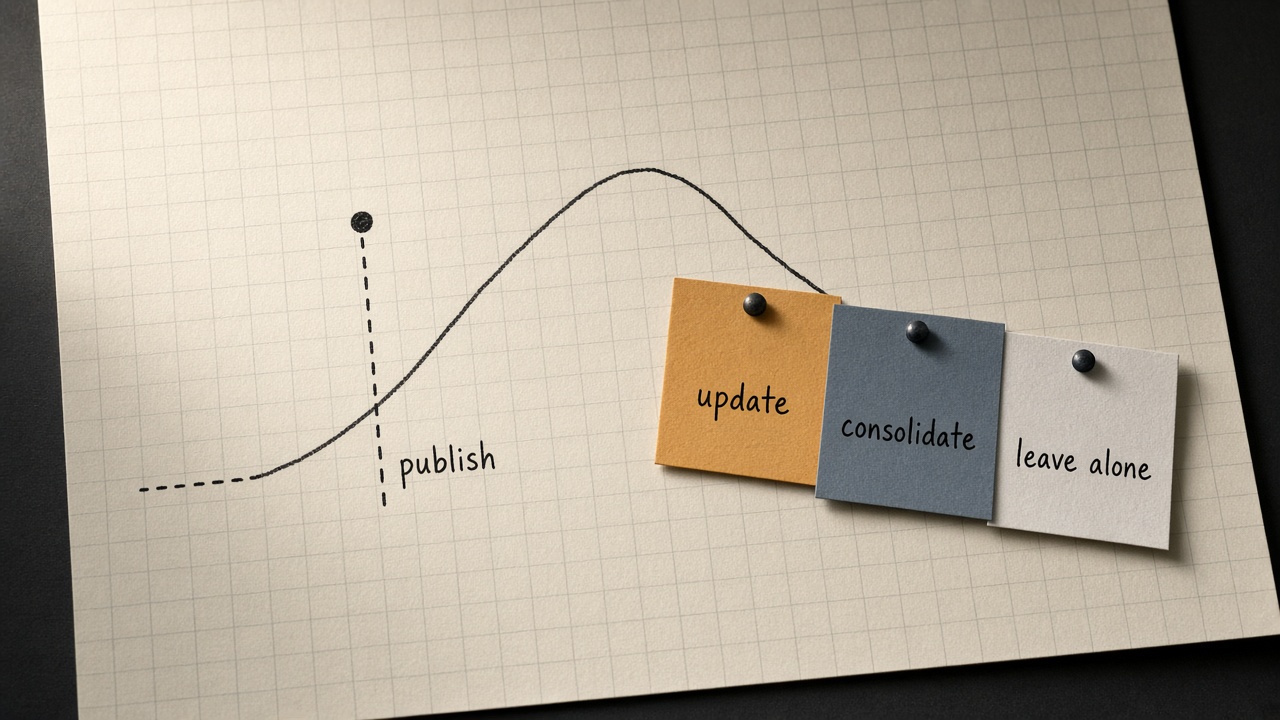
Run the decay-signal check before you choose a rewrite, so you do not rebuild a URL that is losing clicks for the wrong reason. That diagnosis lives on the Search Console checklist — use the result, and do not treat a traffic slide as a broken foundation.
The Fractl sample also splits by format: how-to content lost 61% of peak traffic, listicles 82%, and research and data pieces 89%. That spread means the rule is recurring work, not a one-time rebuild.
Consolidate or leave the URL alone when there is no demand, or when another URL already owns the intent. No impressions and no query match is a leave-alone or consolidate call, not a rewrite. Whether to brief a new page lives on the refresh calendar — do not spawn a competing page from this decision.
Diagnose first — A click drop is a reason to diagnose decay, not to rebuild. No demand means leave the URL alone or consolidate it.
Peak traffic lost within 3 months
How AI search freshness changes the update versus rewrite decision

AI search freshness raises the cost of leaving a sound page stale. It does not justify a full rewrite when the angle still matches the query.
AirOps reported that 95% of pages cited by generative-AI systems were updated within the last 10 months. Pages with a visible last-updated timestamp earned 1.8 times more citations than those without, and pages not updated in more than a year were more than twice as unlikely to be cited.
Update facts, examples, and extractable answers. Rewrite only when the angle no longer matches the query. An autoblogging system may draft that surgical update on a URL that already passed the salvage test. It must not publish a rewrite, change the slug, stamp a new date on an unchanged page, or create a competing URL without a human gate.
Freshness — AI citation freshness makes a sound page more expensive to leave stale. The response is still a surgical update of facts and extractable answers, not a rewrite or a date stamp.
How to brief a writer or AI after you choose update or rewrite
The brief starts where the decision ends. Name the mode first — surgical update or same-URL rewrite — and do not ask the writer or the model to choose again.
For an update, list the sections to keep, the facts and examples to replace, and the extractable answer to refresh. For a rewrite, state the broken foundation, the new structure, and the URL and intent that must not change.
Automation may draft the update; a human must approve any rewrite before publish. Stop at that handoff, and point the writing contract to your existing article-writing and AI-writer guidance instead of rebuilding those briefs here.
Key Takeaways
Run your next ranking URL through the foundation test, then brief a surgical update or a same-URL rewrite before anyone changes the slug or publishes a competing page.
Frequently Asked Questions
You Might Also Like
- Measurement Content Decay Signals: What to Check Before You Rewrite a Ranking Page
- Workflows Content Refresh Strategy: How to Update Pages So Rankings Do Not Decay
- Workflows Content Refresh Calendar: When to Update vs When to Brief a New Page
- AEO How to Write SEO Articles That Survive AI Overviews
- Comparisons AI Article Writer: When to Use One vs a Full Publishing System