AI Article Writer: When to Use One vs a Full Publishing System

If you already have an AI article writer, the useful question is not which tool is “best.” It is which job you are hiring: a first pass on a single URL, or a pipeline that researches, clusters, briefs, gates quality, publishes, and links internally. Treat the writer as a drafting engine. Treat a publishing system as everything around the draft that decides whether the page is worth existing. Google does not ban AI. Using generative AI for research and structure is fine. Generating many pages without adding value for users may violate scaled content abuse—the same policy that covers any factory of thin pages, AI or not. This article gives you a copyable decision matrix—volume job, uniqueness job, pipeline job—so you pick writer versus system without another tool roundup. Quality gates (source tracing, uniqueness, human judgment on high-stakes claims) are what separate helpful automation from thin scale.
- An AI article writer is a first-draft engine; a publishing system owns research, clusters, briefs, gates, CMS, and internal links.
- Google allows AI that adds user value; mass pages without value can violate scaled content abuse.
- Roughly half of new articles are primarily AI-generated, yet most Google rankings and AI citations still go to human-written pages.
- Use a writer for one-offs, variants, and first passes; use a system for topical clusters, cadence, and quality control.
- Original research and proprietary comparisons earn citations; generic AI posts mostly do not.
First-draft engine vs the rest of the publishing loop

That split—tool versus system—is the decision that actually matters. An AI article writer is a first-draft engine: prompt in, draft or variant out. It is useful for one-offs, rewrites, and first passes you will still edit. It is not the rest of the work that turns a page into something worth ranking.
A full publishing system is that remaining loop: research, clustering, briefs, uniqueness and source checks, CMS publish, and internal links. Hands-on tests of 10 popular AI SEO writers found they accelerate drafting but are not end-to-end SEO automation platforms. If you need an autoblogging definition, use a dedicated explainer; this section only draws the boundary so you do not confuse a draft tool with a pipeline.
Writer vs system — Reach for a writer when the job is a draft, a variant, or a first pass; switch to a full system when clustering, quality gates, CMS publish, and user value are the jobs that have to get done.
The line Google actually enforces

That distinction matters because the line Google enforces is not “AI or human.” Generative tools are treated as useful for research and structure; AI-assisted pages are not banned. What is policed is intent and value: producing a flood of URLs whose main job is to occupy ranking slots rather than help a reader.
Scaled content abuse is defined as generating many pages primarily to manipulate rankings, including with generative AI, without adding value for users. Using those tools—or similar ones—to ship volume that does not serve people may violate spam policy. Extra drafts are not the risk. Pages that exist only to sit in the SERP are.
Stay on that policy line. Plugin stacks, auto-blogger setups, and WordPress wiring are a different conversation. Here the operator question is simpler: does each URL earn its place with user value, or is it inventory for rankings?
Policy, not plugins — Google does not ban AI-assisted pages; it flags mass generation without user value. Draft volume is fine. Pages that exist only to occupy SERP slots are not.
Why more drafts rarely become rankings

The web is already flooded with generated copy. Primarily AI-generated articles now make up about half of what gets published, and that share has plateaued near 50% since early 2025. In Graphite’s Common Crawl sample, Q1 2026 sat at 49.9%. Ahrefs estimated that 74% of new pages in April 2025 contained some AI-generated content—so a little AI in the mix is the default, not an edge.
Volume still does not buy the SERP. Despite that publishing share, 86% of articles ranking in Google Search are human-written and only 14% are AI-generated. When those AI pages do rank, they are rarer at the top: only 7% of number-one results are AI-generated. Citations follow the same pattern. ChatGPT and Perplexity cite human-written pieces 82% of the time versus 18% AI-generated. More first drafts do not equal more rankings or citations; search and answer engines still concentrate on human-written pages.
The gap — Half the new web can be primarily AI-written and still lose rankings and citations to human-written pages—draft volume is not the ranking job.
A three-job matrix: when a writer is enough, and when you need a system
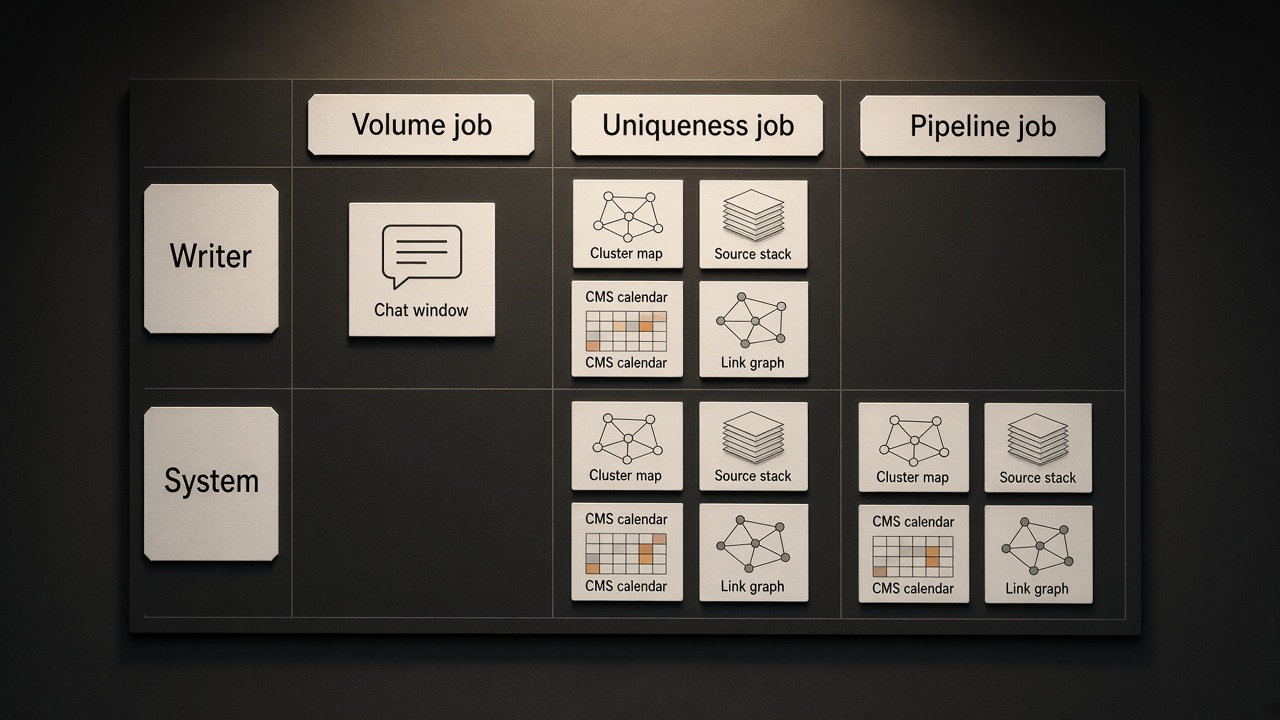
Once you treat ranking as a user-value problem rather than a draft-count problem, the choice between an AI article writer and a full publishing system stops being a feature comparison. It becomes three jobs. Match the tool to the job, and you avoid buying a chat window when you needed a pipeline—or standing up clusters when you only needed a first pass.
Volume, uniqueness, pipeline
Copy this matrix and score the work in front of you. Volume is drafts, variants, and first passes. Uniqueness is original research, proprietary comparisons, and claims only your team can stand behind. Pipeline is topical clusters, publishing cadence, CMS handoff, internal links, and quality gates that a single prompt cannot hold.
- Stay on a writer when the job is a one-off draft, a variant, or a first pass—and a human still owns the brief, the sources, and publish.
- Keep uniqueness with people: interviews, data you collected, and comparisons a model cannot invent.
- Switch to a full system when you need clusters, consistent cadence, and quality control that a chat window cannot remember from page to page.
Marketers already get the volume job. In an Ahrefs survey of almost 900 marketers, 87% used generative AI; AI content was 4.7x cheaper and teams published 47% more each month. That is useful speed, not proof the pipeline is solved. A 2026 operator frame puts informational posts in a 60% AI-assisted bucket with 50–65% time savings versus fully human production—again, drafting time, not index-ready systems.
The cut — Use a writer for volume when a human still owns brief, sources, and publish; use a system when clusters, cadence, and gates are the actual ranking work.
Quality gates that separate helpful automation from thin scale
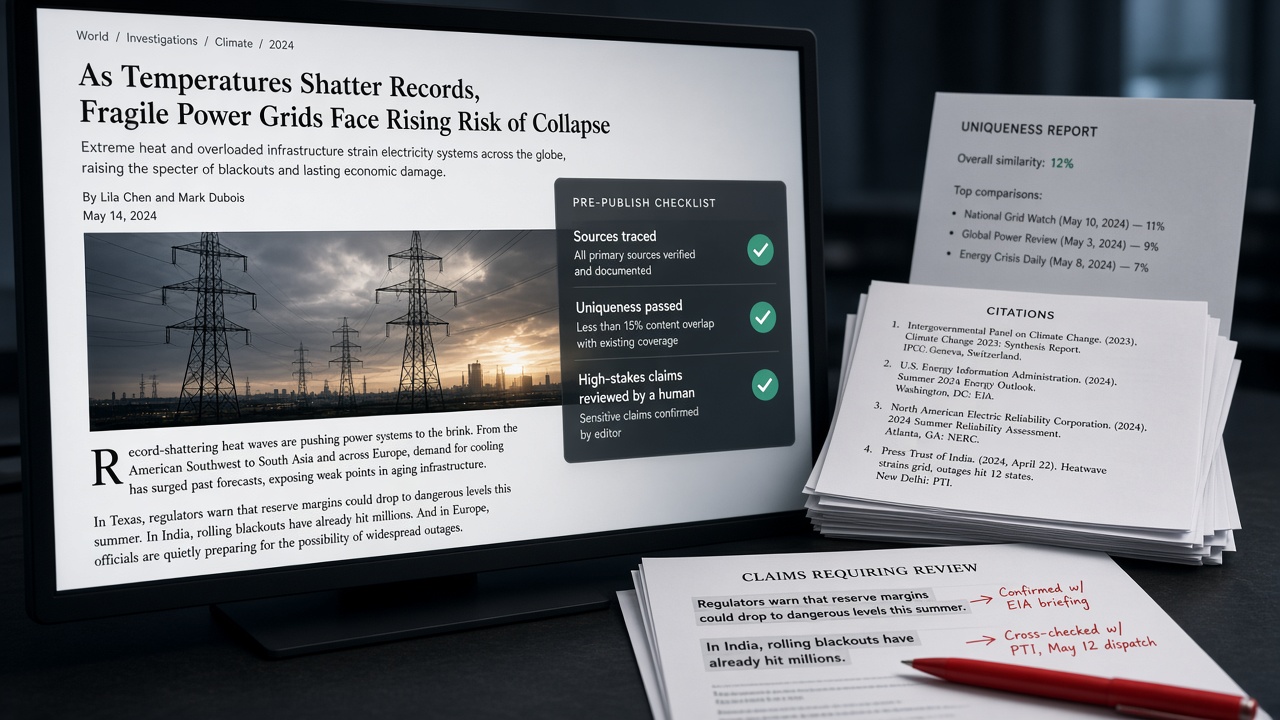
Once you know which job you are hiring for, the remaining question is what actually has to happen on every URL. A writer speeds the first paragraph. A publishing system is worth standing up when quality gates must fire at scale—not because you want more pages, but because ranking and citation still track user value.
The gates that matter are straightforward. Source tracing means every material claim can be walked back to a named origin, not a model’s average of the web. Uniqueness checks catch near-duplicates across a cluster so you are not occupying the same SERP slot ten ways. Human judgment sits on high-stakes claims—prices, medical or legal assertions, competitor facts—before anything hits the CMS. Those three steps are what keep automation from becoming thin scale.
Citation behavior makes the same point. NP Digital’s May 2026 survey of 500 marketers found original research scores 82% for AI-search citation performance versus 25% for generic blog posts. Original research is what earns mentions; interchangeable AI posts mostly do not. If you only need a faster first draft, keep the writer. If those gates have to run on every URL in a cluster, you need the full loop—research, briefs, checks, publish, links. Pipeline anatomy for autoblogging lives in a separate explainer; the decision here is whether quality, not volume, is the job.
The close — Use an AI article writer for first drafts; use a full publishing system when source tracing, uniqueness, and human review must run on every URL—because original research, not generic posts, is what gets cited.
Key Takeaways
If clustering, quality gates, CMS publish, and user value—not page volume—are the jobs you need to rank, move from a first-draft writer to a full publishing system.
Frequently Asked Questions
You Might Also Like
- Comparisons AI Blog Writer vs Autoblogging: Which Model Scales Content?
- Automation What Is Autoblogging? How Automated SEO Publishing Actually Works
- Strategy How to Scale Content Marketing Without Diluting Quality
- Automation SEO Automation: Tools, Workflows, and What to Automate First
- Comparisons Best SEO Automation Tools in 2026 (Compared by Job-to-Be-Done)