Topical Coverage Score: A Spreadsheet Check Before You Open Another Cluster
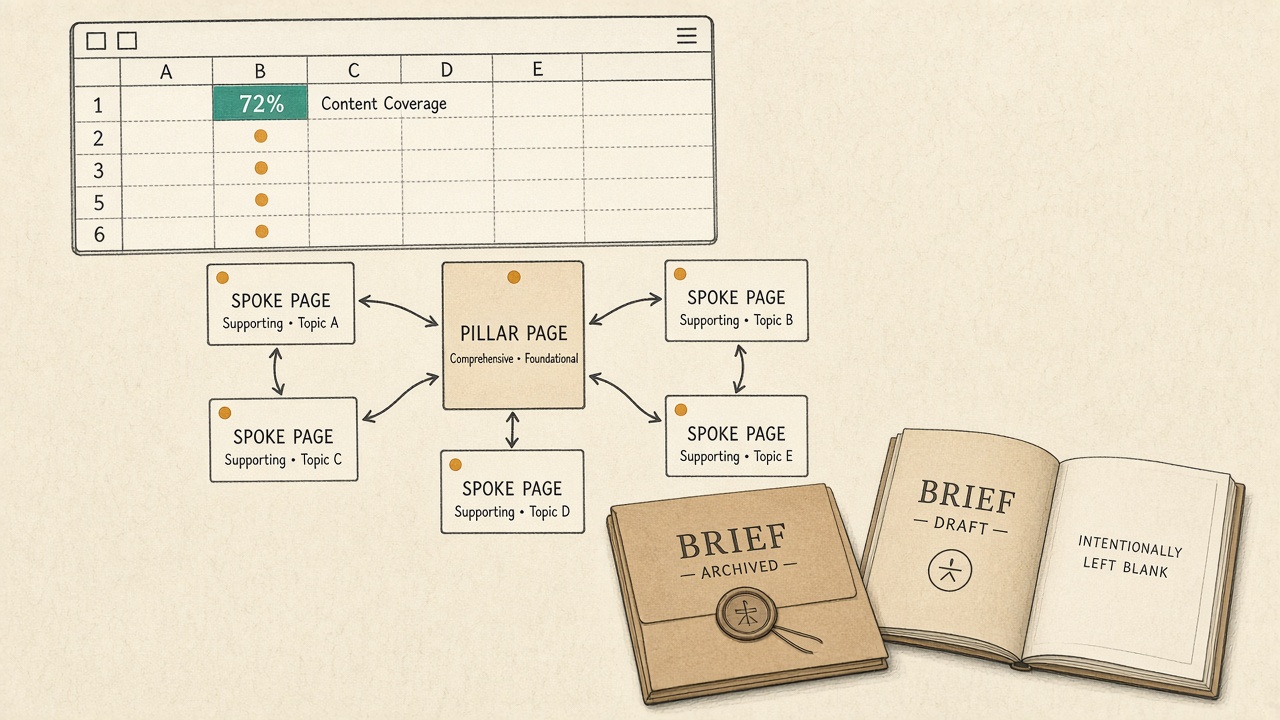
There is no topical authority score in Google Search Console. What you can measure is the map you control: unique intents in one subject, whether a live URL owns each one, and whether that page is indexed and linked both ways to the pillar. That distinction is the whole job of the sheet. Keyword variants are not coverage. A drafted URL that never indexed is not coverage. A page that never links to the pillar, or that the pillar never links back to, is a row that looks finished and is not. Below 40% of unique intents covered, the cluster has barely started. Between 40% and 70% it is still building. Above 70% is the earliest point to treat the subject as approaching the kind of comprehensiveness search engines associate with expertise — and only if the rows are real pages, not thin stubs. Open the next cluster only after this one clears. High map coverage with weak rankings means rewrite and link what you already have. Missing bidirectional links mean the cluster is not actually covered, no matter how full the keyword list looks.
- Google does not publish a topical coverage or topical authority score; proxy it with a sheet you control.
- Score unique intents, not keyword variants: one live, indexed URL that answers the intent and links both ways to the pillar.
- Treat the bands as a hold rule: under 40% unfinished, 40–70% still building, above 70% the earliest point to consider an adjacent cluster.
- Page-level content scores are a different job from a site-level cluster map.
- Do not open another cluster to chase volume while this one is thin, unindexed, or unlinked.
Topical Coverage Is Not the Same as Topical Authority
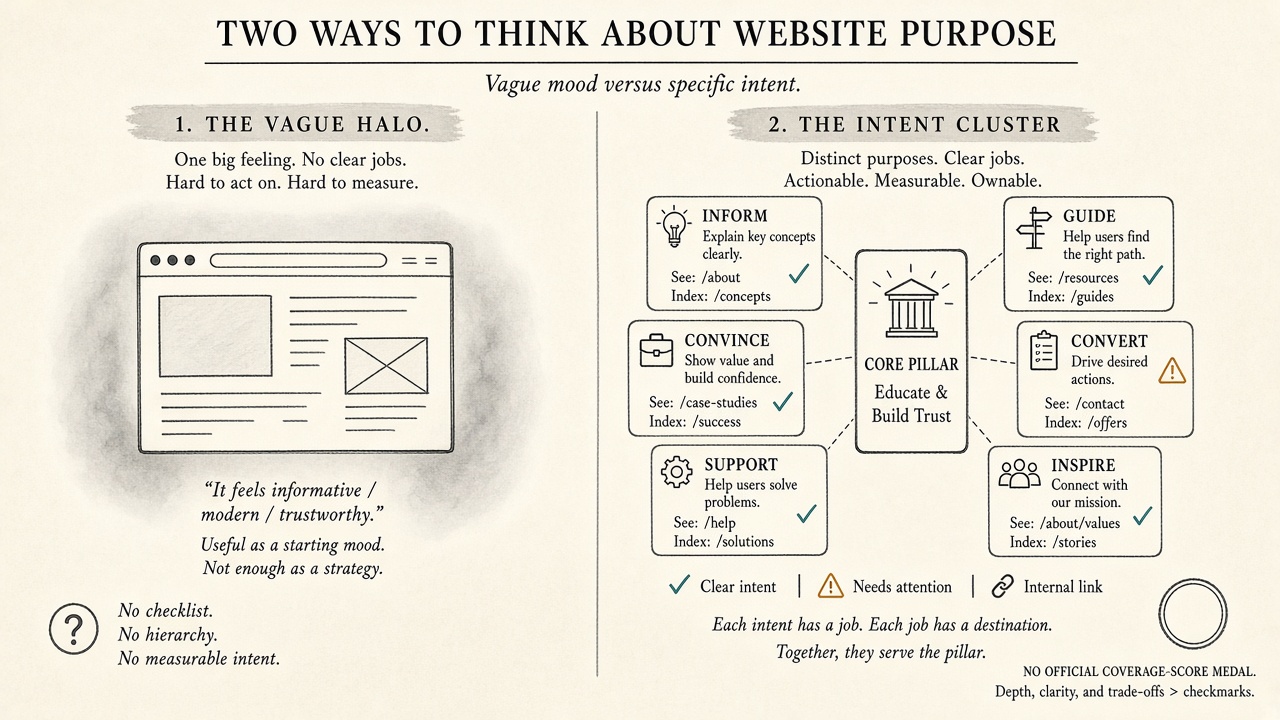
Topical coverage is the share of one cluster’s unique intents that already have a real page. Topical authority is the trust you hope that work compounds. They are not the same thing, and Google publishes neither as a Search Console score.
Coverage is the proxy you control. Authority is an outcome, not a cell you fill before the next brief.
The 2024 API leak describes siteFocusScore and siteRadius as site-level focus attributes stored with Normalized Site Rank data: overall topical coherence, and how far individual pages deviate from the main topic. Google confirmed the documents’ authenticity on May 29, 2024, and warned they were out of context. That is not a public coverage score, and not a reason to widen the site. Google’s May 2023 news topic-authority system is a separate news product, not this sheet.
If you want the trust-building path, use the topical-authority article. This piece only decides hold or go.
Hold the line — Coverage is a cluster-level proxy you can score and hold against; authority is an outcome Google does not publish, and leaked focus attributes are not a license to open the next subject.
Map Coverage, Ranking Coverage, and Topic Share Are Not the Same Check
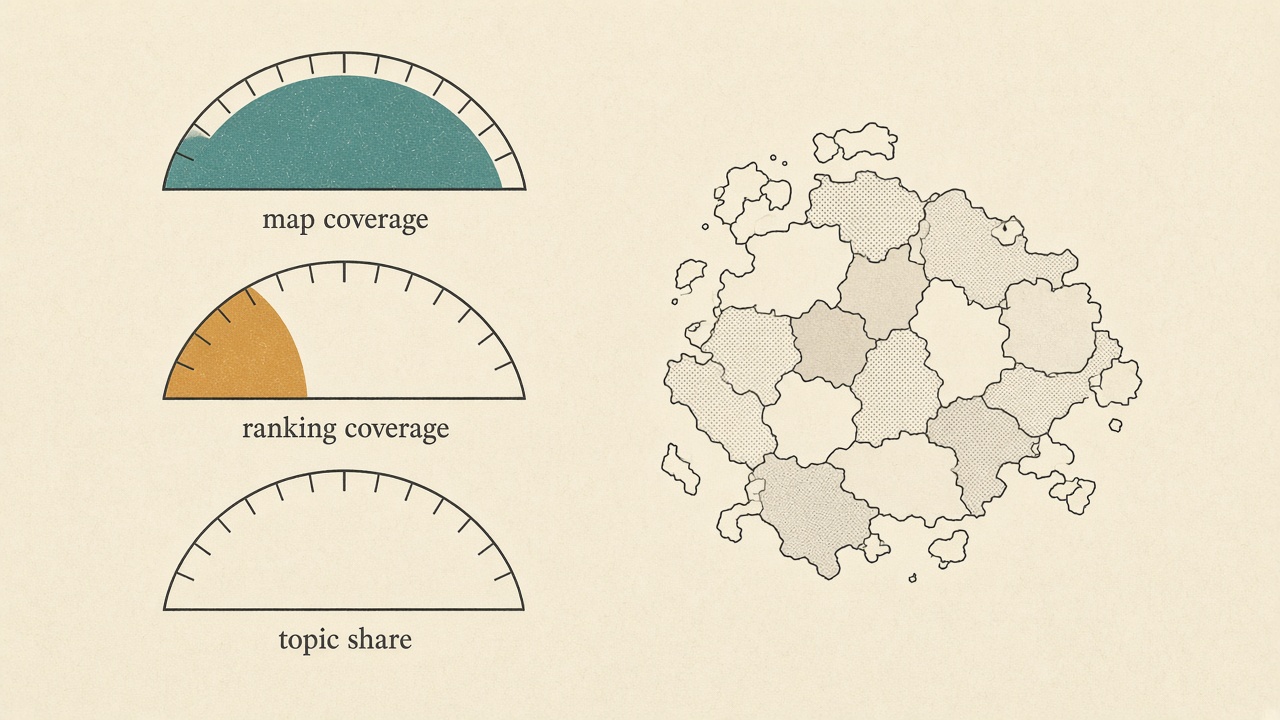
That missing public score is why the sheet splits three proxies — and why a Surfer Content Score is not any of them.
Map coverage is the share of the topical map that already has a published page. It is the only number you fully control. Ranking coverage is the share of that map where a page ranks in Google's top 10. Topic share is topic clicks divided by the map's search volume, and it should move last. No tool reports topical authority directly, so do not wait on rank trackers before you refuse a new cluster. A published page is not the hold by itself: it counts only once it is indexed and linked both ways to the pillar.
A Surfer Content Score is a 0–100 page metric whose SEO component includes topical coverage against top results. That is an on-page job, not a cluster map, and it cannot clear the next brief.
Hold metric — Map coverage is the hold metric, but a published page counts only once it is indexed and linked both ways. Ranking coverage, topic share, and page scores answer later questions.
How to Score Topical Coverage in a Spreadsheet Before the Next Brief
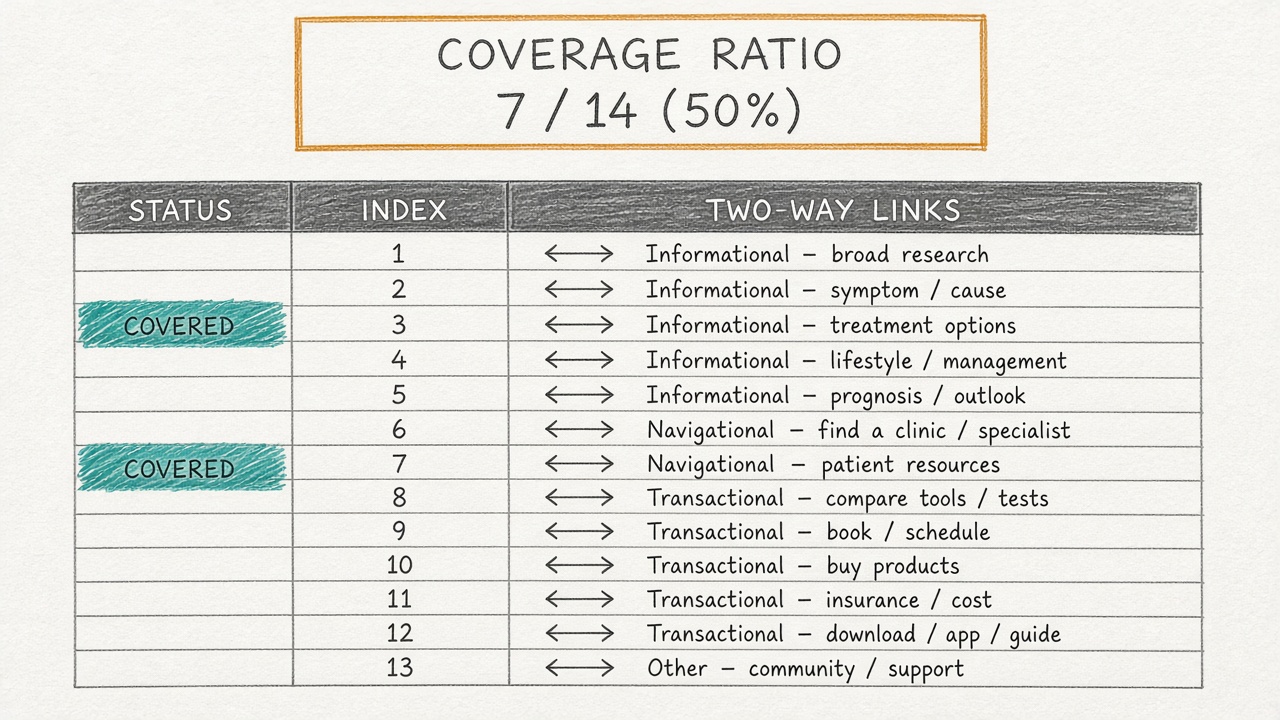
Page grades cannot clear the next brief, so the hold lives in a sheet. A topical coverage score is covered unique subtopics divided by total subtopics, after near-duplicate intents are collapsed. Keyword variants of the same question do not add rows: one row per intent, not per keyword. A simple tracking sheet is enough.
Yes/no fields for links to and from the pillar, plus that missing-page note, are the minimum. The decision cell is what makes the sheet fail closed.
Fail closed — Score unique intents, not keywords, and keep the next subject closed until a live, indexed URL links both ways to the pillar and the decision cell says go.
How Many Unique Intents Belong in One Cluster Before You Score It?
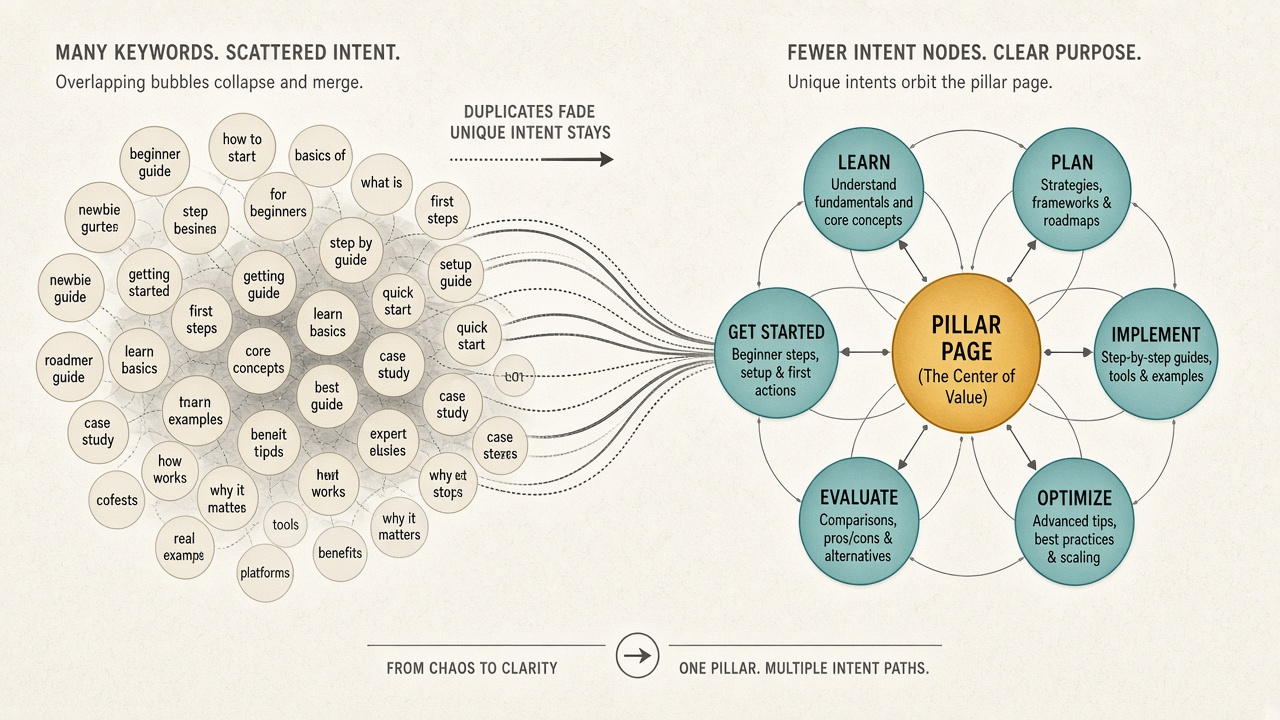
That decision cell only works if the denominator is a real cluster, not a keyword pile. Score the map you already have: one pillar plus about 6 to 15 spokes, one URL per search intent. Treat that as a practical plan, not a quota you invent, and leave the sizing debate to the pillar-count article.
Collapse near-duplicate wording before you divide. Two keywords, one intent, one row. Low-volume questions still count when they are a distinct intent a searcher or an answer engine would ask. Drop variants, not real questions, or the ratio flatters a thin map. If the denominator is still a keyword dump, you are not ready to score or to brief.
How to Mark a Subtopic Covered, Thin, or Missing
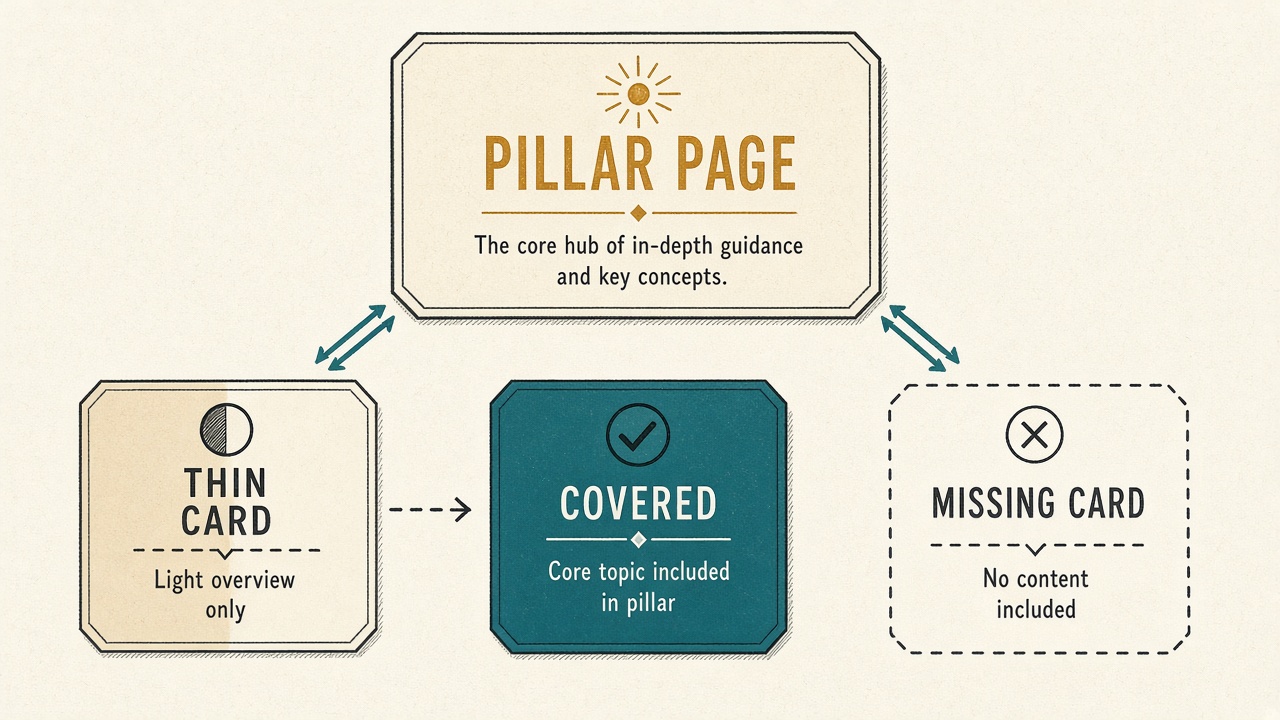
Once each unique intent is one row, mark it covered only when one live URL owns that intent, answers it, is indexed, and links both ways to the pillar. Anything less stays out of the numerator. A drafted, noindexed, or unlinked page does not count as covered, even if it already sits on the map.
Thin means a URL exists but the answer is a stub, the page is not indexed, or the pillar link is missing in either direction. Missing means a real question and no page at all.
An internal-link audit of 596 posts found 295 (49%) with no in-body internal links, so a mapped cluster can look finished when it is not connected. Raw coverage of those thin stubs is a false pass. Mark them thin and keep the decision on hold.
False pass — A mapped URL is not covered until it is live, indexed, answers the intent, and links both ways to the pillar — thin stubs stay on hold.
What Percentage Should Be Covered Before You Open Another Cluster?
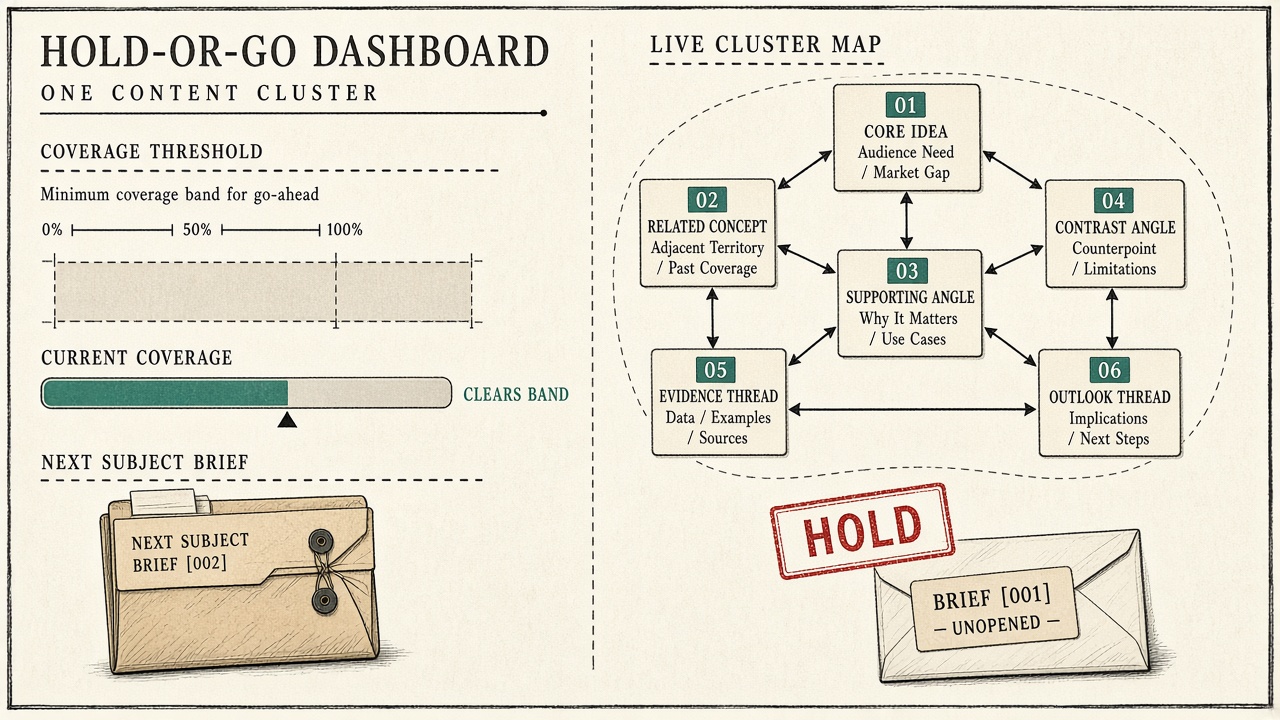
Once a subtopic stays out of the numerator unless it is live, indexed, and linked both ways, the percentage is a hold rule, not a grade. Under 40% the cluster is unfinished. From 40% to 70% it is still building. Above 70% is the earliest point to consider an adjacent cluster — and only then.
That bar only counts if the pages are real. Inbounder treats coverage above 70% as approaching the comprehensiveness search engines associate with expertise, and warns that raw coverage of thin stubs is misleading. Drafts, noindexed URLs, and unlinked stubs do not clear the next subject.
One product model defines cluster coverage as the share of that cluster’s keywords and prompts that already have an article, and bands a blended authority score as Leading at 75+, Strong at 50–74, Building at 25–49, and Early under 25. That is not this decision. Stay with the coverage bands. Rescore after each publish, merge, or index change, and again the day someone wants a new cluster. A stable live cluster does not need a weekly ritual. An empty queue is the right time for a full pass, not a reason to open a second subject.
Hold until 70% — Open an adjacent cluster only after more than 70% of this one’s unique intents are live, indexed, and linked both ways — then rescore on real changes, not on a calendar or an empty queue.
Coverage and Authority Thresholds
What to Do When Coverage Is High but Rankings Are Still Weak
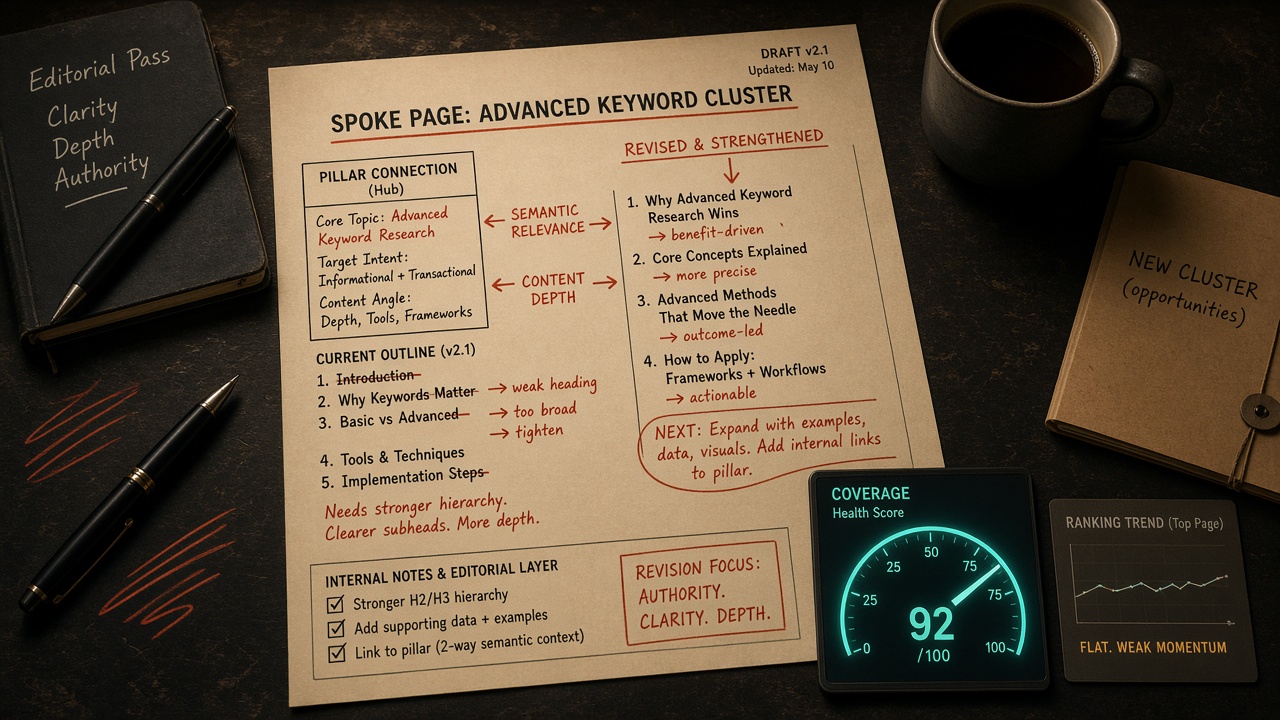
When rankings lag a map that already looks full, stay inside this cluster and strengthen the pages that own each intent.
Check ranking coverage and missing bidirectional links before you blame the subject. If the pillar links run only one way, those intents were never covered, and the next subject stays shut.
When a gap means prune or merge, not publish
- Two URLs share one intent.
- A thin spoke cannibalizes the pillar.
- The question is only a variant you already answered.
Publish only when the row is truly missing and the intent is unique. Otherwise the next brief widens the site instead of finishing it.
Fix first — Weak rankings on a covered cluster are a rewrite-and-link job. Prune or merge duplicate intents, and publish only a genuinely missing unique row.
How Topical Coverage Affects AI Citations
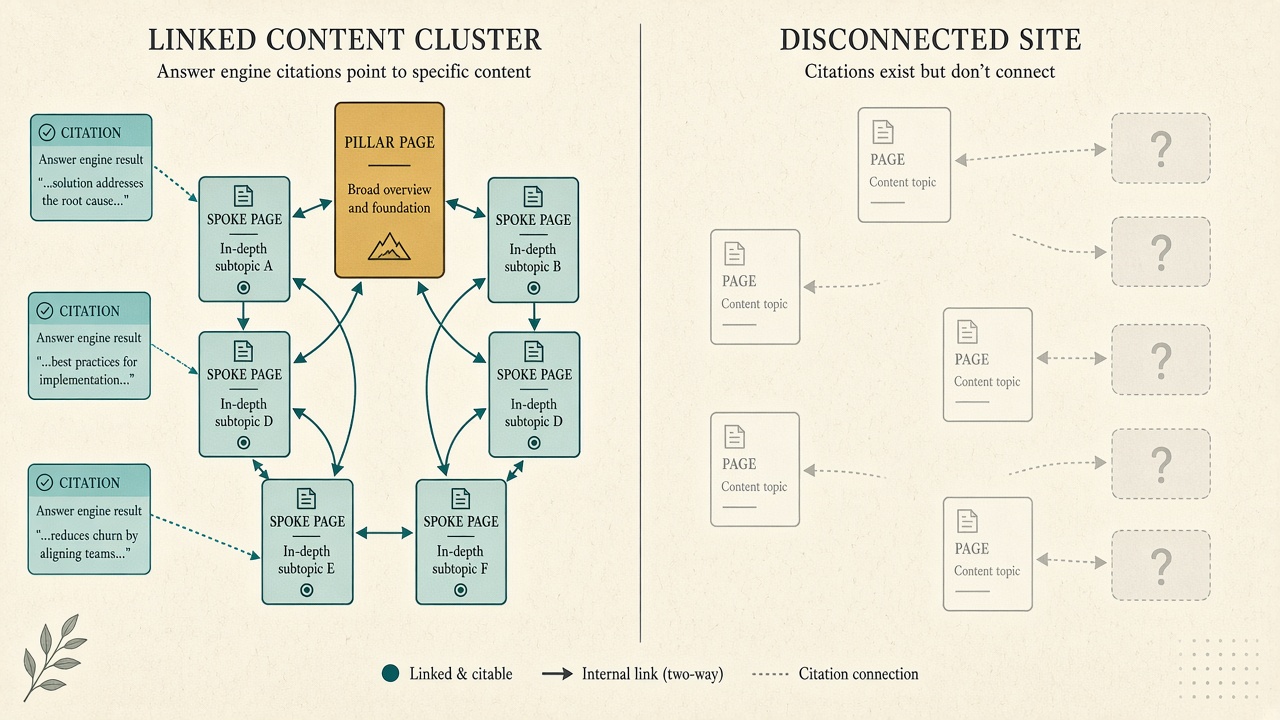
Answer engines cite pages they can find, so AI visibility lags the same sheet rather than unlocking the next cluster. Among 200 Outrank sites, 67% of those with fewer than 50 Google-visible pages had zero AI citations, and none of 110 sites with 400 or more visible pages had zero.
That breadth is not a license to spray clusters. A finished subject gives fan-out one live, indexed URL per intent, linked both ways to the pillar. Thin stubs stay out of the numerator and do not earn the citation. Topic share and AI citations move after map coverage clears the hold bar, not before it.
Lagging signal — Treat AI visibility as a lagging result of covered, indexed, connected intents — not as a reason to open another cluster.
AI Citation Presence by Site Size
Key Takeaways
Run the fail-closed sheet on your live cluster before you brief another subject, and use Flowcrews when you want that hold-or-go check handled with the next publish.
Frequently Asked Questions
You Might Also Like
- Guides How Many Cluster Articles Does a Pillar Need?
- AEO Topic Cluster Strategy: How to Map Pillars That Compound Rankings
- Strategy Topical Authority for a New Site: How Lean Teams Compound Trust Without a Link Budget
- Measurement Citation Share of Voice: A Simple Score for Lean Content Teams
- AI Search AI Overview Citation Patterns: What Gets Quoted vs Ignored