Topical Authority for a New Site: How Lean Teams Compound Trust Without a Link Budget

A new site without a link budget does not fail topical authority by being unknown. It fails by widening. Google's people-first guidance asks whether a site has a primary purpose or focus, and treats lots of content on many different topics — including content produced with extensive automation — as a warning sign, not a growth plan. There is no public ranking factor simply named topical authority for the whole web. The system Google has named is news topic authority, announced in May 2023, and it applies to newsy queries in areas such as health, politics, and finance. What a lean team can actually run is narrower: a substantial, complete description of one subject, real expertise, and pages that stay inside that subject. E-E-A-T is not itself a ranking factor; of its four aspects, trust matters most. That is the first year's job. Finish one cluster, score the questions a specialist would expect to find, and refuse the next pillar until those pages are covered and internally linked. Coverage inside a niche can beat raw domain strength — Ahrefs cites a specialist e-bike retailer at DR 15 outranking Amazon at DR 96 on competitive e-bike queries — but that result came from owning a subject, not from spraying topics. Plan on 6 to 12 months, often with about 15 to 20 well-connected pieces in a specialized niche.
- Google does not publish a general ranking factor called topical authority; the named system is limited to newsy queries.
- Public guidance rewards a primary focus and a complete treatment of one topic, and warns against many topics and heavy automation.
- A specialist can outrank a much stronger generalist inside a niche it owns, but backlinks still matter.
- Expect 6 to 12 months, and about 15 to 20 connected pieces for a narrow niche — not a fixed article quota.
- Do not open a second subject, or a URL for every sub-question, until the first cluster is finished and linked.
What Is Topical Authority in SEO, and How It Differs from Domain Authority

Topical authority in SEO is demonstrated focus and complete coverage of one subject, not a general ranking factor Google publishes under that name. What people mean by it is topical relevance: the site looks like it owns the subject because related questions are answered in depth, not because a tool handed it a score.
Domain authority and Domain Rating measure link strength. Topical relevance asks a different question — whether the site owns a subject a stronger generalist does not. Inside a niche it actually covers, a specialist can beat a much stronger domain.
Coverage can beat link strength inside a niche the generalist does not own. That does not retire links. Ahrefs still says backlinks remain a significant ranking factor outside that niche.
In a Search Engine Journal analysis of about 260,000 results, use of topics related to the searched phrase — their measure of topic authority and semantic SEO — was the largest on-page factor studied. That is evidence for semantic coverage, not a score to buy. A new site can build the same pattern if focus is precise and coverage is comprehensive. Volume across unrelated subjects does not substitute.
Focus, not a score — Topical authority is complete coverage of one subject you own. Domain Rating measures links; it does not measure whether that subject is actually covered, and Google does not publish it as a general ranking factor.
Niche Specialist vs Amazon Domain Rating
What Google Actually Confirmed About Topic Authority
Google has not published a general ranking factor named topical authority. The only system it has publicly called topic authority applies to newsy queries in specialized areas such as health, politics, and finance. Announced on 23 May 2023, that system helps determine which expert sources are helpful on those queries.
Those signals are source-level, not a dial you turn for every blog. They include how notable a source is for a topic or location, whether original reporting is cited by other publishers, and source reputation. A new specialist site does not earn that system by scattering related keywords across unrelated posts.
The guidance a lean site can actually follow
The operable public guidance is site focus. Google's people-first content page asks, "Does your site have a primary purpose or focus?" and treats publishing across many topics as a warning sign. It also asks whether the content provides "a substantial, complete, or comprehensive description of the topic." That page was last updated on 5 October 2026, so these self-checks are current guidance, not retired folklore.
Do not collapse three different things into one ranking factor. A named news system, a helpful-content self-check, and a leaked internal attribute answer different questions. The self-check is the one a lean team can act on now: finish one subject completely, and refuse pages that widen the site.
Not one dial — Google confirmed topic authority only as a news system for health, politics, and finance. For everyone else, the public instruction is a primary purpose plus complete coverage of that one topic.
siteFocusScore and siteRadius: How Much Weight the Leak Deserves
The leaked attributes are the ones a lean team is most tempted to treat as a score, and they are not one. In the 2024 Content Warehouse documentation, siteFocusScore is a number denoting how much a site is focused on one topic, paired with siteRadius for how far pages stray from that core.
Google acknowledged that API documentation as authentic and cautioned that the data was out-of-context, outdated, or incomplete. These fields are not a live public score you can pull, report, or optimize in a tool. Ahrefs treats the same pair as evidence of something sharper: off-topic publishing can dilute authority, not merely fail to help it.
Give the leak directional weight only — narrower scope, fewer drifts — and zero weight as a number. If a page cannot be explained as part of the primary subject, it is a radius problem even if it might rank somewhere else. Refuse it, merge it, or leave it unpublished until it belongs inside the cluster you are finishing.
Directional, not numeric — Use siteFocusScore and siteRadius as a planning model for staying on one subject, not as a metric to chase.
How Do You Build Topical Authority Without a Backlink Budget?

You build topical authority without a backlink budget by finishing one precise subject with well-connected pages, not by out-publishing sites that already have links. A new domain should finish one pillar before it opens a second or chases volume. A second subject is a radius decision, not a growth hack.
There is no fixed article count that makes coverage “enough.” Ahrefs says a specialized niche might need 15 to 20 well-connected pieces, while a broader subject could need 50 or more. A lean team should not start the broader job. Stop when the pillar’s distinct questions are answered and linked. Extra URLs that restate the same intent do not add authority.
A new site can win this way when focus is precise and coverage is comprehensive. Ahrefs points to a low-DR specialist that outranked a much stronger generalist inside its niche: the advantage was owning a narrow subject, not matching a larger site’s link profile. Treat 15 to 20 pieces as a planning band for that kind of niche, not a quota to hit. If the honest map looks closer to 50 pages, the subject is too broad to start without links. Refuse the extra topics until the first cluster is finished.
Finish one cluster — Authority compounds when one pillar’s distinct questions are answered and internally linked. A second subject before that is drift, not growth, and more URLs are not more coverage.
How to Score Topical Coverage Before Opening Another Cluster
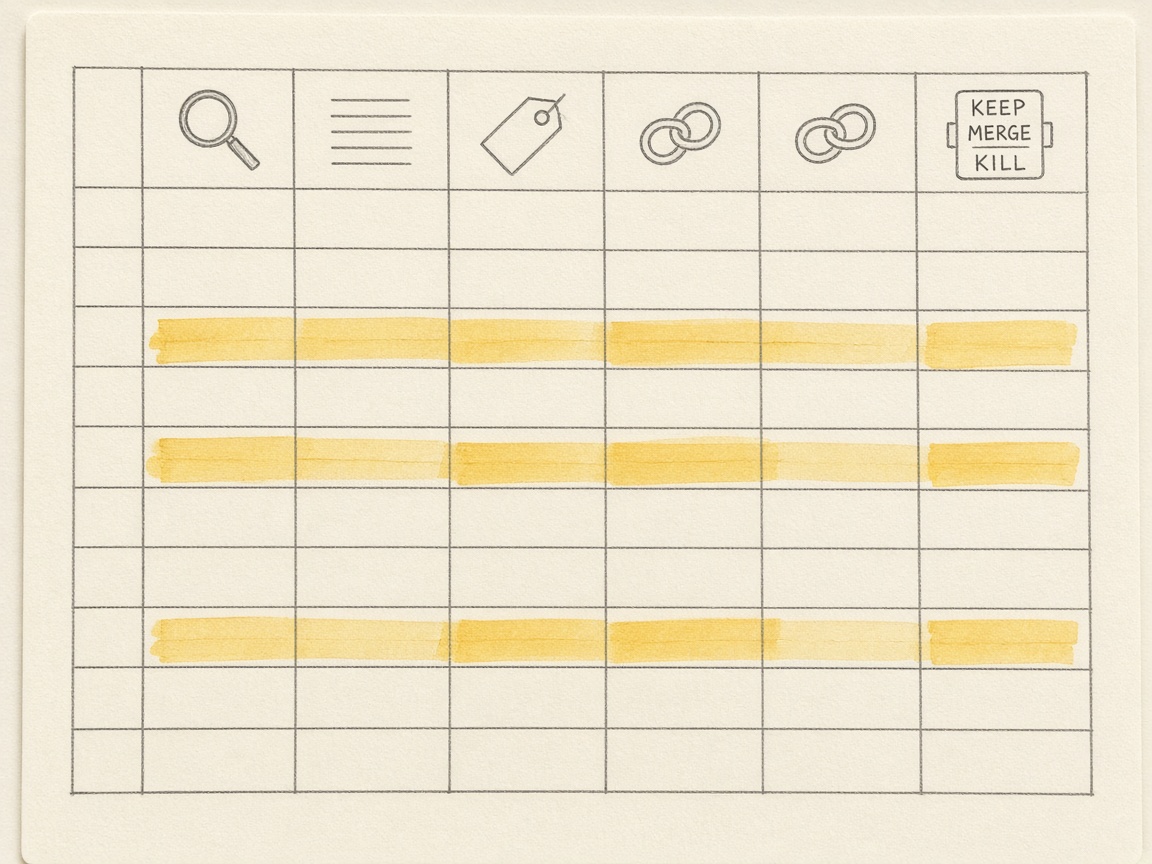
Put every real question in the current cluster on a spreadsheet before you open another subject. A sub-question earns its own page only when it has a distinct intent and enough substance to satisfy someone who lands on it alone. If it cannot do that, it stays a section of the page that already owns the parent question.
What each row has to prove
- Distinct intent: the query is a different job, not a rephrase of a page you already have.
- Depth: the answer can stand alone and actually satisfy the question.
- Named entity: the page is clearly about one identifiable thing.
- Bidirectional link: the page points to the pillar, and the pillar points back.
- Decision: keep, merge, or kill — not publish because the calendar is empty.
Open another cluster only when every real question in this one is covered, linked, and marked keep. A publishing cadence is not coverage. Unfinished rows are a reason to stay inside the subject, not a reason to widen the site.
Depth on one URL can fan out far past the words on the page. Ahrefs notes that Healthline’s magnesium glycinate page shows up for 2,500 Google keywords and 473 AI Overview queries. That is an argument for finishing a strong page, not for splitting every related phrase into its own URL.
The gate — Another cluster opens only after the current one is covered, linked, and marked keep — and a sub-question stays a section unless both intent and substance are distinct.
How Internal Links Turn a Cluster Into a Site-Level Focus Signal
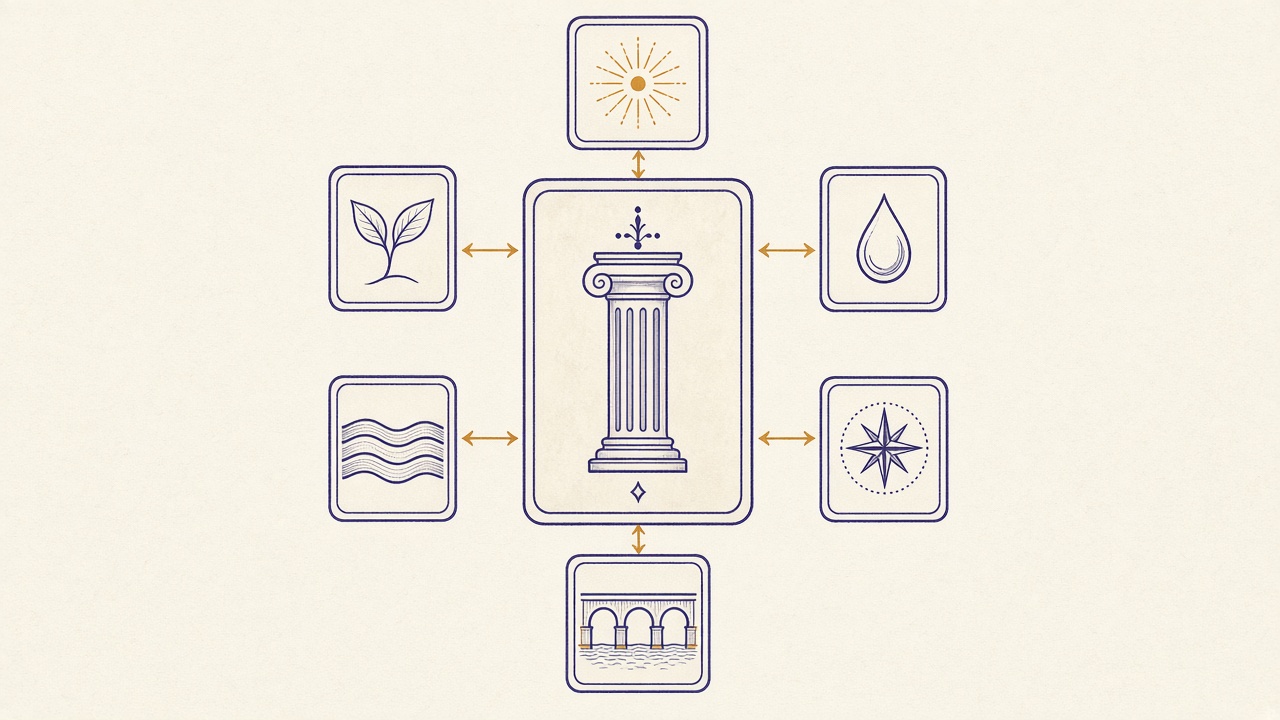
What turns a finished cluster into a site-level focus signal is the link graph, not another URL. Every supporting page should point to the pillar, to the siblings that share a real sub-question, and back again. That return path is what makes the cluster readable as one subject. Unlinked coverage does not compound: a cluster map that never ships as bidirectional links is still a list of separate posts.
Use parent, sibling, and contextual links as the focus gate. The parent names the pillar. Siblings connect adjacent questions inside the same subject. Contextual links belong in the sentence where the reader needs the next step, and they should point into the cluster, the automation rules, and the tool guides you already published rather than rebuilding those guides on a new URL.
Do not let programmatic or suggested links become a doorway mesh. A module that sprays every new post into unrelated hubs widens the site even when each page, read alone, looks on topic. Money pages and off-intent URLs stay gated. If a new page cannot name its pillar and two true siblings, it is not yet part of the site's focus — hold it until it can.
Focus gate — Internal links compound focus only when every supporting page points to its pillar and true siblings and those pages point back; an unlinked map or a suggested-link mesh does not.
What a Lean Team Should Refuse, Merge, or Delete

Once internal links have made a cluster nameable — a pillar plus two true siblings — the next decision is what never earns a URL. Refuse, merge, or delete any page that sits off the primary subject, is thin, duplicates an intent you already cover, or exists only because some of it might rank. A finished cluster is not a license to keep every draft that brushes the subject.
Google’s people-first guidance puts the same test in a single question: are you producing lots of content on many different topics in hopes that some of it might perform well in search results? On a new site that question is the prune rule. Publishing across topics in case a fragment ranks is how site radius grows, not how focus compounds.
Well written does not put a page inside the subject. A second pillar, a trend post, and a tool roundup outside what you own all widen radius even when each draft is clean. Merge overlapping intents into the stronger URL and redirect the weaker one. Delete or noindex pages that cannot be brought inside the subject. The keep column of the coverage sheet is the only publishing queue; everything else waits or goes.
Prune rule — Off-subject, thin, and duplicate pages are refused, merged, or removed. They are not rewritten into a wider site, and nothing outside the keep column gets a URL.
How Long Does Topical Authority Take on a New Domain?

With the keep column as the only publishing queue, the next question is how long that work takes. Plan on 6 to 12 months for meaningful movement on a new domain, and use the first three months to establish coverage rather than to expect authority.
A study of 332 URLs across 12 domains associated higher topical-authority scores with a faster time to the first impression and the first click — faster, not instant. Measure finished questions, internal connections, and queries the cluster can already answer, not articles published per week. Do not open a volume campaign to speed the clock; extra topics reset focus instead of shortening the wait.
The wait — Six to twelve months of finishing one cluster compounds trust; publishing across topics to hurry the clock widens the site.
Does Topical Authority Help ChatGPT and AI Overviews Cite Your Site?

Once the cluster’s questions are finished and linked, that same coverage is what answer engines tend to use. Topical coverage helps ChatGPT, AI Overviews, and other answer engines cite a site, but it is the same focus pattern, not a separate link campaign.
Pages that ranked for the main query and its fan-out queries were 161% more likely to be cited, with a Spearman correlation of 0.77 between fan-out rankings and citation chance, according to a Surfer study cited by Perceptric. In an Ahrefs study of 863,000 keyword results, 37.9% of URLs cited in AI Overviews ranked in the top 10 and 31.2% ranked in positions 11 to 100. Floyi’s topical-authority report found 26.8% to 43.7% of AI citations came from sites ranking elsewhere in the same topical map, not in that exact query’s top 20.
Coverage is only one layer. Pepper Content, citing a Muck Rack analysis of more than 25 million cited links, reports earned media accounted for 84% of AI citations and paid or advertorial content for 0.3%. Advertorials do not stand in for that earned layer.
Put a real author, a clear entity, and first-hand expertise on the page so engines can tell who stands behind the answer. Fabricated expert profiles are deception, not a citation tactic.
Same pattern — Answer engines cite the site that already covers the query and its fan-out, with a real author behind it — not a site running a separate citation campaign.
AI Citations: Earned Media vs Paid
What to Automate, What a Human Reviews, and What the Stack Refuses

The same coverage that earns citations is also the line a publishing stack must not cross. Automate research assembly, coverage-score updates, and internal-link suggestions. Do not automate the decision to open a new subject.
A person still has to review distinct intent, factual claims, and author attribution, then make the keep, merge, or kill call before anything publishes. A real byline and checked claims are part of that review; a fabricated expert profile is not a shortcut around it.
The stack should refuse a second pillar, a page for every fan-out query, and extensive automation across many topics. Google’s people-first guidance asks whether you are using extensive automation to produce content on many topics — a search-engine-first warning sign, not a growth plan. Building a page for every AI fan-out query in order to manipulate rankings or AI answers is a scaled content abuse violation. Quality at scale is allowed only inside the subject the coverage sheet already owns, and only while that refuse gate stays closed.
Refuse gate — Automate assembly, scores, and link suggestions; a human owns intent, facts, authorship, and keep, merge, or kill. Refuse a second pillar, a page per fan-out, and automation across many topics.
Key Takeaways
Finish the cluster your coverage sheet already owns, and let Flowcrews help you score, link, and refuse the rest before you publish another subject.