How to Automate Keyword Research for Content Briefs

Keyword research that stops at a spreadsheet is unfinished work. The job is to turn related terms, search intent, and what actually ranks into a brief a writer can execute: primary topic, supporting angles, questions to answer, and constraints that keep the page on-intent.
Automation helps when it clusters long-tail queries, scores intent, and maps SERP patterns into an SEO content brief template. It fails when it pastes volume lists into a doc and calls that research. The rest of this article walks through that pipeline—research to brief fields—so the output stays useful whenever you run it.
You do not need a black-box “content automation” stack. You need a repeatable flow: collect candidates, group them, read the SERP, fill brief slots, then reject anything that fails a quality gate. That is how automated keyword research stays evergreen instead of becoming another export.
- Treat keyword research as brief-filling, not as a ranked list of terms.
- Cluster queries by topic and intent before you pick a primary keyword.
- Pull SERP signals (format, questions, entities) into named brief fields.
- Use quality gates so thin or mixed-intent clusters never become a brief.
- Long-tail research belongs in supporting sections and FAQs, not as extra primaries.
Stop dumping metrics—ship a brief the writer can actually use

Volume, difficulty, and CPC look like research until you open the brief and find a spreadsheet instead of a job. Those figures are inputs. They do not encode search intent, the SERP format you have to beat, or the one outcome the page must win. Automation that stops at a ranked keyword list is still a dump—and dumps do not scale content.
A metrics dump produces duplicate briefs for the same intent, thin long-tail pages that cannibalize each other, and revision spirals when writers guess the angle. Clustering never happens, questions never get assigned, and internal links stay an afterthought. The pipeline looks busy; the site does not get clearer.
Define the destination first, then let research fill the fields. Every automated run should land as structured brief data: a primary keyword, the cluster members that belong with it, an intent label, SERP notes on format and competitors, supporting questions, and internal-link targets. Quality gates belong on those fields—not on whether a volume number exists.
This workflow is keyword-to-brief only. It is not full-stack content automation, not auto-publishing, and not a tour of tools. Clusters, intent, and SERP signals pay off when they arrive as those fields, with gates, so a writer can ship without inventing the strategy.
The real output — Automated keyword research only pays off when clusters, intent, and SERP signals land as gated fields in a brief—not as a raw keyword dump.
Treat keyword research as a brief-production pipeline
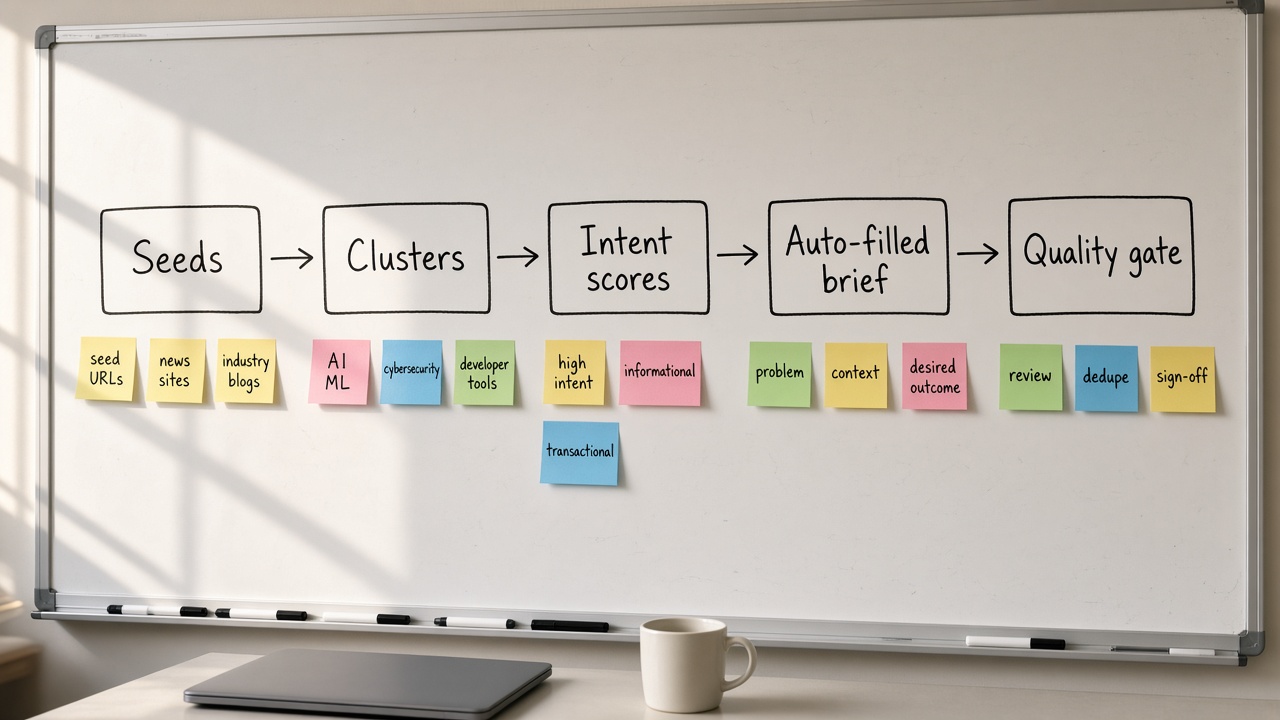
That destination only works as a pipeline: extract, cluster, score, fill, then gate. Software should take a tight set of inputs, group them by meaning, and emit one usable brief per cluster—or refuse to emit anything that fails the gates.
Keep the inputs small and high-signal: seed topics you actually intend to cover, existing URLs so you can flag cannibalization, Search Console queries that already prove demand, competitor titles that show how the SERP is framed, and a short sample of SERP features (featured snippets, people-also-ask, sitelinks). You do not need every difficulty slider or CPC cell. Those numbers belong upstream as scoring hints, not as the brief itself.
Humans stay on seed selection and the final accept/reject. Grouping, SERP sampling, and field population are the machine’s job. Outline generation, CMS publishing, and refresh cadences belong in adjacent playbooks. Next we walk clustering, intent scoring, and how those fields get filled automatically.
Pipeline, not dump — Automation pays off when the pipeline outputs one gated brief per cluster—not a spreadsheet of keywords.
Cluster first, then score intent and fill the brief
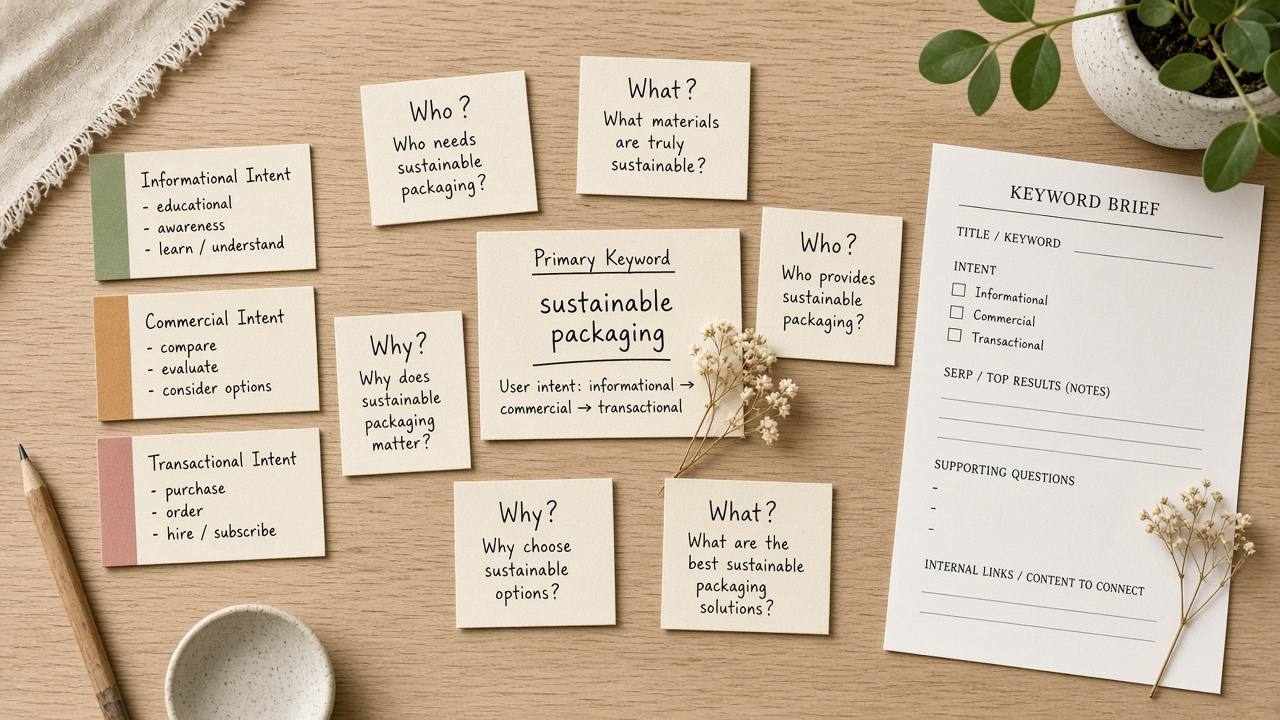
Clustering is the operator step that turns a pile of queries into something a writer can own. Group terms that share SERP overlap or the same job-to-be-done so one URL can rank for the set. If the same handful of pages keep appearing for two queries, they belong together. If people are trying to do the same thing—compare, define, buy, or execute a how-to—they belong together even when the wording differs.
One cluster equals one brief. Split only when the results clearly diverge: a tool page versus a definition versus a step-by-step guide is not one job, and forcing them onto a single URL usually produces a muddled outline. Everything else stays in the parent cluster so you do not mint competing pages for the same intent.
Read intent from the SERP, then write it into fields
Score intent from composition, not from a guessed modifier. If the top results are guides, listicles, product pages, or videos, that mix is the label. Put the label in the brief plus a short “what to match” line: informational explainer with a comparison table, commercial roundup with specs, or transactional landing copy. That pair tells the writer the shape of the page without another round of research.
Auto-fill the template from the cluster and the sample: an H1 or title pattern, the primary keyword, secondary terms that stay in-cluster, people-also-ask style questions, competitor outline gaps, and must-link URLs. Long-tail research does not become a farm of thin satellites. Route those queries into FAQ and H3 slots on the parent brief so the hub page absorbs related demand. Hub-and-spoke mapping lives inside the brief as parent versus supporting URLs—who owns the cluster and which existing pages should be linked—not as a sitewide information-architecture lecture.
Pipeline rule — Group by SERP overlap and job-to-be-done, one brief per cluster, intent scored from result types, long tails parked in FAQs and H3s on the parent page.
Quality gates before a brief leaves research

Clustering and auto-fill only help if a brief can fail. Without gates, the pipeline still ships colliding URLs, mixed-intent outlines, and empty fields—the same dump, just prettier. Three checks sit between filled fields and handoff.
What must fail before a writer ever sees it
Gate one: if the cluster overlaps a live URL, do not open a new page. The brief is an update—or the work stops. Gate two: if intent is mixed or the SERP format is unclear, send the cluster back. Guessing a hybrid outline is how thin pages get commissioned. Gate three: required fields must be complete—primary term, intent, audience, outline skeleton, sources and internal links—or the brief does not leave research.
A human still reviews what software should not decide: the angle, claims you will not automate, and whether the page deserves to exist versus a redirect or merge. That judgment is the last gate, not a courtesy pass.
Writers and AI receive only the gated brief—never the raw keyword file. If the file can skip the gate, automation has already failed. That is how clusters, intent, and SERP notes become a brief someone can actually write from.
Gate, then hand off — Automation pays off only when a brief can be rejected—collision, mixed intent, or missing fields stop handoff; people and models never see the ungated keyword file.
Key Takeaways
Build your next content brief from a gated cluster, not a raw keyword export, and ship only the fields a writer can actually use.
Frequently Asked Questions
You Might Also Like
- Guides SEO Content Brief Template: The Complete Guide to Briefs That Rank
- Strategy Keyword Clustering: How to Group Keywords into Rankable Topics
- Guides Free SEO Content Brief Generator: How to Brief Writers in Minutes
- Automation SEO Automation: Tools, Workflows, and What to Automate First
- Comparisons Best SEO Automation Tools in 2026 (Compared by Job-to-Be-Done)