Flows Concierge: Questions It Should Answer From Your Articles
An on-site assistant is useful only when a visitor can trust the sentence it just gave. Most self-service attempts still fail that test: a 2024 Gartner study, as cited by Rework, found that only 14% of customer service issues are fully resolved through self-service alone, so the rest still reach a human queue. The gap is not a missing model. It is an article set that does not yet match the questions people actually ask.
Flows Concierge is built for a narrower job than a general chatbot. It may answer when the question maps clearly to one current article and the answer is already complete on that page, then it cites that URL. Rework’s grounded-agent rule is the same: act automatically only in that case. If there is no match, the default is a handoff plus a content-gap task tagged with the exact question phrasing — never a synthesized answer, even when the inference looks obvious.
That cite-or-log rule is what makes AI concierge use cases safe to ship. Well-designed knowledge portal experiences can deflect 40–60% of incoming queries before they reach a person, but only when each fact lives on one current page and the answer sits in the lines retrieval will actually pull. The sections that follow are the allow-list: which question classes one article can carry, what to cite, and what to log when none match.
- Answer only when one current article fully covers the question, then cite that URL.
- A direct FAQ or how-to hit is the safe use case; a missing match is a handoff and a content-gap log, not a guess.
- Never synthesize an answer that is not written on the site, even if the inference seems obvious.
- Duplicates are worse than gaps: two disagreeing articles produce a confident wrong answer.
- Track knowledge-base hit rate and volume coverage, not chat volume alone.
Practical AI concierge use cases versus a generic chatbot

Practical AI concierge use cases on a content site are answers already written there: what the product does, a how-to whose steps are complete in one article, a definition the page states, a comparison the site published, and a setup or policy rule already on a page. Flows Concierge should answer only when one current article fully covers the question, then cite that URL.
Volume follows the corpus. TravelJoy went live at 76% and later resolved 80% of tickets from its website plus an internal workspace, saving 193 hours a month. Well-designed knowledge portals deflect 40–60% before a human—only when the page contains the answer.
An AI concierge differs from a generic website chatbot by citing one owner-supplied URL and refusing to browse or blend. Many chatbots treat “stay inside the content” as a model instruction, not a filter that checks every word. The deploy choice belongs in the chatbot-versus-concierge article, not a second decision here.
Cite or stop — Safe use cases are questions one current article already answers in full; the concierge cites that URL instead of guessing or blending passages.
Which questions should an AI concierge answer from published articles?
With the frame already set, the filter is the useful part. An AI concierge should answer only when the question maps clearly to one current published article and the answer is complete in that article, then cite that URL. A direct FAQ hit is the safe case, but product questions are in scope whenever a published page states them — not only help-center FAQs. A marketing post is safe only if it states a complete current fact. Do not improvise product scope: point “what it does” at the product-map article and cite that page alone.
That allow-list is copyable. Each row is a question pattern the site already wrote, the article type required, the cite rule, and what to log when nothing matches.
| Question pattern | Required article | Cite rule | Log if nothing matches |
|---|---|---|---|
| Product scope (“what it does”) | Product-map page that states the scope | Cite that URL only; do not infer | Exact “what it does” phrasing |
| Complete how-to | One article whose steps are finished | Cite that URL | The unfinished task as asked |
| Stated definition | Page that defines the term | Cite that URL | The term plus the asker’s wording |
| Published comparison | The site’s own comparison | Cite that URL | The two options named |
| Setup or policy rule | Page that states the rule | Cite that URL | The rule asked for |
| Direct FAQ | Matching FAQ | Cite that URL | The FAQ question as typed |
| Marketing claim | Only a post that states a complete current fact | Cite that post; otherwise do not answer | The claim as phrased |
A miss is a handoff plus that log, not a guess. One canonical URL per fact is the precondition: a gap can wait, but two articles with different figures produce a confident wrong answer. Write the answer in the first lines. Retrieval pulls passages, so buried answers and image-only steps fail even when the page exists.
One article — Answer only when one current article fully covers the question, cite that URL, and log the exact phrasing when nothing matches — including product questions, if a published page already states them.
When no article fully answers, hand off and brief the next article
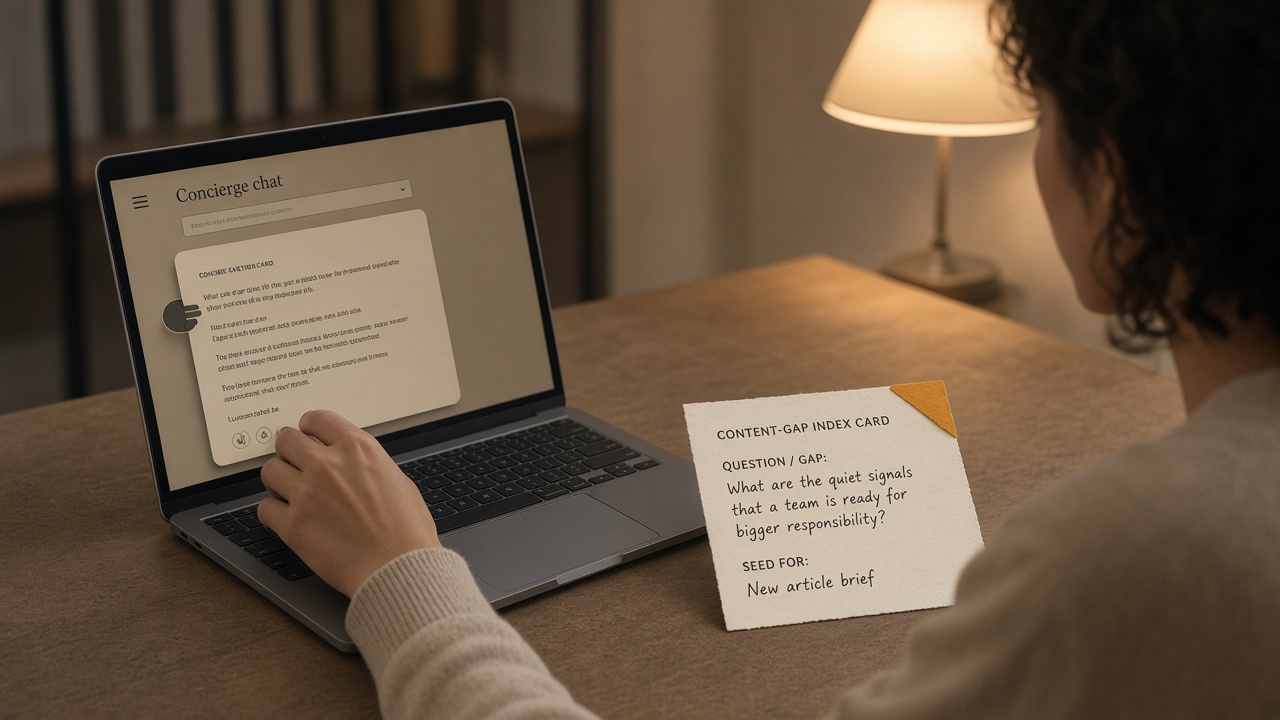
When no current article fully covers the question, do not invent a reply. Hand the visitor to a specialist and open a content-gap task tagged with their exact phrasing. Rework’s blueprint says to tell them you are connecting them with a specialist, and never to synthesize an answer that is not in the knowledge base, even when the inference seems obvious.
A partial overlap is still a miss. Clarify once only if a single page is close; otherwise fail closed. A missing match is a log, not a guess.
Turn those repeats into the next article brief: exact phrasing, the missing fact, and the one canonical URL that should own it. Send that brief into the publishing workflow; do not rebuild ownership beside it.
Fail closed — No full article match means a specialist handoff and a content-gap log of the exact question — never a synthesized answer.
What makes an article safe to cite, and how a duplicate or stale page breaks it
After a miss is logged, the page has to earn the cite. An article is safe for the concierge to cite only when it is the one current URL, it fully covers the question, and that answer is in the opening lines. Two articles on the same topic break the answer: a gap can return "I don't know," while two disagreeing pages produce a confident citation of the retired figure. A stale article stays out only if you retire or redirect its URL; do not leave both live.
Retrieval pulls passages, not the whole page. An answer buried after background, or steps that exist only in an image, often never gets selected even when the page is live. Write the answer first, then the context: one question, stated and answered before you explain why.
When the concierge answers wrong, the usual cause is a missing article, a stale article, or two that disagree, not the model. A redirect only works if the old URL is no longer a live page the concierge can cite.
Safe to cite — One current URL, the complete answer in the opening lines, and every older or duplicate URL retired or redirected so it cannot be cited.
How many articles before a grounded assistant is useful?
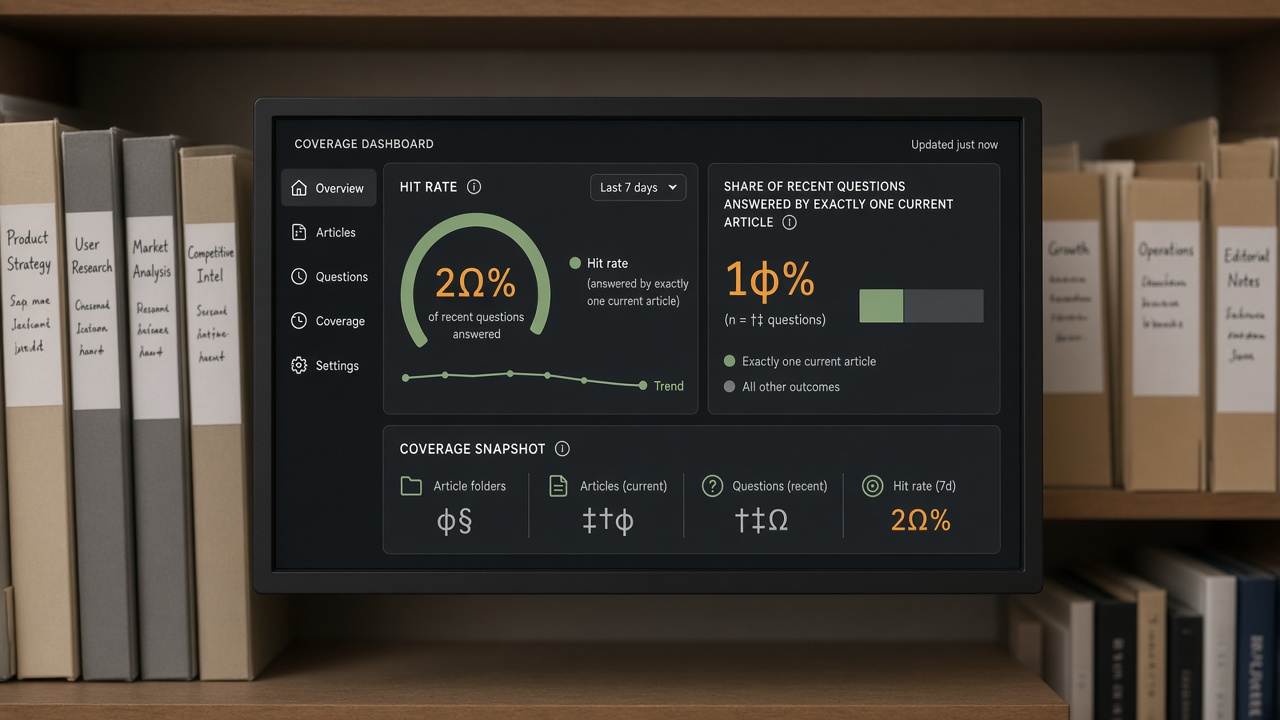
Cite-safety is the precondition; library size is not the test. There is no magic article count. A grounded assistant becomes useful when the questions you actually receive each map to exactly one current article—not when the shelf looks full.
What is a healthy knowledge-base hit rate? Treat a hit rate stuck below 60% as documentation failing to keep up with questions. Healthy volume coverage is above 80% of the last 90 days of demand answered by exactly one current article.
Resolution claims swing with that article set: 20% to 45% in the first one to two months, that 76% average, and observed rates from 25% to over 80%—the spread tracks the knowledge base, not the model. A five-pass coverage audit of a help center under 500 articles takes about a day and a half. Use that audit, not a model swap, as the lever.
Coverage, not count — Useful starts when recent questions each hit exactly one current article—above 80% of the last 90 days—not when the library is large.
Coverage floors vs Fin resolution
Which questions must still go to a human, even if an article exists?
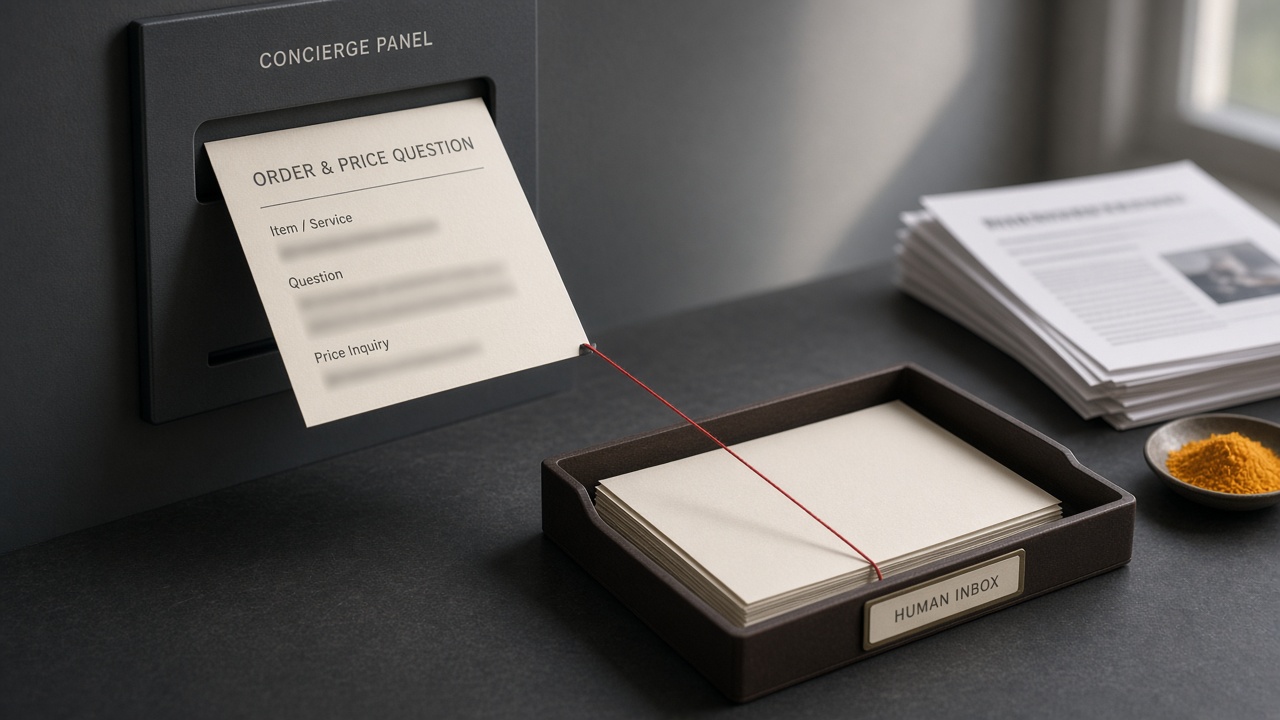
A match to one current article is still not enough when the visitor needs account state, a live order, a price that is not the canonical figure on one current page, or a judgment the page does not settle. Hand those off; the full fail-closed list lives in the answer-versus-escalate article.
Self-service rarely closes the loop. A 2024 Gartner study cited by Rework found only 14% of customer service issues are fully resolved through self-service alone, so 86% of people who try it still reach a human. Salesforce’s survey of 6,500 service professionals estimates AI handles 30% of cases today and projects 50% by 2027. The concierge is a cited front door, not a closed queue.
Do not answer pricing, account, or order questions from blog posts. A roundup is not the price book or the order system. Escalate unless one current canonical page states that exact fact and you have chosen it as the source of record.
What the concierge should cite when a visitor asks what Flows can help with
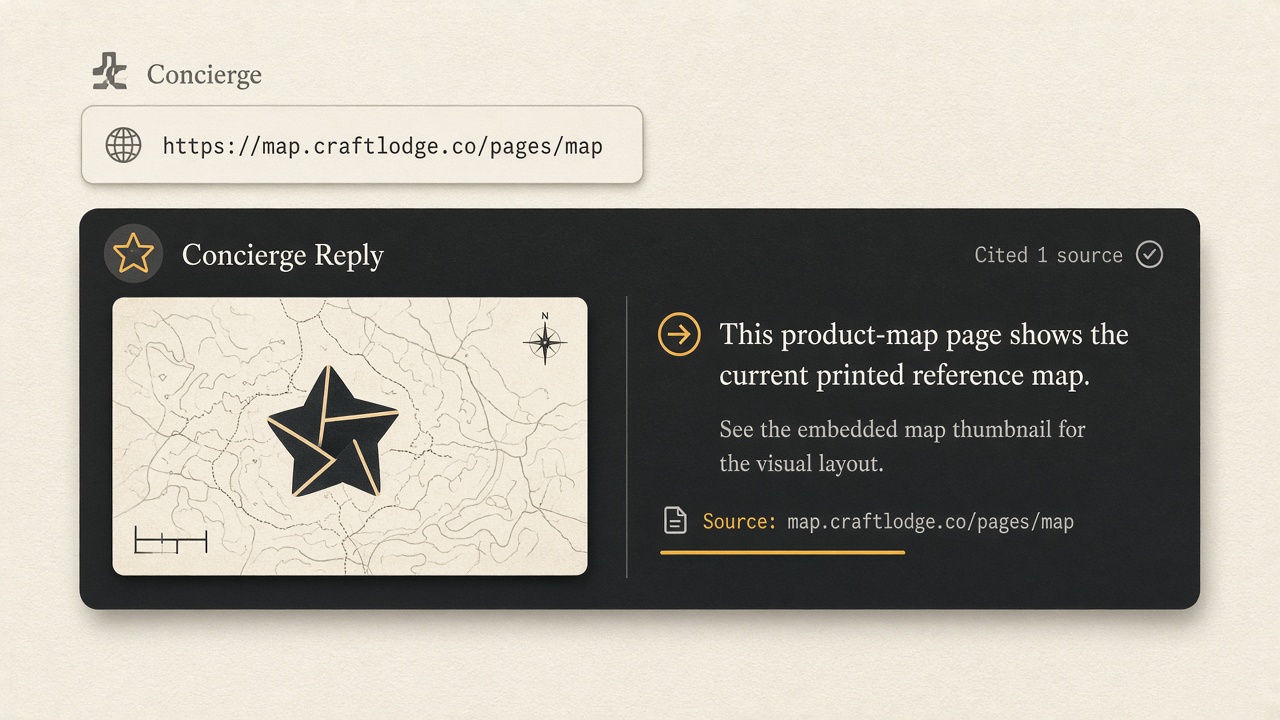
Those human-only cases leave a narrower question the concierge can still close from the site. When a visitor asks what Flows can help with, cite the product-map article at /what-can-flows-help-with. Do not paraphrase the two jobs, and do not use this page’s allow-list as the product answer.
Cite this page only for “which questions can you answer from our articles?” The artifact is the question-class table: the pattern, the article type, the cite rule, and the log when nothing matches.
Cited on-site answers are the same habit as answer engine optimization: one URL, the answer in the first lines, so an on-site concierge and an outside answer engine can quote a passage instead of blending two posts. The query-handling playbook holds that feedback loop; this page does not rebuild it.
Cite rule — Product questions cite /what-can-flows-help-with. This page is only for which article questions the concierge may answer, via the question-class table.
Key Takeaways
Audit your published set for one current URL per fact, then point Flows Concierge at that corpus and route every miss into the next article brief.
Frequently Asked Questions
You Might Also Like
- Concierge What Questions Should an AI Concierge Answer vs Escalate?
- Concierge How to Train a Site Assistant on Your Own Articles
- Measurement AI Assistant Analytics: Which Unanswered Questions Become Articles
- Guides What Can Flows Help With? A Product Map for Publishing and Concierge
- Comparisons Website Chatbot vs AI Concierge: Which Should You Deploy?