SEO Content Repurposing: Turn One Published Page Into Briefs Without New Thin URLs
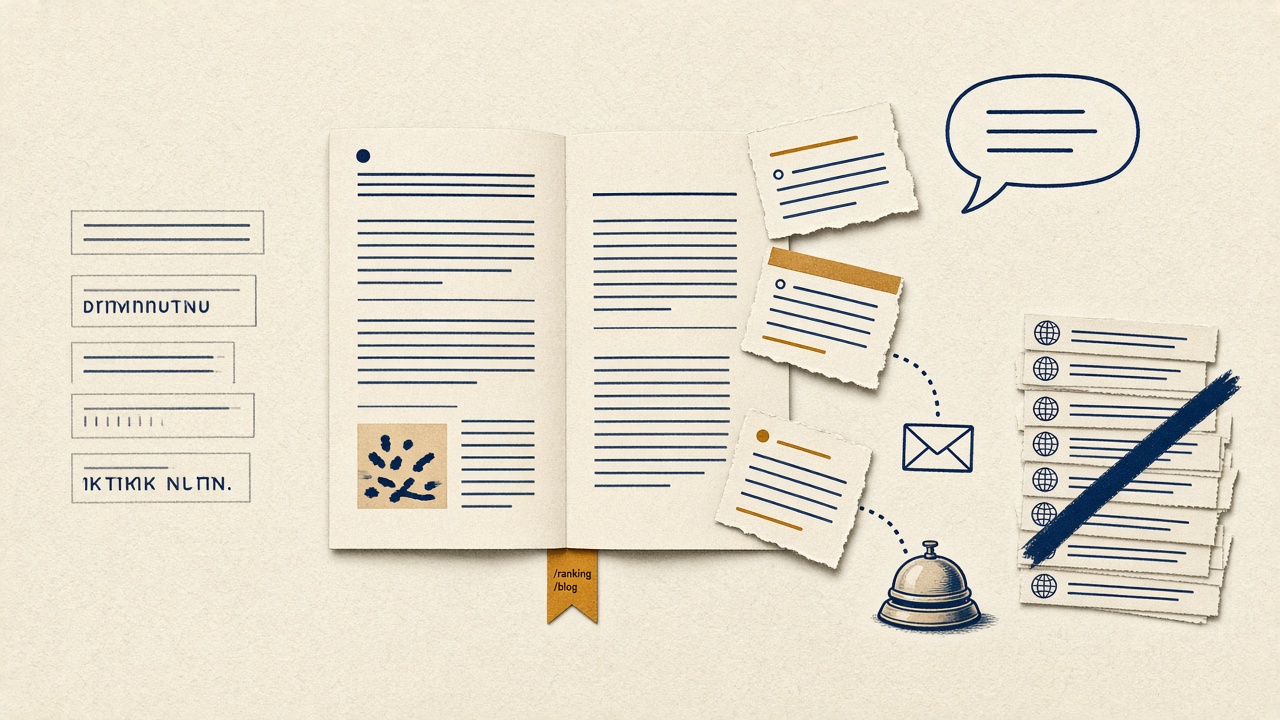
A published page that already ranks is an asset. The mistake is treating content repurposing as a reason to mint another URL for the same job. Email, social, a short video, a help-center excerpt, and an AI concierge answer can all come from that page without becoming a second indexable document. Google treats some duplicate content on a site as normal and not a spam violation, but it still clusters pages with the same or very similar primary content, judges quality on the page it selects as canonical, and crawls the copies less often. A rel=canonical tag is a hint, not a rule. A second thin URL does not “distribute” the ranking; it asks Google to pick an owner you may not have chosen. The useful unit of work is a repurposing brief, not a new post. The brief names the source URL, the intent that URL already owns, what must stay on that page, which surfaces may extract, and which new URLs are refused. Refresh the owner when the page has gone stale. Commission another indexable page only when the intent is distinct and the new page adds something the canonical does not already own.
- The ranking URL owns the intent; email, social, video, and concierge answers are extracts, not new pages.
- Ordinary duplication is not a spam penalty, but Google clusters similar primary content and evaluates quality on the canonical.
- A declared canonical is a hint; a redirect is a stronger signal, and a self-referential canonical plus consistent internal links is the baseline.
- A second indexable URL is allowed only when the job is different and the new page adds something the owner does not already cover.
- Same-URL refresh beats a new “updated” address, and stitching pages without added value is scaled content abuse however it was produced.
What Content Repurposing Means When You Cannot Publish a New URL
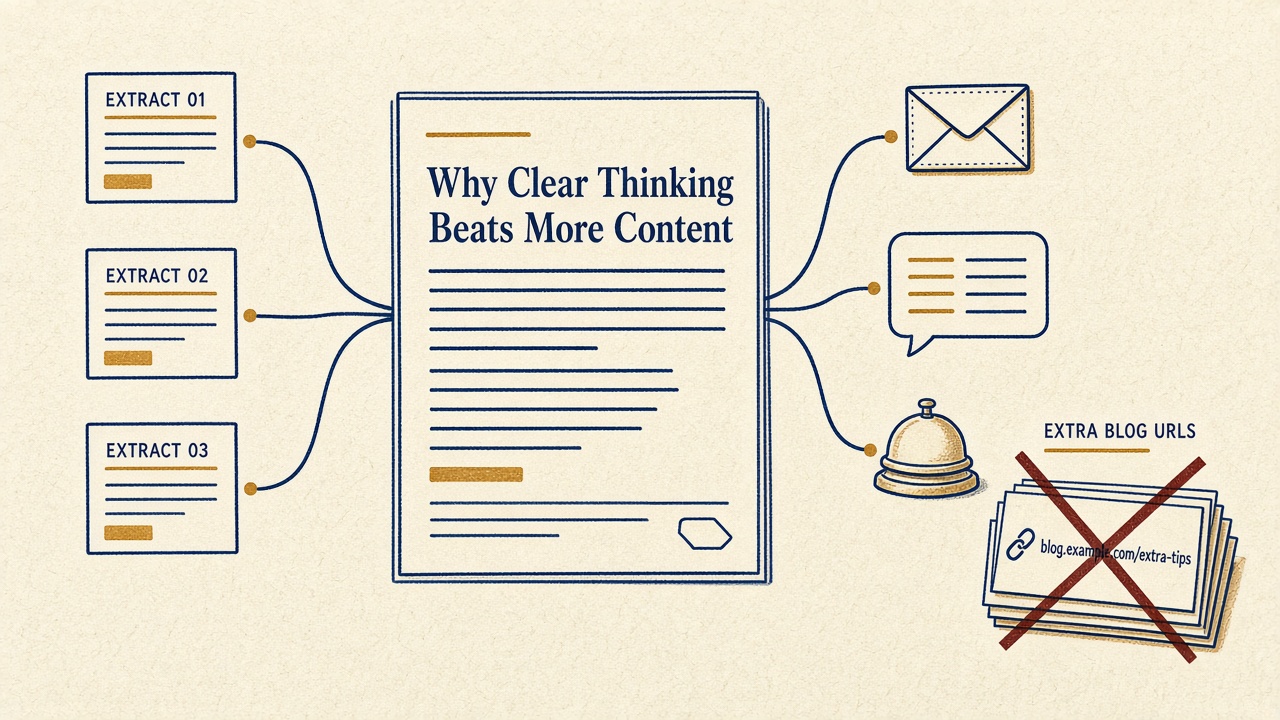
If you are not allowed to publish a new URL, content repurposing is a surface decision, not a second page. The ranking URL stays the owner of the intent. Email, social, video, an on-page FAQ block, and a concierge answer are extracts of that owner — they carry the idea to another format and point back, they do not become a new destination for the same job.
Atomization is not a thin new URL
Content atomization splits one idea into deliverables: a social post, a short video, an email, a help snippet, a concierge reply. Those pieces can all come from one published page. A thin new URL is something else — a second indexable page that does not answer a different job and does not add information the canonical already lacks. The split is useful. The extra URL is not.
Thin is a value problem, not a word count. A page that gives a visitor little they could not get elsewhere should be improved or removed if it has no job of its own. Applied here, the test is simple: if someone landing on the derivative learns little they could not already get on the owner page, improve that owner page or do not publish the derivative. Length will not save it.
Refuse the derivative blog post when the extract can live as a section on the canonical, a social post, an email, or a concierge answer that points back. Repurposing your own blog content for social or for a concierge reply is still repurposing. Publishing a near-copy so the calendar has another URL is not.
This page is the refuse rule, not a brief-field tutorial. If you need worked samples of how a page type is briefed, use the site’s SEO content brief examples. Keep the decision here narrower: change the surface, leave the ranking URL in charge, and withhold a new URL unless the new page answers a different job.
Surface, not owner — Without a new URL, repurposing changes the surface and leaves the ranking page as the owner of the intent. A second indexable page is thin when it adds nothing the canonical does not already own — atomize the idea instead, and point every extract back.
Does Repurposing Your Own Blog Post Count as Duplicate Content?

No. Turning the ranking post into an email, a social post, or a concierge answer is not, by itself, a spam violation. Some duplicate content on a site is normal, and that ordinary overlap is not a violation of Google's spam policies. A quote in a newsletter, a clip on social, or an answer that sends the reader back to the owner URL never becomes a second page Search has to choose between.
What Google does cluster is pages that share the same or very similar primary content. It selects the most complete and useful version as the canonical, uses that page as the main source for evaluating content and quality, and a search result usually points to that URL. Pages in the cluster that are not the canonical are crawled less often, so a near-copy does not get its own independent evaluation.
The practical risk is therefore a second indexable URL that joins the cluster and weakens the page that already ranks, not a passage reused off-site. Stop treating every reuse as a penalty. Treat every new URL as the decision that matters: if the extract never becomes its own page, you have not created a duplicate for Search to resolve.
The line that matters — Email, social, and concierge extracts of your own post are not a spam violation. The duplicate-content problem starts when a second indexable URL repeats the same primary content and gets clustered under the owner.
Does a Canonical Tag Guarantee Google Keeps Your Original URL?
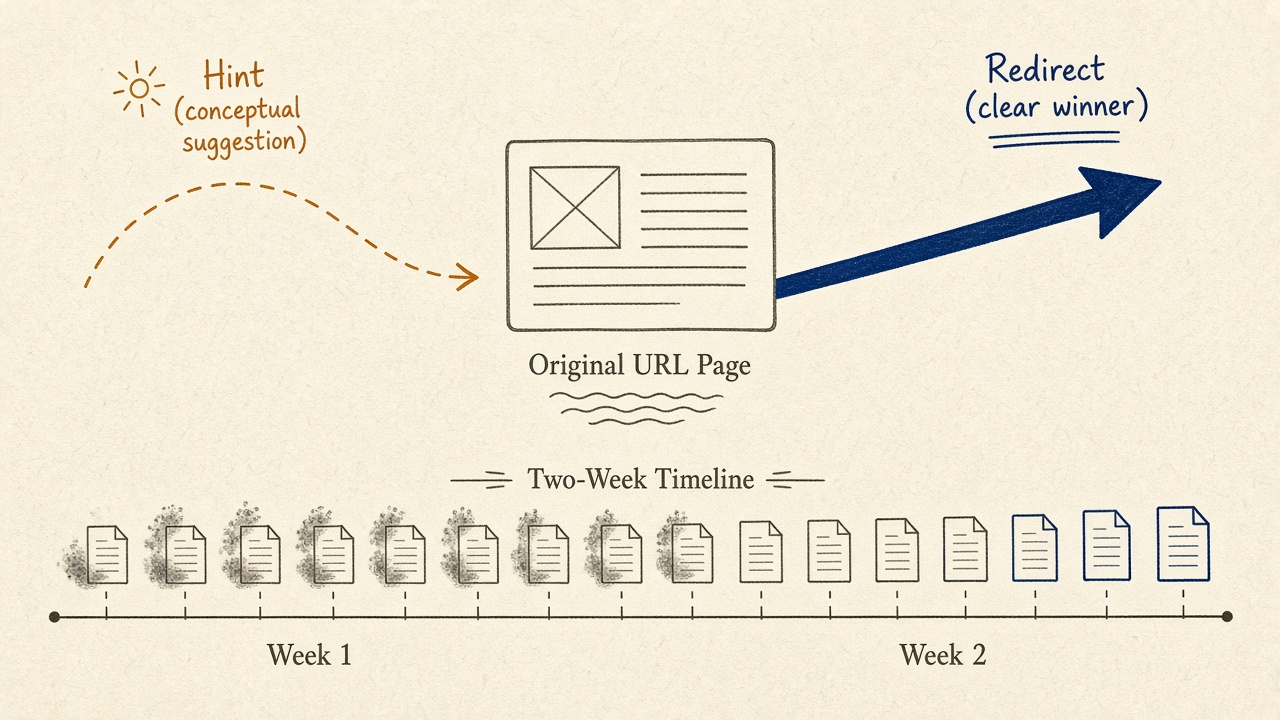
No. A rel=canonical does not lock your original URL in place. Google treats a declared canonical as a hint, not a rule, and it may select a different URL as canonical even when the ranking page is the one you named.
Signal strength is uneven. A redirect is a stronger canonicalization signal than a rel=canonical annotation, because the redirect says the target should become canonical. Sitemap inclusion is only a weak signal. Prefer a self-referential canonical on the owner page, and point internal links at that URL rather than at a duplicate. A declared canonical on a second indexable page remains a hint. It does not guarantee Google will keep the original URL if redirects and internal links treat the copy as the destination.
Fixing the overlap does not split the cluster overnight. After a content fix, Google may keep two similar pages in the same duplicate cluster for up to two weeks. They separate faster only if the difference is clear and significant. That window is a processing lag, not a grace period you can publish into.
Do not plan a second page and hope a tag will save the original. If the job is the same, consolidate onto the ranking URL. Email, social, video, and concierge answers can still extract from that page. A near-duplicate that stays live only adds another URL for the cluster to judge, and the annotation will not guarantee which one wins.
Hint, not a lock — A rel=canonical is a hint, a redirect is stronger, and similar pages can stay clustered for up to two weeks — so same-job pages should be consolidated, not tagged and published.
When to Refresh the Page You Already Rank With

Refresh the URL you already rank with whenever the intent is unchanged. Do not commission an updated twin. A self-referential canonical and internal links only protect an owner you keep; they do not make a second same-job page safer. If the job is the same, rewrite the page that already owns it.
Same-URL re-optimization is the evidence, not a slogan. Brafton grew blog traffic from 20,000 to 200,000 monthly visitors over three years while consistently re-optimizing existing posts rather than only publishing new ones. In a Search Console study of 41 articles updated and republished on the same URLs, 85.37% gained total clicks. The set gained 29% more clicks and 62.35% more impressions, and every article gained impressions. Of those posts, 43.9% gained page-one keyword rankings, and the set ranked for 36.45% more page-one keywords. The lift sat on addresses that already existed.
Stale pages stay at the same address
When a page still has a job but has gone stale or drifted from search intent, keep the address and refresh it. A new address is the wrong pruning move. Moving the same answer to a fresh URL throws away the history the study was measuring and hands you another page to cluster, consolidate, or refuse.
The repurposing brief is the input to a cannibalization audit, not a license for a second outline. List every URL that shares the intent, name one owner, merge or refuse the rest, then refresh that owner. Hand the refresh through the existing brief-to-publish workflow. Email, social, video, and concierge answers can still extract from the updated page. They do not need a new ranking URL to do it.
Same URL — If the intent is unchanged, refresh the URL that already ranks. Name that owner in the repurposing brief, merge or refuse the twins, and send the refresh through the workflow you already use.
Gains After Same-URL Refresh
When a Second Page Is Allowed, and When You Should Merge or Refuse It
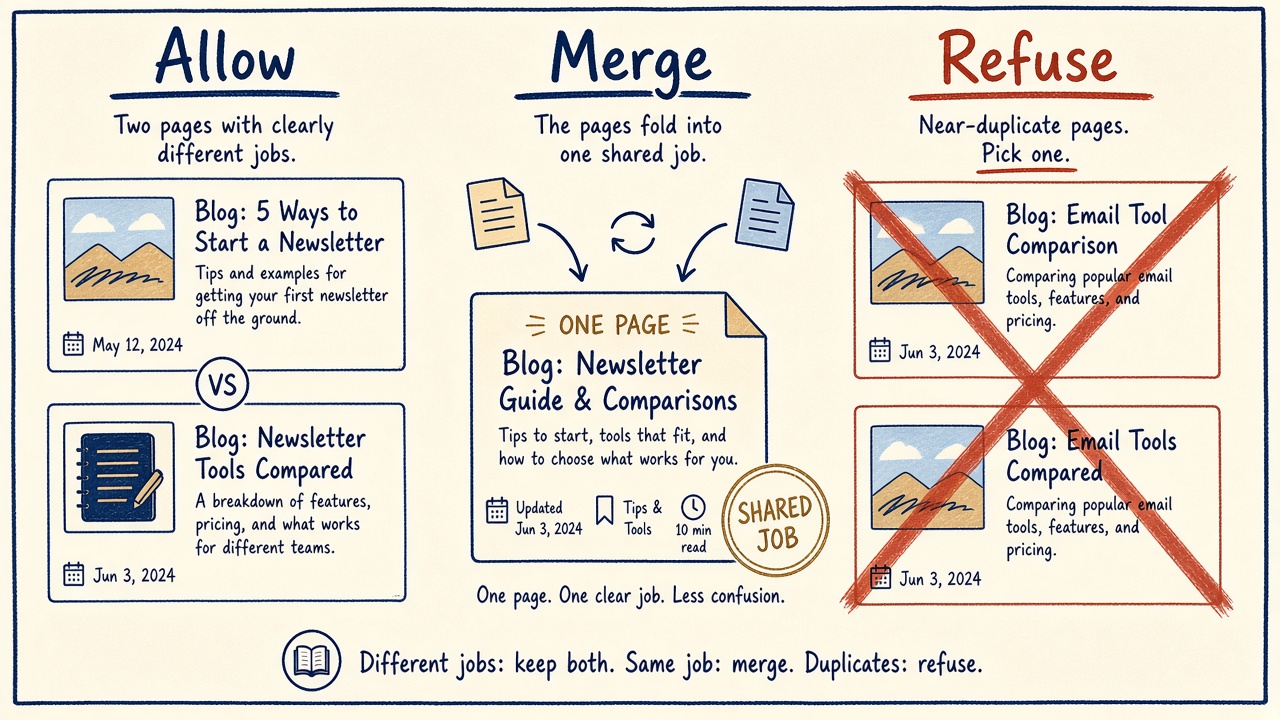
A second indexable URL is allowed only when the intent is distinct and the new page adds something the ranking URL does not already own. If the job is the same, merge into the owner or refuse the page. The operating rule is one intent, one owner URL: a refresh of that URL beats a new page written for the same intent.
Should a help-center version of a blog post be indexable?
No, not when it is the same article rewritten for a second address. A help-center version of the blog post should not be a second indexable URL. Product help can exist when the job is different — account steps, UI states, logged-in tasks — because that page answers work the blog post does not own. A rewritten article in the help center is a clone.
Do not use noindex as the way to stop a same-site page from being chosen as canonical. Google does not recommend that, because noindex blocks the page from Search entirely. Consolidate the duplicate, or give the help page a genuinely different job so it can stand on its own.
Run that order before anyone opens a brief. A surface extract never needs its own address; a new indexable page does, and only after the owner test fails.
The gate — One intent, one owner URL. A second page is allowed only when the job is different and the page adds what the canonical lacks; otherwise merge or refuse it, and never hide a same-site clone with noindex.
Can You Republish the Same Article on Medium, LinkedIn, or a Partner Site?
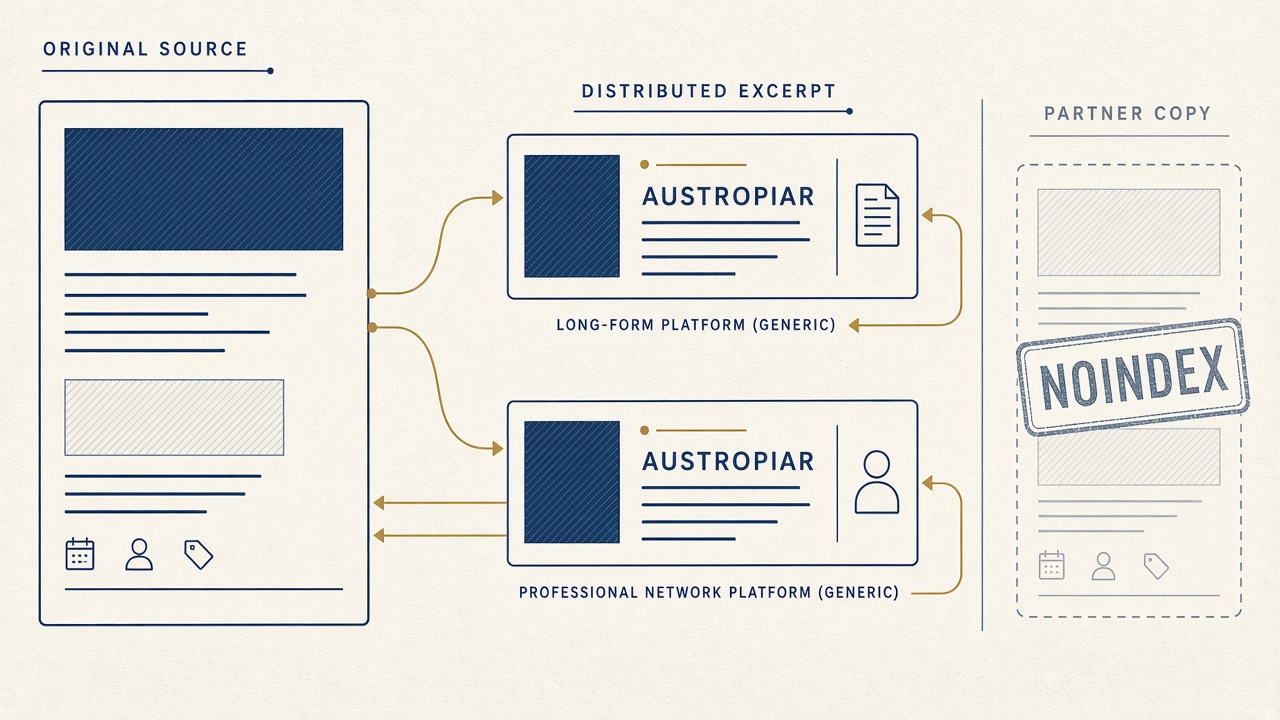
Once a second indexable URL is off the table, syndication is the remaining temptation. You can republish the same article on Medium, LinkedIn, or a partner site for reach and branding. A verbatim copy can put your byline in front of a new audience, and that branding value is the gain. A Forbes Agency Council contributor says verbatim republishing has zero SEO benefit.
The SEO alternatives are a distinct rewrite for that platform, or a refresh of the original URL. Neither is a second page you expect to own the same query.
Do not rely on a canonical link from a syndicated copy. Partner pages are often very different from yours, and Google’s guidance is direct: the most effective solution is for partners to block indexing of your content. Prefer a short original excerpt plus a link to the canonical over pasting the full article and hoping the tag holds.
Republishing other sites’ content onto yours, without original value, is a different problem. Google treats republishing content from other sites without adding any original content or value as abusive scraping, even if you omit a citation. Do not build your footprint that way. The practical substitute is the excerpt and link, or a platform-native rewrite that is not an SEO URL you expect to rank.
Reach, not rank — Verbatim syndication can brand you; it does not earn the query. Excerpt and link, or rewrite for the platform, and keep the ranking URL as the owner.
How Do You Turn One Published Page Into Briefs for Email, Social, and the Concierge?
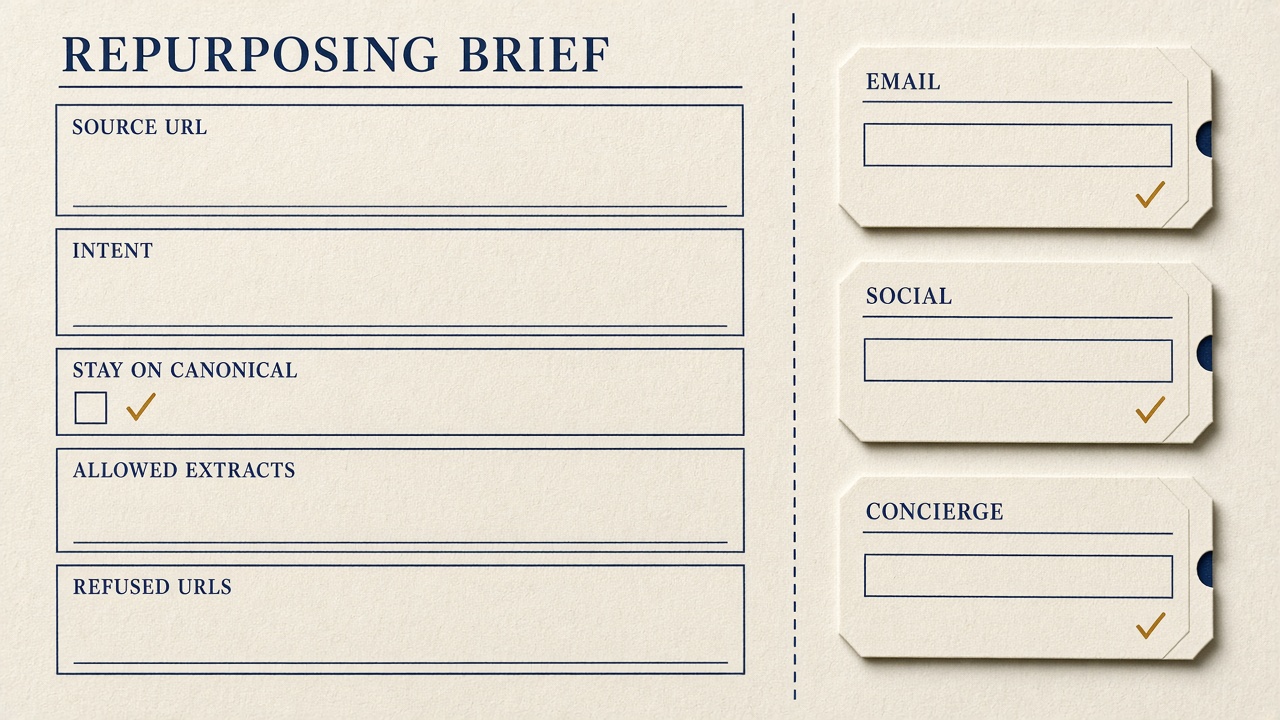
You do it with one repurposing brief, not a stack of new posts. The published URL already owns the intent, so the brief names that source, writes the intent in one sentence, and then splits the work: what must stay on the canonical, which surfaces may extract a piece of it, which new URLs are refused, and the consolidation rule for anything that still has to stay live.
What stays is the complete answer: original proof, worked examples, and the primary query the page already ranks for. What can leave is a slice. One claim, one step, a quote, an FAQ line, a social hook, an email angle, or a concierge answer that cites the owner URL. Those slices are extracts. They are not a second version of the page.
Do not extract until the owner page is still the full answer
If pulling a claim out leaves the canonical as a stub, the extract is too early. Proof that the reader needs in order to trust the claim stays on the owner page, and the extract links back to it. Email, social, and concierge briefs are production tickets for those surfaces. They are not SEO outlines for new URLs. Field samples, the outline template, and the path from brief to publish live in the long-tail brief workflow, the brief examples, and the workflow guide — use those when you are actually briefing a page, not when you are only cutting extracts.
A refused-URL line is mandatory on every brief. If the writer or the model cannot name a different job — a question the owner page does not already answer, with material the owner does not already own — the brief ends at extracts. No derivative post, no help-center clone, no “updated” twin. Video follows the same rule: a clip can quote the page; it does not earn its own indexable URL unless the job is different.
The brief ends at extracts — A repurposing brief is a surface ticket: the ranking URL keeps the full answer, extracts cite it, and the brief refuses any new URL that cannot name a different job.
What Scaled Content Abuse Says About Stitching Old Posts

That refused-URL line is how the brief treats stitching. Scaled content abuse means many pages made mainly to manipulate rankings rather than help users: large amounts of unoriginal content with little or no added value, however it is created.
Google lists stitching or combining content from different pages without adding value as an example, next to generating many AI pages that add none. The ranking page already owns those paragraphs. Recombining them under a fresh address does not create a new job, and it does not add what the canonical lacks.
The March 2024 policy applies whether automation, humans, or both produced the pages. A human-edited stitch is not a safe harbor. Sites that violate spam policies may rank lower or not appear at all. The policies also cover attempts to manipulate generative AI responses in Google Search.
Automation must refuse a new URL whose method is reassembling paragraphs the existing posts already own. A human review confirms that refusal; it does not negotiate a thinner version of the same stitch.
Not a safe harbor — Editing the seams by hand does not make a stitched page legitimate. If the method is reassembling paragraphs existing posts already own, refuse the URL instead of publishing a shorter version of the same stitch.
How Do You Measure Repurposing When the Surfaces Are Not SEO URLs?
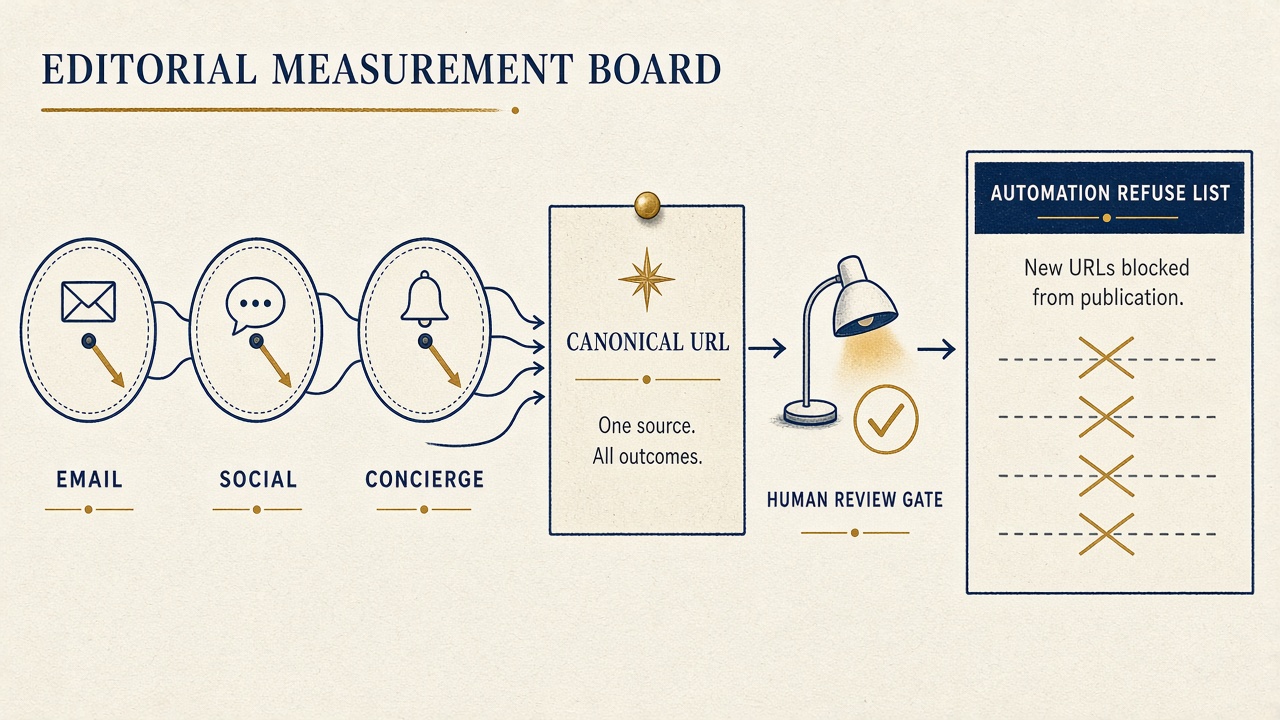
Once a stitch has been refused, measure the surfaces you actually shipped, not a count of new indexed URLs. Email clicks and replies that land on the canonical, social actions that create branded demand, and concierge resolutions that hand the reader to the owner URL are the results that count.
More production is not the result. In Orbit Media's 2026 survey of 1,042 content marketers, only 13.9% reported strong blog results, an all-time low, while 92.4% used AI for blogging and that use correlated with nothing. The average post was 1,312 words and took 3 hours 20 minutes, down from a 2022 peak of 4 hours 10 minutes. Faster drafts do not prove the owner page earned more demand.
What a human reviews, and what automation refuses
Human review checks three things: intent collision with the owner, whether the extract still depends on proof that must stay on the canonical, and whether any proposed URL has a different job plus new information. Automation refuses a second indexable URL for the same intent, verbatim syndication framed as an SEO win, a stitched page, and a help-center clone of the blog post.
Report repurposing as assisted demand and assisted answers on the owner URL, then decide the next refresh from that evidence. The ranking page stays the scoreboard; extracts are how readers get back to it.
Measure the owner — Judge repurposing by clicks, replies, branded demand, and concierge handoffs to the owner URL — not by how many new pages the workflow published.
Key Takeaways
Turn your next published page into a repurposing brief that names the owner URL, the extracts each surface may use, and every same-intent URL you will refuse.
Frequently Asked Questions
You Might Also Like
- Strategy Merge, Redirect, or Canonical: A Decision Rule for Overlapping SEO URLs
- Quality Content Cannibalization Audit: How to Merge, Redirect, or Hold Overlapping URLs
- Workflows How to Brief a Content Refresh for Writers and AI
- Measurement Striking Distance Keywords: When a Query Deserves a Refresh, Not a New URL
- Publishing How to Brief Help Center Pages Without Duplicating the Blog Cluster